Megamod’s 14-slide deck focuses on lowering the barrier to entry for the 50 million creators who lack professional coding skills. By offering a suite of no-code tools—including a game engine, skin editor, and prop editor—Megamod claims to reduce game development time from six months to just 3-4 hours. The deck highlights significant early traction, reporting over 65,000 games built by 2,500+ creators since their April 2023 launch. While the financial projections are aggressive, aiming for $170M ARR by 2028 based on Roblox-style monetization metrics, the team’s background in launching 100+ mob…
Key takeaways
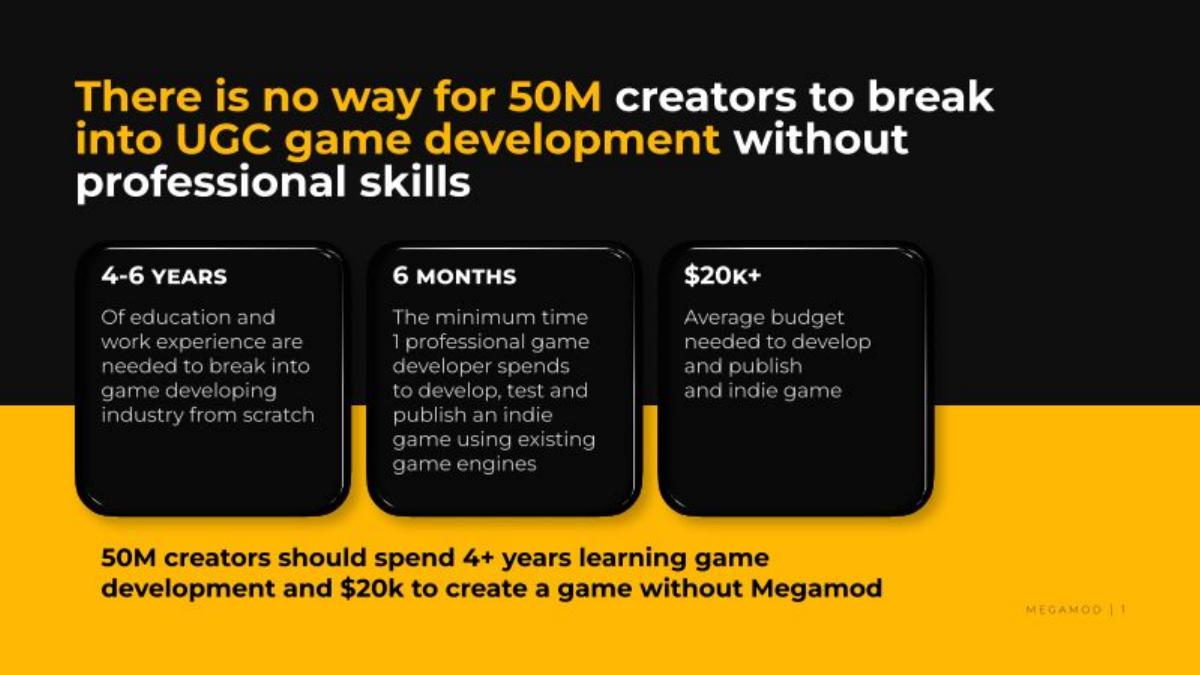
- Megamod identifies a barrier where 50M creators need 4+ years of training and $20k to build games without their platform (Slide 1).
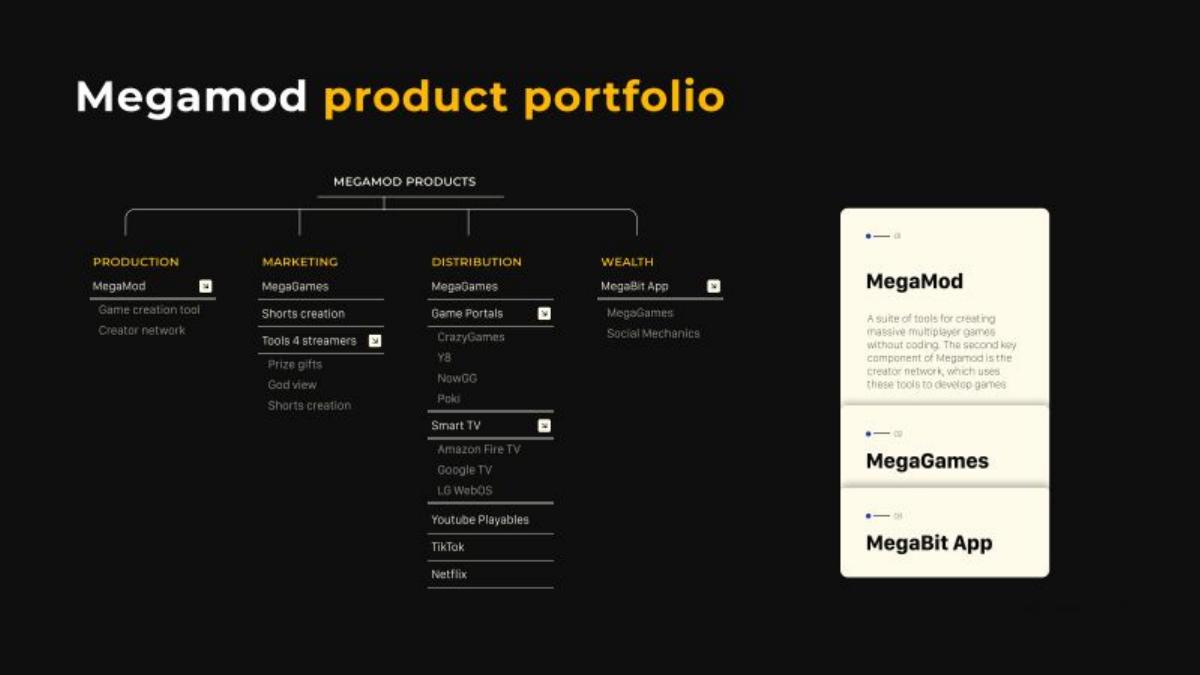
- The product ecosystem is divided into four pillars: Production, Marketing, Distribution, and Wealth (Slide 2).
- The platform targets Gen Z and Gen Alpha, noting that 45% of Gen Z want to become creators (Slide 3).
- Megamod claims a development cost of just $5 per game, compared to $200k+ for Roblox Studio or Fortnite Creative (Slide 8).
- The company reports 65,793 games created as of June 16, 2024, with a 1.39% average weekly growth rate (Slide 9).
- Financial targets are set at $170M ARR by 2028, assuming a $12 Average Revenue Per Monthly Active User (Slide 10).
- The founding team has experience launching 100+ mobile games with a combined audience of 150M (Slide 11).
- The $2M raise (of which $1.9M was secured) was intended to reach 100k users by the first half of 2024 (Slide 12).
Megamod Pitch Deck Teardown: The No-Code Bet on Gen Z Creators
Megamod’s pitch deck for their 2024 Seed round is a masterclass in comparative positioning. In a market dominated by giants like Roblox and Epic Games, Megamod argues that the current tools are still too difficult and expensive for the average amateur. By focusing on the 'no-code' and 'mobile-first' aspects of game creation, they raised $1.9M from investors including Rubylight Fund and Alexander Agapitov. This teardown examines the 14-slide deck used to secure that funding.
Slide 1: The Problem of Professional Barriers
The deck opens with a stark contrast. Slide 1 states that there is 'no way for 50M creators to break into UGC game development without professional skills.' It quantifies the barrier to entry as 4-6 years of education and a minimum budget of $20,000 to develop an indie game. By putting a dollar amount and a time frame on the 'status quo,' Megamod immediately sets the stage for their solution to be viewed as a cost-saving and time-saving utility.
Slide 2: The Product Portfolio Hierarchy
Slide 2 introduces the 'Megamod product portfolio.' This is a complex organizational chart that divides the business into four categories: Production (MegaMod creation tool), Marketing (Shorts creation, tools for streamers), Distribution (MegaGames, Smart TV, TikTok, Netflix), and Wealth (MegaBit App). This slide is ambitious, perhaps overly so for a Seed stage company, as it suggests a presence on every major platform from Amazon Fire TV to Netflix. However, it communicates that Megamod is not just a tool, but an entire ecosystem for the lifecycle of a game.
Slide 3: Targeting the Creator Generation
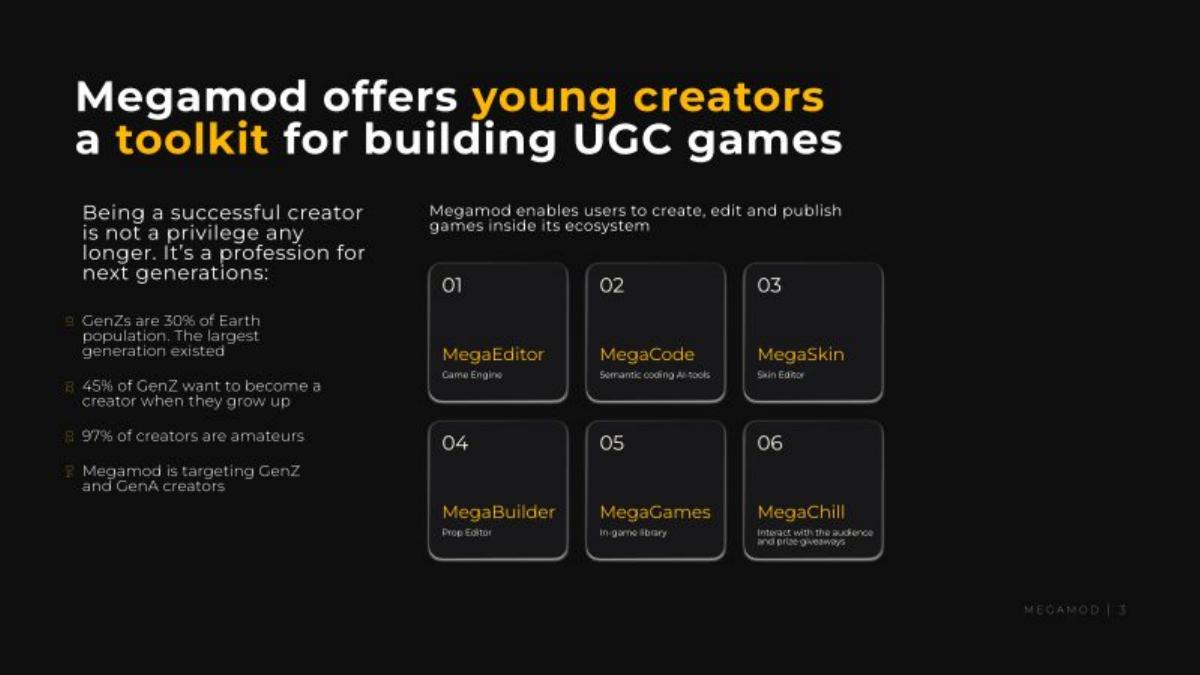
Slide 3 focuses on the demographic opportunity. It notes that Gen Z makes up 30% of the Earth's population and that 45% of Gen Z want to be creators. The most important figure here is that '97% of creators are amateurs.' This defines Megamod’s target market: the vast majority of people who want to create but lack the technical skills to use professional engines like Unity or Unreal.
Slides 4-7: The Feature Deep Dive
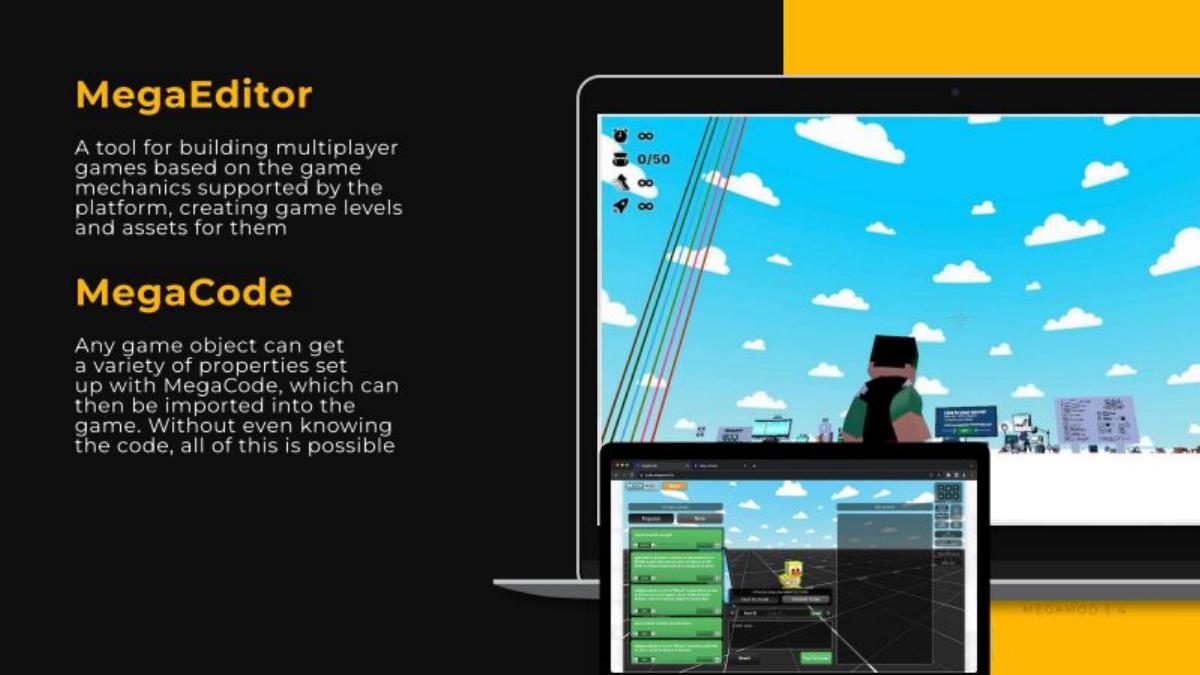
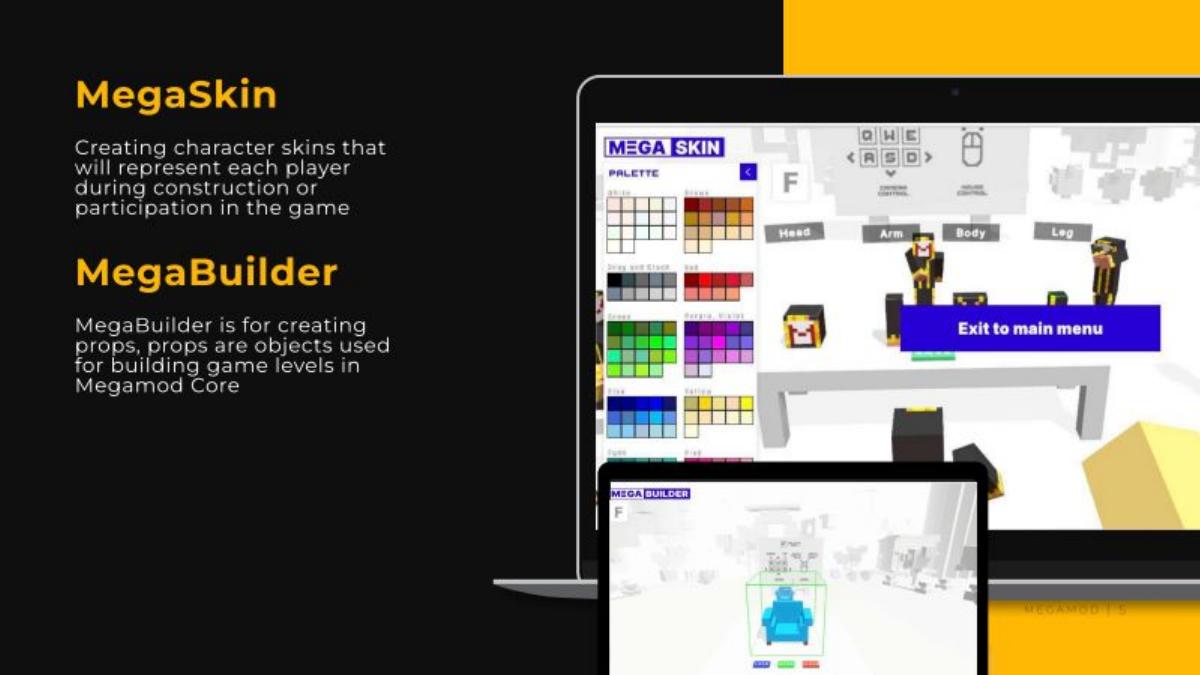
These four slides break down the specific tools within the ecosystem. MegaEditor and MegaCode (Slide 4) are presented as the core building blocks, allowing for multiplayer game construction without coding. MegaSkin and MegaBuilder (Slide 5) cover the aesthetic side, allowing for character and prop creation. MegaGames (Slide 6) is the distribution portal where games are published and played. Finally, MegaChill (Slide 7) is a tool specifically for streamers and influencers to host giveaways and interact with audiences. The claim on Slide 7 is particularly bold: they state they can accommodate an audience '10 times larger than Roblox’s similar service, or 5 times larger than Fortnite’s.'
Slide 8: The Competitive Matrix
This is the 'money slide' of the deck. Slide 8 compares Megamod to Roblox Studio/Fortnite Creative and Unity/Unreal Engine. The figures are designed to shock: a development cost of $5 for Megamod vs. $200k+ for peers, and a creation time of 3-4 hours vs. 6+ months. It also highlights that Megamod is available on mobile devices, a feature it claims its competitors lack for creation. This slide provides a clear, numerical reason for why a creator would choose Megamod over the incumbents.
Slide 9: Traction and Growth
Slide 9 provides the proof of concept. Since launching in late April 2023, the platform has onboarded 2,564 creators and seen 65,793 games built. The deck tracks this on a weekly basis, showing a 1.39% average weekly growth rate for game creation. While the creator count is relatively small (2.5k), the volume of games produced per creator (roughly 25 games per creator) suggests that the tool is indeed as easy to use as the previous slides claim.
Slide 10: The $170M ARR Vision
The financial projections on Slide 10 are aggressive. Megamod expects to reach $170M ARR by 2028. They base this on a $3B TAM, calculated from 620M under-18 gamers. The monetization math is borrowed directly from Roblox: a 40% MAU conversion rate and a $12 Average Revenue Per Monthly Active User (ARPMAU). While borrowing metrics from a successful peer is a common shortcut, investors would likely want to see how Megamod’s current conversion rates compare to these long-term targets.
Slide 11: Team and Advisors
The team slide provides the necessary 'right to play.' Aleksey Kostarev and the founding team have launched 100+ mobile games with a combined audience of 150M. The inclusion of advisors from Xsolla (Tyler Kim) and COM2US (Kyu Lee) adds significant industry weight, suggesting that Megamod has the backing of established gaming infrastructure players.
Slide 12: The Ask and Roadmap
Slide 12 outlines the $2M raise. The goal for the funding is to reach 100k users by the first half of 2024 (1H24). The roadmap is split between Marketing and Product, with future goals including 'Text-to-code game dev via AI tools' in 2H24. A 'done' stamp is placed over the 1H24 milestone, indicating that the deck was likely updated mid-round or just after reaching that specific goal.
What Megamod Does Well
Megamod excels at quantifying the value of time . By explicitly stating that a game takes 3-4 hours to build on their platform versus 6 months elsewhere, they create a compelling 'why now' for creators. The deck is also very disciplined in its visual style, using a consistent black, white, and yellow palette that feels modern and 'gaming-adjacent' without being cluttered.
The competitive comparison on Slide 8 is particularly effective because it doesn't just list features; it lists costs and time. For a Seed stage investor, seeing a $5 development cost compared to $200,000 is a powerful indicator of a disruptive business model.
What is Missing from the Megamod Deck
The most significant omission is current revenue and unit economics . While Slide 10 projects $170M ARR, there is no mention of what the company is earning today. Even if the revenue is zero, a Seed deck usually includes the 'cost to acquire a creator' (CAC) or the 'lifetime value' (LTV) assumptions based on early beta tests.
Furthermore, the Distribution slide (Slide 2) lists massive platforms like Netflix and TikTok under their 'Distribution' pillar. The deck does not explain if these are active partnerships, planned integrations, or merely aspirations. Without clarification, listing 'Netflix' as a distribution channel can come across as 'logo soup'—adding famous brands to a slide to imply a relationship that may not exist.
Founder Takeaways: Lessons from Megamod
Use 'Anchor' Metrics: If you are entering a market with a dominant player (like Roblox), use their public metrics (ARPMAU, conversion rates) to validate your own market size. It makes your projections feel grounded in reality, even if they are ambitious. · Focus on the 'Amateur' Gap: Megamod correctly identified that while professional tools exist, there is a massive gap for the 97% of people who aren't pros. If your product simplifies a complex task, quantify exactly how many hours and dollars you are saving the user. · Show, Don't Just Tell, the Product: Slides 4 through 7 use actual UI mockups and screenshots. This is crucial for a 'tool' startup. Investors need to see that the product actually exists and looks functional. · The Power of the 'Done' Stamp: Adding a 'done' indicator to your roadmap (as seen on Slide 12) is a subtle but effective way to show momentum. It tells investors that you are a team that hits its milestones on time.
Frequently asked questions
- What is Megamod's core value proposition?
- Megamod positions itself as a no-code User-Generated Content (UGC) platform. According to Slide 8, it allows creators to build games in 3-4 hours for approximately $5, whereas traditional platforms like Roblox or engines like Unity require months of work and thousands of dollars in budget. It aims to democratize game creation for the 97% of creators who are amateurs.
- How does Megamod plan to make money?
- Slide 10 outlines a business model based on in-app purchases and game time sales. The company uses Roblox as a benchmark, projecting a $12 Average Revenue Per Monthly Active User (ARPMAU) and a 40% MAU conversion rate. They target a $3 billion total addressable market consisting of 620 million under-18 gamers worldwide.
- What traction has the company achieved so far?
- As of June 2024, Megamod reports having onboarded over 2,500 creators who have collectively built 65,793 games (Slide 9). The growth charts show a steady upward trajectory since the April 2023 launch, with the number of games growing at an average weekly rate of 1.39%.
- Who is the team behind Megamod?
- The team is led by Aleksey Kostarev, who has experience building a $20M+ sales business, and Katerina Novichkova, who has experience in financial functions for companies with up to $8B in revenue. The broader team has launched over 100 mobile games and is supported by advisors from Xsolla and COM2US (Slide 11).
- How does Megamod compare to Roblox and Fortnite?
- Slide 8 explicitly compares Megamod to Roblox Studio and Fortnite Creative. Megamod claims to support over 400 online players (compared to 50-100 for peers), offers mobile-based creation which peers lack, and utilizes a drag-and-drop interface that is significantly faster than the '6+ months' required by professional engines.