How game studios and gaming startups show their product: three app screens with captions, in-game shots with a written walkthrough.
Gaming Product Slides: Real Pitch Deck Examples
Seven product slides from gaming decks (a game-discovery app, two narrative adventure games, a multiplayer game-building platform, an arcade racer, a board game before its Kickstarter and a farming simulator), shown in full. A game is judged by how it looks and plays, so investors and publishers want to see it, understand what the player does and see what sets it apart. The stronger slides pair real footage or screens with a sentence on each; the weakest describes features in text.
TL;DR
A gaming product slide should show the game or app itself and say what the player does. ANDi shows three app screens, each with a caption on how it works. Button City pairs two in-game shots with a written walkthrough of the world and its arcade games. Beacon Pines lists five gameplay bullets beside a scene from the game. Megamod shows its game editor on a laptop with two short tool descriptions. Turbo Boom lists five core features beside two track shots. Conquerors of the Realm shows its board game set out on a table. One Lonely Outpost describes its farming features in paragraphs, the weaker example here.
Gaming product slides
Each example shows the exact stored slide above its analysis and links to the full teardown. Stronger examples first. Claims are as shown on the slides; we have not verified them.
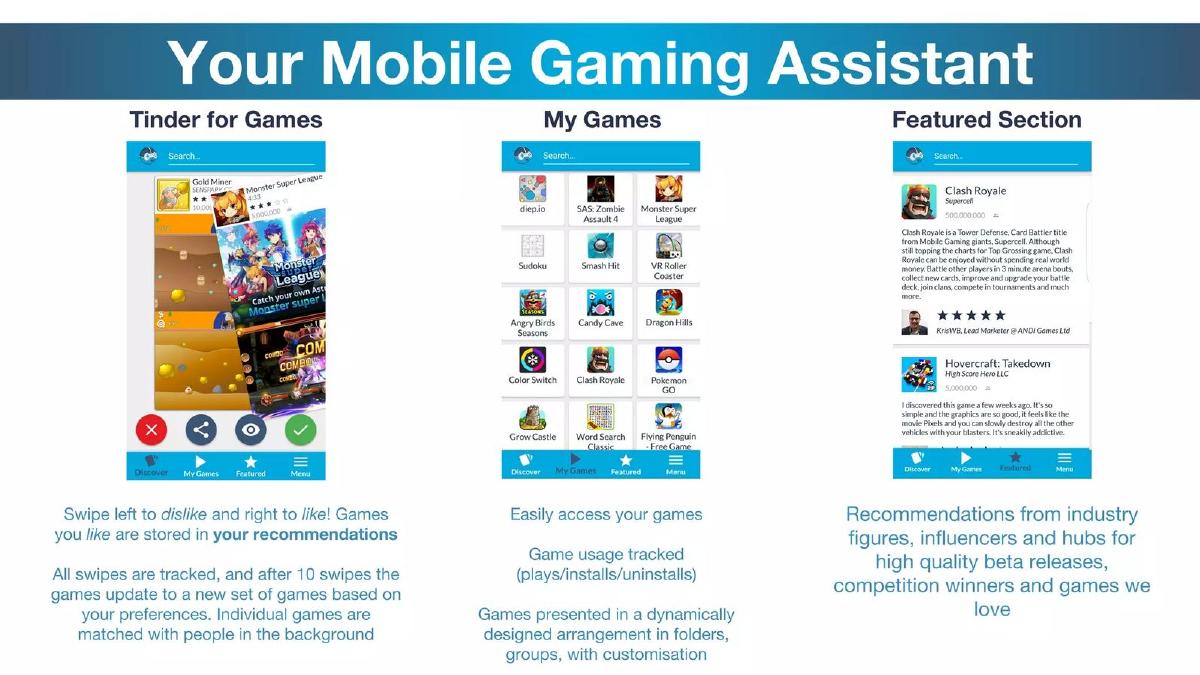
ANDi Games product slide — slide 5
Seed (recorded). Mobile game-discovery app. Three screens with captions.
ANDi Games deck, slide 5. Exact stored slide matched to this analysis.
Our analysis: The clearest example here: each screen has a name and a plain explanation, so the whole app is understood in one read.
Evidence and limitation: Three app screens with a caption each; no usage figures on this slide.
What a founder can adapt: Show your two or three main screens side by side, each with a name and one or two sentences.
Supporting analysis
What the deck claims: "Your Mobile Gaming Assistant." Three screens: "Tinder for Games" ("Swipe left to dislike and right to like! Games you like are stored in your recommendations. All swipes are tracked, and after 10 swipes the games update to a new set of games based on your preferences"), "My Games" ("Game usage tracked (plays/installs/uninstalls)") and "Featured Section" ("Recommendations from industry figures, influencers and hubs").
Presentation choice: The "Tinder for Games" label borrows a pattern investors already know.
When it does not fit: Keep captions short; three dense paragraphs compete with the screens.
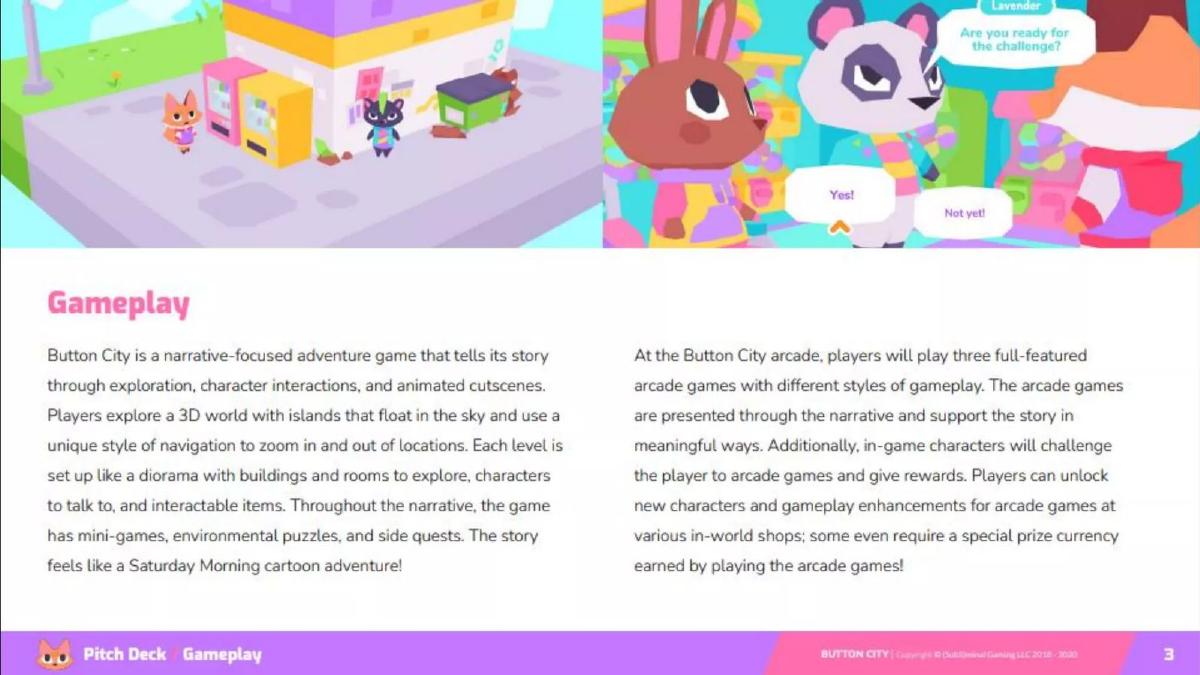
Stage not recorded. Narrative adventure game. Two in-game shots with a walkthrough.
Button City deck, slide 4. Exact stored slide matched to this analysis.
Our analysis: The shots show the art style and a real choice; the text explains the loop from exploring to arcade games to rewards.
Evidence and limitation: Real in-game shots and two paragraphs of gameplay; no sales or wishlist figures.
What a founder can adapt: Pick one shot of the world and one of the player making a choice, and describe the loop beneath.
Supporting analysis
What the deck claims: "Gameplay." "Button City is a narrative-focused adventure game that tells its story through exploration, character interactions, and animated cutscenes." "Each level is set up like a diorama with buildings and rooms to explore." "At the Button City arcade, players will play three full-featured arcade games with different styles of gameplay." "Players can unlock new characters and gameplay enhancements for arcade games at various in-world shops." Two shots show the town and a dialogue choice ("Are you ready for the challenge?" "Yes!" "Not yet!").
Presentation choice: A dialogue screenshot shows interaction, not just scenery.
When it does not fit: Cut the paragraphs to bullets; investors skim.
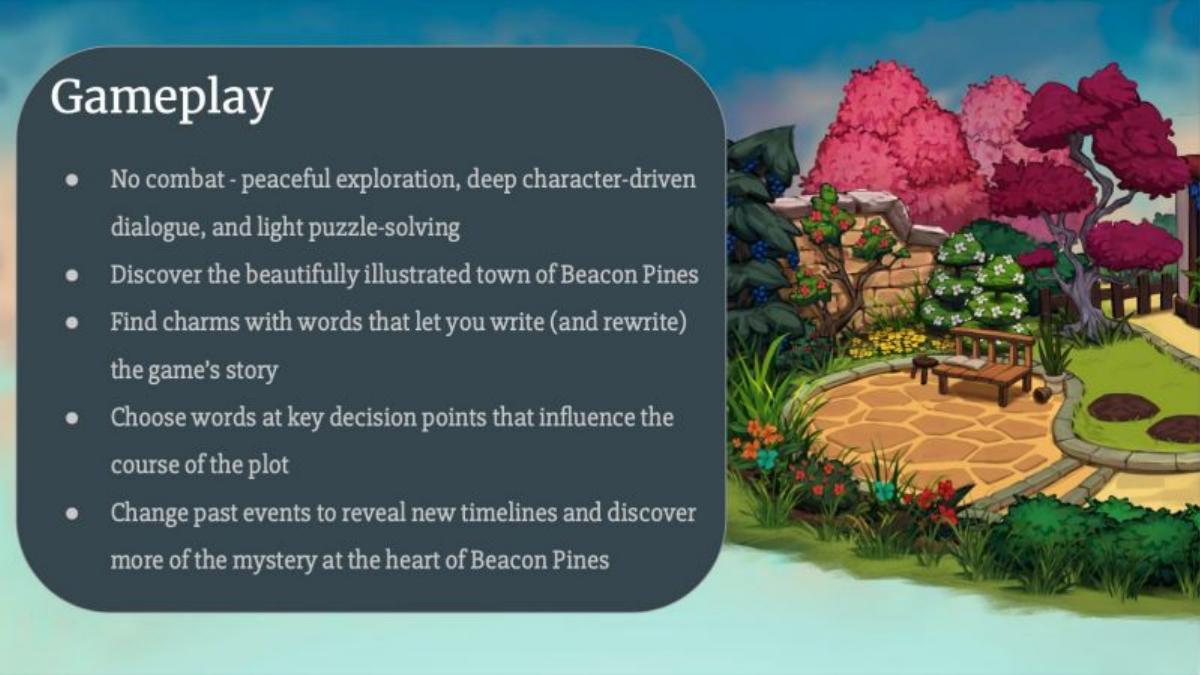
Stage not recorded. Narrative adventure game. Five bullets beside a scene.
Beacon Pines deck, slide 4. Exact stored slide matched to this analysis.
Our analysis: It names the mechanic that sets the game apart (word charms that rewrite the story) and says what the game is not (no combat).
Evidence and limitation: Five gameplay bullets and one illustrated scene; no figures.
What a founder can adapt: Lead with the genre in one line, then the one mechanic nobody else has.
Supporting analysis
What the deck claims: "Gameplay." "No combat - peaceful exploration, deep character-driven dialogue, and light puzzle-solving." "Discover the beautifully illustrated town of Beacon Pines." "Find charms with words that let you write (and rewrite) the game's story." "Choose words at key decision points that influence the course of the plot." "Change past events to reveal new timelines."
Presentation choice: Saying "no combat" places the game for the reader immediately.
When it does not fit: Show the charm mechanic on screen, not only a scenic background.
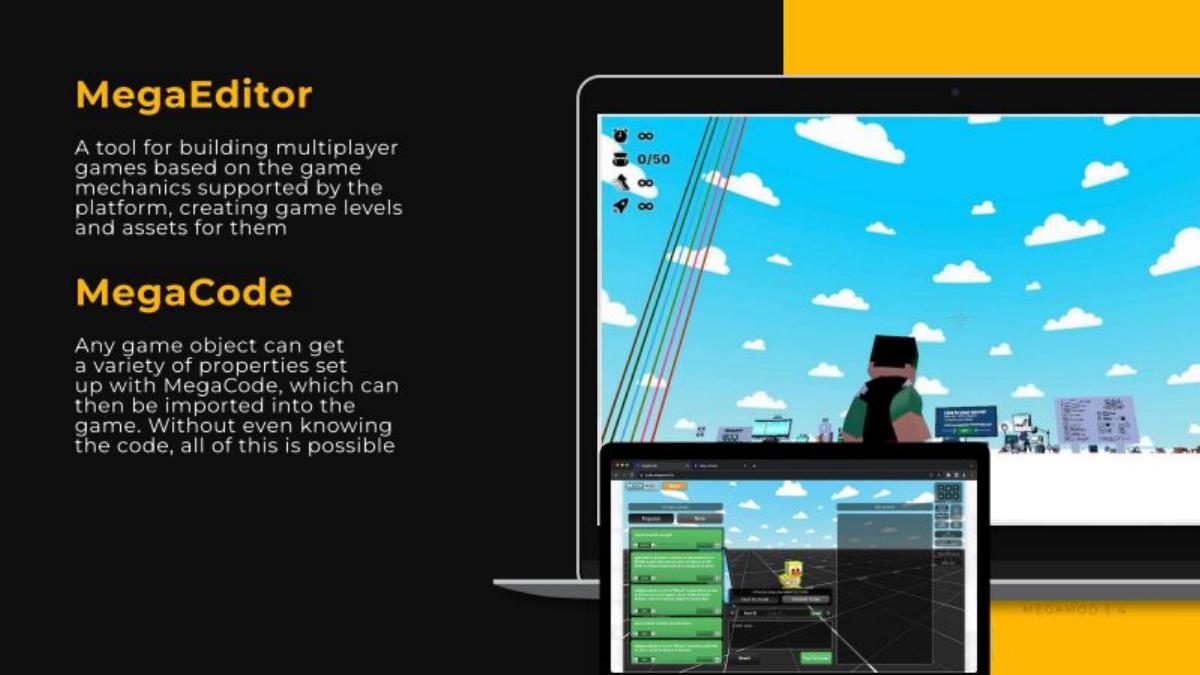
Seed (recorded). Multiplayer game-building platform. The editor on a laptop.
Megamod deck, slide 5. Exact stored slide matched to this analysis.
Our analysis: For a creation tool, showing the editor beside the resulting game answers "what can people build?"
Evidence and limitation: A real editor screen with two tool descriptions; no user numbers on this slide.
What a founder can adapt: Show the tool and the thing it makes on one slide, and name who uses it.
Supporting analysis
What the deck claims: "MegaEditor: A tool for building multiplayer games based on the game mechanics supported by the platform, creating game levels and assets for them." "MegaCode: Any game object can get a variety of properties set up with MegaCode, which can then be imported into the game. Without even knowing the code, all of this is possible." A laptop shows a 3D game world, with an editor window of settings in front.
Presentation choice: "Without even knowing the code" names the user: creators who don't program.
When it does not fit: The editor window is too small to read; enlarge one panel.
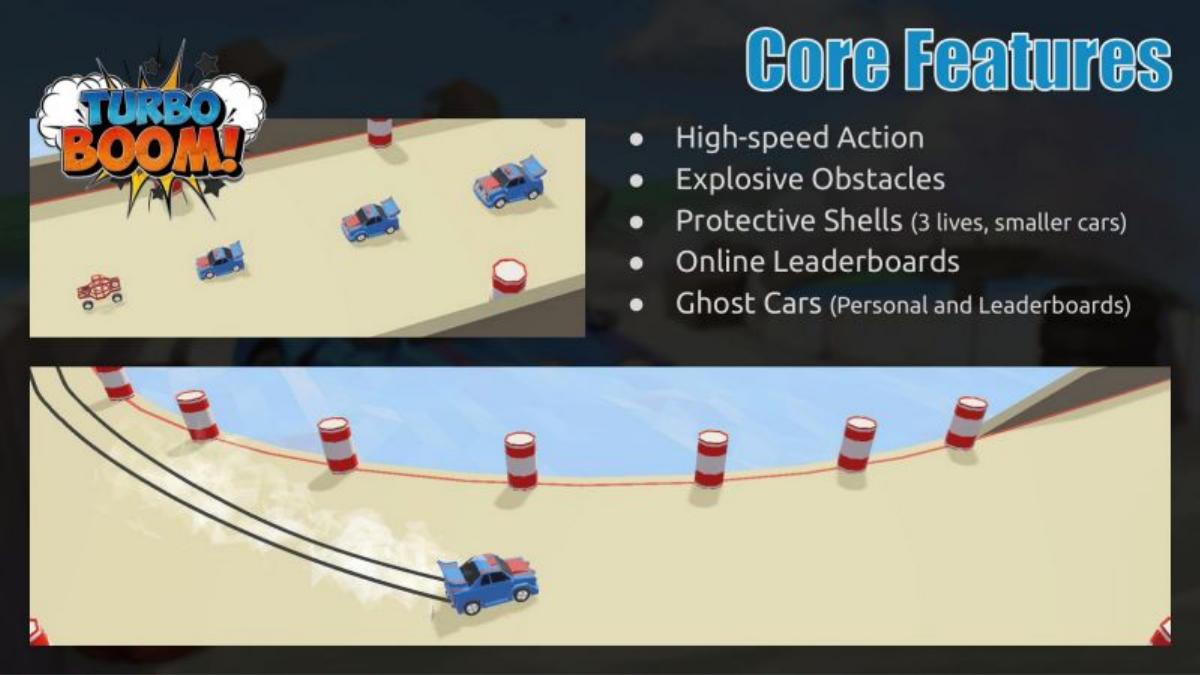
Stage not recorded. Arcade racing game. Five features beside two track shots.
Turbo Boom deck, slide 5. Exact stored slide matched to this analysis.
Our analysis: Short and readable, but most features (speed, leaderboards) are common to the genre.
Evidence and limitation: Five short features and real track shots; no figures on this slide.
What a founder can adapt: Keep the shots and the short list, and put the one unusual feature first.
Supporting analysis
What the deck claims: "Core Features." "High-speed Action." "Explosive Obstacles." "Protective Shells (3 lives, smaller cars)." "Online Leaderboards." "Ghost Cars (Personal and Leaderboards)." Two in-game shots show cars on a track with barrels.
Presentation choice: Two large shots make the look of the game clear at a glance.
When it does not fit: "High-speed action" describes every racer; say what is different.
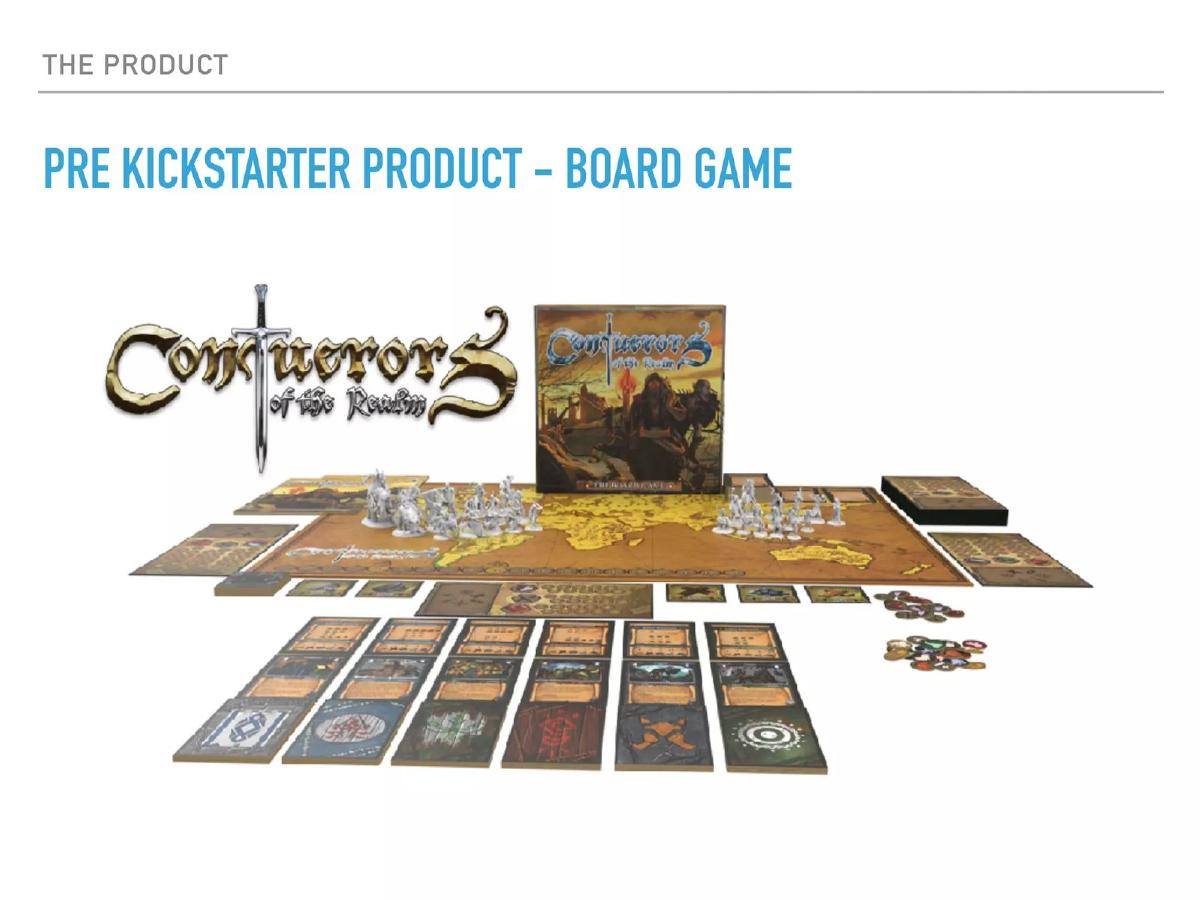
Seed (recorded). Board game before its Kickstarter. The product laid out.
Conquerors of the Realm deck, slide 6. Exact stored slide matched to this analysis.
Our analysis: It shows exactly what a buyer gets in the box, but nothing about how the game plays or who it is for.
Evidence and limitation: One product image and a title; no text on how it plays.
What a founder can adapt: Keep the layout and add player count, play time and one line on how you win.
Supporting analysis
What the deck claims: "The Product." "Pre Kickstarter Product - Board Game." A render of the box, board, miniatures, cards and tokens laid out on a table.
Presentation choice: For physical games, the laid-out components are the product shot backers expect.
When it does not fit: An image alone leaves the gameplay to the presenter.
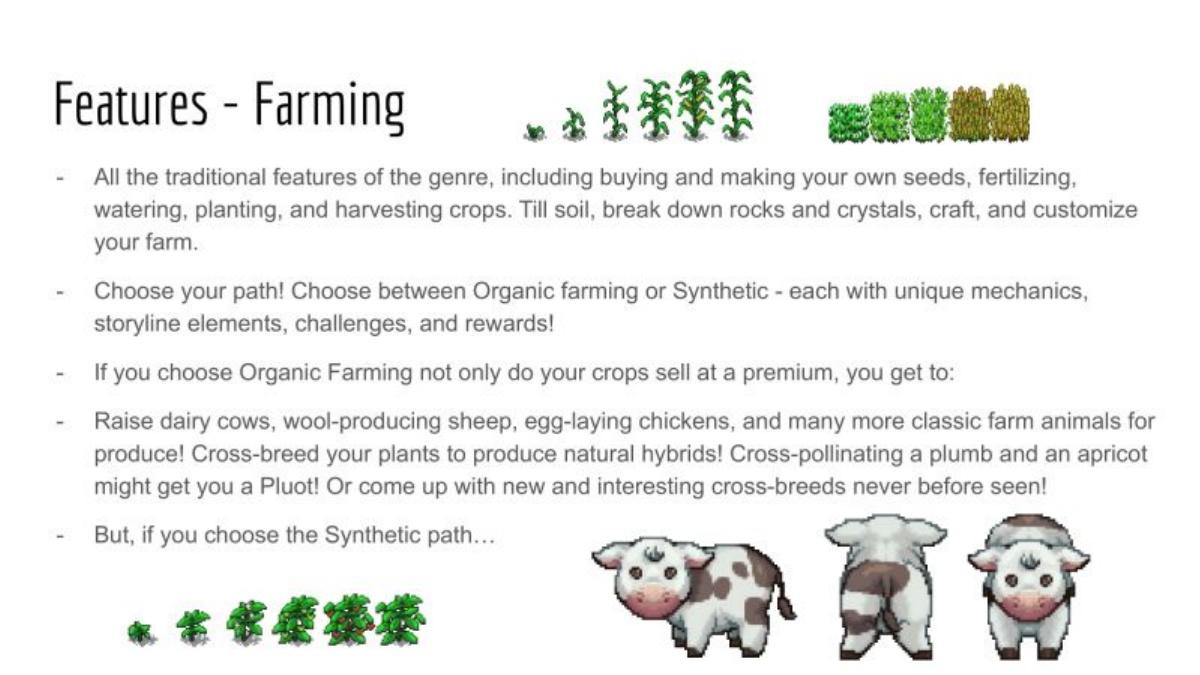
Seed (recorded). Farming simulator. Features in text (weaker example).
One Lonely Outpost deck, slide 5. Exact stored slide matched to this analysis.
Our analysis: The organic-or-synthetic choice is a real difference, but it sits in the middle of a genre checklist.
Evidence and limitation: Paragraphs of features and a few sprites; no scene from the game.
What a founder can adapt: Lead with the organic-or-synthetic choice and show one screenshot of each path.
Supporting analysis
What the deck claims: "Features - Farming." "All the traditional features of the genre, including buying and making your own seeds, fertilizing, watering, planting, and harvesting crops." "Choose your path! Choose between Organic farming or Synthetic - each with unique mechanics, storyline elements, challenges, and rewards!" "Raise dairy cows, wool-producing sheep, egg-laying chickens." "Cross-breed your plants to produce natural hybrids!" Small crop and cow sprites.
Presentation choice: Included for contrast: the only slide here that describes a video game without showing it being played.
When it does not fit: "All the traditional features of the genre" tells an investor what is the same, not what is new.
How the product is presented, whether real screens or footage appear, and whether the slide names what sets it apart.
Example
Product
Presented as
Real screens
Difference named
ANDi Games
Game-discovery app
Three captioned screens
Yes
Swipe to rate
Button City
Adventure game
Shots + walkthrough
Yes
Arcade games in story
Beacon Pines
Adventure game
Bullets + scene
Art only
Word charms
Megamod
Game-building tool
Editor on laptop
Yes
No code needed
Turbo Boom
Racing game
Features + shots
Yes
Partly (ghost cars)
Conquerors of the Realm
Board game
Product render
Physical
No
One Lonely Outpost
Farming game
Text features
Sprites only
Organic or synthetic
Key Takeaways
Show real screens or footage, not concept art alone.
Say in one line what the player actually does.
Name the one mechanic that is different from the genre.
Caption every screen so the slide reads without a presenter.
Build your gaming product slide
Start with a real screenshot of play, then say what the player does and what is new.
Screen. One or two in-game shots of the player doing something.
Genre. The genre in a few words, and any comparison titles.
Loop. What the player does again and again.
Difference. The one mechanic that is new to the genre.
Copyable framework: [Screenshots of play] [Game] is a [genre] where players [core loop]. Unlike [comparison titles], you can [new mechanic].
Illustrative example 1 — written by us
Before: All the traditional features of the genre, including buying and making your own seeds, fertilizing, watering, planting, and harvesting crops. Choose your path! Choose between Organic farming or Synthetic.
After: [Screenshot: organic farm] [Screenshot: synthetic farm] A farming simulator where you choose your path: organic or synthetic, each with its own mechanics and story. Unlike [comparison titles], [what the synthetic path adds].
What improved: Our illustrative rewrite; not One Lonely Outpost's wording. Bracketed parts are placeholders to fill with real facts. It leads with the difference and shows both paths.
What this guide adds
The library already has gaming problem, solution, market and business model guides, a general product slide guide, product slides by stage, and product guides for consumer, media and other sectors. This page looks at how a game or gaming product is shown on its own slide.
Sector labels come from the sector recorded for each published teardown (high confidence for six; medium for ANDi). None of these seven slides appears in another guide. One other slide from the Conquerors of the Realm deck is used elsewhere in the library for a different lesson.
Four ways gaming decks show the product
Screens with captions (ANDi, Megamod): the app or tool on screen, with a sentence on what each part does.
Footage with gameplay text (Button City, Beacon Pines, Turbo Boom): in-game shots next to what the player does.
The physical product (Conquerors of the Realm): the box and components laid out, as a buyer would see them.
Features in text (One Lonely Outpost): a written list, with small sprites but no scene from the game.
Common mistakes
No gameplay shown. A game described in text leaves the investor to imagine it.
Genre checklist. Features every game in the genre has don't show an advantage.
Uncaptioned screens. Each screen needs a label so the slide reads on its own.
Art without play. A pretty scene doesn't show what the player does.
Diagnostic checklist
Real in-game screens or product shot.
What the player does, in one line.
The one new mechanic.
A caption on every screen.
Frequently asked questions
How we chose these examples
Corpus: published pitch deck teardowns on StartupFundraising.com. Founder-uploaded private decks are excluded.
Selection (2026-09-27): we took teardowns whose recorded sector is gaming, slides 2 to 8, with a stored slide image and readable text mentioning the product, app, features, gameplay or platform. We viewed nine candidate slides, left out slides already used in other guides, duplicate uploads of the same deck, a slide marked draft and confidential (Savvy's app slide), and a slide that is mainly a tagline over a stock phone image (GameXplain), and kept seven that show different ways of presenting a gaming product. One Lonely Outpost is included as a weaker example for contrast.
Sector is the category recorded for each teardown (high confidence for six; medium for ANDi Games). Stages as recorded: ANDi Games, Megamod, Conquerors of the Realm and One Lonely Outpost, seed; Button City, Beacon Pines and Turbo Boom, not recorded.
Review: stored slide images were checked on 2026-09-27 and matched to company, deck and slide number, and quoted text was read from the images (editorial model review). No person has yet completed an editorial review of this page.
Claims are as shown on the slides; we have not verified them. We make no claim that any slide caused a fundraising outcome.