How gaming, esports and virtual-world startups present the problem in a pitch deck: name the studio, player or league that loses, what it costs them.
Gaming Startup Problem Slide: Real Pitch Deck Examples
Eight problem slides from gaming, esports and virtual-world startups, shown in full, compare whether each slide names who loses (the studio, the player, the league or the platform maker), what it costs them, and whether it measures the loss.
TL;DR
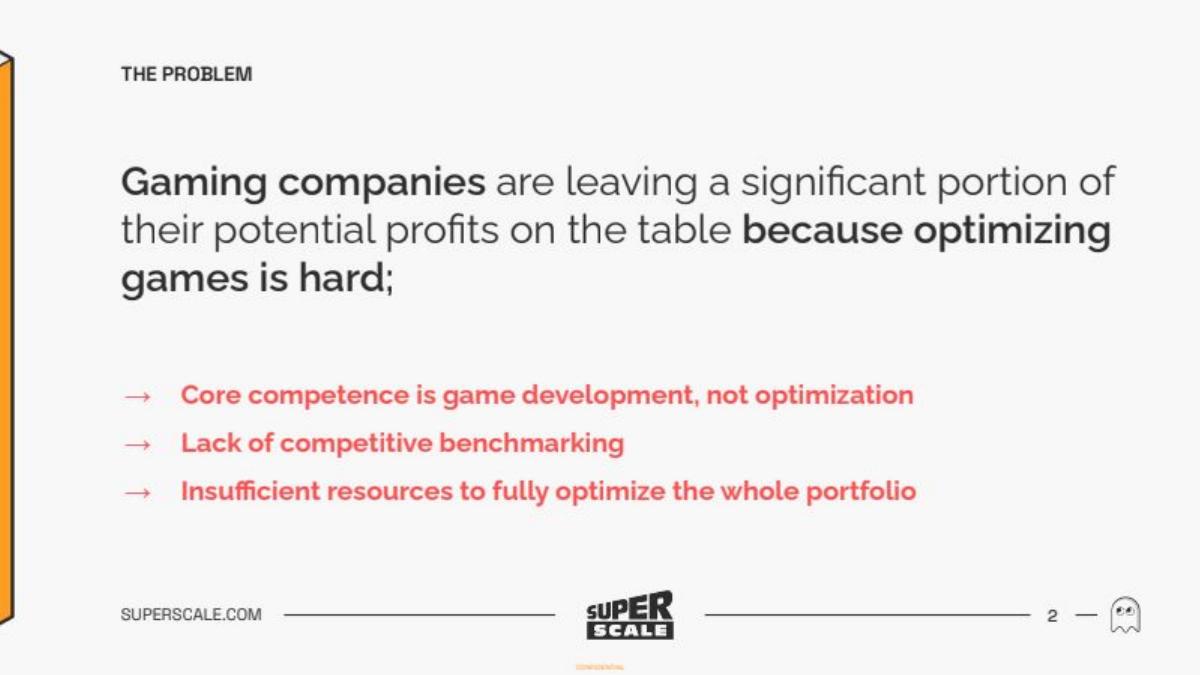
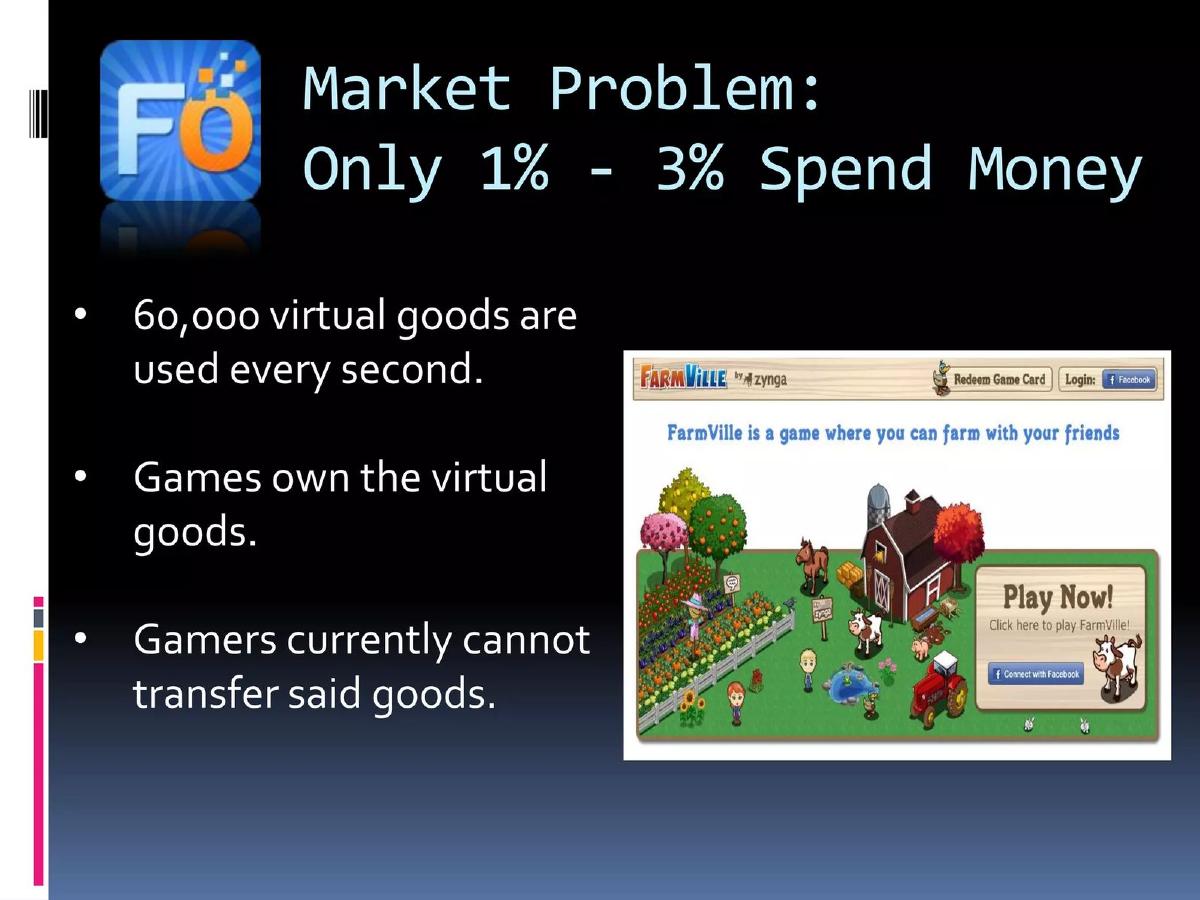
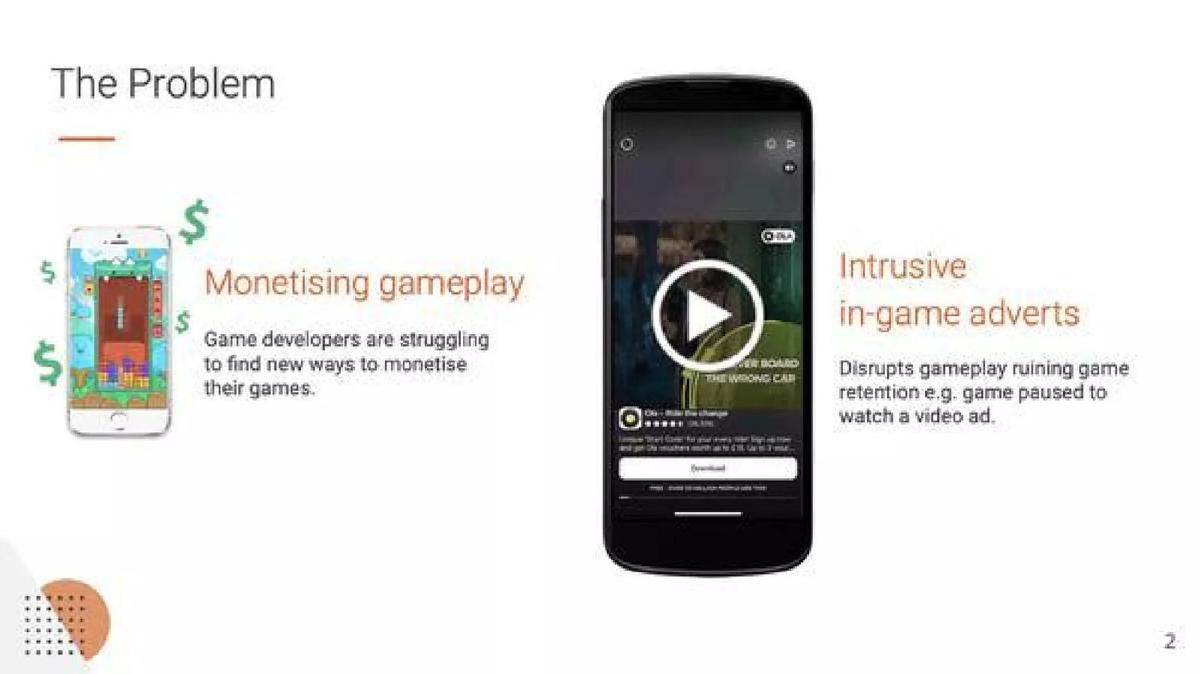
A gaming problem slide should name who loses — usually the studio, sometimes the player — say what it costs them in money or players, and give one number. Superscale names the studio and the loss in one sentence: "Gaming companies are leaving a significant portion of their potential profits on the table because optimizing games is hard", then three causes. Fayceoff leads with a number in the headline: "Only 1% - 3% Spend Money". Audiomob shows the cost of today's fix — a game "paused to watch a video ad" that "disrupts gameplay ruining game retention". Juked's whole slide is "The esports industry is highly fragmented", with no one named and nothing measured, which is the weaker pattern.
Gaming problem slides from real pitch decks
Each example shows the exact stored slide above its analysis and links to the full teardown. Claims are as shown on the slides; we have not verified them.
Superscale problem slide — slide 2
Optimisation service for mobile game studios. One sentence and three causes.
Superscale deck, slide 2. Exact stored slide matched to this analysis.
Our analysis: The strongest structure here: who (gaming companies), what they lose (profit) and why (three causes that each point to an outsourced service).
Evidence and limitation: No figures; "a significant portion" is not measured.
What a founder can adapt: One sentence for who loses what, then two or three causes that your product removes.
Supporting analysis
What the deck claims: "The problem." "Gaming companies are leaving a significant portion of their potential profits on the table because optimizing games is hard;" "Core competence is game development, not optimization." "Lack of competitive benchmarking." "Insufficient resources to fully optimize the whole portfolio."
Presentation choice: Each cause answers "why don't studios do this themselves?" before the investor asks.
When it does not fit: Replace "a significant portion" with a figure, such as revenue lift from optimising one title.
Virtual goods that players can move between games. Number in the headline, three bullets and a FarmVille screenshot.
Fayceoff deck, slide 3. Exact stored slide matched to this analysis.
Our analysis: It measures the studio's problem (few players pay) and offers a cause from the player side (goods can't leave the game).
Evidence and limitation: 1–3% of players spend; 60,000 virtual goods a second. No source named.
What a founder can adapt: Put your one number in the headline.
Supporting analysis
What the deck claims: "Market Problem: Only 1% - 3% Spend Money." "60,000 virtual goods are used every second." "Games own the virtual goods." "Gamers currently cannot transfer said goods." Screenshot: "FarmVille is a game where you can farm with your friends."
Presentation choice: A number in the headline is read even when nothing else is.
When it does not fit: Connect the two halves: show that players would pay more if goods could move. Source the 1–3%.
Audio ads for mobile games. Two labelled problems, a game icon and a phone showing a video ad.
Audiomob deck, slide 2. Exact stored slide matched to this analysis.
Our analysis: It names the studio and shows the trade-off: today's way to make money (video ads) costs players.
Evidence and limitation: No figures.
What a founder can adapt: Show the current fix and what it breaks.
Supporting analysis
What the deck claims: "The Problem." "Monetising gameplay: Game developers are struggling to find new ways to monetise their games." "Intrusive in-game adverts: Disrupts gameplay ruining game retention e.g. game paused to watch a video ad."
Presentation choice: The phone with a paused game makes the problem obvious to anyone who has played a free game.
When it does not fit: Measure the retention loss: players lost after an interrupting ad.
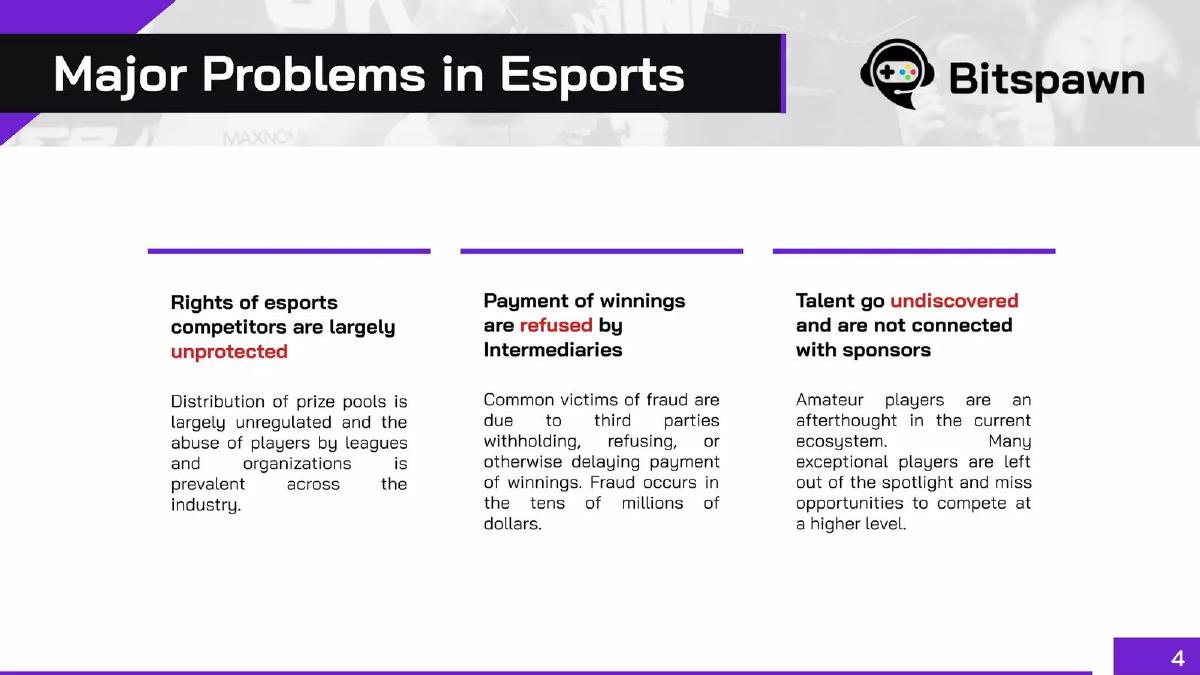
Esports platform for players and tournaments. Three columns of text.
Bitspawn deck, slide 4. Exact stored slide matched to this analysis.
Our analysis: It names the player as the one losing and prices one of the three problems.
Evidence and limitation: "Tens of millions of dollars" of fraud; not sourced.
What a founder can adapt: Lead with the column you can measure.
Supporting analysis
What the deck claims: "Major Problems in Esports." "Rights of esports competitors are largely unprotected: Distribution of prize pools is largely unregulated and the abuse of players by leagues and organizations is prevalent across the industry." "Payment of winnings are refused by intermediaries: ... Fraud occurs in the tens of millions of dollars." "Talent go undiscovered and are not connected with sponsors."
Presentation choice: Withheld prize money is concrete and easy to believe.
When it does not fit: Three problems in small text; the undiscovered-talent column is a separate business.
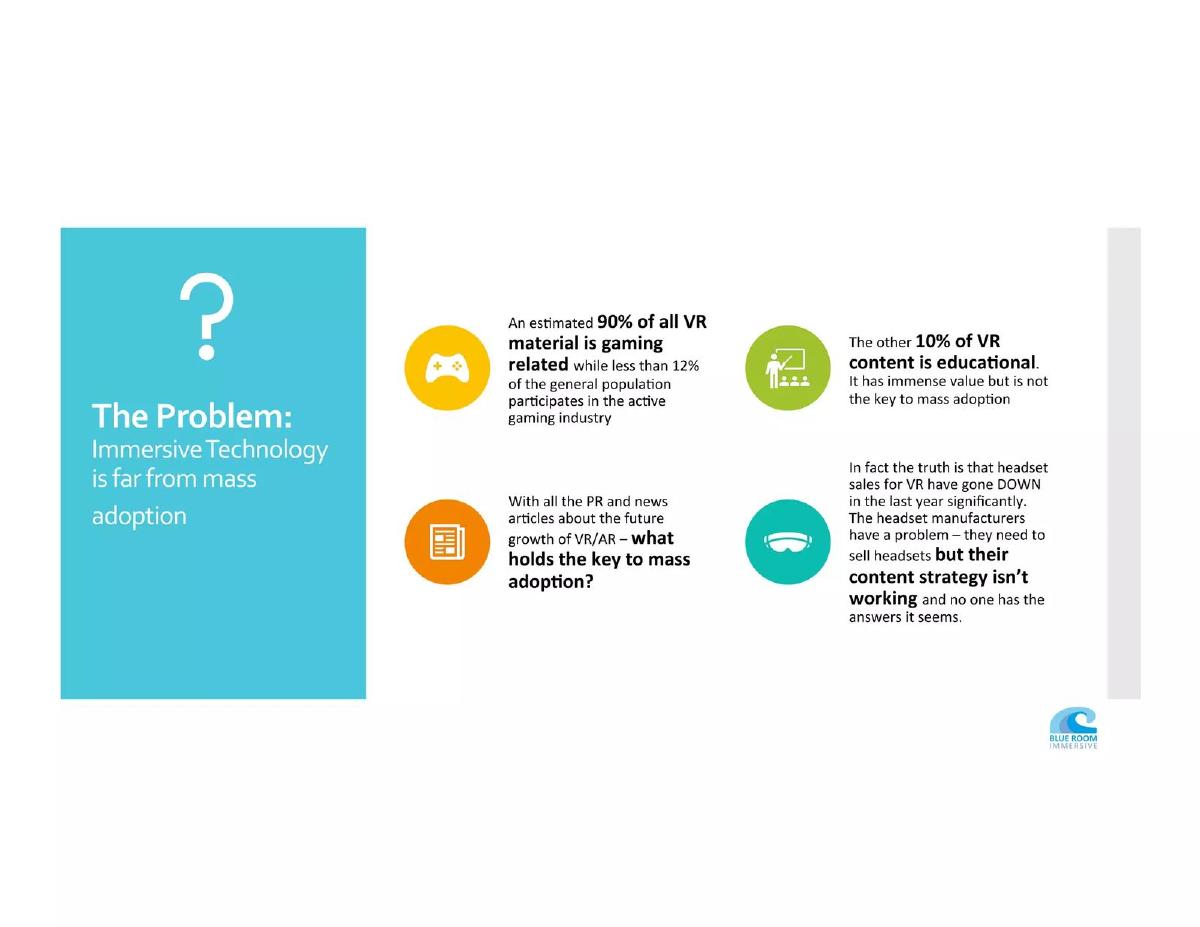
Immersive content for VR headset makers. A question panel and four icon blocks. Partial.
Blue Room deck, slide 3. Exact stored slide matched to this analysis.
Our analysis: It names a customer (headset makers) and a cause (content aimed at gamers only), but buries the customer in the last block.
Evidence and limitation: 90% of VR content is games; under 12% of people are active gamers. No source named.
What a founder can adapt: Lead with the customer and their loss: headset sales down, and why.
Supporting analysis
What the deck claims: "The Problem: Immersive Technology is far from mass adoption." "An estimated 90% of all VR material is gaming related while less than 12% of the general population participates in the active gaming industry." "The other 10% of VR content is educational." "Headset sales for VR have gone DOWN in the last year significantly. The headset manufacturers have a problem — they need to sell headsets but their content strategy isn't working."
Presentation choice: Kept as partial: the argument is good, the order hides it.
When it does not fit: Give the sales decline as a number; tiny text on a mostly empty slide.
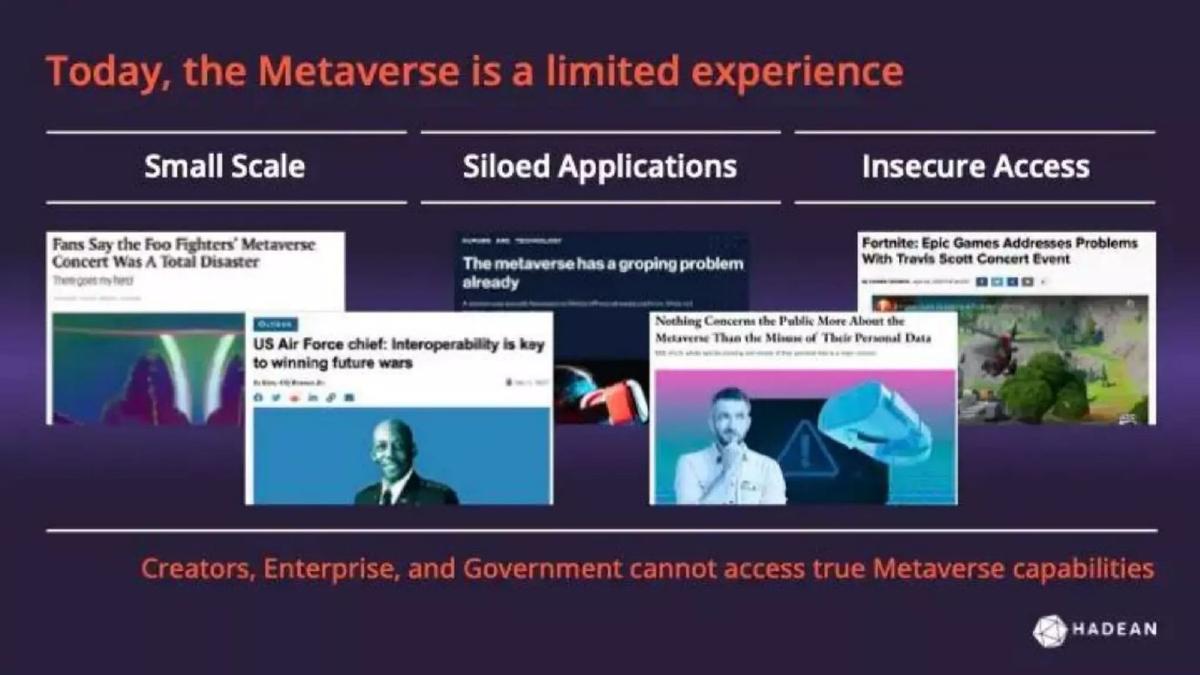
Infrastructure for large virtual worlds. Three problem labels over press headlines. Partial.
Hadean deck, slide 6. Exact stored slide matched to this analysis.
Our analysis: Headlines about failed virtual concerts make "small scale" credible, but three customer groups dilute who the slide is for.
Evidence and limitation: Press headlines; no figures.
What a founder can adapt: Keep the headlines that fit one customer and say what that failure cost them.
Supporting analysis
What the deck claims: "Today, the Metaverse is a limited experience." "Small Scale", "Siloed Applications", "Insecure Access". Headlines: "Fans Say the Foo Fighters' Metaverse Concert Was A Total Disaster"; "Fortnite: Epic Games Addresses Problems With Travis Scott Concert Event"; "US Air Force chief: interoperability is key to winning future wars". "Creators, Enterprise, and Government cannot access true Metaverse capabilities."
Presentation choice: Kept as partial: third-party headlines are evidence; the audience is too broad.
When it does not fit: The Air Force headline pulls away from gaming and entertainment; pick one customer.
Whether each slide names who loses, what it costs them, and a number.
Example
Who loses
What it costs
Number
Superscale
Yes (gaming companies)
Yes (profit)
No
Fayceoff
Partly (studios and players)
Yes (few players pay)
Yes (1–3%)
Audiomob
Yes (game developers)
Yes (revenue and retention)
No
Bitspawn
Yes (esports players)
Yes (withheld winnings)
Yes (tens of millions)
Blue Room
Yes (headset makers, stated late)
Yes (headset sales)
Partly (90% / 12%)
Hadean
Partly (three groups)
Partly (failed events)
No
Gamerzclass
Implied (players)
No
No
Juked
No
No
No
Key Takeaways
Pick one party: studio, player, league, or platform maker. Studios are the customer in most gaming B2B decks.
State the loss in gaming units: revenue per player, share of players who pay, retention, prize money withheld.
Show what today's fix breaks; Audiomob's paused-game video ad makes the trade-off visible.
A number in the headline (Fayceoff's "1% - 3%") does more than three paragraphs.
"The industry is fragmented" describes a market, not a loss.
Build your gaming problem slide
One party who loses, what it costs, one number.
Who. Studio, player, league or platform maker? Name one, with size (for example, mobile studios with 1–5 live titles).
Loss. Revenue per player, share who pay, day-7 retention, prize money, headset sales?
Today. What do they do now, and what does it break (ads that lose players, manual tuning)?
Number. One figure you can source, ideally in the headline.
Copyable framework: [Studio type] lose [number] of [revenue / players] because [cause]. Today they [workaround], which [side effect]. (Source: [source].)
Illustrative example 1 — written by us
Before: Game monetisation is broken and players hate ads.
After: Mobile puzzle studios lose 18% of day-7 players after the first forced video ad, yet ads are 60% of their revenue. (Source: our data from 14 titles.)
What improved: Our illustrative rewrite; the figures are invented for the example. It names who loses, the cost, the trade-off and a source.
What this guide adds
The media problem guide covers content, audio and publishing; the consumer guide covers products bought by individuals. Gaming decks have their own pattern: most sell to studios, whose revenue depends on a small share of players who pay and on keeping players playing. Investors ask whose revenue or retention leaks, and by how much.
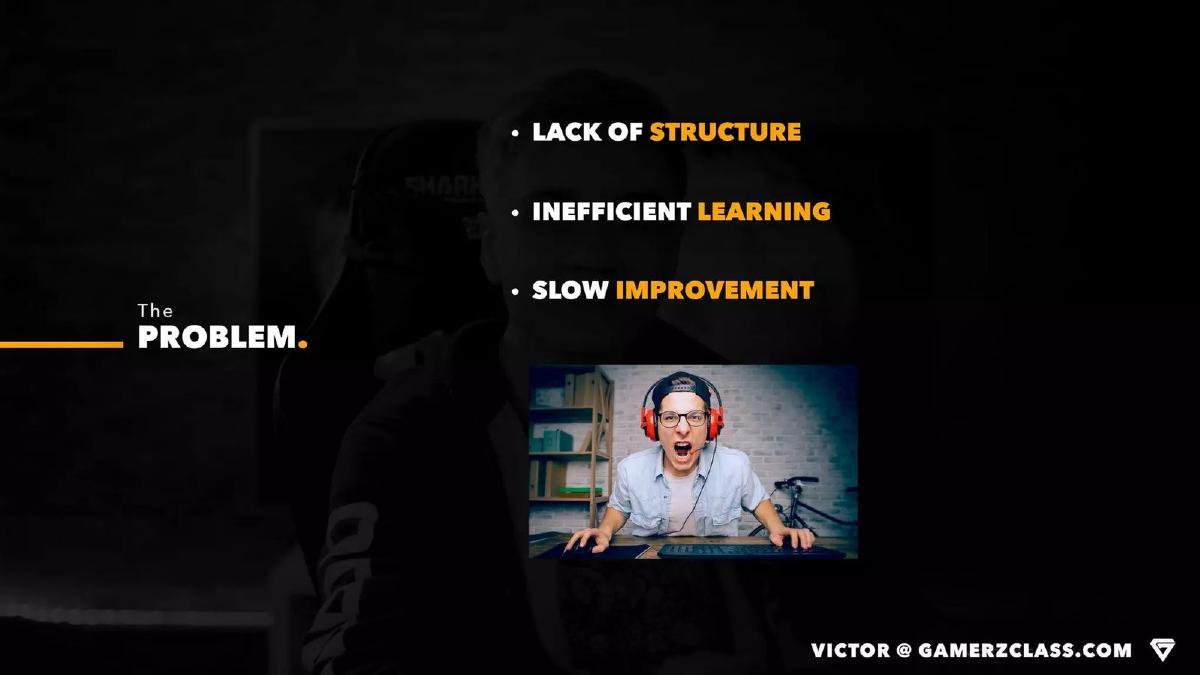
Four slides here are written from the studio or platform side (Audiomob, Superscale, Blue Room, Hadean). Fayceoff and Gamerzclass start from the player. Bitspawn covers players and leagues. Juked names no one.
What it costs: lost profit (Superscale), lost retention (Audiomob), withheld winnings (Bitspawn), falling headset sales (Blue Room).
How much: Fayceoff's 1–3% who spend, Blue Room's 90% of VR content being games, Bitspawn's fraud "in the tens of millions of dollars". Half the slides give no number.
Common mistakes
Market description instead of loss. "Fragmented" or "growing" says nothing about who is losing.
Too many customers. Creators, enterprise and government on one slide means none is developed.
Labels with no sentence. Three words per problem leave the cause and cost to the investor.
Customer buried at the bottom. If headset makers are the buyer, name them first.
Unsourced big numbers. "Tens of millions" and "1–3%" need a source to be believed.
Diagnostic checklist
It names one party who loses: studio, player, league or platform maker.
It says what it costs in revenue, players or money.
It gives one number, with a source.
It shows what today's fix breaks.
The slide is readable at a glance.
Frequently asked questions
How we chose these examples
Corpus: published pitch deck teardowns on StartupFundraising.com. Founder-uploaded private decks are excluded.
Selection (2026-09-25): we searched slides 2–6 for problem slides mentioning games, gamers, esports, game developers, virtual goods or the metaverse. Nine stored images were inspected. Lollipop Audio was excluded because its problem slide appears in the media problem guide; sports and betting decks (Mustard, Brand Boards, Fantasy Life, Aladino) were left out as not gaming; game pitches without a problem slide (Diablo, Button City) were left out. Blue Room, Hadean and Gamerzclass are marked partial; Juked is kept as a weaker contrast.
Overlap check: none of these eight slides appears in another guide. Hadean's slide 5 appears in the customer slide guide; this guide uses its slide 6.
Review: all eight stored slide images were inspected on 2026-09-25 and matched to company, deck and slide number (editorial model review). No person has yet completed an editorial review of this page.
Claims are as shown on the slides; we have not verified them. We make no claim that any slide caused a fundraising outcome.