SuperScale’s Series A deck presents a compelling case for a dual-revenue model in the gaming analytics space. By combining a traditional SaaS offering for active games with a 'Legacy Game Management' arm that acquires and revives undervalued titles, the company addresses both steady recurring revenue and high-upside profit sharing. The deck highlights significant market opportunities, projecting a €87.7m revenue by 2027 with a 50% EBIT margin. While the team slide is lean on detailed bios, the inclusion of high-profile case studies like EA and Zynga provides strong social proof. The 23-slide…
Key takeaways
- The company operates a hybrid business model consisting of SaaS for active games and Legacy Game Management for acquired titles (Slide 10).
- SuperScale projects reaching €87.7m in revenue by 2027, with legacy management accounting for 64% of that total (Slide 15).
- The platform claims to save clients 3-5 internal Big Data headcounts while delivering 10-300% extra profit (Slide 9).
- Case studies show significant impact, including a +262% revenue growth for Nimblebit and a +$21.3 million increase in profitable marketing spend for EA/Zynga/Fingersoft (Slide 12).
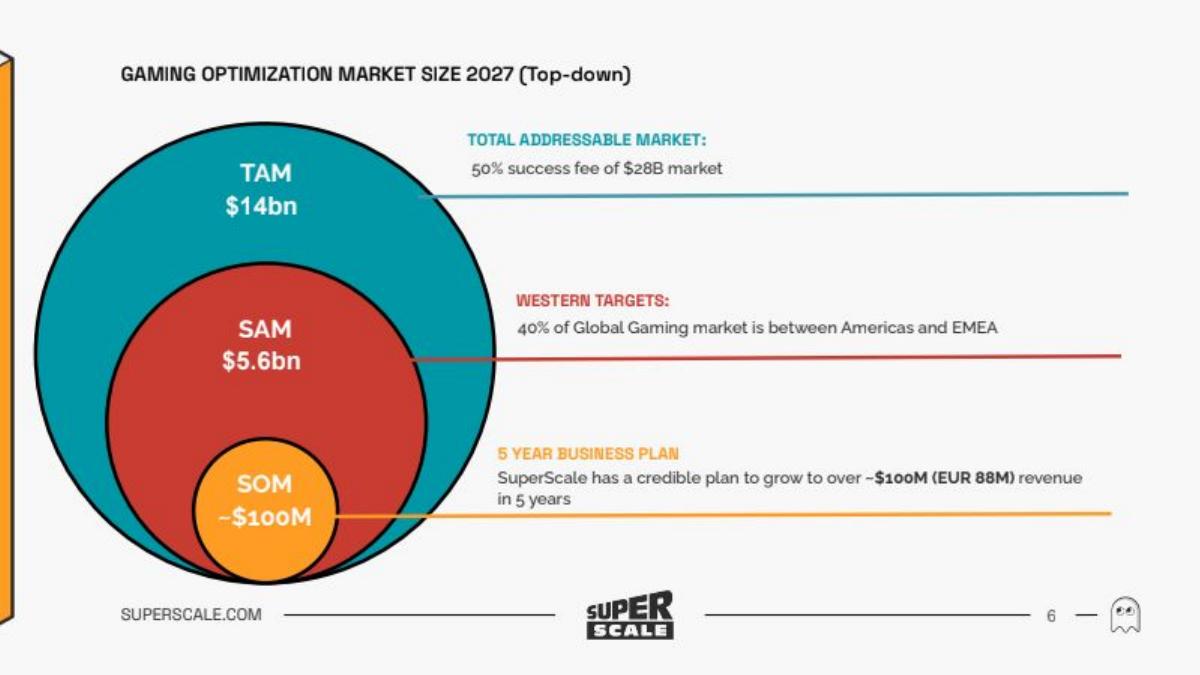
- The total addressable market is defined as a $14bn opportunity, based on a 50% success fee of a $28bn optimization market (Slide 6).
- The team consists of 70 people across the UK and Central Europe, led by CEO Ivan Trancik and CFO Paraag Amin (Slide 19).
- The Series A ask was €5M, intended to fund platform R&D and build an M&A machine for legacy games (Slide 17).
- The competitive landscape positions SuperScale as a high-business-impact platform, distinct from pure 'tech enablers' like Firebase or AppsFlyer (Slide 13).
Executive Summary: The Data-Driven Game Reviver
SuperScale’s 2023 Series A deck is a masterclass in presenting a complex, two-pronged business model. The company, which raised $4.4M, positions itself as the ultimate optimization layer for the gaming industry. By tackling the problem that gaming companies are developers first and optimizers second, SuperScale carves out a niche that serves both the giants of the industry and the forgotten 'legacy' titles that still hold value. The deck is structured to move from broad market pain points to specific, high-dollar case studies, ending with a bold five-year financial roadmap.
Slides 1-3: The Hook and the Hybrid Solution
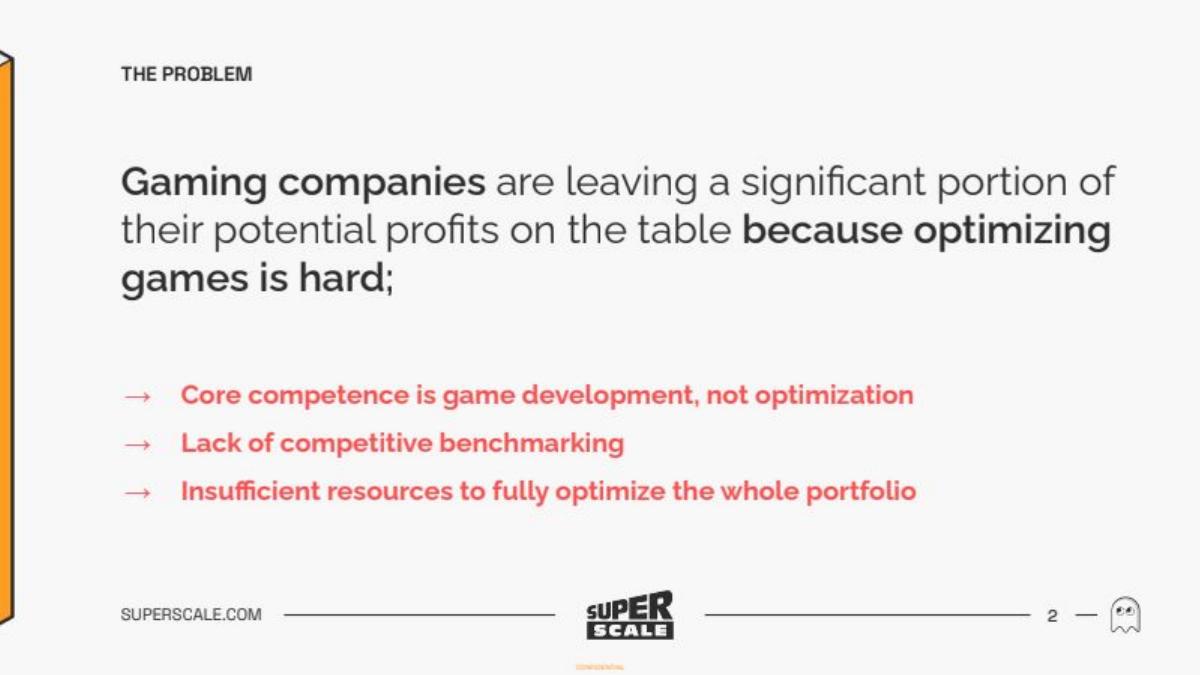
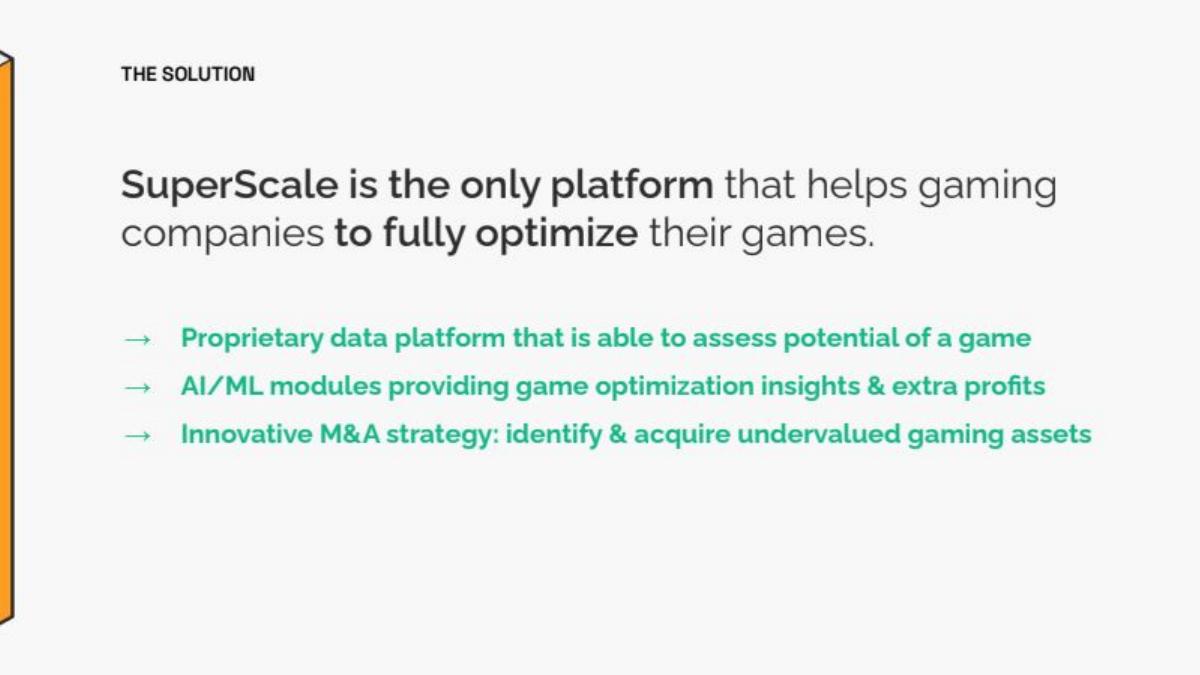
The deck opens with a clear mission statement on Slide 1 : "Optimizing Games To Their Maximum Potential." This immediately identifies the target audience—game publishers—and the core value proposition. Slide 2 defines the problem with three crisp bullet points: developers lack optimization competence, they lack competitive benchmarking, and they have insufficient resources to manage their entire portfolios. This sets the stage for Slide 3 , which introduces SuperScale as the "only platform" to solve these issues through a proprietary data platform, AI/ML modules, and an "innovative M&A strategy." This third point is the most critical differentiator in the deck, signaling that SuperScale isn't just a software vendor, but an asset manager.
Slides 4-7: Market Size and Target Identification
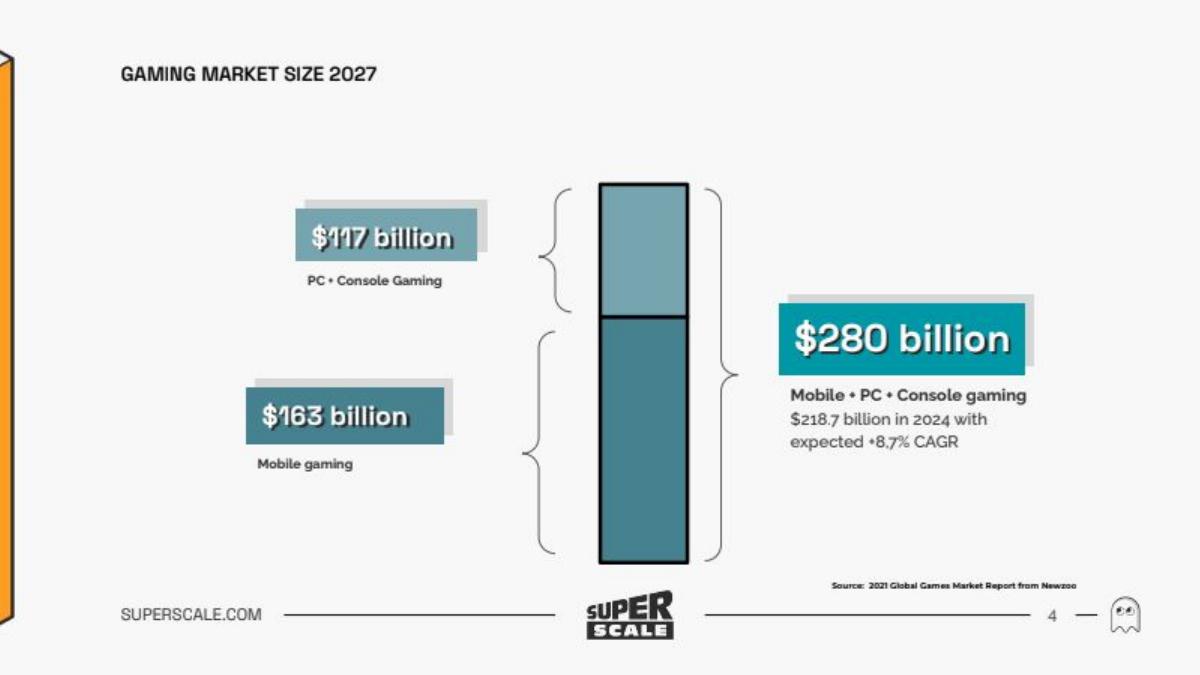
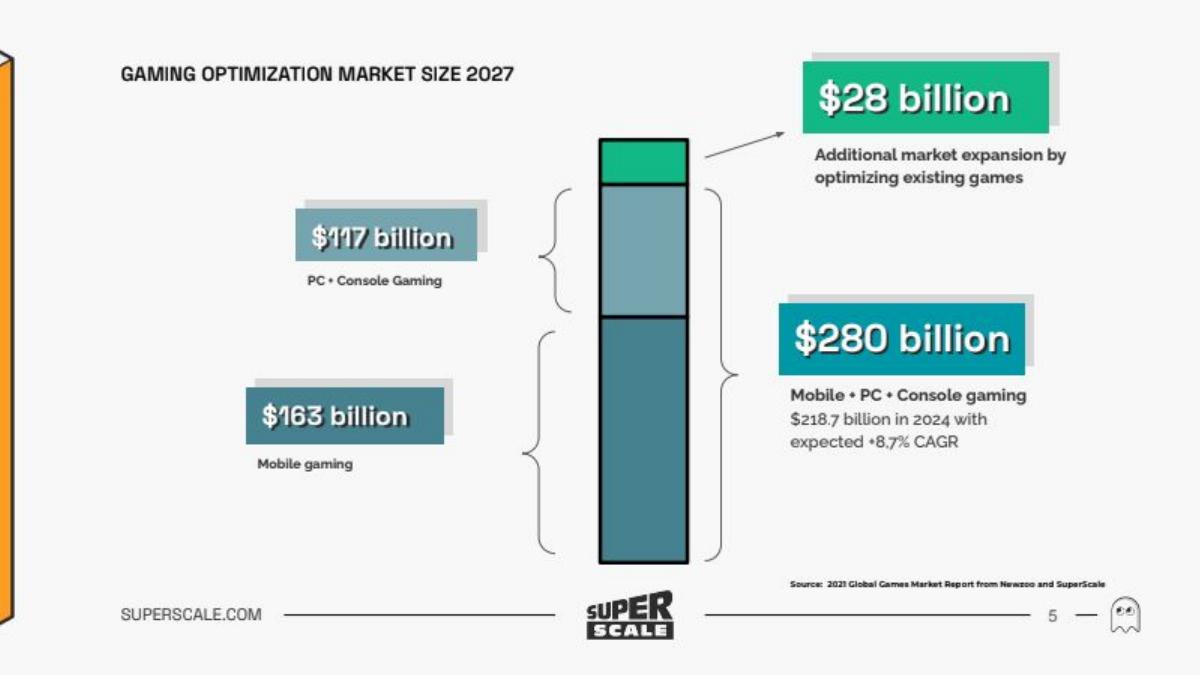
SuperScale uses a layered approach to market sizing. Slide 4 establishes the baseline gaming market at $280 billion by 2027. Slide 5 adds a unique layer: a $28 billion "additional market expansion" created specifically by optimizing existing games. This is a clever way to show that they aren't just fighting for a piece of the pie; they are growing the pie itself. Slide 6 breaks this down into a TAM of $14bn (assuming a 50% success fee on that $28bn) and a SAM of $5.6bn focused on Western markets. Slide 7 provides granular detail on their "Current Mobile Target List," identifying 5,456 actively developed games and 1,994 legacy games. This level of specificity proves the team has already done the legwork to identify their sales pipeline.
Slides 8-10: The Platform and Dual Offering
Slide 9 gets into the technical weeds of the "SuperScale Platform." It divides the tech into Data Modules (Data Lake & SuperETL) and AI Modules (SuperInsights & SuperBrain). The key metric here is the claim that the platform saves "3-5 internal Big Data headcounts," providing a clear ROI for potential B2B clients. Slide 10 clarifies the two-pillar strategy: SaaS for active games and Legacy Game Management (LGM) for older titles. This is a pivotal slide because it explains that for LGM, SuperScale actually acquires the assets and takes full responsibility for their growth, effectively acting as a specialized private equity firm for mobile games.
Slides 11-13: Business Model, Social Proof, and Competition
Slide 11 details the economics. The SaaS model yields €360k average ARR with a 25-50% profit share, while the LGM model targets a €1M yearly upside per game with an 80-100% revenue share. Slide 12 provides the "meat" of the deck: case studies. Citing household names like EA, Zynga, and Fingersoft, they claim a $21.3 million increase in profitable marketing spend. A specific chart for Nimblebit shows a 262% revenue growth after SuperScale took over management. This social proof is essential for a Series A round. Slide 13 uses a standard 2x2 matrix to position SuperScale against competitors. They place themselves as having higher business impact than tech enablers like Amplitude and a more platform-centric approach than traditional publishers like Tilting Point.
Slides 14-18: The Five-Year Plan and The Ask
The "Business Plan" section kicks off with Slide 15 , projecting a leap to €87.7m in revenue by 2027. The high EBIT forecast of €43.9m suggests a very lean, scalable operation. Slide 16 and Slide 17 cover the investment round. They were seeking €5M in 1H 2023, with a notable claim that "no further external funding [is] required to achieve targets." The use of funds is clearly bifurcated between platform R&D and the M&A engine. Slide 18 summarizes the pitch with six checkmarks, reinforcing their status as a "high growth gaming-tech start-up" disrupting the status quo.
Slides 19-23: Team, History, and Appendix
Slide 19 introduces the team. While it lists 70 people and mentions the CEO's background at Exponea and the CFO's time at Goldman Sachs, the slide is relatively light on the broader leadership team's specific gaming experience, relying instead on a list of "Veteran Investors & Advisory" from companies like Google, Meta, and Devolver. Slide 21 provides a timeline from 2016 to 2022, showing a steady progression from their first global #1 game launch (Hill Climb Racing 2) to their first $1M ARR deals in 2022. The deck concludes with a standard thank you and contact slide.
What SuperScale Does Well
The deck excels at quantifying the value of optimization . Instead of just saying games could be better, they put a $28 billion price tag on the inefficiency of the current market. By showing exactly how many games fit their criteria (Slide 7), they demonstrate a level of market awareness that is often missing in Series A decks. Furthermore, the dual-revenue model is presented as a way to hedge risk: the SaaS business provides steady, predictable income, while the Legacy Game Management arm provides high-upside, equity-like returns.
What is Missing from the Deck
The most significant omission is a detailed breakdown of the M&A process . Since 64% of their projected 2027 revenue comes from Legacy Game Management, investors would likely want to see more about how they value these assets, what the typical acquisition cost is, and how they handle the legal transfer of IP. Additionally, while the team slide mentions 70 people, it lacks depth in the technical leadership . For a company claiming to be a "proprietary technology platform," seeing the faces and pedigrees of the CTO or Head of AI would have strengthened the technical credibility.
Founder Takeaways: What to Copy
The "Pie-Grower" Strategy: If your startup improves existing assets, don't just show the market size; show the value you add to that market, as seen on Slide 5. · Specific Target Lists: Using tools like data.ai to count your exact number of potential customers (Slide 7) makes your SAM feel much more real than a vague percentage. · Hybrid Revenue Models: If you have a service that can also be applied to assets you own, show the economics of both. It demonstrates that you have multiple ways to win. · Clear Social Proof: If you have worked with giants like EA or Zynga, put their logos and the specific dollar impact front and center.
Frequently asked questions
- What is SuperScale's core value proposition to game developers?
- SuperScale focuses on 'optimizing games to their maximum potential' by providing a proprietary data platform and AI/ML modules. According to slide 9, the platform automates data processing to save 3-5 internal data headcounts and uses predictive modeling to scale marketing spend. The goal is to unlock 'untapped potential' in games where developers may lack the resources or expertise to fully optimize for profit.
- How does the Legacy Game Management model differ from the SaaS model?
- The SaaS model is a subscription-based service for actively developed games, often including a 25-50% profit share (Slide 11). In contrast, Legacy Game Management involves SuperScale acquiring undervalued legacy titles or securing exclusive IP licenses. In this model, SuperScale takes 80-100% of the revenue share and assumes full responsibility for growth and financing (Slide 10).
- What are the financial projections for the company over the next five years?
- SuperScale forecasts significant growth, aiming for €87.7m in revenue by 2027 (Slide 15). This is split between SaaS (€31.7m) and Legacy Game Management (€56.1m). The company also projects a highly profitable operation with a forecast EBIT of €43.9m by 2027, suggesting a margin of approximately 50%.
- Who are the key competitors identified in the deck?
- Slide 13 maps the competitive landscape. SuperScale distinguishes itself from 'Tech Enablers' like Firebase, Amplitude, and AppsFlyer, and 'Publishers' like N3TWORK and Tilting Point. They position themselves in the top-right quadrant, combining a 'Platform' approach with high 'Business Impact,' suggesting they offer more than just data tools by directly influencing revenue outcomes.
- What is the specific use of funds for the €5M Series A round?
- The funds are split into two primary buckets as shown on slide 17. One portion is dedicated to the 'Platform' to enhance R&D and enterprise sales. The second portion is for 'M&A + Working Capital,' specifically to build an 'efficient M&A machine' and provide the capital necessary to grow the legacy games they acquire.