How gaming, esports and virtual-world startups present the solution in a pitch deck: answer the problem slide, show how it fits into the game or tournament.
Gaming Startup Solution Slide: Real Pitch Deck Examples
Eight solution slides from gaming, esports and virtual-world startups, shown in full, compare whether each slide answers the problem the same deck raised, shows how the product fits into a game or tournament, and makes clear who pays.
TL;DR
A gaming solution slide should answer the problem slide directly, show where the product sits in the game (a plugin, a store, a tournament flow) and make clear who pays. Audiomob's problem slide complained about games "paused to watch a video ad"; its solution slide draws the chain from advertisers through Audiomob's "Unity Plugin" to "Targeted audio ads streamed into gaming publishers". Playsav turns the ad into the game itself: a slot machine made of brand logos that pays out a discount. Juked answers its "highly fragmented" problem with "everything esports fans need into a single destination". Blue Room's slide is about a philosophy — "The #1 factor in mass adoption is RELEVANCE" — and never shows the product, which is the weaker pattern.
Gaming solution slides from real pitch decks
Each example shows the exact stored slide above its analysis and links to the full teardown. Claims are as shown on the slides; we have not verified them.
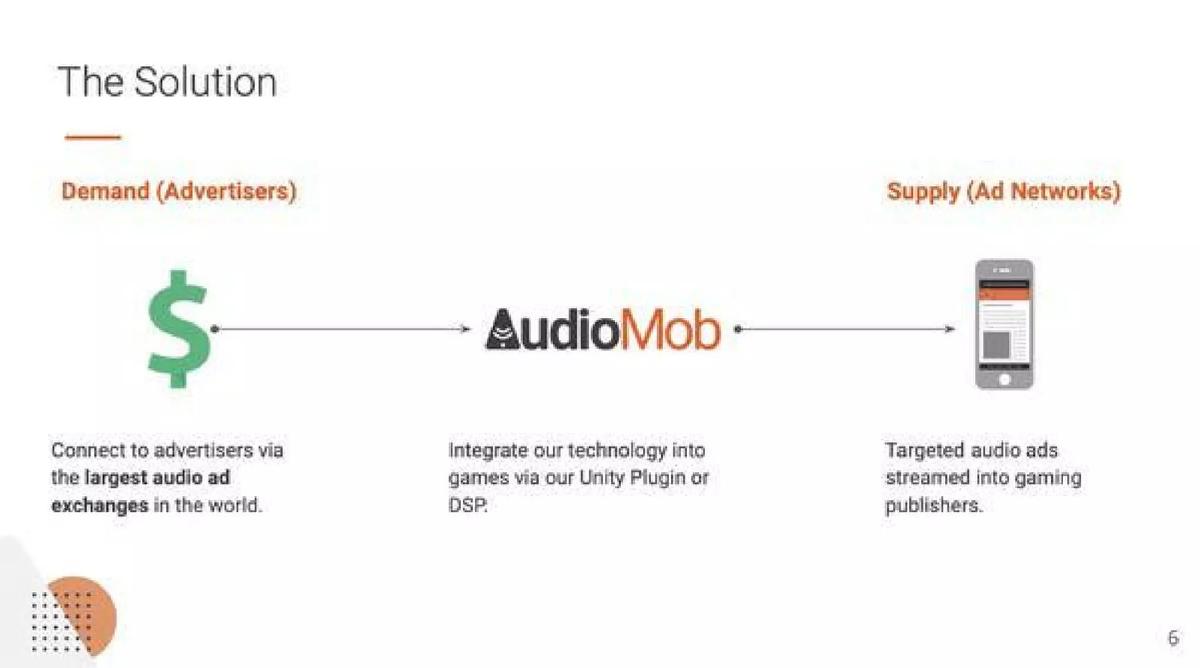
Audiomob solution slide — slide 6
Audio ads for mobile games. A three-step chain from advertiser money to a phone.
Audiomob deck, slide 6. Exact stored slide matched to this analysis.
Our analysis: The strongest answer here: its problem slide showed a game paused for a video ad, and this slide replaces it with an audio ad that plays without stopping the game, with money flowing from advertisers to studios.
Evidence and limitation: No figures; the ad exchanges are not named on this slide.
What a founder can adapt: Draw the chain from who pays to what the player experiences, and name the integration (engine plugin, SDK).
Supporting analysis
What the deck claims: "The Solution." "Demand (Advertisers): Connect to advertisers via the largest audio ad exchanges in the world." "Integrate our technology into games via our Unity Plugin or DSP." "Supply (Ad Networks): Targeted audio ads streamed into gaming publishers."
Presentation choice: Three icons and one line each: where the money comes from, how it gets into the game, what the player hears.
When it does not fit: Say in one line what changes for the player — the game keeps running — since that is the point of the whole deck.
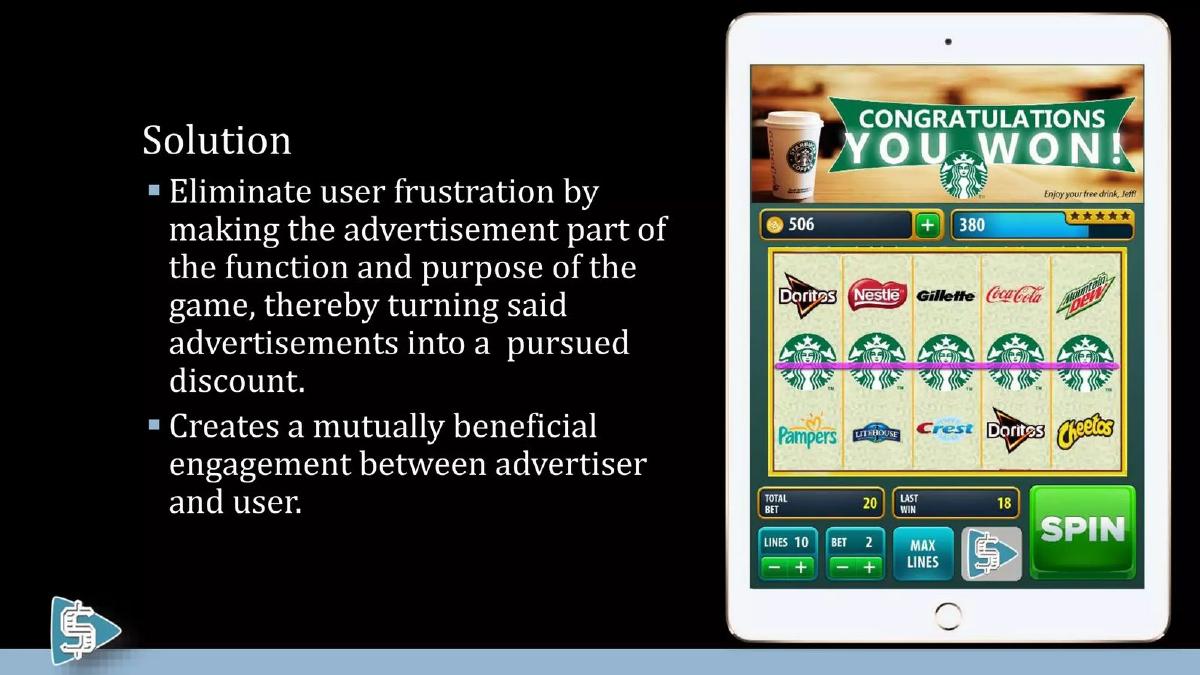
Games built from brand advertising. Two bullets beside a tablet showing a slot machine of brand logos.
Playsav deck, slide 6. Exact stored slide matched to this analysis.
Our analysis: It shows the product doing the job: the ad is the game, and winning means a discount.
Evidence and limitation: No figures; the brand logos on the screen are a mock-up, not stated partnerships.
What a founder can adapt: Put the product screen next to one sentence saying what it changes.
Supporting analysis
What the deck claims: "Solution." "Eliminate user frustration by making the advertisement part of the function and purpose of the game, thereby turning said advertisements into a pursued discount." "Creates a mutually beneficial engagement between advertiser and user." Screen: "Congratulations You Won!"
Presentation choice: The screen explains the idea faster than the two bullets.
When it does not fit: Real brand logos in a mock-up can be read as signed advertisers; label it as a concept.
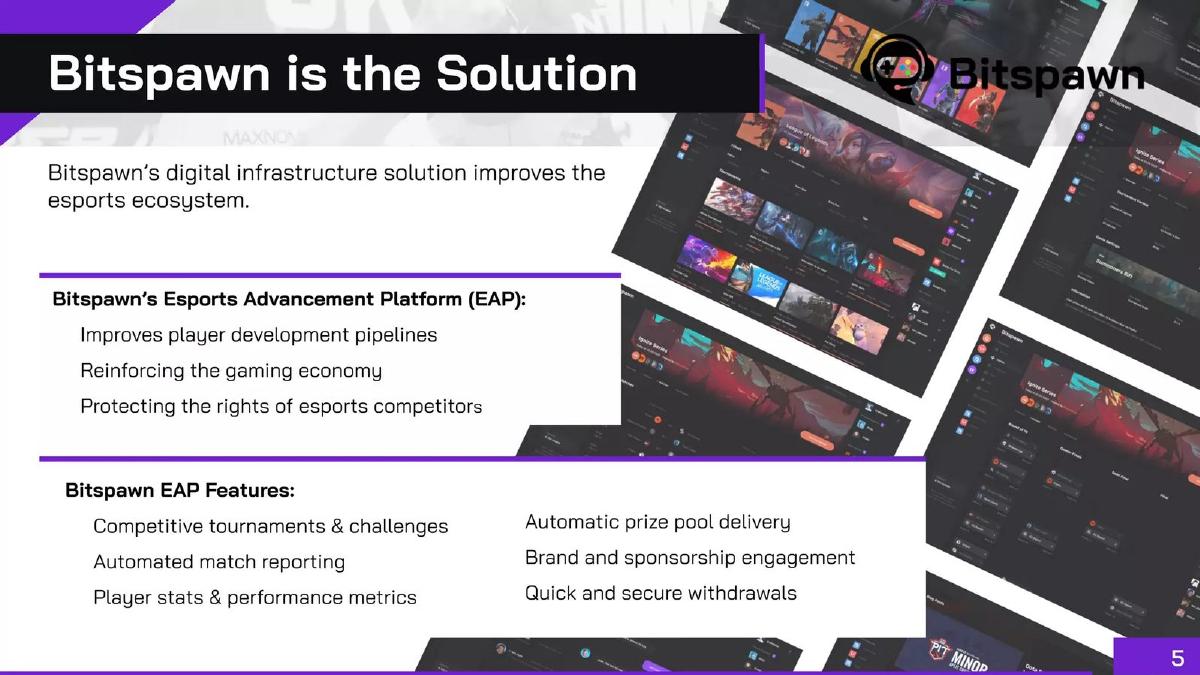
Esports platform for players and tournaments. Two text boxes over tilted product screens.
Bitspawn deck, slide 5. Exact stored slide matched to this analysis.
Our analysis: Its problem slide said winnings were withheld by intermediaries; "Automatic prize pool delivery" answers that, but it sits sixth in a list of six features.
Evidence and limitation: No figures.
What a founder can adapt: Lead with the feature that answers your headline problem.
Supporting analysis
What the deck claims: "Bitspawn is the Solution." "Bitspawn's digital infrastructure solution improves the esports ecosystem." "Esports Advancement Platform (EAP): Improves player development pipelines; Reinforcing the gaming economy; Protecting the rights of esports competitors." Features include "Automatic prize pool delivery" and "Quick and secure withdrawals".
Presentation choice: The screens show a real product; the next slide ("How it Works", slide 6) walks through entry fee to "Instant Payout".
When it does not fit: "Improves the esports ecosystem" says nothing; the payout promise should be the headline.
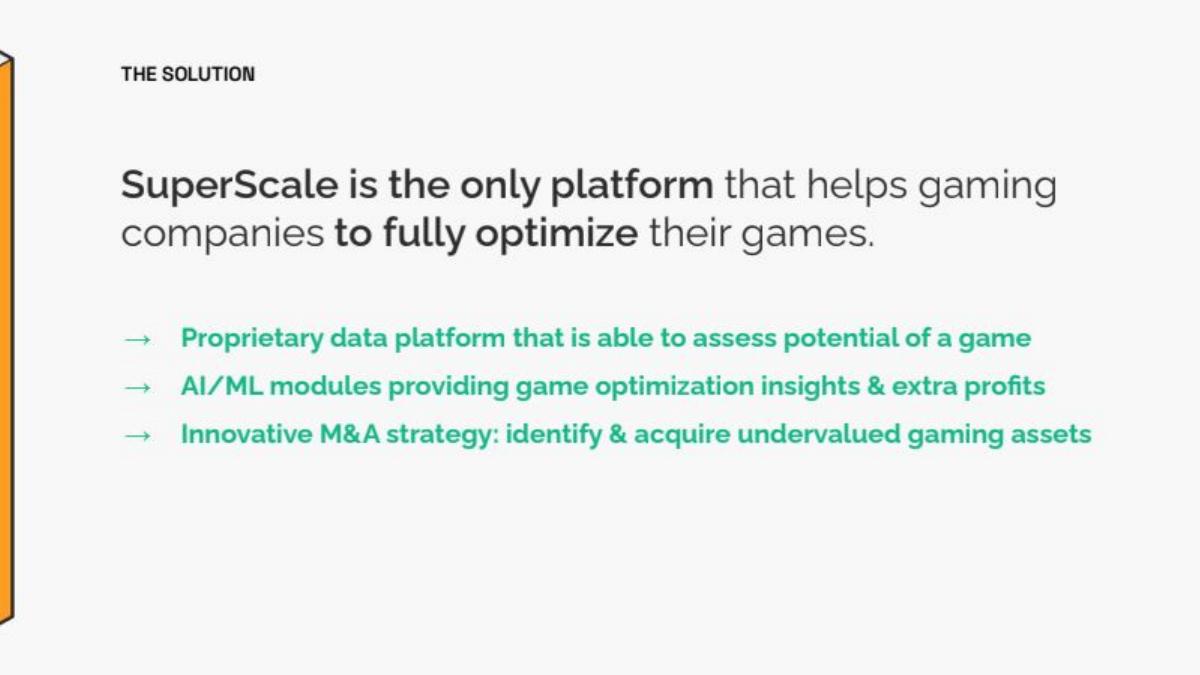
Optimisation service for mobile game studios. One sentence and three arrows.
Superscale deck, slide 3. Exact stored slide matched to this analysis.
Our analysis: It answers its problem slide (studios leave profit on the table) with a data platform and optimisation modules, then adds a third, separate business: buying games.
Evidence and limitation: No figures; "the only platform" is unsupported.
What a founder can adapt: Mirror the problem slide's wording so the investor sees the answer.
Supporting analysis
What the deck claims: "The Solution." "SuperScale is the only platform that helps gaming companies to fully optimize their games." "Proprietary data platform that is able to assess potential of a game." "AI/ML modules providing game optimization insights & extra profits." "Innovative M&A strategy: identify & acquire undervalued gaming assets."
Presentation choice: Short and matched to the problem; the same customer and the same word ("optimize") carry across both slides.
When it does not fit: The acquisition strategy is a different business model; give it its own slide. Drop "the only" unless you can show it.
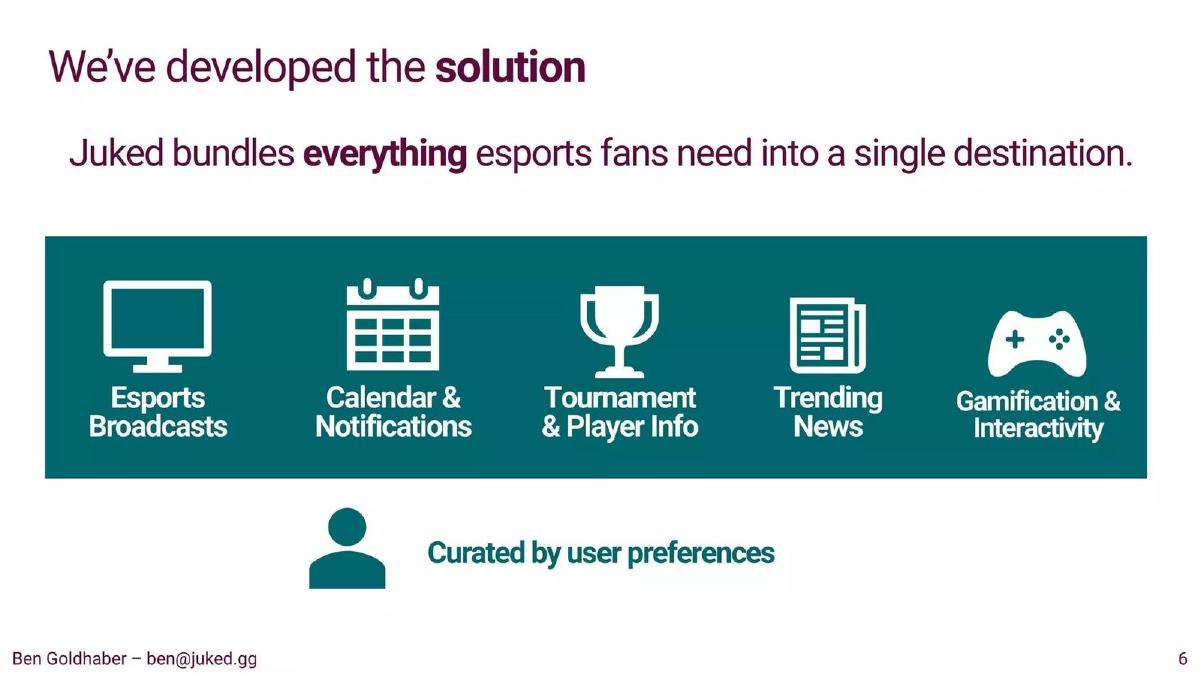
Esports news and results app. One sentence and five feature icons.
Juked deck, slide 6. Exact stored slide matched to this analysis.
Our analysis: Its problem slide said only that esports is fragmented; the slide before this one (slide 5) listed the scattered sources, and this slide bundles them. The answer is clear; who pays is not.
Evidence and limitation: No figures.
What a founder can adapt: Name the sources you replace (the apps fans juggle today) next to the one you offer.
Supporting analysis
What the deck claims: "We've developed the solution." "Juked bundles everything esports fans need into a single destination." Icons: "Esports Broadcasts", "Calendar & Notifications", "Tournament & Player Info", "Trending News", "Gamification & Interactivity". "Curated by user preferences."
Presentation choice: One sentence carries it; the icons list what is bundled.
When it does not fit: Add a screen of the app; icons alone don't prove it exists.
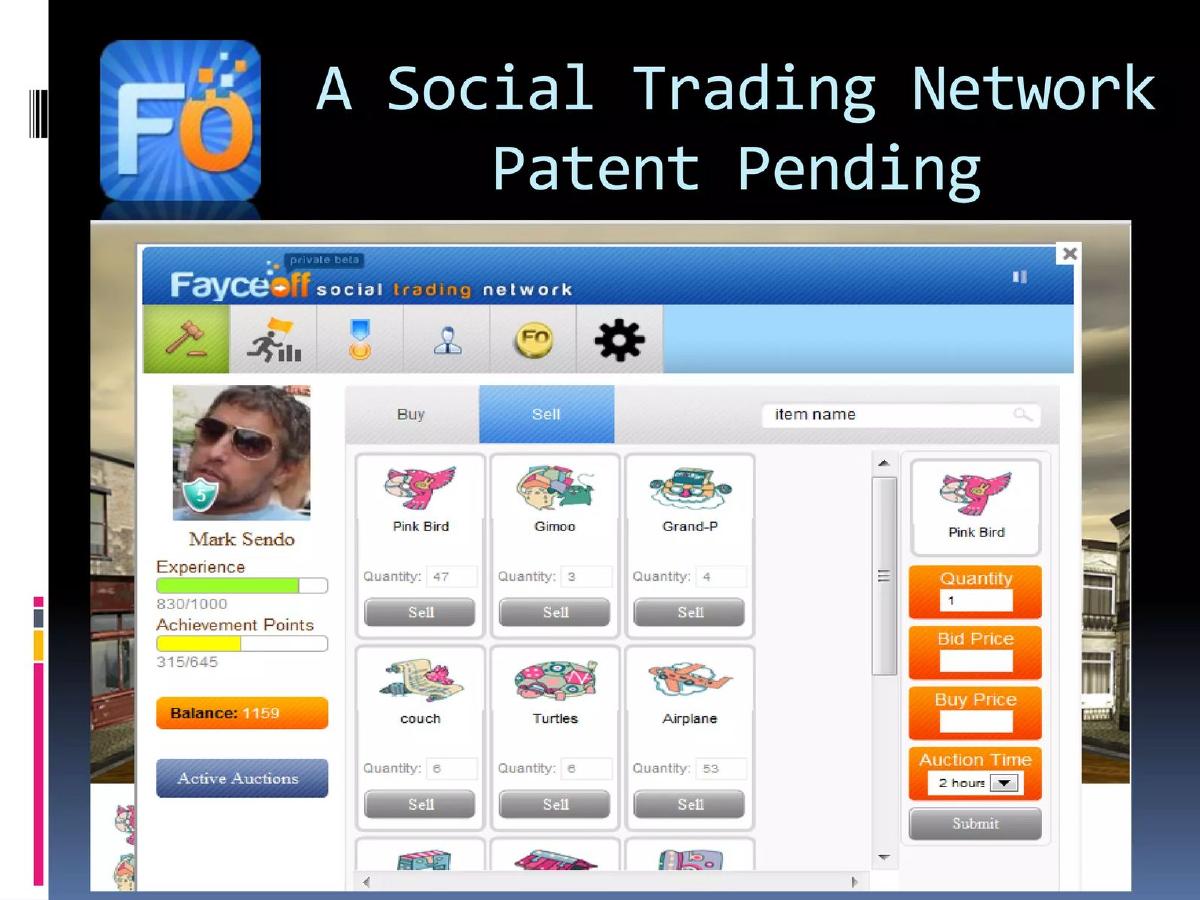
Virtual goods that players can trade. A headline over a screenshot of the trading screen.
Fayceoff deck, slide 4. Exact stored slide matched to this analysis.
Our analysis: Its problem slide said players cannot move goods out of games; this screen shows them buying, selling and auctioning those goods.
Evidence and limitation: No figures.
What a founder can adapt: Show the screen where the problem goes away, and add one line saying so.
Supporting analysis
What the deck claims: "A Social Trading Network. Patent Pending." Screen: a player profile with "Experience", "Achievement Points" and "Balance"; tabs for "Buy" and "Sell"; items such as "Pink Bird", "Turtles" and "Airplane" with quantities and sell buttons; an auction panel with "Bid Price", "Buy Price" and "Auction Time".
Presentation choice: A working screen proves the product exists better than any bullet.
When it does not fit: No sentence explains the screen; an investor who skipped the problem slide won't know what "social trading" means here.
Paid video courses from top esports players. Three bullets over a dark photo and a dashboard. Partial.
Gamerzclass deck, slide 3. Exact stored slide matched to this analysis.
Our analysis: Three features that answer its problem slide's labels, with a recognisable pro player on screen, but no sentence saying who it is for or what improves.
Evidence and limitation: "Top 100 players"; no other figures.
What a founder can adapt: Add the result: how much a player's rank moves after a course.
Supporting analysis
What the deck claims: "The Solution." "Exclusive video courses." "Professional instructors (Top 100 players)." "Data driven progress tracking."
Presentation choice: Kept as partial: the offer is clear, the outcome is missing.
When it does not fit: Labels only; say who buys and what they get.
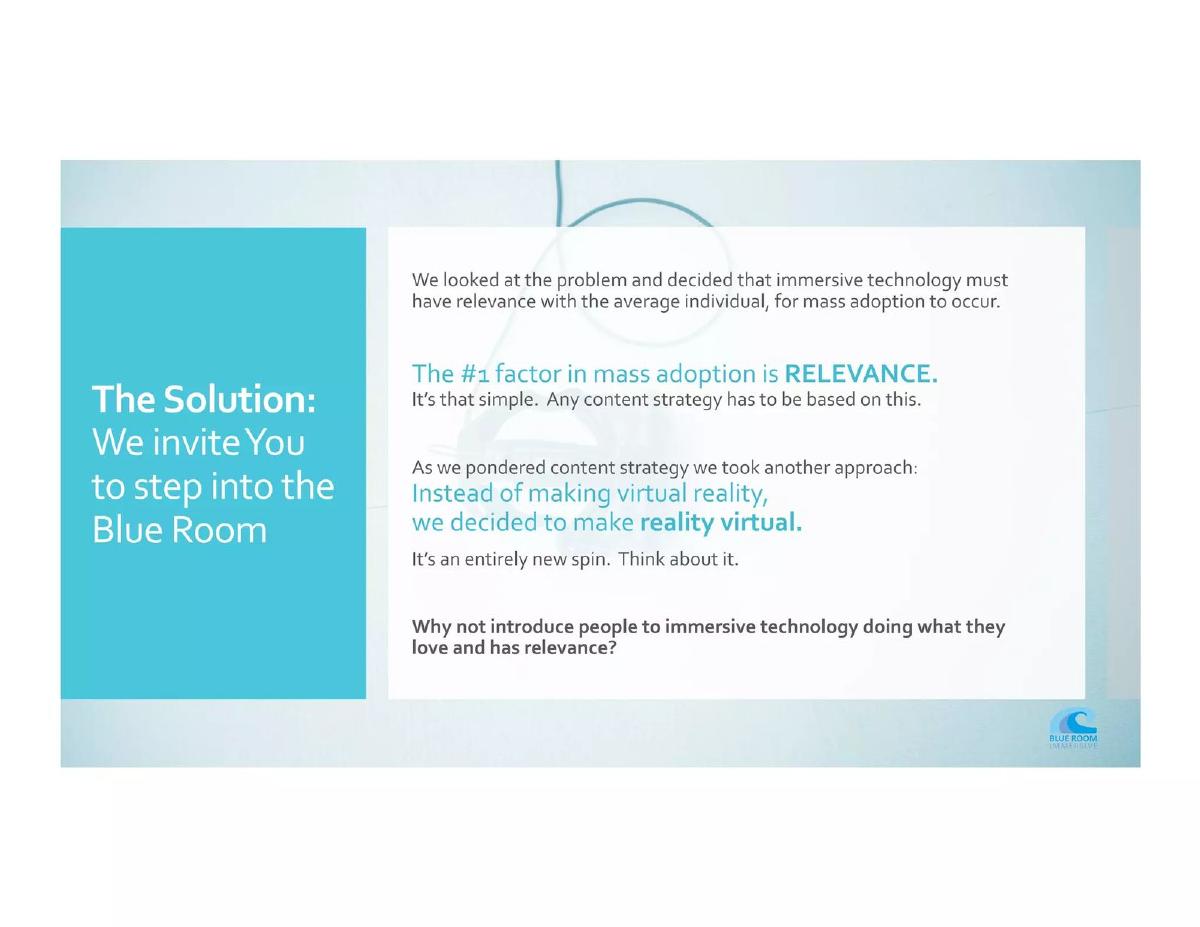
Immersive VR content. A coloured panel and a block of small text. Weak on purpose.
Blue Room deck, slide 4. Exact stored slide matched to this analysis.
Our analysis: It states a content strategy, not a product: no content, screen or customer is shown, and the headset makers named on its problem slide are missing.
Evidence and limitation: No figures.
What a founder can adapt: Show one piece of the content (the 360° nature footage from slide 7) and the headset maker who would license it.
Supporting analysis
What the deck claims: "The Solution: We invite You to step into the Blue Room." "The #1 factor in mass adoption is RELEVANCE. It's that simple." "Instead of making virtual reality, we decided to make reality virtual." "Why not introduce people to immersive technology doing what they love and has relevance?"
Presentation choice: It shows what a solution slide needs beyond an idea: the thing itself and who buys it.
When it does not fit: A slogan and a rhetorical question leave the investor to imagine the product.
Whether each slide answers its own problem slide, shows where the product fits, and says who pays.
Example
Answers its problem
Shows the fit
Who pays
Audiomob
Yes (no paused game)
Yes (Unity plugin)
Yes (advertisers)
Playsav
Yes (ads that annoy)
Yes (game screen)
Yes (advertisers)
Bitspawn
Partly (payout listed sixth)
Partly (screens)
Next slide (entry fees)
Superscale
Yes (optimisation)
Partly (platform named)
Not on this slide
Juked
Yes (one destination)
Partly (icons)
No
Fayceoff
Yes (goods can be traded)
Yes (trading screen)
No
Gamerzclass
Partly (features only)
Partly (dashboard)
No
Blue Room
No
No
No
Key Takeaways
Answer your own problem slide; seven decks here have their problem slide in the gaming problem guide, so you can compare the pair.
Show where the product sits: Unity plugin, in-game store, tournament flow.
In two-sided gaming businesses (studios and advertisers, players and sponsors), name both sides and what each gets.
A screen from the product proves more than a list of features.
A strategy ("make reality virtual") is not a solution until the product is shown.
Build your gaming solution slide
Answer the problem, show where it plugs in, say who pays.
Answer. Which line on your problem slide does this answer? Reuse its words.
Fit. Where does it sit: engine plugin, SDK, store, tournament flow, app?
Screen. Which one screen shows the problem gone?
Pays. Studio, advertiser, sponsor or player — and for what?
Copyable framework: [Product] lets [studio / player] [outcome] by [how it works], installed as [plugin / app]. [Payer] pays [price model].
Illustrative example 1 — written by us
Before: Our platform revolutionises monetisation for the gaming ecosystem.
After: A Unity plugin that plays 15-second audio ads between levels without pausing the game; advertisers pay per completed listen and studios keep 70%.
What improved: Our illustrative rewrite; the figures are invented for the example. It shows the fit, what the player experiences and who pays.
What this guide adds
The gaming problem guide covers the slide before this one. Seven of the eight companies here — all but Playsav — have their problem slide in that guide, so each solution can be checked against the problem it promised to solve.
Gaming solutions often sit inside someone else's product: a studio's game, a publisher's store, a tournament. Investors want to see where the product plugs in and who pays for it — the studio, the advertiser, or the player.
Three things a gaming solution slide proves
It answers the problem: Audiomob replaces the paused video ad with an audio ad; Bitspawn's "Automatic prize pool delivery" answers withheld winnings; Juked's single destination answers fragmentation.
It shows the fit: Audiomob's "Unity Plugin", Fayceoff's trading screen with buy and sell buttons, Playsav's slot machine on a tablet.
It says who pays: advertisers (Audiomob, Playsav), studios through a success fee (Superscale), players through an entry fee (Bitspawn). Juked, Gamerzclass and Blue Room leave this out.
Common mistakes
Strategy instead of product. "Make reality virtual" is a direction, not something an investor can see.
Answer buried in a feature list. If withheld winnings is your problem, instant payout is your headline.
Two businesses on one slide. Optimisation software and buying games need separate slides.
Screen with no sentence. Say what the screenshot proves.
No payer. Gaming products often have three possible payers; name yours.
Diagnostic checklist
It answers the headline of your problem slide, in the same words.
It shows where the product sits in the game or tournament.
It includes one real screen.
It says who pays.
The slide is readable at a glance.
Frequently asked questions
How we chose these examples
Corpus: published pitch deck teardowns on StartupFundraising.com. Founder-uploaded private decks are excluded.
Selection (2026-09-25): we searched slides 2–6 for solution slides mentioning games, gamers, esports, players or the metaverse. Eleven stored images were inspected. Play2be (a music-learning game) was left out because its solution slides describe game features rather than a gaming business; Bitspawn slide 6 was left out because slide 5 is its solution slide (slide 6 is referenced in the analysis); sports, betting and gamification-for-work decks were left out as not gaming. Gamerzclass is marked partial; Blue Room is kept as a weaker contrast.
Overlap check: none of these eight slides appears in another guide. Seven of the companies have their problem slide in the gaming problem guide, so readers can compare each pair.
Review: all eight stored slide images were inspected on 2026-09-25 and matched to company, deck and slide number (editorial model review). No person has yet completed an editorial review of this page.
Claims are as shown on the slides; we have not verified them. We make no claim that any slide caused a fundraising outcome.