AudioMob's 11-slide Series A deck is a masterclass in identifying a specific friction point—intrusive video ads in mobile games—and presenting a high-margin technical solution. By highlighting that 78% of all app store spend in 2018 came from gaming (Slide 5) and contrasting this with user reviews expressing hatred for video ads (Slide 3), the founders created an immediate 'why now' narrative. The deck is light on current revenue traction but heavy on industry validation, listing meetings with giants like Ubisoft, Riot Games, and Voodoo (Slide 4). With a leadership team boasting experience fr…
Key takeaways
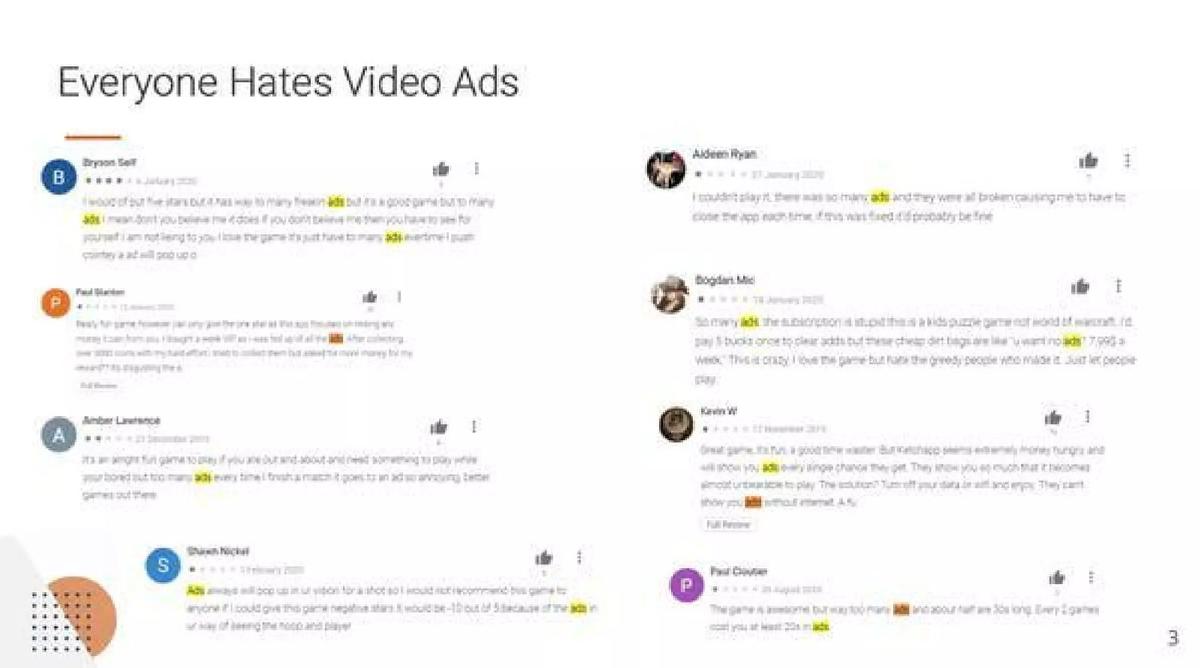
- The deck uses a visceral 'Everyone Hates Video Ads' slide featuring negative app store reviews to establish the problem (Slide 3).
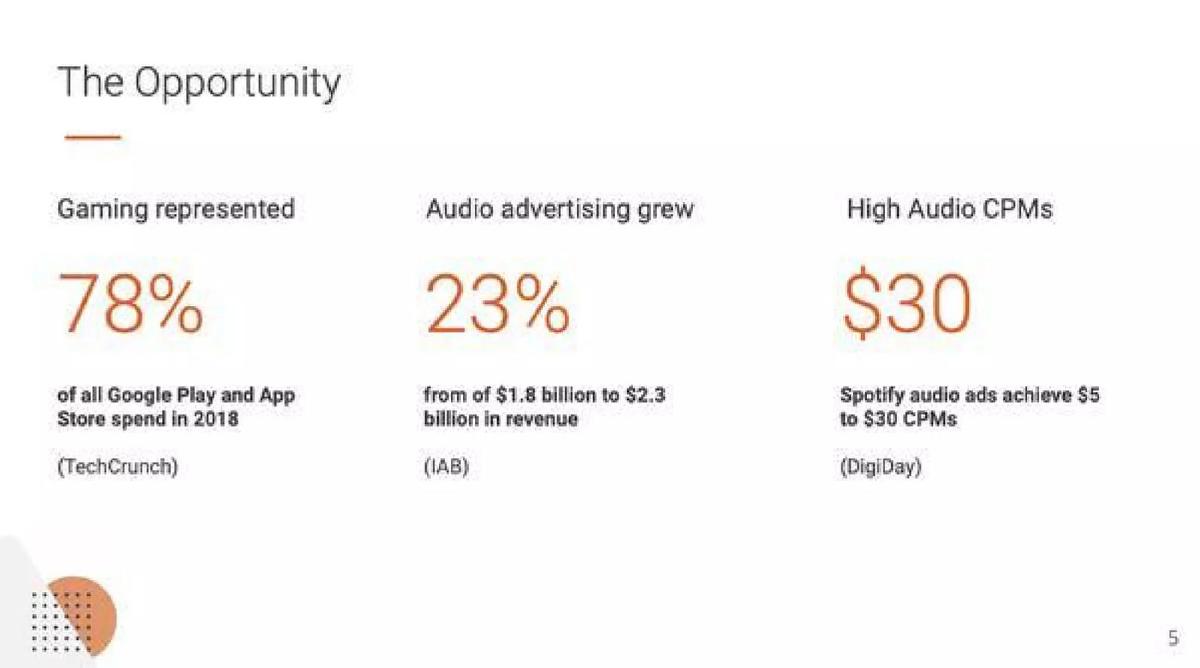
- Gaming is identified as the dominant mobile sector, representing 78% of all Google Play and App Store spend in 2018 (Slide 5).
- The company targets high-value audio CPMs, citing that Spotify audio ads achieve between $5 to $30 (Slide 5).
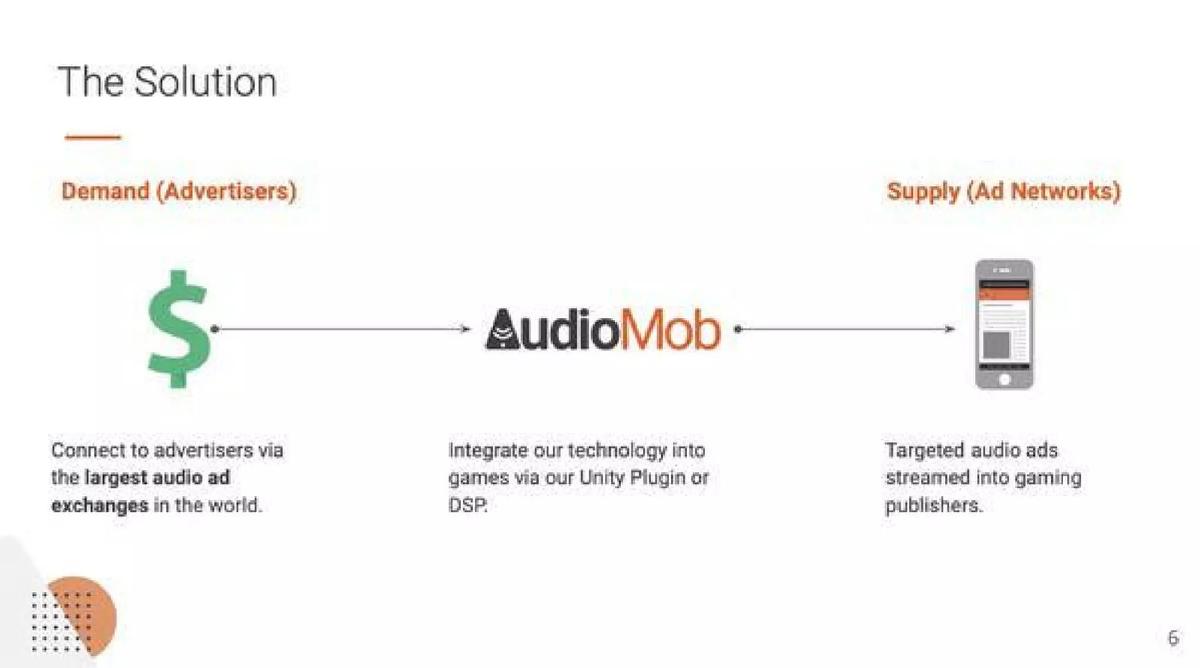
- AudioMob positions itself as a technical bridge, integrating via Unity Plugin or DSP to connect advertisers with gaming publishers (Slide 6).
- The platform tracks specific audio-centric metrics including 'Quartile listened to' and 'Sound On / Off' (Slide 8).
- Market sizing is ambitious, claiming a Total Addressable Market (TAM) of $35B and a Serviceable Obtainable Market (SOM) of $224M (Slide 9).
- The leadership team features deep domain expertise with former employees from Facebook, Google, and Goldman Sachs (Slide 10).
- The deck concludes with a 'comparable exits' slide showing AdTech acquisitions ranging from $145M to $750M to prove the liquidity path (Slide 11).
The AudioMob Series A Teardown
AudioMob entered the market at a time when mobile gaming was exploding, but monetization was reaching a breaking point of user frustration. This 11-slide deck, used to secure a $16,000,000 Series A in 2020, focuses heavily on the 'unfilled gap' in the market: high-quality audio ads for a medium that is traditionally visual-heavy. By leveraging the growth of the audio sector (podcasts, music streaming) and applying it to the massive gaming audience, AudioMob presented a clear arbitrage opportunity for investors.
Slides 1-3: The Emotional Hook and Problem Definition
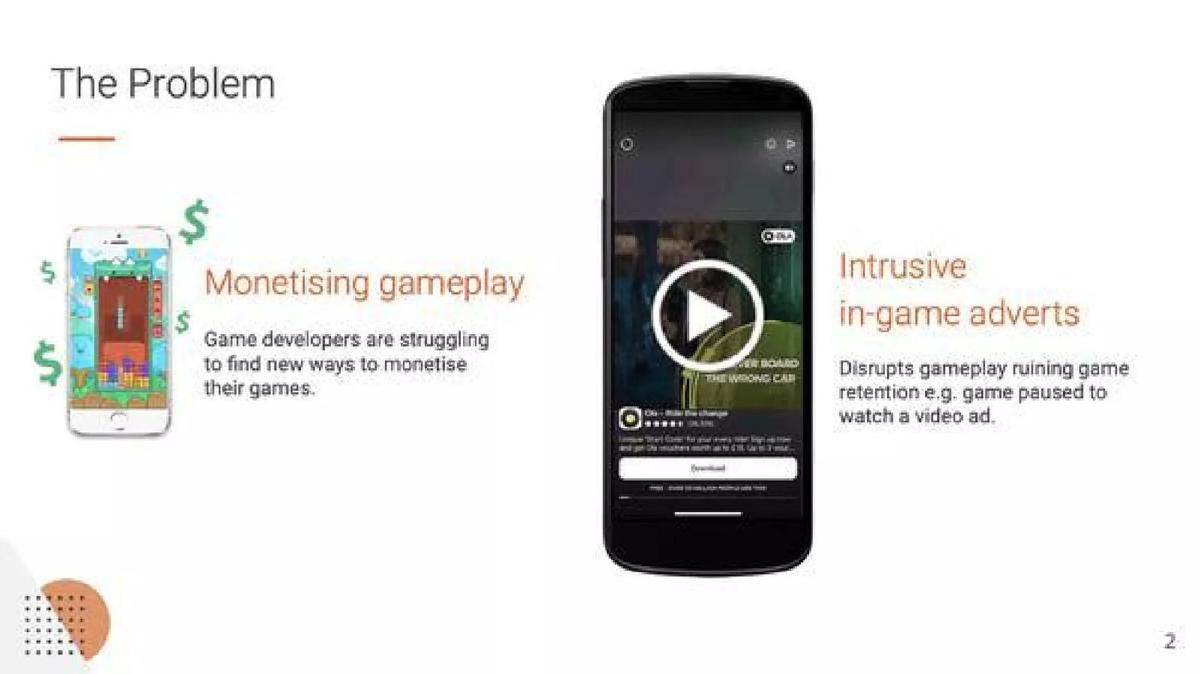
Slide 1 is a standard title page, clearly stating the value proposition: "Serving Digital Audio Ads in games." It establishes the brand identity immediately without unnecessary fluff. Slide 2 dives into the problem, identifying two main pain points: the struggle for developers to find new monetization methods and the 'intrusive' nature of current in-game adverts that ruin retention. The visual of a paused game with a video play button serves as a relatable trigger for anyone who has played a mobile game.
Slide 3 is perhaps the most effective slide in the deck. Titled "Everyone Hates Video Ads," it features a collage of real user reviews from the App Store and Google Play. The reviews, such as those from 'Bryson Self' and 'Aideen Ryan,' are highlighted to show the word "ads" appearing repeatedly in negative contexts. This slide moves the problem from a theoretical business challenge to a visceral user experience failure, making the need for a solution feel urgent.
Slides 4-5: Validation and Market Opportunity
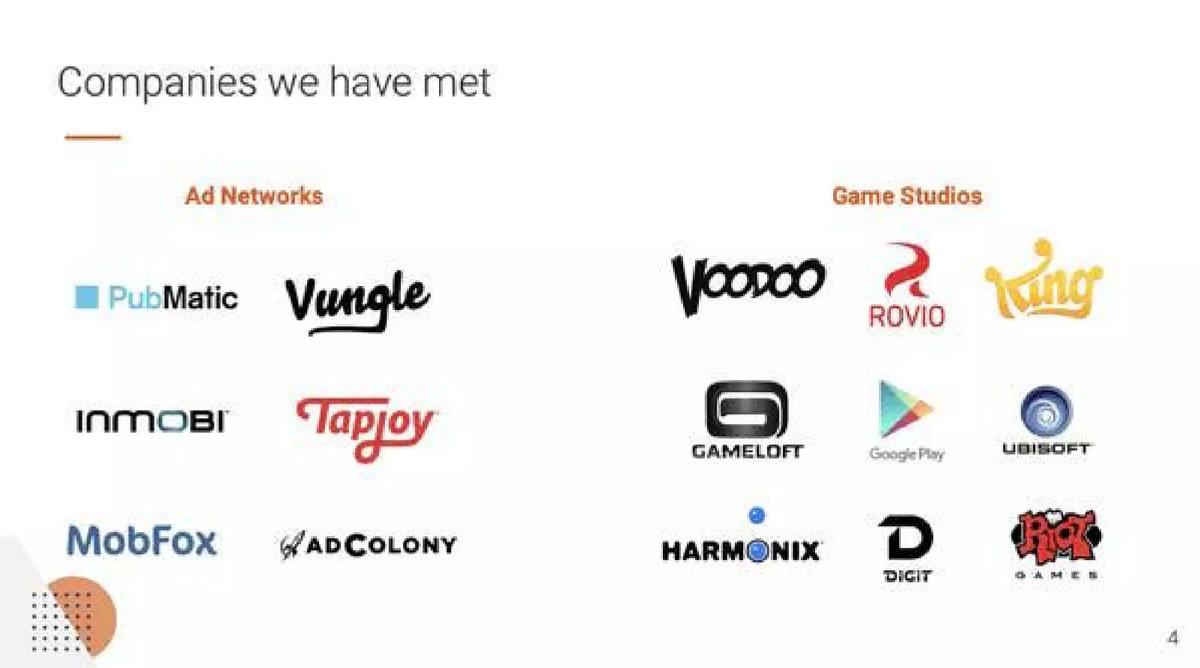
Slide 4 , "Companies we have met," serves as a proxy for traction. While the deck does not list signed contracts or revenue on this slide, it lists heavyweights in two categories: Ad Networks (PubMatic, Vungle, InMobi, Tapjoy, MobFox, AdColony) and Game Studios (Voodoo, Rovio, King, Gameloft, Google Play, Ubisoft, Harmonix, Digit, Riot Games). For a Series A deck, showing this level of access to the industry's gatekeepers is a strong signal of product-market fit potential.
Slide 5 quantifies the opportunity. It cites TechCrunch stating that gaming represented 78% of all app store spend in 2018. It then pivots to the audio market, noting 23% growth in audio advertising revenue (to $2.3 billion) according to the IAB. The 'kicker' on this slide is the CPM comparison: Spotify audio ads achieving $5 to $30 CPMs. This suggests that if AudioMob can successfully port these high CPMs into the gaming world, the revenue potential is massive.
Slides 6-8: The Technical Solution and Product Specs
Slide 6 explains the mechanics of the platform. AudioMob acts as the central node between Demand (Advertisers) and Supply (Ad Networks/Publishers). The technical delivery is handled via a Unity Plugin or DSP. This slide is crucial because it shows that AudioMob isn't just a broker; it's a technology layer that integrates directly into the game development workflow.
Slide 7 introduces the "AudioMob Format." It describes their ability to detect audio signals within games to deliver "audio enhanced banner ads." The visual suggests a non-intrusive experience where the user continues to play while the audio ad runs. Slide 8 goes deeper into the "Format Breakdown." It lists specific tracking capabilities: Clickable, Mutable, Closable, and Full control of gameplay. Most importantly, it introduces "New Audio metrics," such as 'Quartile listened to' and 'Sound On / Off,' which are essential for proving ad efficacy to buyers.
Slides 9-11: Business Model, Team, and Exit Strategy
Slide 9 outlines the business model and market sizing. The company uses the standard TAM/SAM/SOM framework, claiming a $35B TAM, a $3.6B SAM, and a $224M SOM. The revenue model is a simple percentage share of the advertising CPM. While the slide is clean, it lacks the specific 'bottom-up' calculation that some rigorous investors look for, relying instead on large industry figures.
Slide 10 introduces the leadership. CEO Christian Facey and CTO Wilfrid Obeng have the 'pedigree' that Silicon Valley and London VCs often prioritize. With logos for Facebook, Google, and Goldman Sachs prominently displayed, the slide communicates that the founders have both the technical chops to build the product and the corporate experience to navigate large-scale partnerships.
Finally, Slide 11 addresses the 'Exit' question. It lists four major AdTech exits: Vungle ($750m), AdMob (acquired by Google for $750m), Adswizz ($145m), and Triton ($150m). By showing these comparables, AudioMob is telling investors that there is a well-trodden path for acquisition in this space, particularly by giants like Google or Blackstone.
What Works in the AudioMob Deck
The deck is exceptionally focused. It doesn't try to solve all of advertising; it only tries to solve audio in games. The use of social proof via negative reviews (Slide 3) is a brilliant way to build empathy for the user, which in turn justifies the product's existence. Furthermore, the CPM comparison on Slide 5 provides a clear financial incentive—it shows that audio isn't just 'nicer' for the user, it's potentially more lucrative for the developer.
The 'Companies we have met' slide (Slide 4) is a clever way to show momentum without disclosing sensitive revenue data. In the world of Series A, showing that you are already in the room with Riot Games and Ubisoft is often enough to prove that the industry takes your solution seriously.
What is Missing from the AudioMob Deck
The most glaring omission is hard traction data. There are no charts showing month-over-month growth, no mention of current Monthly Recurring Revenue (MRR), and no case studies of specific games that have seen a lift in retention or revenue after implementing AudioMob. While the 'Companies we have met' slide is good, it doesn't confirm who is actually paying or how much volume is flowing through the system.
Additionally, there is no 'Ask' slide in this version of the deck. We know from catalogue facts that they raised $16M, but the deck itself does not specify the amount sought, the valuation, or the intended use of funds (e.g., hiring 20 engineers, expanding to the US market). The unit economics—specifically the take-rate percentage—are also left vague, described only as a "percentage share."
What a Founder Should Copy
The Emotional Problem Slide: Use real customer pain (reviews, tweets, support tickets) to prove the status quo is broken. It is much more convincing than a bulleted list of 'pain points.' · The Proxy Traction Slide: If you don't have massive revenue yet, show the caliber of the people who are willing to take a meeting with you. It proves you have 'permission to play' in the industry. · The Comparative Exit Slide: Especially in AdTech or niche SaaS, showing that similar companies have exited for $100M+ helps investors visualize their 10x return. · Metric Specificity: Don't just say you track 'data.' Slide 8 lists exactly what they track (Quartiles, Sound On/Off), which shows a deep understanding of what the end customer (the advertiser) actually values.
Frequently asked questions
- What is the core problem AudioMob is trying to solve?
- AudioMob addresses the conflict between mobile game monetization and user retention. Slide 2 and Slide 3 highlight that intrusive video ads disrupt gameplay and ruin retention, leading to negative user reviews. By replacing or supplementing these with non-intrusive audio ads, developers can monetize without forcing the player to stop playing.
- How does AudioMob integrate with mobile games?
- According to Slide 6, AudioMob provides a Unity Plugin or integrates via a Demand-Side Platform (DSP). This allows them to stream targeted audio ads directly into gaming publishers' environments. Slide 7 further explains that they detect audio signals within games to deliver 'audio enhanced banner ads'.
- What are the key metrics AudioMob tracks for advertisers?
- Slide 8 details their 'Format Breakdown,' which includes tracking if an ad is clickable, mutable, or closable. Crucially for audio, they track 'Quartile listened to' and 'Sound On / Off' status, providing addressable metrics that traditional banner ads cannot offer.
- What is the business model and market opportunity?
- Slide 9 states the business model is taking a percentage share of the advertising CPM. They estimate a TAM of $35B and an SOM of $224M. Slide 5 supports the revenue potential by noting that audio advertising grew 23% to $2.3 billion and that high-end audio CPMs can reach $30.
- Who are the founders and what is their background?
- The leadership team consists of CEO Christian Facey and CTO Wilfrid Obeng. Slide 10 shows they have significant experience at major tech and finance firms, including Facebook, Google, and Goldman Sachs, which lends credibility to their ability to navigate the complex AdTech landscape.