Audoo’s pitch deck is a concise, problem-focused presentation that targets a massive inefficiency in the music industry: the inaccurate tracking of public performances in venues like cafes and retail stores. By highlighting that $2.7 billion is lost annually by artists due to flawed statistical processes (Slide 3), Audoo positions its 'Audio Meter' hardware as the essential bridge between real-world playback and Performing Right Organisations (PROs). The deck successfully maps out a global opportunity across 400 collection societies distributing $55 billion annually (Slide 4). While the deck…
Key takeaways
- The music industry loses over $2.7 billion annually due to inaccurate statistical reporting of public performances (Slide 3).
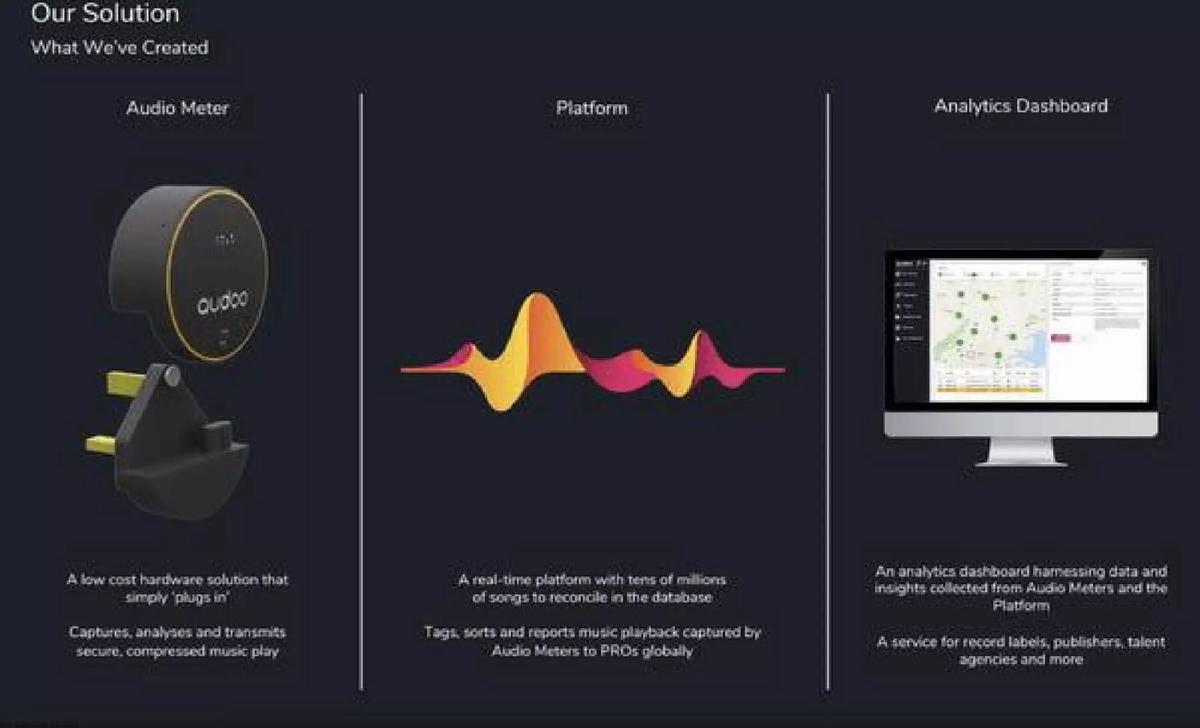
- Audoo’s primary product is a 'low cost hardware solution' called the Audio Meter that plugs into standard wall outlets (Slide 5).
- The total addressable market involves over 400 performing right and collection societies distributing more than $55 billion per year (Slide 4).
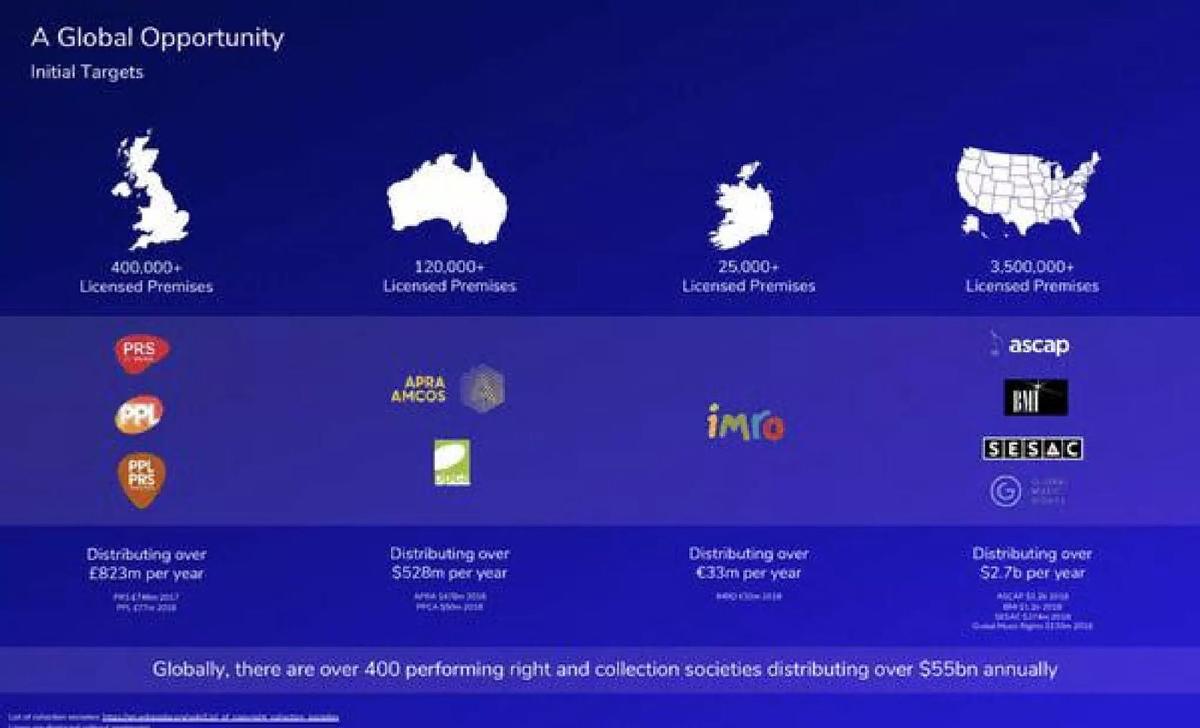
- Initial targets for the technology include the UK, Australia, Ireland, and the US, representing millions of licensed premises (Slide 4).
- The solution replaces manual, paper-based set lists and Excel broadcast lists with automated, real-time reporting (Slide 7).
- Audoo identifies an 'upsell' opportunity by offering an analytics dashboard to record labels, publishers, and talent agencies (Slide 6).
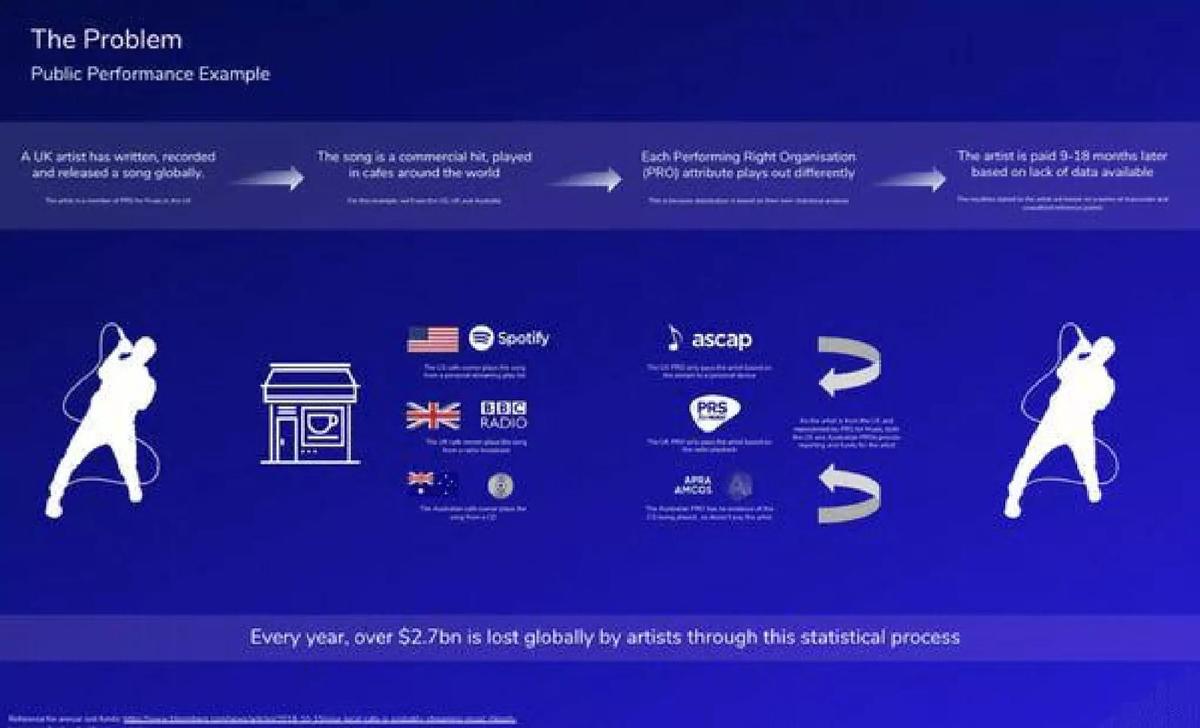
- The deck emphasizes a 9-18 month delay in artist payments caused by the current lack of available data (Slide 3).
- The company is supported by major entities including the Department for International Trade and the Mayor of London (Slide 8).
The Audoo Pitch Deck: A Masterclass in Problem Identification
Audoo’s 8-slide deck is a highly focused document that prioritizes the 'Why' and 'How' over the 'Who' and 'How Much.' Founded in 2018, the London-based startup tackles a niche but incredibly lucrative problem: the black hole of music royalties in public spaces. The deck uses a clean, dark aesthetic and high-contrast visuals to explain a complex financial supply chain in simple terms.
The Hook and the Industry Mandate
Slide 1: Title The deck opens with the Audoo logo and the tagline 'The Royalty Revolution is Coming...' The visual of a digital soundwave or data particles sets a high-tech tone immediately.
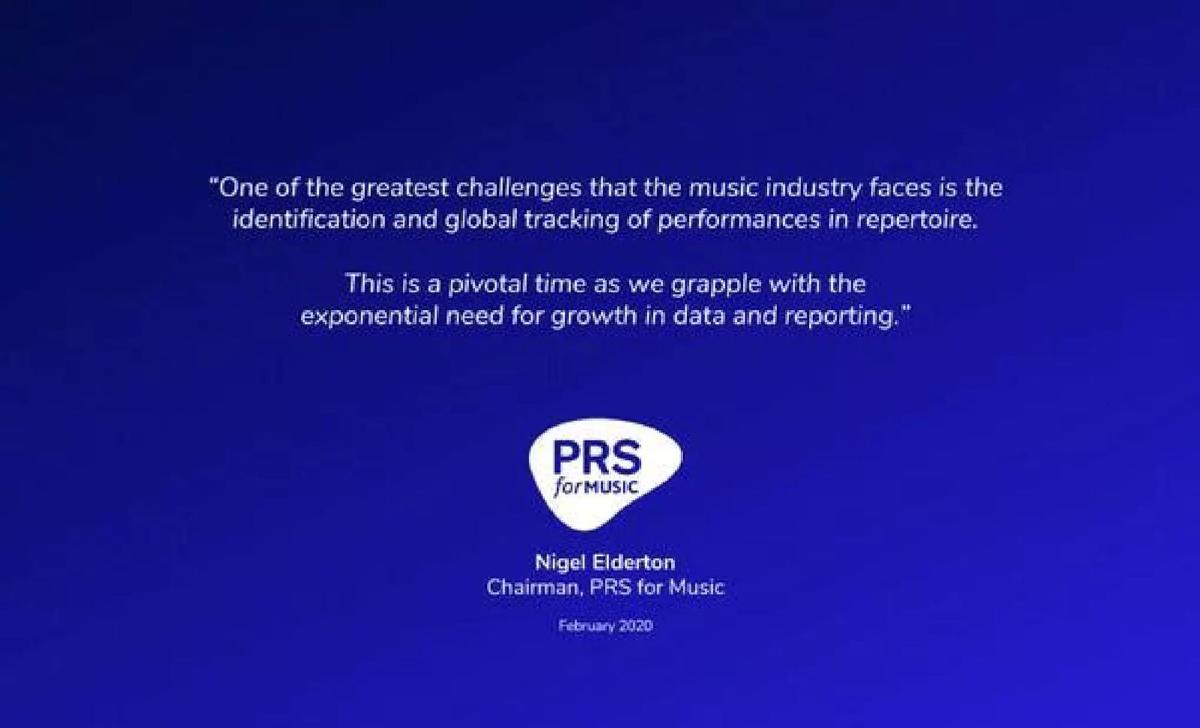
Slide 2: The Validation Instead of starting with a team or a product, Audoo leads with a quote from Nigel Elderton, Chairman of PRS for Music, dated February 2020. He identifies the 'identification and global tracking of performances' as one of the greatest challenges the industry faces. By using a quote from a major industry authority, Audoo validates the existence of their market before they even describe their product.
Defining the $2.7 Billion Gap
Slide 3: The Problem This slide is the core of the pitch. It uses a linear infographic to show how a song played in a cafe in the UK, US, or Australia is currently tracked. It highlights that different PROs (Performing Right Organisations) like ASCAP or APRA AMCOS attribute plays differently. The punchline is at the bottom: 'Every year, over $2.7bn is lost globally by artists through this statistical process.' It also notes a significant 9-18 month delay in artist payments.
Slide 4: A Global Opportunity Audoo quantifies the market by licensed premises. They list 400,000+ in the UK, 120,000+ in Australia, 25,000+ in Ireland, and 3,500,000+ in the US. By showing the logos of the PROs in each region (PRS, PPL, APRA AMCOS, IMRO, ASCAP, BMI, SESAC) and the billions they distribute, Audoo demonstrates that the infrastructure for payment already exists—it just lacks the data Audoo provides.
The Hardware-Software Solution
Slide 5: Our Solution - What We've Created This slide introduces the three pillars of the business: the Audio Meter (hardware), the Platform (database/matching), and the Analytics Dashboard (UI). The hardware is described as a 'low cost hardware solution that simply plugs in.' This is a critical detail for investors; it suggests a scalable, low-friction installation process that doesn't require professional electricians or complex setups.
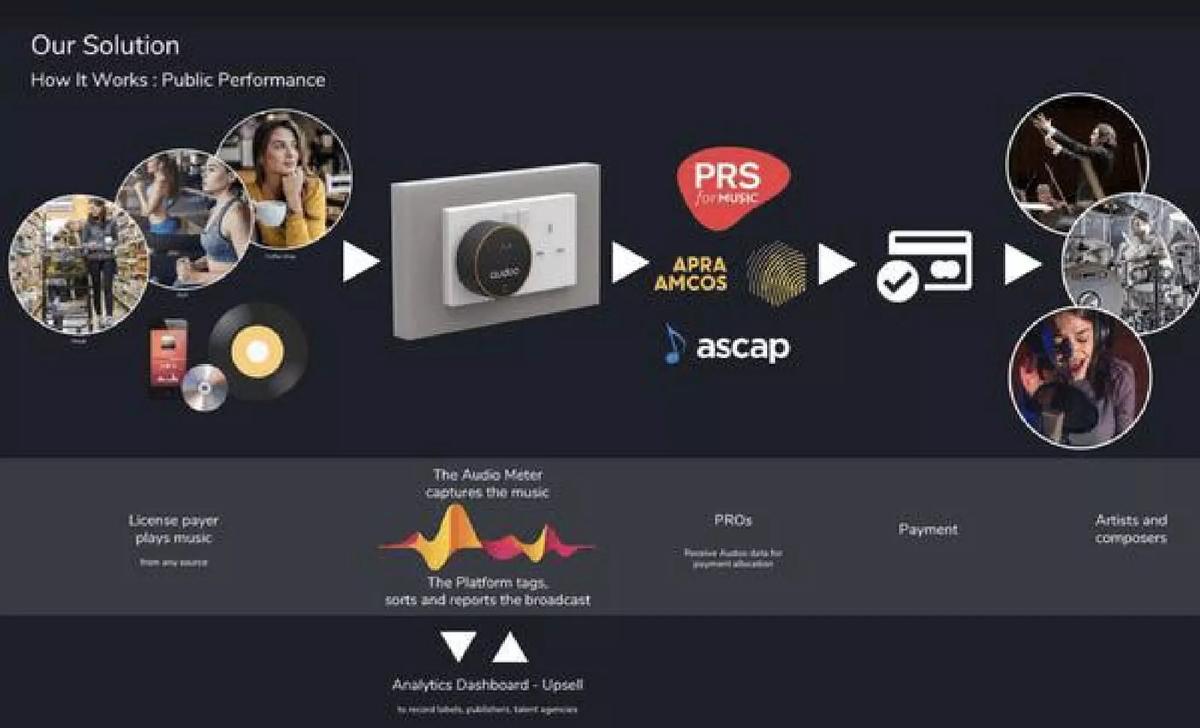
Slide 6: Our Solution - How It Works This flow chart connects the venue (coffee shop, gym, retail) to the Audio Meter, then to the PROs, and finally to the artists. It introduces a key business model detail: the 'Analytics Dashboard - Upsell' for record labels and talent agencies. This shows that Audoo isn't just a utility for PROs, but a data provider for the wider music industry.
Slide 7: Our Solution - Digital Transformation This slide uses a 'Before and After' comparison. The 'Before' side shows messy paper forms and Excel spreadsheets, labeled 'Manual processing & ambiguous data sets.' The 'After' side shows a clean laptop interface. This visualizes the transition from 'Paper Based Ambiguity' to a 'Fully Automated Real Time Platform.'
The Final Word
Slide 8: Appendix and Support The final slide functions as a contact and credibility page. It lists Audoo as a winner of MIDEMLAB and CEBIT, and an alumni of Abbey Road Red. Most importantly, it displays the logos of the Department for International Trade and the Mayor of London, signaling strong institutional backing in its home market.
What Works in the Audoo Deck
The 'Lost Money' Metric: Citing a specific figure like $2.7 billion (Slide 3) gives investors a clear 'size of the prize.' · Hardware Simplicity: By emphasizing that the device 'simply plugs in' (Slide 5), Audoo addresses the common investor fear that hardware startups face insurmountable distribution and installation hurdles. · Industry Validation: Leading with a quote from the Chairman of PRS for Music (Slide 2) immediately positions the startup as a partner to the industry rather than a disruptive threat that the industry might fight. · Visual Storytelling: The deck uses icons and flowcharts effectively to explain the movement of data and money, which is much more effective than dense text blocks in a complex sector like music rights.
What is Missing from the Audoo Deck
The Team: There is no team slide in these 8 pages. For a hardware/data play, the technical pedigree of the founders and their industry connections are usually paramount. · Unit Economics: While the hardware is called 'low cost,' the deck does not explain the manufacturing cost, the subscription fee for the data, or the cost of customer acquisition (CAC). · The Ask: The deck does not state how much capital is being raised or what the milestones for that capital would be. · Competition: There is no mention of existing competitors or alternative technologies (like ACR - Automatic Content Recognition apps) that might also be trying to solve this problem. · Financial Projections: There are no charts showing projected revenue growth or the number of units they expect to ship over the next 3-5 years.
What Founders Should Copy
The Linear Problem Flow: Use Slide 3 as a template for explaining any complex B2B2C process. It clearly shows the actor, the action, the friction point, and the financial consequence. · The 'Before and After' Slide: Slide 7 is a perfect example of how to sell 'Digital Transformation.' Show the actual ugly spreadsheets your customers are currently using; it makes your sleek UI look even more valuable. · Market Sizing by Physical Nodes: Instead of just saying 'The music market is $X billion,' Audoo counts 'Licensed Premises' (Slide 4). If you are a hardware or location-based startup, count the doors you can walk through, not just the total dollars in the industry. · Third-Party Social Proof: If you have a quote from a major incumbent in your industry saying your problem is their biggest headache, put it on Slide 2. It is the ultimate shortcut to credibility.
Frequently asked questions
- What exactly does the Audoo hardware do?
- According to Slide 5, the Audio Meter is a low-cost hardware device that 'plugs in' to a standard outlet. It captures, analyzes, and transmits secure, compressed music play data. This data is then sent to a real-time platform where it is reconciled against a database of tens of millions of songs to identify exactly what was played in a public venue.
- Who are the primary customers for Audoo's data?
- The deck identifies Performing Right Organisations (PROs) as the primary recipients of the data for payment allocation (Slide 6). However, Slide 5 and Slide 6 also mention an 'Analytics Dashboard' designed as a service for record labels, publishers, and talent agencies, indicating a secondary B2B revenue stream based on data insights.
- How big is the market Audoo is entering?
- Slide 4 states that globally there are over 400 performing right and collection societies distributing over $55 billion annually. The slide highlights specific initial targets: the US (3.5M+ licensed premises), the UK (400k+), Australia (120k+), and Ireland (25k+), showing a massive footprint for potential hardware installation.
- What is the 'problem' with current music royalty tracking?
- Slide 3 and Slide 7 explain that the current system relies on 'paper set lists,' 'Excel broadcast lists,' and 'ambiguous data sets.' This leads to a 'statistical process' where artists are paid 9-18 months late, and over $2.7 billion is lost globally because the data simply isn't accurate or available.
- Does the deck disclose how much money Audoo was seeking?
- No. The 8-slide deck provided does not include a 'The Ask' slide or any financial requirements. While catalogue data indicates the company raised $14,000,000, the deck itself focuses entirely on the problem, the solution, and the market opportunity without disclosing valuation or funding needs.