Aumet’s 10-slide deck from 2016 is a masterclass in brevity, focusing heavily on market size and early traction. The company positions itself as the connective tissue for a fragmented medical supply chain, citing a massive $100B yearly spend in the sector. Most notable is their claim of a $2.50 Cost Per Acquisition (CAC) for a platform that already boasted over 3,500 registered entities at the time of the pitch. While the deck lacks a formal 'Ask' slide and detailed financial projections, it compensates with strong social proof through a slide of global medical brand logos and a clear '10 Yea…
Key takeaways
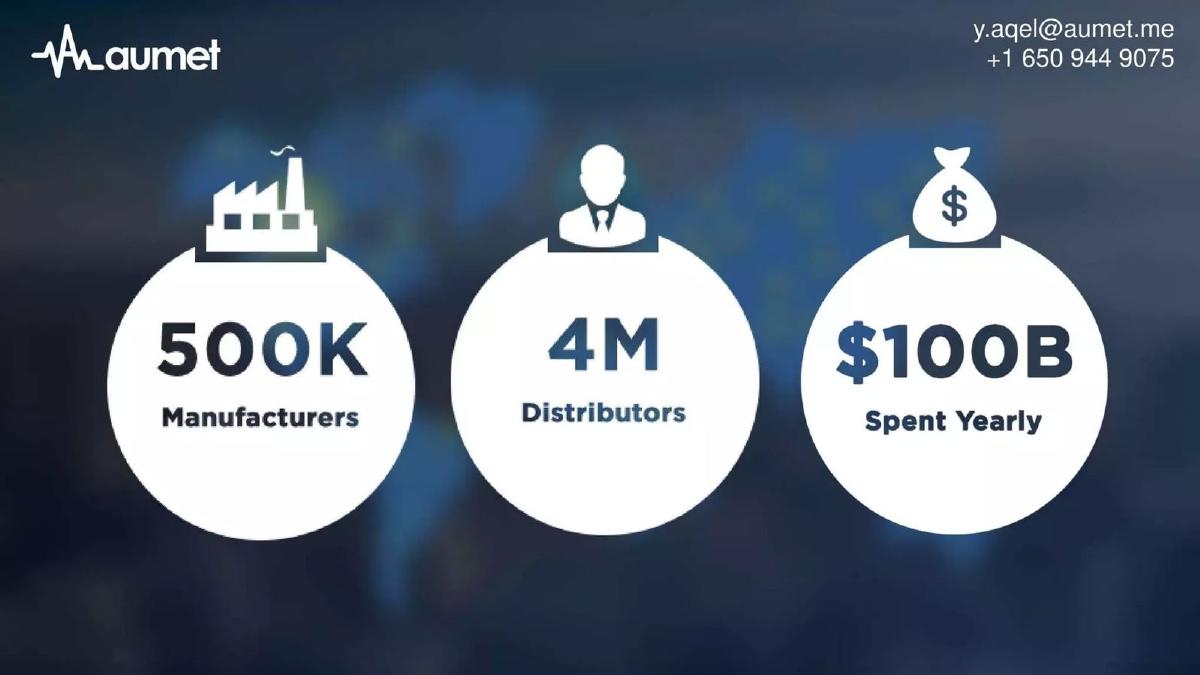
- The deck highlights a massive market opportunity with 500k manufacturers and 4M distributors spending $100B annually (Slide 6).
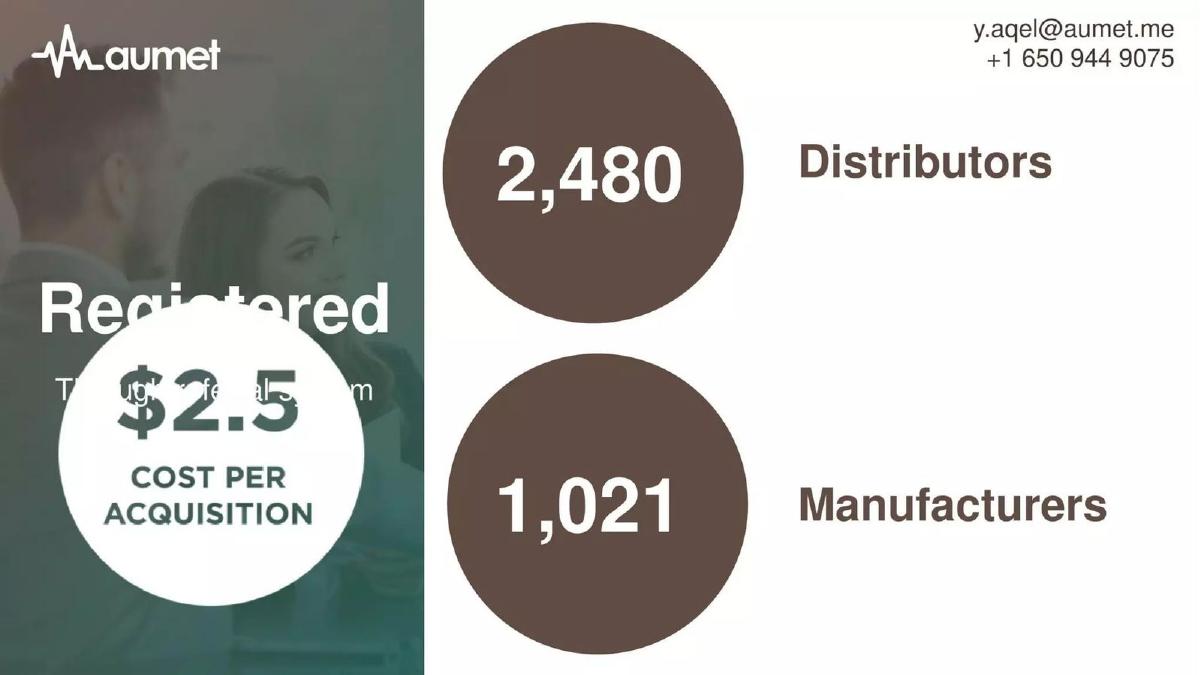
- Aumet claims a remarkably low Cost Per Acquisition (CAC) of $2.50 for its registered users (Slide 4).
- The platform had already secured 2,480 distributors and 1,021 manufacturers at the time of the presentation (Slide 4).
- The founders emphasize their industry expertise, citing '10 Years Experience' across software, sales, and medical business (Slide 8).
- Early revenue traction is shown with $100k in ARR, with a stated potential to reach $1M ARR (Slide 9).
- The deck uses a 'social proof' strategy by displaying logos of major industry players like GE, Siemens, and Abbott (Slide 3).
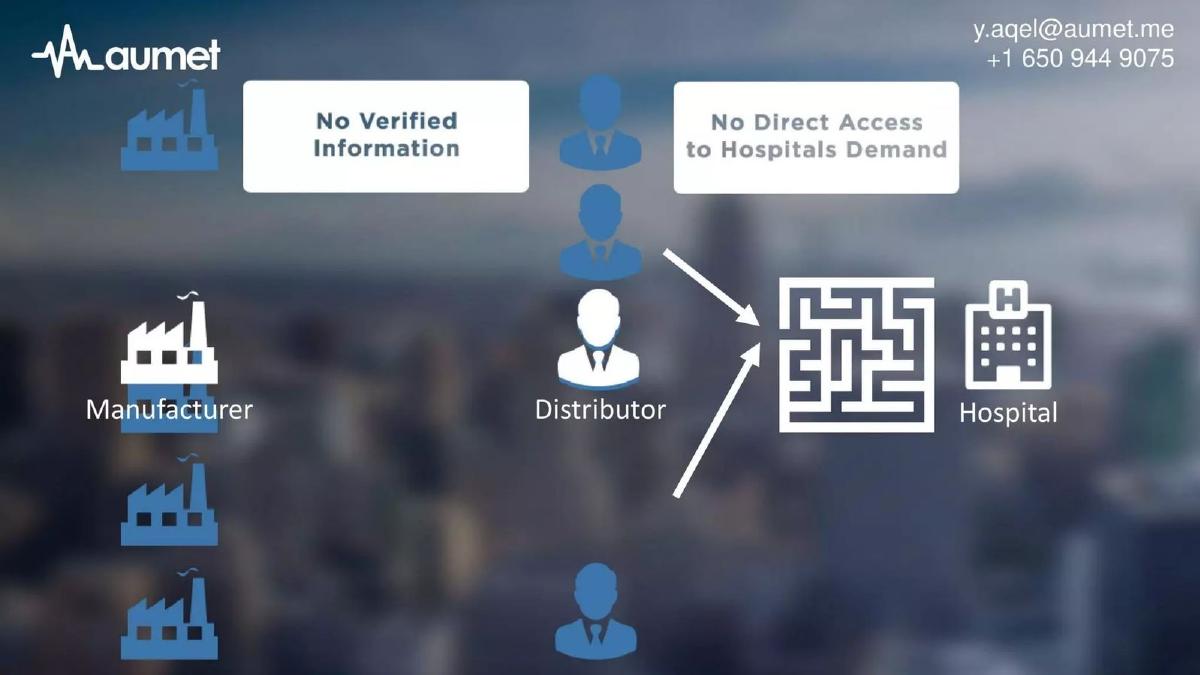
- The problem is visualized as a 'maze' between distributors and hospitals, indicating a lack of direct access to demand (Slide 5).
- The deck omits a specific funding 'Ask' or a breakdown of how the $945,000 would be spent (Slide 10).
Introduction: The Medical Supply Chain Connector
Aumet’s 2016 pitch deck is a lean, 10-slide presentation that focuses on the inefficiencies of the global medical distribution market. The company positions itself as a digital bridge between medical manufacturers, distributors, and hospitals. By the time this deck was circulated, Aumet had already achieved significant user milestones and early revenue, which likely contributed to their successful $945,000 funding round. The deck is characterized by high-contrast visuals, minimal text, and a heavy reliance on big-number metrics to tell the story.
Slide 1: Title and Value Proposition
The opening slide establishes the brand identity with a logo that incorporates a heartbeat/EKG line, immediately signaling the healthcare sector. The tagline is functional and direct: "Connecting medical manufacturers, distributors, & hospitals." This slide also includes contact information (email and phone number) in the top right corner, a practice maintained throughout the entire deck to ensure the founder is reachable at any point during a review.
Slide 2: Market Validation
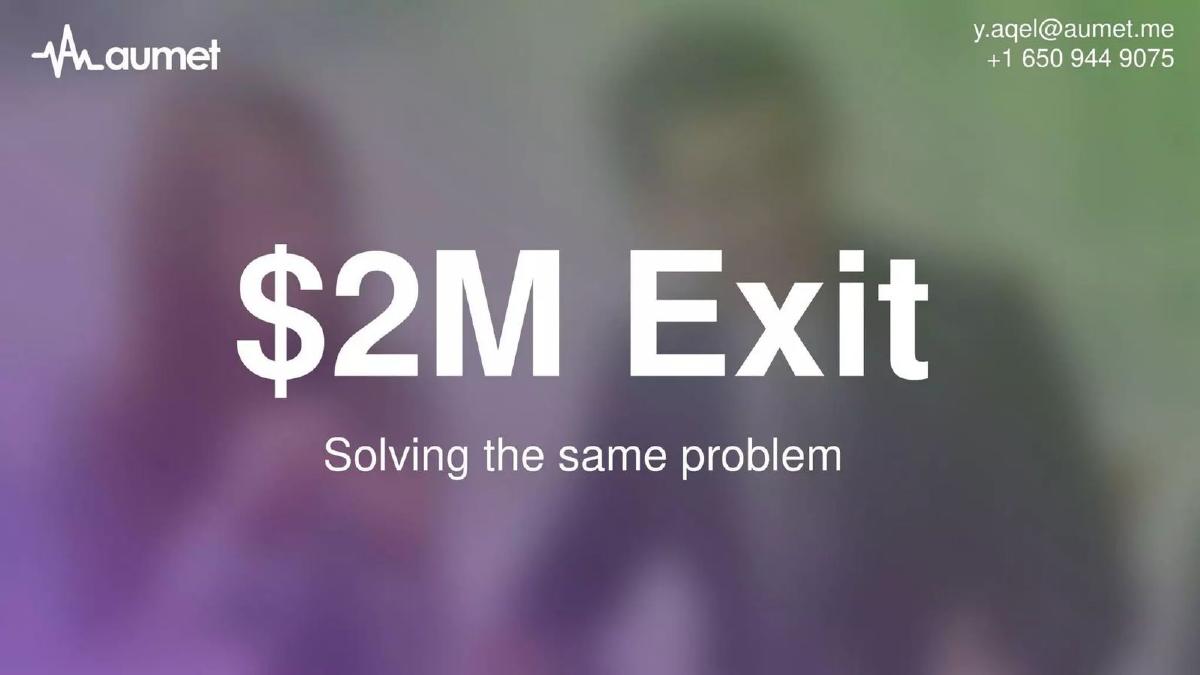
Slide 2 is a bold 'hook' slide. It features the text "$2M Exit" in large font, followed by the sub-caption "Solving the same problem." This is a strategic move to de-risk the investment. By pointing to a previous successful exit in the same niche, Aumet demonstrates that the problem is real and that there is an appetite for acquisitions in this specific vertical. It frames the opportunity not as a theoretical experiment, but as a proven business category.
Slide 3: Social Proof and Global Reach
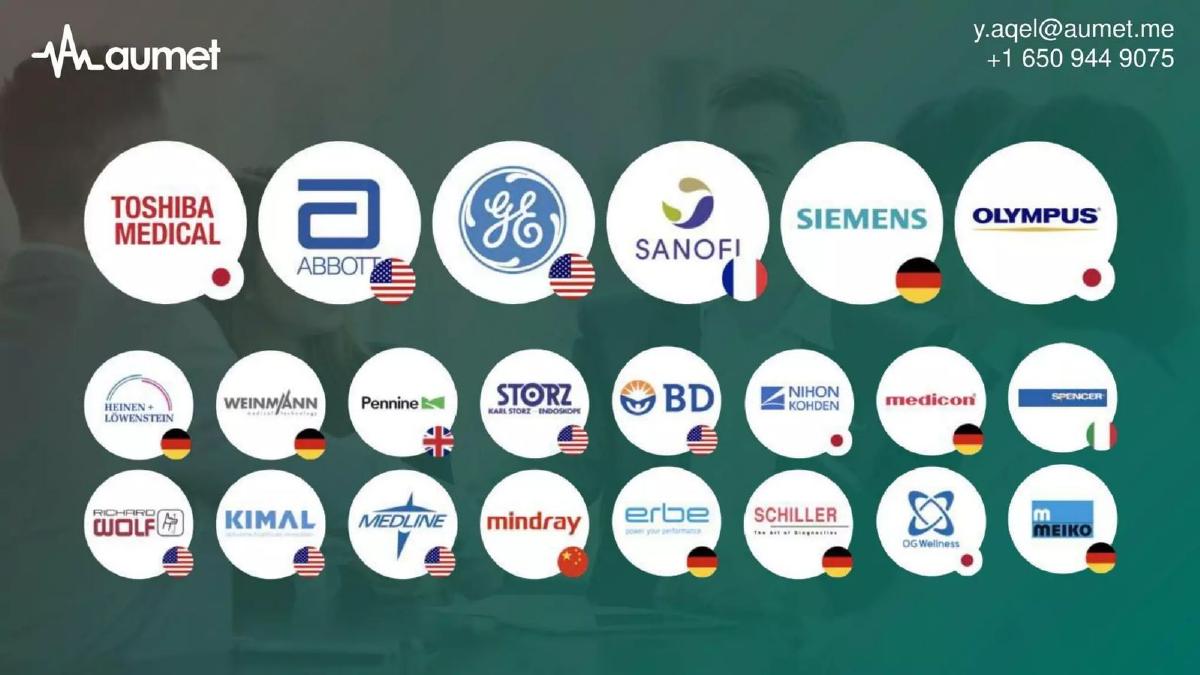
This slide is a 'logo wall' featuring 21 major medical and pharmaceutical brands. Notable names include Toshiba Medical, Abbott, GE, Sanofi, Siemens, Olympus, and Mindray. Each logo is accompanied by a small flag icon representing the company's country of origin (USA, France, Germany, Japan, China, etc.). This slide serves two purposes: it shows the global nature of the medical supply chain and implies that Aumet is operating in an ecosystem populated by multi-billion dollar enterprises.
Slide 4: User Traction and Unit Economics
Slide 4 provides the most compelling data in the deck. It lists 2,480 registered Distributors and 1,021 registered Manufacturers. Overlaid on the left is a white circle stating "$2.50 COST PER ACQUISITION." For a B2B platform, a CAC of $2.50 is exceptionally low, suggesting that Aumet has found a highly efficient way to onboard professional users. This slide effectively argues that the platform has reached a level of critical mass and can scale cheaply.
Slide 5: The Problem Statement
The problem is illustrated through a simple flow diagram. It shows manufacturers on the left and hospitals on the right, with distributors in the middle. Two callouts identify the friction points: "No Verified Information" between manufacturers and distributors, and "No Direct Access to Hospitals Demand" for the distributors. A maze icon is placed between the distributor and the hospital, visually representing the difficulty of navigating hospital procurement and tenders.
Slide 6: Total Addressable Market (TAM)
Aumet quantifies the market opportunity with three massive figures: 500k Manufacturers, 4M Distributors, and $100B Spent Yearly. By placing these numbers side-by-side, the deck suggests that even a small percentage of the $100B annual spend captured as a platform fee or subscription would result in a massive business. It effectively moves the conversation from 'does this work?' to 'how big can this get?'
Slide 7: Product Interface (Hospital Side Demand)
This slide shows a laptop displaying the Aumet interface. The header "HOSPITAL SIDE DEMAND" (though the text appears slightly garbled/overlapping in the visual) highlights a key feature: Latest Tenders. The screen shows specific bids for medical supplies in Saudi Arabia with due dates and costs (e.g., SAR 1500, SAR 2000). This provides a concrete example of how the platform generates value: by making hospital needs transparent and actionable for distributors.
Slide 8: The Team
Rather than individual headshots and bios, Aumet opts for a collective 'Experience' slide. The headline is "10 Years Experience," and the slide lists five core competencies: Software Engineering, Sales, Medical Business, UX/UI, and Digital Marketing. While this lacks the specificity of naming the founders' previous companies, it communicates that the team possesses the necessary cross-functional skills to build, design, and sell a medical SaaS product.
Slide 9: Revenue and Potential
The penultimate slide addresses the financials. It states that Aumet "STARTED SELLING IN NOVEMBER" and has already reached "$100K in revenue ARR." It then sets a target of "$1M Potential ARR." This slide is crucial because it proves that the 3,500+ users mentioned earlier are not just 'free' users, but that there is a subset of paying customers validating the monetization model.
Slide 10: The Close
The final slide is a simple call to action: "What are you waiting for? Talk to us." It repeats the contact information from the first slide. Notably, there is no mention of the specific amount being raised or the terms of the round, which is common in decks intended for a wide initial circulation where the 'Ask' might be tailored in follow-up conversations.
What Works in This Deck
Efficiency of Information: With only 10 slides, the deck respects the investor's time. It hits the high notes—traction, market size, and revenue—without getting bogged down in technical jargon. · Unit Economics: Highlighting a $2.50 CAC is a brilliant move. It suggests that the founders understand their growth levers and that the business model is highly scalable. · Visual Problem Solving: Using a maze icon to represent hospital procurement (Slide 5) is a simple but effective way to communicate a complex industry pain point. · Social Proof: The logo wall on Slide 3 immediately gives the startup a sense of legitimacy by associating it with established industry giants.
What is Missing
The Ask: The deck never specifies how much money is being raised or what the milestones for the next 18 months look like. This is a significant omission for a fundraising document. · Competitive Landscape: There is no slide addressing competitors. While Slide 2 mentions a similar company had an exit, it doesn't explain how Aumet is different or better than existing procurement software or traditional medical directories. · Detailed Team Bios: While "10 Years Experience" is a good summary, investors generally want to see the specific pedigree of the founders—where they worked, what they built previously, and why they are the specific people to win this market. · Financial Projections: Beyond the $1M ARR 'potential,' there are no projections regarding margins, burn rate, or long-term profitability.
What a Founder Should Copy
The 'Hook' Slide: Using a previous exit in the space (Slide 2) is an excellent way to prove market viability. If someone else has already been bought for doing something similar, it proves there is an 'out' for investors. · Metric-First Design: Aumet uses large, bold numbers for their most important stats (Slide 4 and Slide 6). This ensures that even if an investor only spends 30 seconds on the deck, they will remember the 3,500 users and the $100B market. · Consistent Contact Info: Putting the email and phone number on every single slide is a small but professional touch that makes it incredibly easy for an interested party to reach out. · Focus on Unit Economics: If you have a low CAC or a high LTV, make it a centerpiece of your deck. It is often more persuasive than a complex product roadmap.
Frequently asked questions
- What is Aumet's core business model based on the deck?
- Aumet operates as a B2B marketplace and information exchange. It connects medical manufacturers with distributors and provides hospitals with a way to broadcast their demand (tenders). According to the deck and listing, it allows these parties to share inquiries, search for products, and verify business news to increase sales efficiency.
- How much revenue was Aumet making at the time of this pitch?
- Slide 9 states that Aumet had $100,000 in Annual Recurring Revenue (ARR) and had started selling in November. The slide also projects a 'potential' of $1M ARR, though it does not provide a specific timeline for reaching that milestone.
- What are the key metrics used to prove traction?
- The primary metrics are user growth and acquisition cost. Slide 4 shows 2,480 registered distributors and 1,021 registered manufacturers. Most importantly, it highlights a $2.50 Cost Per Acquisition (CAC), suggesting a highly efficient and scalable marketing engine.
- Who are the target customers for the Aumet platform?
- The platform targets three main pillars of the healthcare supply chain: medical manufacturers (who need to find distributors), distributors (who need products and hospital leads), and hospitals (who have the demand and issue tenders).
- Is there a clear exit strategy or 'Ask' in the deck?
- No. Slide 2 mentions a '$2M Exit' for a company 'solving the same problem,' which serves as a proof of concept for the business model rather than a specific exit plan for Aumet. The deck also ends on a contact slide without specifying the amount of capital they are seeking.