YayPay’s 13-slide deck is a study in minimalism, relying on bold imagery and sparse text to communicate a clear value proposition: transforming the 'Finance Team' from manual operators into 'Revenue Heroes.' The deck effectively highlights the pain points of manual AR processes—manual tasks, prioritization struggles, and guesswork—before introducing its 'Accounts Receivables CRM.' With a reported $150k ARR and 30% month-over-month growth at the time of the deck's creation (Slide 10), the company demonstrated strong early traction. While the deck lacks a formal 'Ask' slide or detailed competit…
Key takeaways
- The deck uses a 'before and after' narrative, contrasting the 'Finance Team' (Slide 2) with 'Revenue Heroes' (Slide 3).
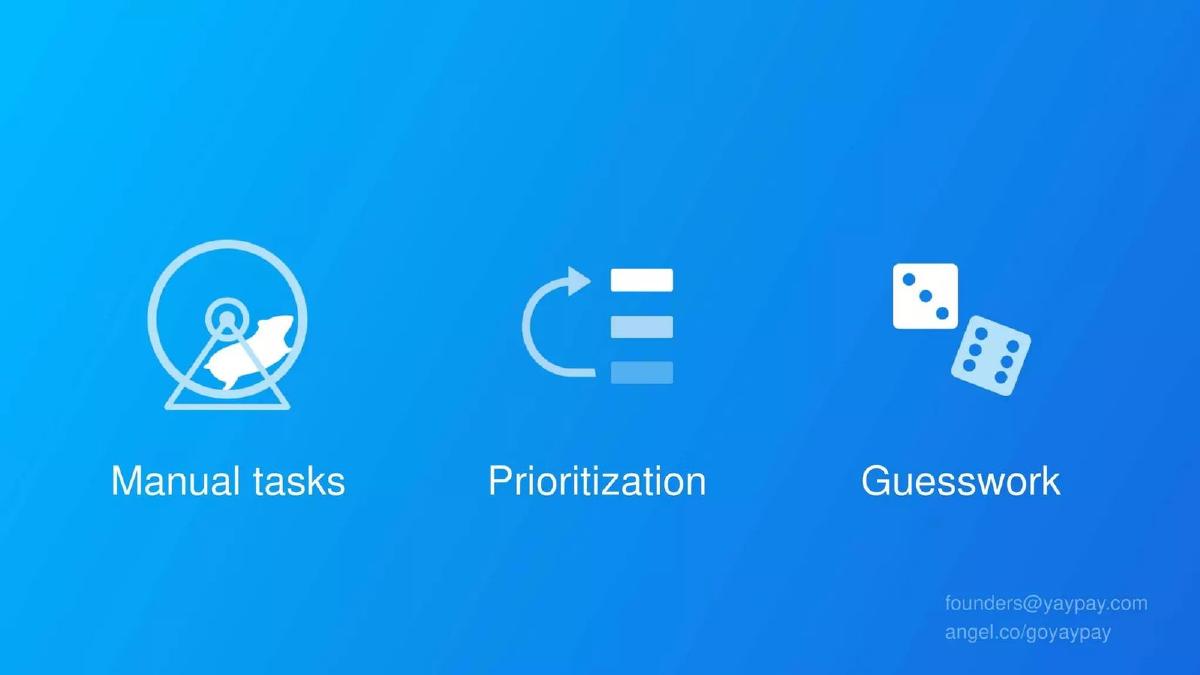
- Manual inefficiency is identified as the core problem, visualized through icons for manual tasks, prioritization, and guesswork (Slide 4).
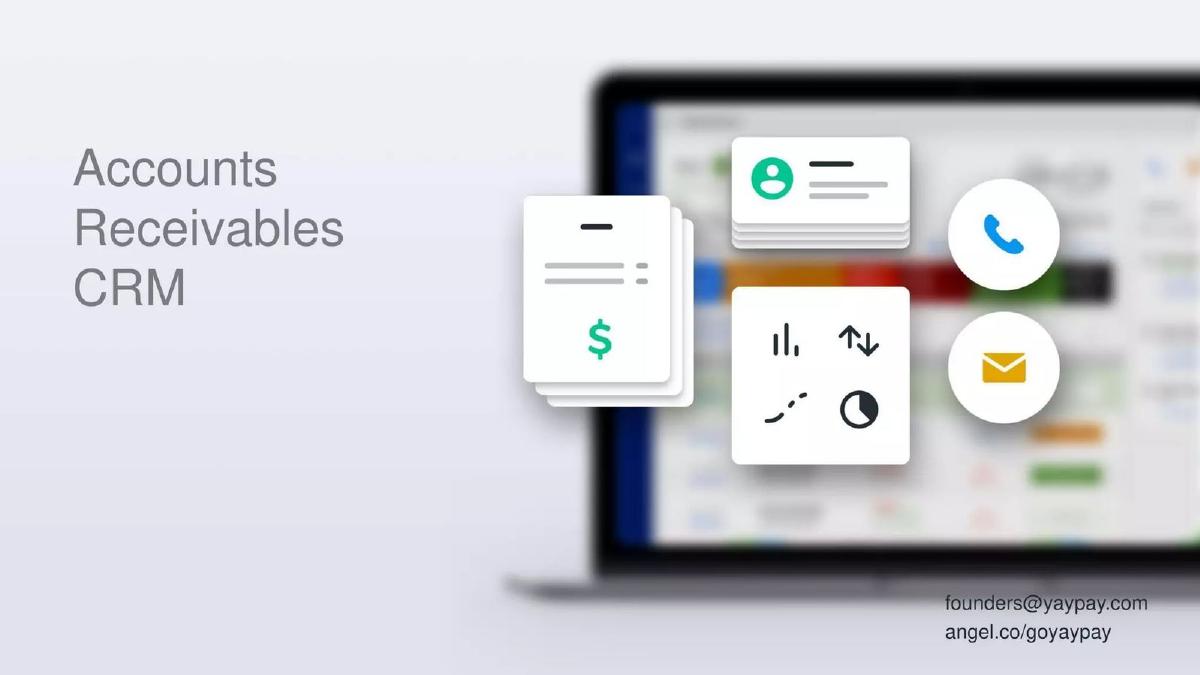
- The product is positioned as an 'Accounts Receivables CRM,' a familiar category applied to a new niche (Slide 5).
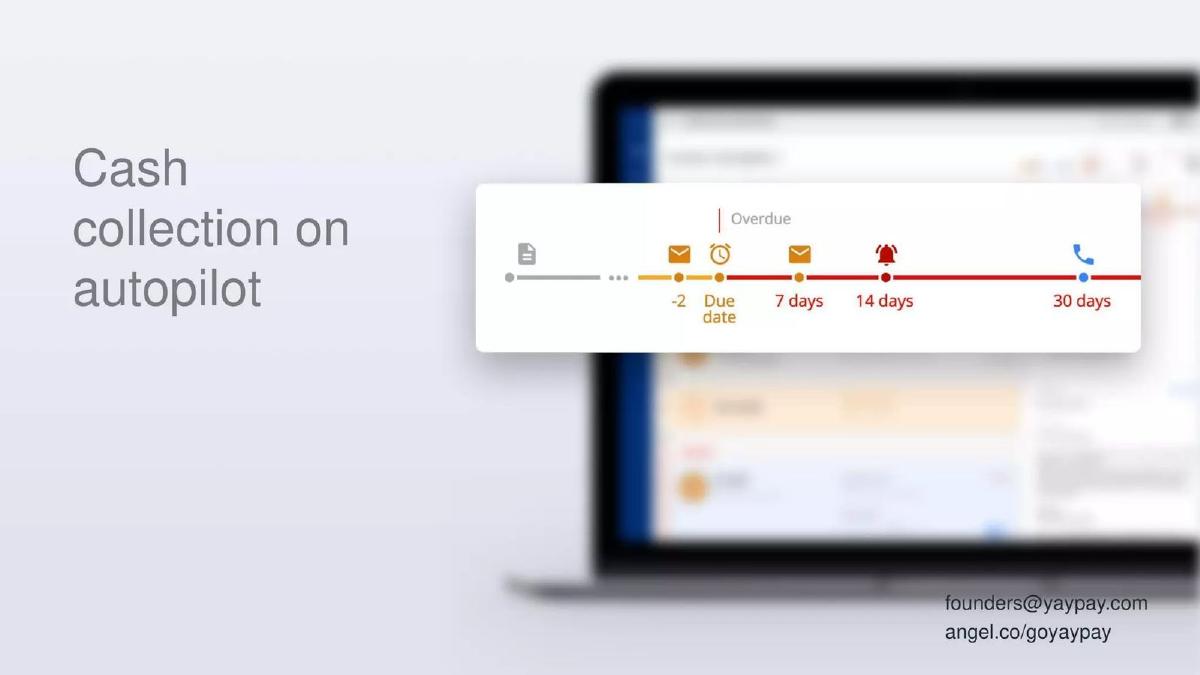
- Automation is a central theme, specifically highlighting 'Cash collection on autopilot' through a visual timeline (Slide 6).
- Machine learning is leveraged for predictive analytics, showing a 'Cash forecast' feature with future-dated projections (Slide 7).
- Social proof is established through six major logos, including Airbus, Bitly, and Edmunds.com (Slide 8).
- Traction is quantified by $100 million collected through the platform at a 20% faster rate (Slide 9).
- Growth metrics show $150k ARR with a 30% month-over-month growth rate (Slide 10).
The Minimalist Path to a $13.8M Series A
YayPay’s pitch deck is an exercise in restraint. In an industry as dense and jargon-heavy as FinTech, the founders opted for a visual-first approach that prioritizes emotional resonance and high-level metrics over technical specifications. Founded in 2015, the New York-based company sought to solve the 'unsexy' problem of accounts receivable (AR) management. By the time this deck was circulated, they had already processed $100 million in collections and were growing at a clip of 30% month-over-month. The following teardown examines how 13 slides managed to convey enough value to secure a significant Series A round.
Slides 1-3: The Narrative Hook
Slide 1: Title Slide The deck opens with a clean, branded title slide. The background is a blurred screenshot of the actual software interface, suggesting a product that is already built and functional. The contact information includes an AngelList URL, indicating the company's roots in the startup ecosystem.
Slide 2: Finance Team This slide uses a black-and-white archival photo of switchboard operators. It is a metaphorical jab at the current state of finance departments: manual, outdated, and tethered to old ways of working. It sets the stage for the 'Problem' without using a single bullet point.
Slide 3: Revenue Heroes The 'Solution' is introduced not as software, but as a transformation of identity. A modern professional woman stands with a superhero shadow. This slide establishes the emotional goal of the product: to empower finance teams and elevate their status within the organization from cost centers to 'Revenue Heroes.'
Slides 4-7: The Product and Problem
Slide 4: The Friction YayPay identifies three core pain points: 'Manual tasks,' 'Prioritization,' and 'Guesswork.' The icons—a hamster wheel, a circular arrow, and dice—are simple but effective. This slide explains why the 'Finance Team' of Slide 2 is struggling: they are stuck in repetitive cycles and forced to gamble on which customers will pay.
Slide 5: Accounts Receivables CRM This is the core product definition slide. By calling the platform an 'Accounts Receivables CRM,' YayPay hitches its wagon to the well-understood CRM category (Salesforce, etc.). The visual shows a laptop with UI elements floating in front of it, highlighting features like contact management, calling, and emailing directly from the platform.
Slide 6: Cash collection on autopilot This slide focuses on automation. It shows a timeline of an invoice: from the due date to reminders at 7, 14, and 30 days. The 'autopilot' claim is the primary selling point for busy finance teams looking to reduce the 'Manual tasks' mentioned on Slide 4.
Slide 7: Cash forecast with machine learning YayPay moves from simple automation to predictive intelligence. The slide displays a 'Cash Collected' graph with a 'Predictive' section marked by dotted lines. The figures shown—$10.5M current, $8.4M overdue, and $6.2M over 90 days—demonstrate how the software categorizes risk and forecasts future liquidity.
Slides 8-10: Traction and Validation
Slide 8: Customer Logos Social proof is delivered via six logos: Bitly, Airbus, Edmunds.com, PubMatic, Yieldbot, and Kjus. The inclusion of Airbus, a massive global enterprise, is particularly significant for a Series A company, as it proves the software can scale to complex, multi-national organizations.
Slide 9: Performance Metrics This slide provides the ROI. It states that '$100 Mill' has been collected through the platform and that collections are happening '20% Faster.' These are the two most important numbers for a CFO: total throughput and the reduction of Days Sales Outstanding (DSO).
Slide 10: Growth Curve The traction slide shows a classic 'hockey stick' growth curve. The text specifies '$150k ARR' and '30% MoM' (Month-over-Month) growth. While $150k ARR is relatively low for a Series A, the 30% growth rate suggests a high velocity that justifies the larger round size.
Slides 11-13: Team and Market
Slide 11: YayPay Team The team slide features six headshots. Rather than listing individual bios, the slide uses three powerful corporate logos—Chase, Grant Thornton, and Deloitte—to signal deep industry expertise in banking, accounting, and consulting. This builds trust that the founders understand the regulatory and professional requirements of the finance world.
Slide 12: $10 Billion This is the 'Market Size' slide, though it is extremely vague. The figure '$10 Billion' is presented without context—it is unclear if this refers to the Total Addressable Market (TAM) for AR software, the volume of fees, or the total amount of late B2B payments. In a teardown context, this is the weakest slide in the deck due to its lack of specificity.
Slide 13: Contact The deck concludes with contact information for Anthony Venus, including his email address. The background returns to the blurred software interface, maintaining visual consistency.
What Works in the YayPay Deck
The primary strength of this deck is its visual storytelling . By using the 'Revenue Hero' metaphor, YayPay moves the conversation away from boring accounting software and toward professional empowerment. The deck is also remarkably efficient ; it covers the problem, solution, product, traction, and team in just 13 slides with almost no 'fluff' text. The 30% MoM growth metric on Slide 10 is the star of the show, providing the quantitative evidence needed to back up the qualitative claims made earlier in the deck. Finally, the logo selection on Slide 8 is excellent, showing a mix of tech-forward companies (Bitly) and traditional giants (Airbus).
What is Missing from the YayPay Deck
Despite its success, the deck has several notable omissions. There is no 'Ask' slide , which is standard for a fundraising deck; it doesn't specify how much capital is being sought or how it will be deployed. There is also a complete lack of competitive analysis . The AR automation space was already becoming crowded in 2015, and failing to mention how YayPay differs from incumbents or other startups is a missed opportunity. Furthermore, the unit economics (CAC, LTV, Churn) are absent. While 30% MoM growth is impressive, investors at the Series A level usually want to see the underlying efficiency of that growth. Lastly, the market slide (Slide 12) is far too brief, offering a large number without the 'bottom-up' calculation that sophisticated investors prefer.
What a Founder Should Copy
Founders should emulate YayPay’s category positioning . By framing their product as a 'CRM for AR,' they made a complex back-office tool immediately understandable to anyone who knows how a sales team works. The clean UI-focused visuals are also worth copying; they show the product in action without the clutter of full screenshots. Most importantly, founders should learn from the 'Hero' narrative . Every B2B product has a user who is currently frustrated or overlooked; showing how your software makes that person the 'hero' of their department is a powerful way to win over both investors and customers. Keeping the text to a minimum forces the presenter to know their story and prevents the audience from reading ahead instead of listening.
Company: YayPay · Sector: FinTech · Stage: Series-A · Amount Raised: $13,800,000 · Year: 2015 · Slides: 13 · HQ: New York
Frequently asked questions
- What is the primary value proposition of YayPay according to the deck?
- YayPay positions itself as an 'Accounts Receivables CRM' that automates the credit-to-cash process. By replacing manual tasks and guesswork with data science and predictive analytics, it allows finance teams to collect cash up to 20% faster and provides machine-learning-powered cash flow forecasts, effectively turning back-office staff into 'Revenue Heroes.'
- How does YayPay demonstrate market validation?
- The deck uses two primary methods for validation: high-tier logos and hard performance metrics. Slide 8 displays logos for Airbus, Bitly, Edmunds.com, PubMatic, Yieldbot, and Kjus. Slide 9 supplements this by stating that $100 million has been collected through the platform, achieving a 20% increase in collection speed.
- What are the key growth metrics shared in the Series A deck?
- On Slide 10, YayPay discloses an Annual Recurring Revenue (ARR) of $150,000. More importantly for a Series A pitch, they highlight a 30% month-over-month (MoM) growth rate, visualized by a steep upward curve starting from December and leading into April.
- Who is the target customer for YayPay's software?
- While the slides are minimalist, the inclusion of enterprise-level logos like Airbus and the self-description from the listing indicate a focus on mid-market and enterprise customers. The product is designed for finance, credit, and collections teams who manage high volumes of B2B invoices.
- What is missing from the YayPay pitch deck?
- The deck is notably missing a slide detailing the specific 'Ask' (how much they are raising and on what terms). It also lacks a competitive landscape analysis, a detailed breakdown of unit economics (like CAC or LTV), and a roadmap for future product development beyond the current features.