The Artisanal Spirits Company (ASC) FY21 investor presentation is a masterclass in demonstrating operational progress and market opportunity for a post-IPO or late-stage growth company. The deck emphasizes a membership-led business model, showing an 18% year-over-year increase to 33,300 members by the end of 2021. Financially, the company reported a 21% revenue increase to £18.2m and a significant gross margin improvement to 61.5%. The strategy centers on 'Future Sales Cover,' with 15,300 casks in stock providing 100% coverage for projected sales through 2026. While the company reported a neg…
Key takeaways
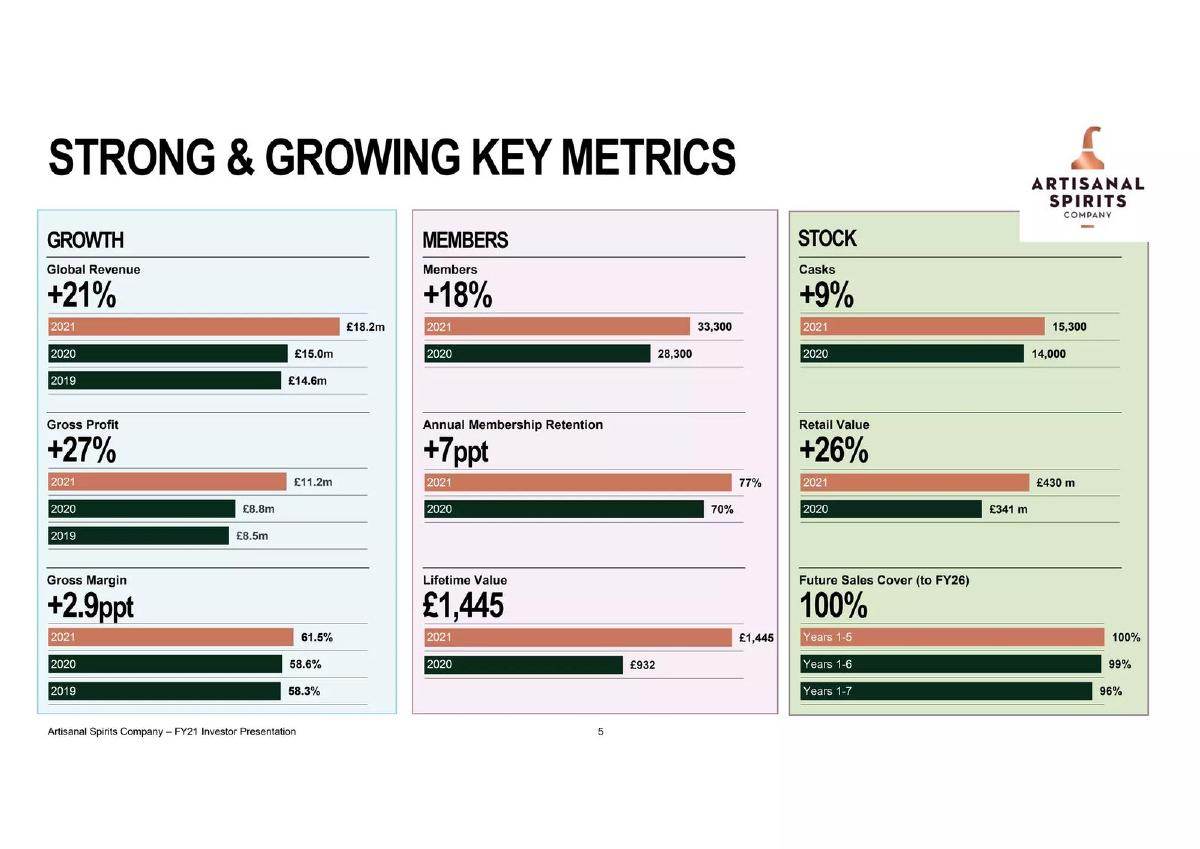
- Global revenue grew 21% to £18.2m in 2021, up from £15.0m in 2020 (Slide 5).
- Gross margins improved by 2.9 percentage points to reach 61.5% in 2021 (Slide 5).
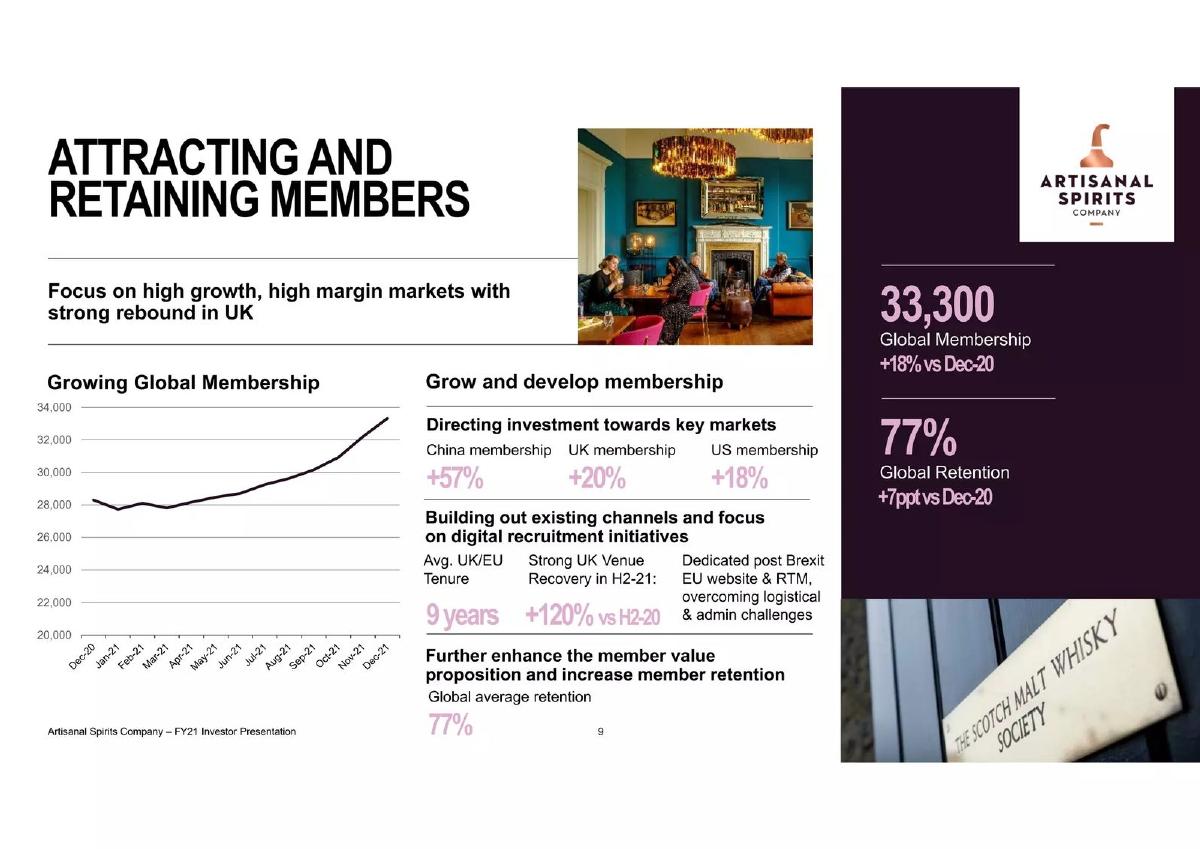
- The membership model reached 33,300 global members, an 18% increase over the previous year (Slide 9).
- Inventory management is a core strength, with 15,300 casks providing 100% sales cover through FY26 (Slide 5).
- China represents a high-growth frontier with a 57% increase in membership during the period (Slide 9).
- The company defines its Total Addressable Market at $4.3 billion, focusing on 'Ultra Premium' and 'Prestige' price points (Slide 37).
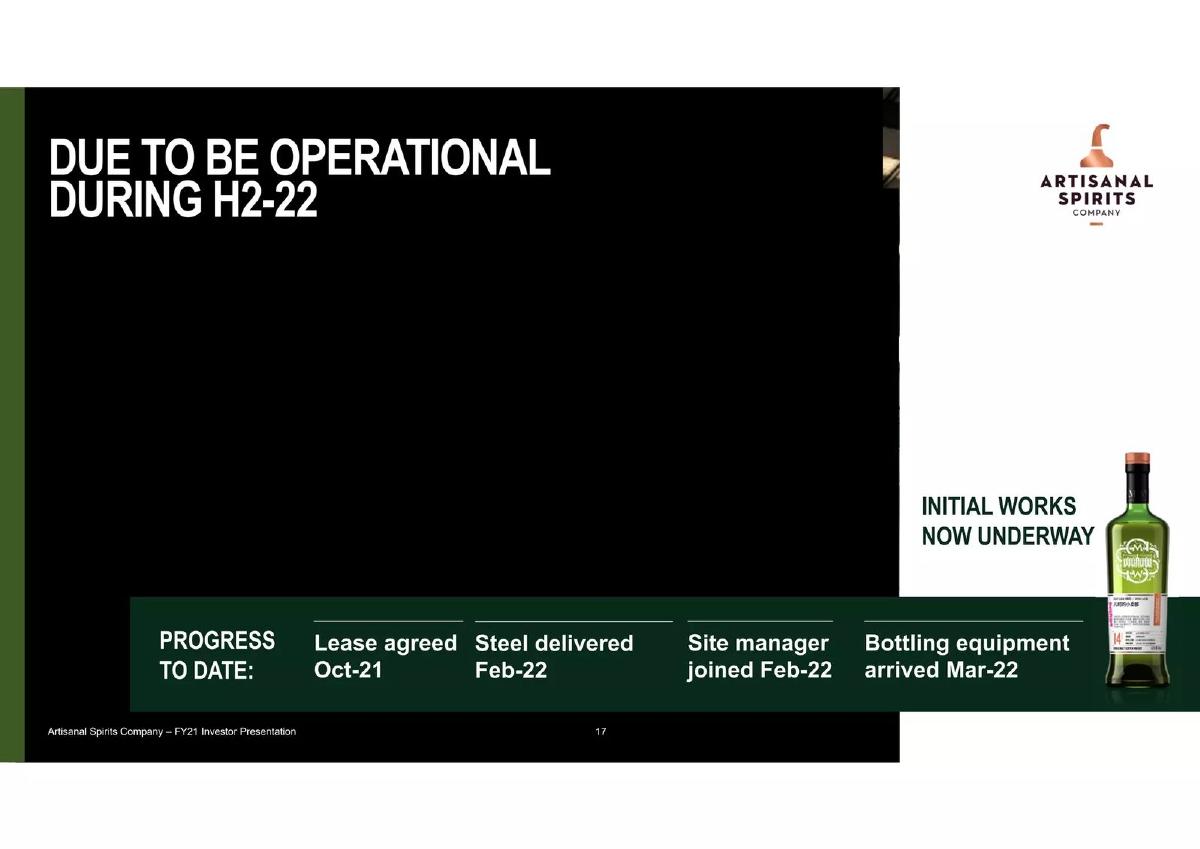
- Operational expansion is highlighted by a new bottling facility due to be operational in H2-22 (Slide 17).
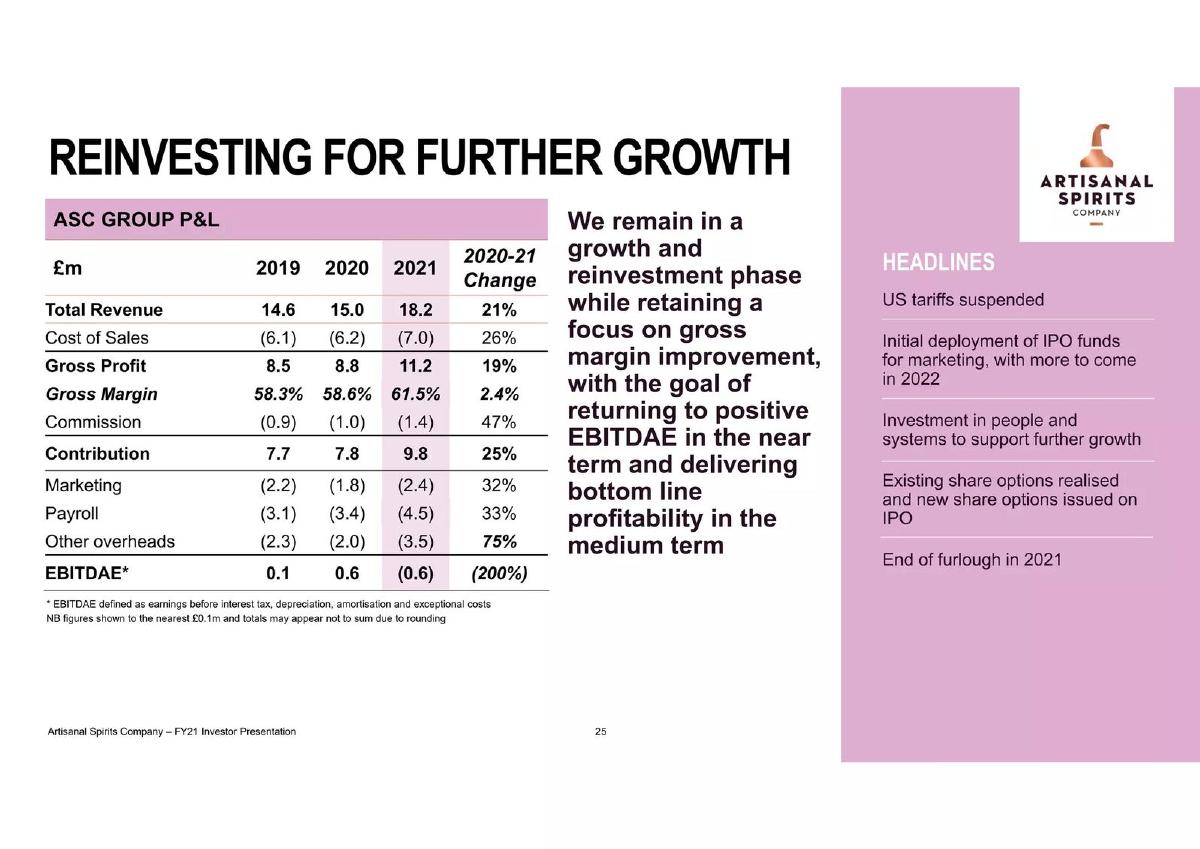
- Despite revenue growth, EBITDAE shifted from £0.6m in 2020 to a loss of £(0.6)m in 2021 due to planned reinvestment (Slide 25).
Executive Summary: The Premiumization Playbook
The Artisanal Spirits Company (ASC) presentation for the full year 2021 is a comprehensive look at how a niche luxury brand transitions into a scalable global entity. The deck focuses heavily on the 'membership economy' and 'inventory as an asset.' By treating their whisky casks as both product and a long-term financial hedge, ASC presents a stable yet high-growth investment opportunity. The narrative moves from high-level financial success to the granular mechanics of membership retention and supply chain optimization.
Slide 1: Title and Branding
The cover slide establishes a premium, artisanal tone. It features the company logo—a stylized copper pot still—and a high-contrast image of a man lifting a whisky barrel. The title 'Investor Presentation Full Year 2021' clearly defines the scope of the document. The aesthetic is minimalist and sophisticated, aligning with the 'Ultra Premium' market segment the company targets.
Slide 5: Strong & Growing Key Metrics
This is the 'traction' slide, and it is exceptionally dense with data. It is divided into three pillars: Growth, Members, and Stock. Under Growth, the company reports a 21% increase in Global Revenue to £18.2m and a 27% increase in Gross Profit to £11.2m. Crucially, Gross Margin improved by 2.9 percentage points to 61.5%, suggesting that the company is gaining pricing power or operational efficiency. The 'Members' section shows an 18% increase in membership (33,300) and a significant jump in Lifetime Value from £932 to £1,445. The 'Stock' section highlights 15,300 casks, representing a retail value of £430m. The standout metric here is 'Future Sales Cover,' which claims 100% coverage through FY26, de-risking the long-term revenue outlook.
Slide 9: Attracting and Retaining Members
This slide dives into the mechanics of their membership model. A line graph shows a steady upward trajectory in global membership from December 2020 to December 2021. The text highlights specific growth rates in key markets: China (+57%), UK (+20%), and US (+18%). It also notes a 77% global retention rate, which is high for a subscription-style model. The mention of a '9-year average UK/EU tenure' suggests a very loyal base, which is a strong indicator of long-term brand health. The slide also mentions overcoming 'logistical & admin challenges' post-Brexit, showing resilience in their European operations.
Slide 12: Value Creation - Improve Margins
This is a section divider that signals a shift in the presentation toward operational strategy. The imagery—grain being shoveled and bottled products—emphasizes the physical, craft nature of the business while the headline focuses on the financial objective: margin improvement.
Slide 17: Operational Milestones (H2-22)
Slide 17 provides a timeline for a new operational facility. It lists progress to date: Lease agreed (Oct-21), Steel delivered (Feb-22), Site manager joined (Feb-22), and Bottling equipment arrived (Mar-22). The headline states the facility is 'Due to be operational during H2-22.' This slide is critical for investors because it demonstrates how the company is using capital to vertically integrate, which typically leads to better margin control and reduced reliance on third-party bottlers.
Slide 21: Talent & Organisational Development
Another section divider focusing on the human capital element of the business. While the specific details of the team are likely in the following slides (not all provided in this set), this indicates that ASC views its staff and organizational structure as a core pillar of its growth strategy.
Slide 25: Reinvesting for Further Growth (P&L)
This slide provides a three-year P&L comparison (2019-2021). While revenue and gross profit show strong growth, the EBITDAE (Earnings before interest, tax, depreciation, amortisation and exceptional costs) shows a swing from a £0.6m profit in 2020 to a £(0.6)m loss in 2021. The deck explains this as a 'growth and reinvestment phase.' The 'Headlines' column notes that US tariffs were suspended and IPO funds were deployed for marketing and systems. This transparency is vital; it frames the loss not as a failing, but as a deliberate investment in future scale.
Slide 30: Appendices
A transition slide into the supplementary data section. The use of high-quality product photography continues the brand's premium positioning even into the technical sections of the deck.
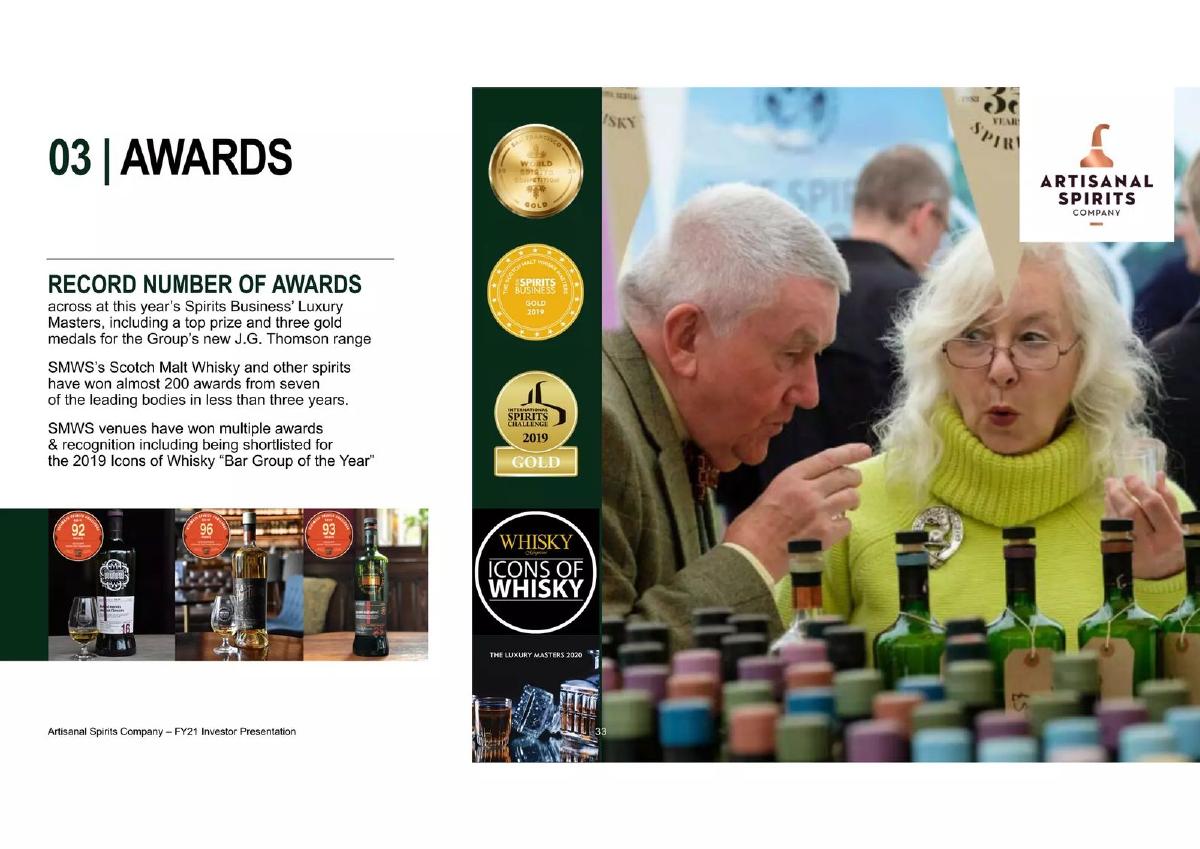
Slide 33: Awards and Recognition
This slide serves as social proof and validation of product quality. It lists a 'Record number of awards,' including top prizes from the Spirits Business' Luxury Masters and the International Spirits Challenge. Mentioning that the Scotch Malt Whisky Society (SMWS) venues won 'Bar Group of the Year' in 2019 adds a layer of lifestyle/hospitality success to their spirits production credentials.
Slide 37: Market Data and TAM
The final slide in this set defines the Total Addressable Market (TAM) at $4.3 billion. It breaks down the 'Key Markets' with the US at $1.4b (growing 296% since 2010) and China at $0.5b (growing 155%). The table on the right shows ASC's current market share, which is tiny (0.4% overall), effectively arguing that there is massive 'headroom' for growth. The definition of the market as 'Ultra Premium, Prestige and Prestige Plus' justifies their high-margin strategy.
What Works in This Deck
1. Inventory Transparency: In the spirits world, stock is everything. By explicitly stating their cask count (15,300) and how many years of sales that covers (100% through 2026), they eliminate the biggest question mark for investors: 'Will you run out of product?'
2. Membership Metrics: The deck treats membership like a SaaS business. Metrics like Lifetime Value (£1,445) and Retention (77%) are much more convincing to modern investors than simple retail sales figures. It proves a recurring, loyal revenue stream.
3. Geographic Specificity: Rather than saying 'we are global,' they provide specific growth percentages for China, the UK, and the US. This allows investors to see exactly where the momentum is coming from.
What Is Missing
1. Unit Economics: While Gross Margin is provided, a deeper breakdown of the cost to acquire a member (CAC) versus the Lifetime Value (LTV) would have strengthened the argument for the negative EBITDAE. They show LTV grew, but not what it cost to get those new members.
2. Competitive Landscape: The deck focuses entirely on ASC. There is no mention of other independent bottlers or how they compete with major conglomerates (like Diageo or Pernod Ricard) who are also moving into the 'Ultra Premium' space.
3. Team Bios: In the provided slides, there is no detailed team slide. For a company at this stage, the pedigree of the management team in spirits and luxury retail is a major selling point that is omitted here.
Founder's Playbook: What to Copy
Use 'Future Sales Cover' as a Metric: If you are in a business with long lead times (hardware, aged goods, agriculture), create a metric that shows your current assets can meet future demand. It turns 'sitting inventory' into 'guaranteed future revenue.'
Segment Your Growth: Don't just show one growth number. ASC breaks growth down by revenue, profit, membership, and specific countries. This prevents a single high-performing area from masking weaknesses elsewhere, which builds trust with sophisticated investors.
Own the 'Reinvestment' Narrative: If your P&L shows a loss after a period of profit, be proactive. ASC uses a 'Headlines' box to explain exactly where the money went (marketing, systems, payroll) and why (IPO deployment). This turns a potential red flag into a sign of strategic execution.
Frequently asked questions
- What is the primary business model for Artisanal Spirits Company?
- ASC operates a membership-based model, primarily through The Scotch Malt Whisky Society (SMWS). This model drives recurring engagement and high lifetime value (£1,445 as of 2021). By building a community of enthusiasts, the company creates a captive audience for its curated, high-margin spirits, allowing for better demand forecasting and inventory management compared to traditional retail-only spirits brands.
- How does the company handle inventory and supply chain risks?
- The deck introduces a 'Future Sales Cover' metric. As of 2021, they held 15,300 casks, which they state covers 100% of their projected sales through 2026. This long-term inventory strategy is critical in the aged spirits industry, where product cannot be manufactured on demand. The stock's retail value was estimated at £430m in 2021, providing a significant asset buffer.
- Why did the company's EBITDAE turn negative in 2021?
- According to Slide 25, the company is in a 'growth and reinvestment phase.' The shift from a £0.6m profit to a £(0.6)m loss was driven by increased spending in marketing (£2.4m), payroll (£4.5m), and other overheads (£3.5m). These investments were funded by their IPO to support global expansion and the development of new operational systems.
- Which international markets are most important to ASC?
- China and the US are the primary growth targets. China saw a 57% membership growth in 2021, while the US market is highlighted for its high e-commerce growth and consumer willingness to pay premium prices. Slide 37 shows the US as the largest addressable market at $1.4 billion, followed by China at $0.5 billion.
- What operational milestones are mentioned in the deck?
- A major milestone is the development of a new supply chain facility. Slide 17 notes that the lease was agreed in October 2021, steel was delivered in February 2022, and bottling equipment arrived in March 2022. The facility was scheduled to be fully operational in the second half of 2022, aimed at improving internal margins by bringing bottling in-house.