Yellow Hammock is a chatbot development agency that differentiates itself through a performance-based pricing model. Instead of charging the typical $2,000 to $20,000 development fee cited on slide 5, the company takes a 5-10% commission on transactions made through the bot (slide 7). The 11-slide deck focuses heavily on the 'general' versus 'specific' problem, arguing that users suffer from app fatigue and businesses suffer from the unpredictable ROI of bot investments. While the deck identifies a clear pain point for small-to-medium enterprises—upfront cost risk—it lacks critical data inclu…
Key takeaways
- The company identifies a specific market barrier where custom chatbots cost between $2k and $20k to develop without guaranteed performance (Slide 5).
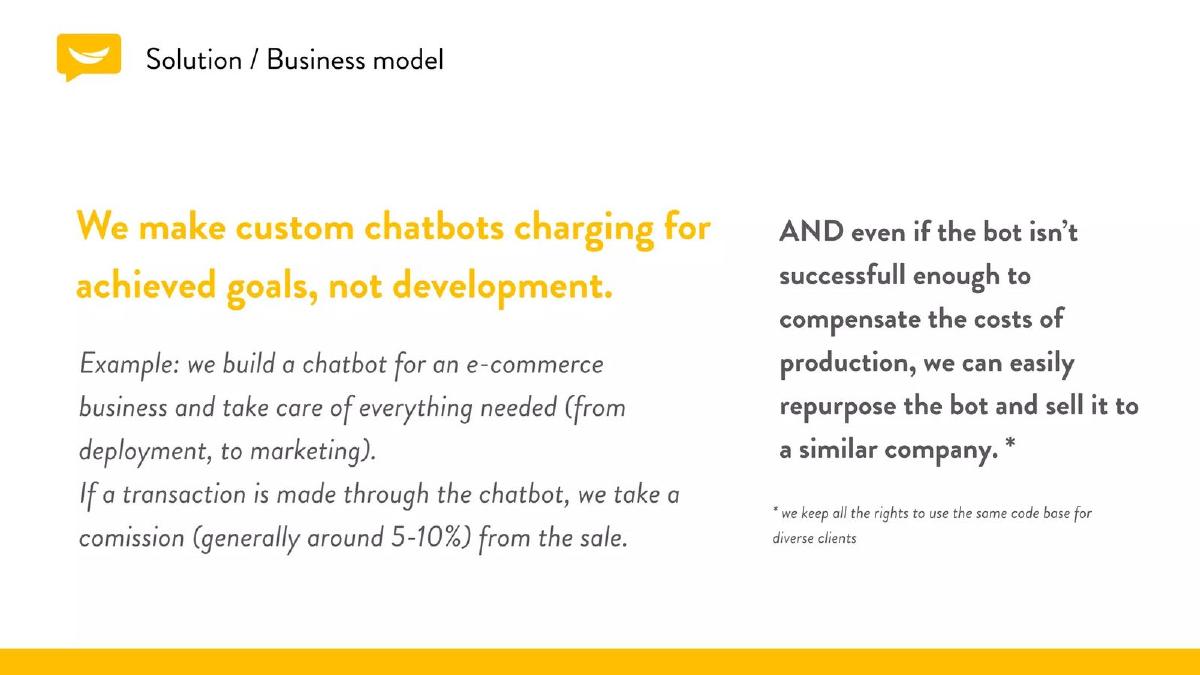
- The core business model is a 5-10% commission on sales generated through the chatbot (Slide 7).
- Yellow Hammock retains all rights to their code base, allowing them to repurpose and resell bots to similar companies if a specific client fails (Slide 7).
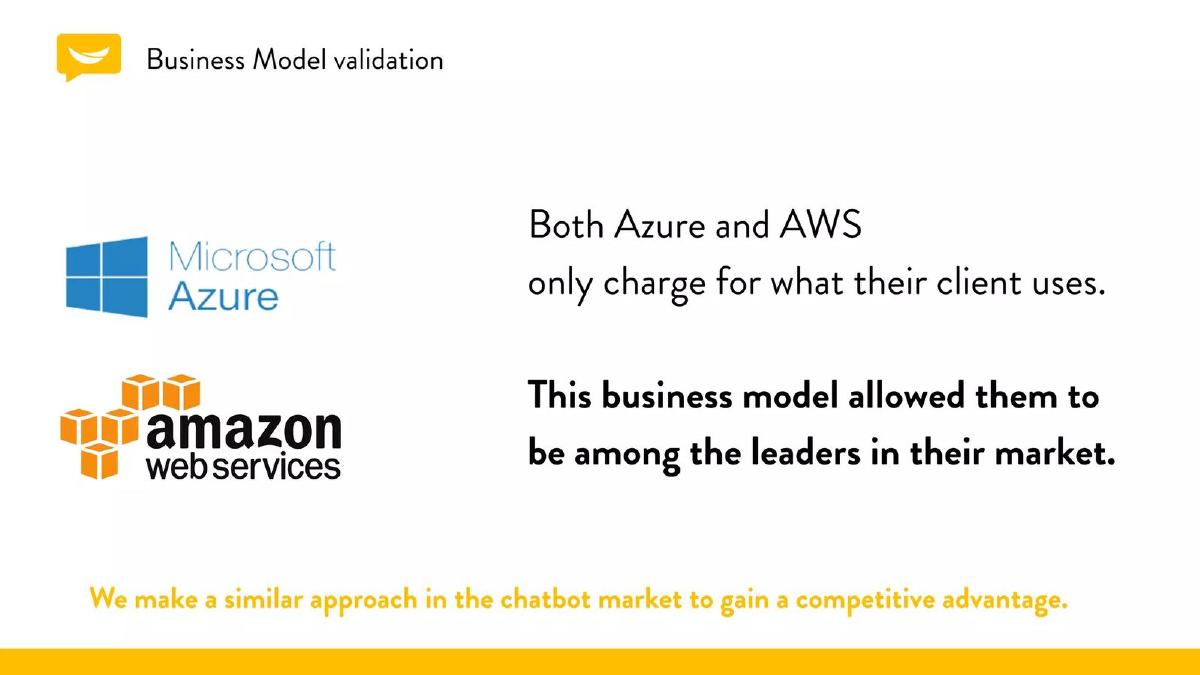
- The deck uses Microsoft Azure and AWS as validation for usage-based pricing models in the tech sector (Slide 8).
- Market validation is based on the volume of 2 billion messages exchanged monthly between people and businesses on Messenger (Slide 9).
- The team consists of four members: a CEO, COO, and two developers, but provides no professional background or past successes (Slide 11).
- The deck completely omits a 'The Ask' slide, leaving investors without knowledge of the funding goal or use of proceeds.
- There are no financial projections or historical performance metrics included in the presentation.
Slide-by-Slide Teardown
Slide 1: Title Slide
The deck opens with a minimalist title slide featuring the Yellow Hammock logo—a yellow speech bubble containing a hammock shape. There is no tagline or mission statement on the first slide.
Slide 2: Welcome
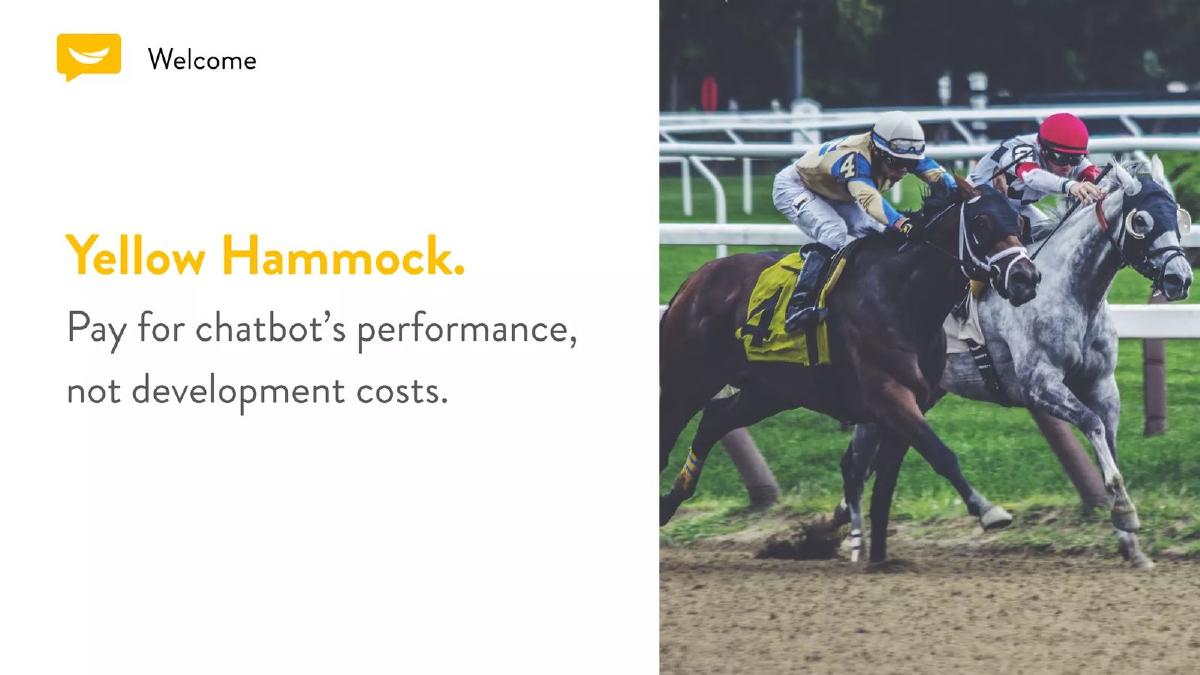
This slide introduces the core value proposition: "Pay for chatbot's performance, not development costs." The visual choice of a horse race suggests competition and speed, though it does not directly relate to the technical nature of the product.
Slide 3: The General Problem
The founders argue that the average person only uses 3-5 apps per day. They attribute this to friction points such as finding the app, signing up, learning a new UI, and remembering the app exists. This sets the stage for a solution that lives within existing ecosystems rather than a standalone app.
Slide 4: The General Solution
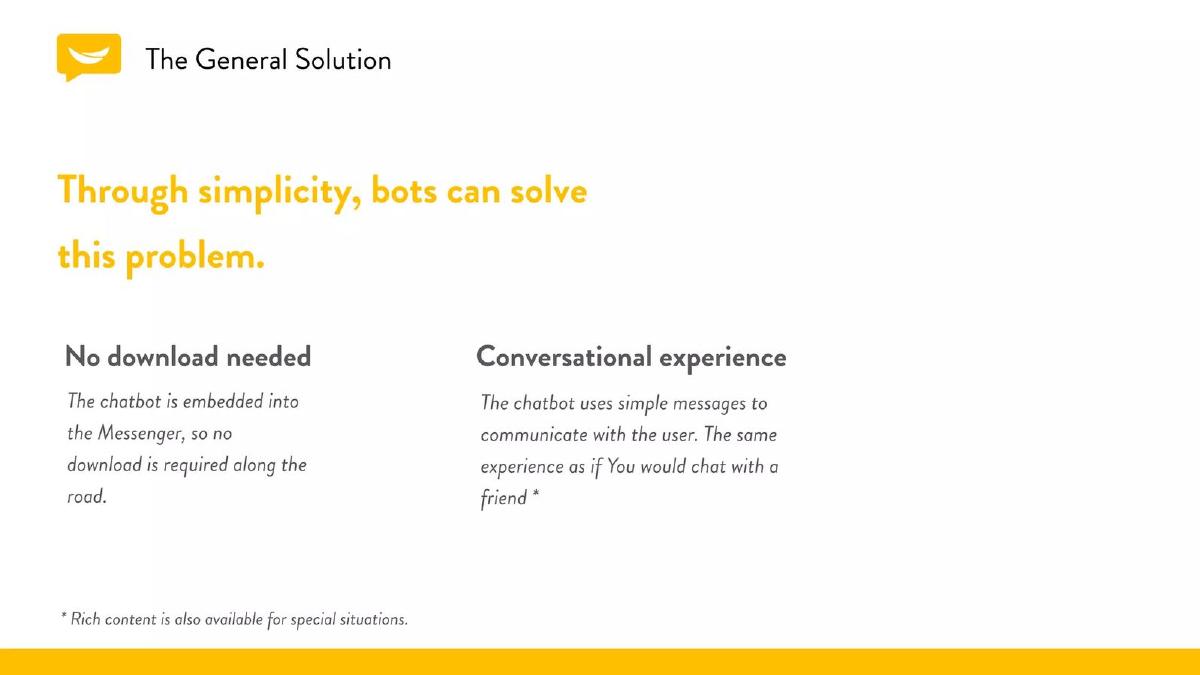
The solution presented is the use of bots. The two key benefits listed are "No download needed" (because the bot is embedded in Messenger) and a "Conversational experience" that mimics chatting with a friend. A footnote mentions that "Rich content is also available for special situations."
Slide 5: The Specific Problem
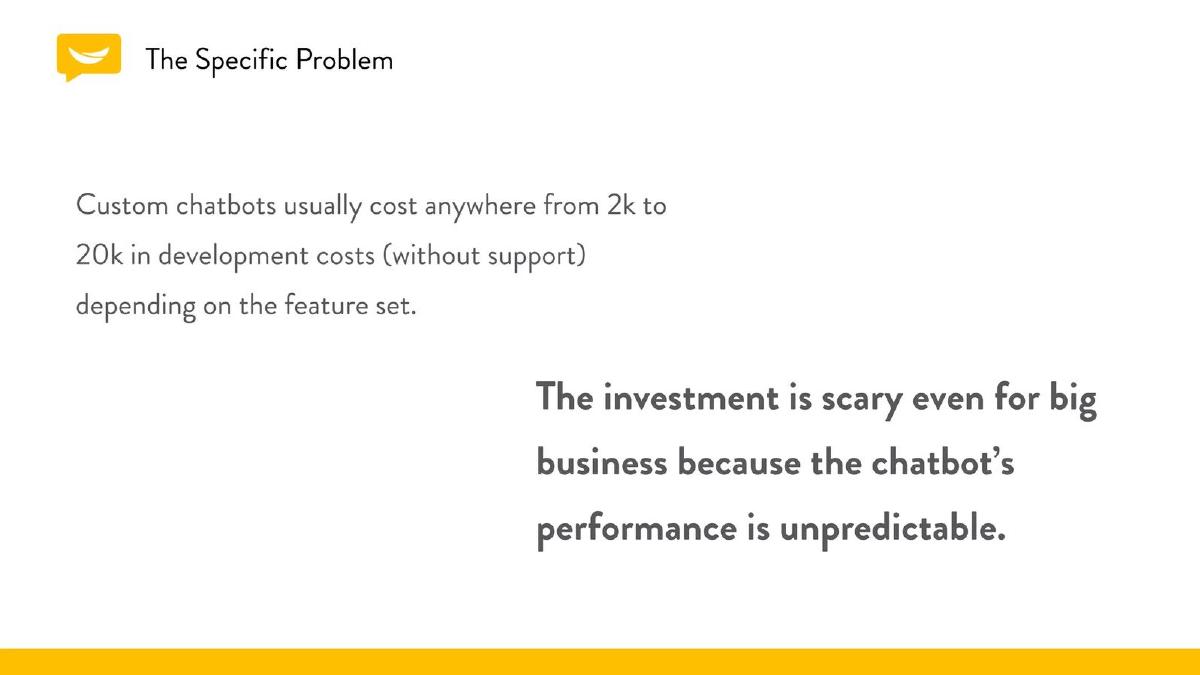
This slide moves from general consumer behavior to business pain points. It states that custom chatbots cost between 2k and 20k in development costs, excluding support. The slide claims this investment is "scary" even for big businesses because performance is unpredictable.
Slide 6: The Solution (Visual)
This is a transition slide featuring the company logo over a lifestyle image of a person using a smartphone. It provides no new information but serves as a visual break.
Slide 7: Solution / Business Model
This is the most critical slide in the deck. It explains the commission-based model: Yellow Hammock builds the bot and manages deployment and marketing in exchange for a 5-10% commission on sales. Crucially, they state they "keep all the rights to use the same code base for diverse clients," allowing them to repurpose bots for similar companies if one client fails.
Slide 8: Business Model Validation
The deck attempts to validate the "pay-for-what-you-use" model by citing Microsoft Azure and Amazon Web Services. While these are infrastructure-as-a-service (IaaS) examples, Yellow Hammock uses them to justify their own performance-based competitive advantage.
Slide 9: Market Validation
The market size is defined by Facebook Messenger activity. The slide cites 2 billion messages exchanged monthly between people and businesses and the existence of 30,000 chatbots already on the platform. These figures are used to demonstrate existing demand for conversational commerce.
Slide 10: Competition
The slide displays logos for eight competitors, including Digiteum and THECHATBOTFACTORY. There is no analysis of how Yellow Hammock's product or service compares to these rivals, only an acknowledgement of their existence.
Slide 11: The Team
The final slide introduces four team members: Dovydas Steponavičius (Front-End dev.), Vytautas Mikalainis (Back-End dev.), Simonas Žilinskas (CEO), and Domas Inta (COO). The slide lacks bios, LinkedIn links, or any mention of previous experience or education.
What Works
Clear Pricing Differentiation: The deck does an excellent job of highlighting a specific financial barrier to entry for businesses (high upfront costs) and offering a direct alternative (commission-based). This is a compelling hook for small businesses that are hesitant to invest in unproven technology.
Risk Mitigation Strategy: The mention on slide 7 that they retain code rights to repurpose bots is a smart inclusion. It shows the founders have thought about how to protect their own time and investment if a specific client's campaign underperforms.
Platform Focus: By focusing specifically on Messenger, the deck avoids the trap of trying to be everything to everyone. It identifies a specific ecosystem with high volume (2 billion messages) and targets it directly.
What is Missing
The Ask: The most significant omission is the lack of a funding request. There is no mention of how much capital is being raised, the valuation, or how the funds will be allocated. This is a fundamental requirement for a pitch deck.
Traction and Metrics: The deck is entirely theoretical. There are no case studies, no pilot program results, and no revenue figures. For a company pitching a performance-based model, the absence of performance data is a major red flag for investors.
Unit Economics: While they mention a 5-10% commission, there is no data on the cost of acquisition (CAC) for their own clients or the average life-time value (LTV) of a bot deployment. Since they are also handling the "marketing" for the bots (Slide 7), their own margins could be very thin.
Team Pedigree: The team slide provides names and titles but no evidence of why these four individuals are the right ones to build this business. Investors look for "founder-market fit," which is not demonstrated here.
What a Founder Should Copy
The "General vs. Specific" Problem Framework: Using slides 3 and 5 to bridge the gap between broad market trends (app fatigue) and specific business hurdles (high dev costs) is a logical way to build a narrative. It helps the investor understand the "why now" of the business.
Simple Visual Language: The deck is clean and avoids clutter. The use of large text for key figures (Slide 9) makes the data easy to digest during a quick flip-through.
Direct Business Model Explanation: Slide 7 is a model of clarity. It uses a simple example (e-commerce) to explain exactly how they make money and what they do for the client. Founders should always aim for this level of transparency regarding their revenue streams.
Frequently asked questions
- What is Yellow Hammock's primary value proposition?
- Yellow Hammock proposes to eliminate the financial risk for businesses wanting to deploy chatbots. By removing upfront development costs (which they state range from $2k to $20k) and charging only a 5-10% commission on successful transactions, they align their incentives with the client's sales performance.
- How does the company handle failed bot deployments?
- According to slide 7, the company retains the rights to the code base for all bots they build. If a bot is not successful enough to cover production costs for a specific client, Yellow Hammock repurposes the bot and sells it to a similar company in the same industry.
- What platform does Yellow Hammock focus on?
- The deck focuses exclusively on Facebook Messenger. Slide 9 cites the 30,000 chatbots already on Messenger and the 2 billion messages exchanged monthly on that specific platform as the primary market opportunity.
- Who are the competitors listed in the deck?
- Slide 10 lists eight competitors: botmanufaktur, Persona, chatbots agency, alivenow, Digiteum, OH MY BOT!, SocialHouse BOTS, and THECHATBOTFACTORY. The deck does not provide a feature comparison or explain how Yellow Hammock differs from these entities beyond the pricing model.
- Is this a software-as-a-service (SaaS) company?
- Based on the deck, it appears to be a service-based agency rather than a pure SaaS platform. They build 'custom chatbots' and 'take care of everything needed (from deployment to marketing)' as stated on slide 7. There is no mention of a self-service platform for clients.