Yapily's pitch deck is a masterclass in regulatory-driven storytelling. The company positions itself not as a consumer app, but as the invisible infrastructure layer necessary for the post-PSD2 banking world. With only 12 slides, the deck focuses on the massive scale of the problem—citing 2 billion people lacking financial access and $4.4 trillion in yearly revenues at stake—and the specific technical and regulatory barriers that Yapily solves. While the deck is light on specific unit economics and lacks a dedicated team slide, it leans heavily on its technical positioning (no scraping, Open…
Key takeaways
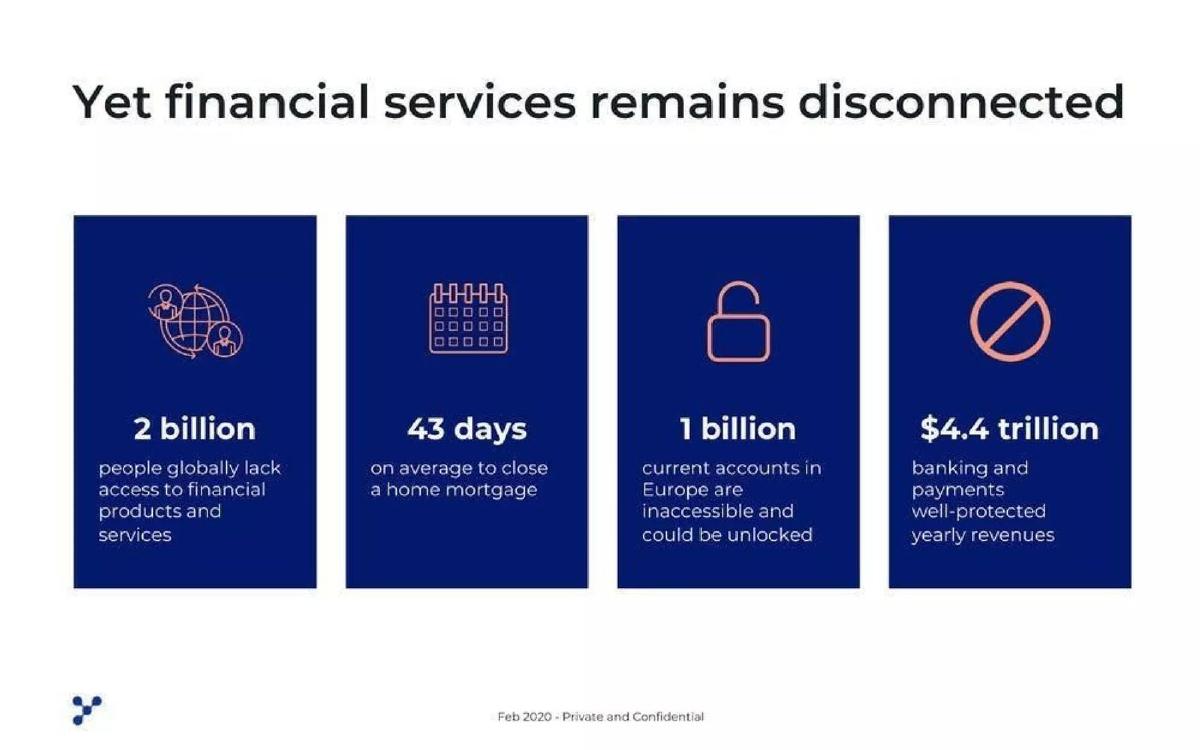
- The deck identifies a $4.4 trillion market in banking and payments yearly revenues that are currently protected by disconnected services (Slide 3).
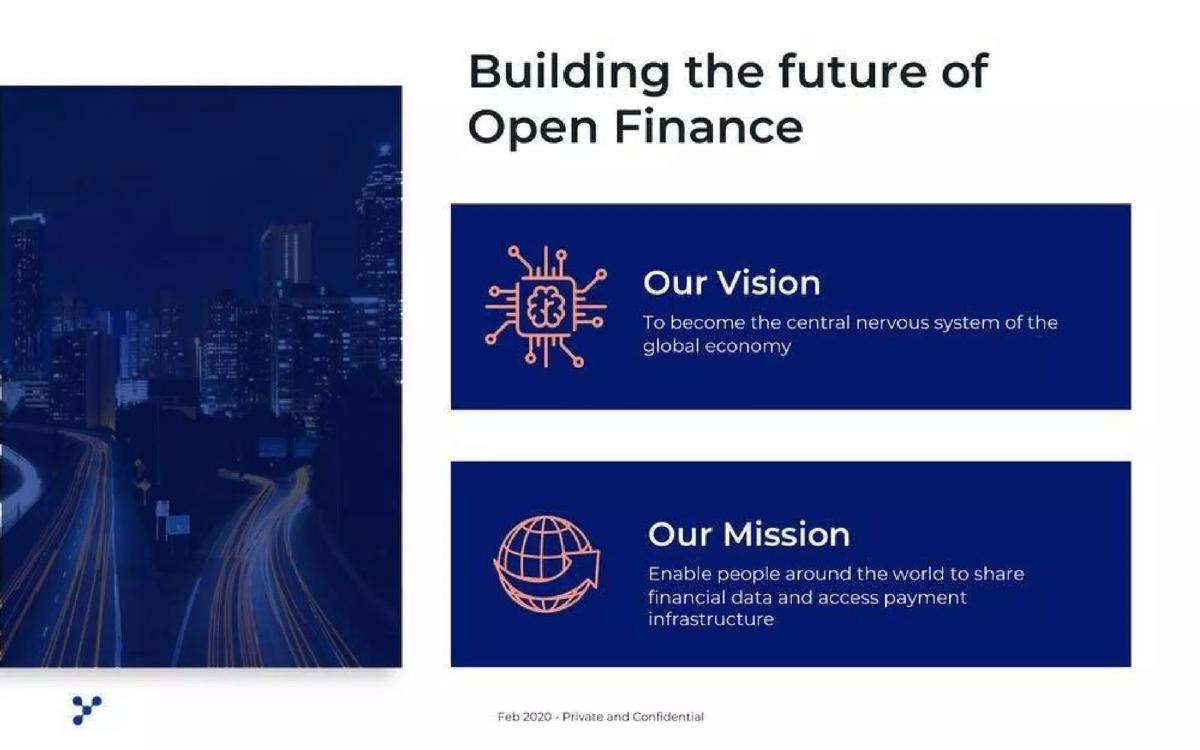
- Yapily positions itself as the 'central nervous system of the global economy' to move beyond simple data sharing (Slide 4).
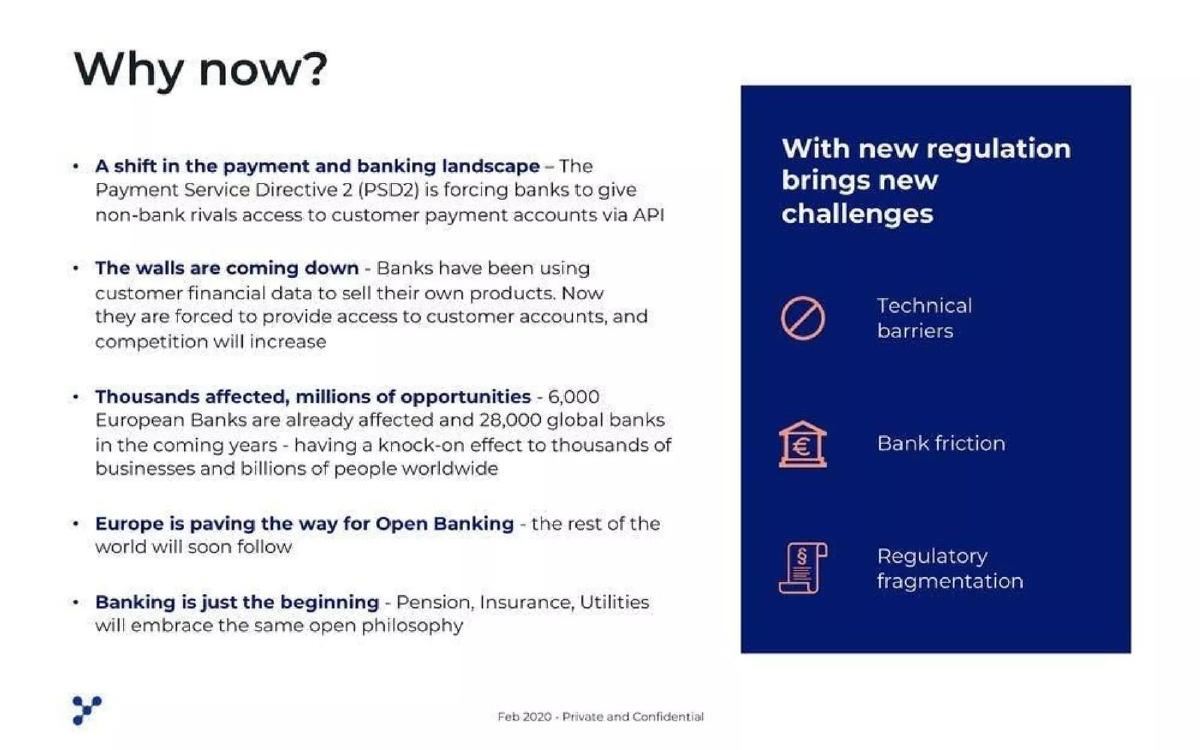
- The 'Why Now' slide leverages the PSD2 directive, noting that 6,000 European banks are already affected by new regulations (Slide 5).
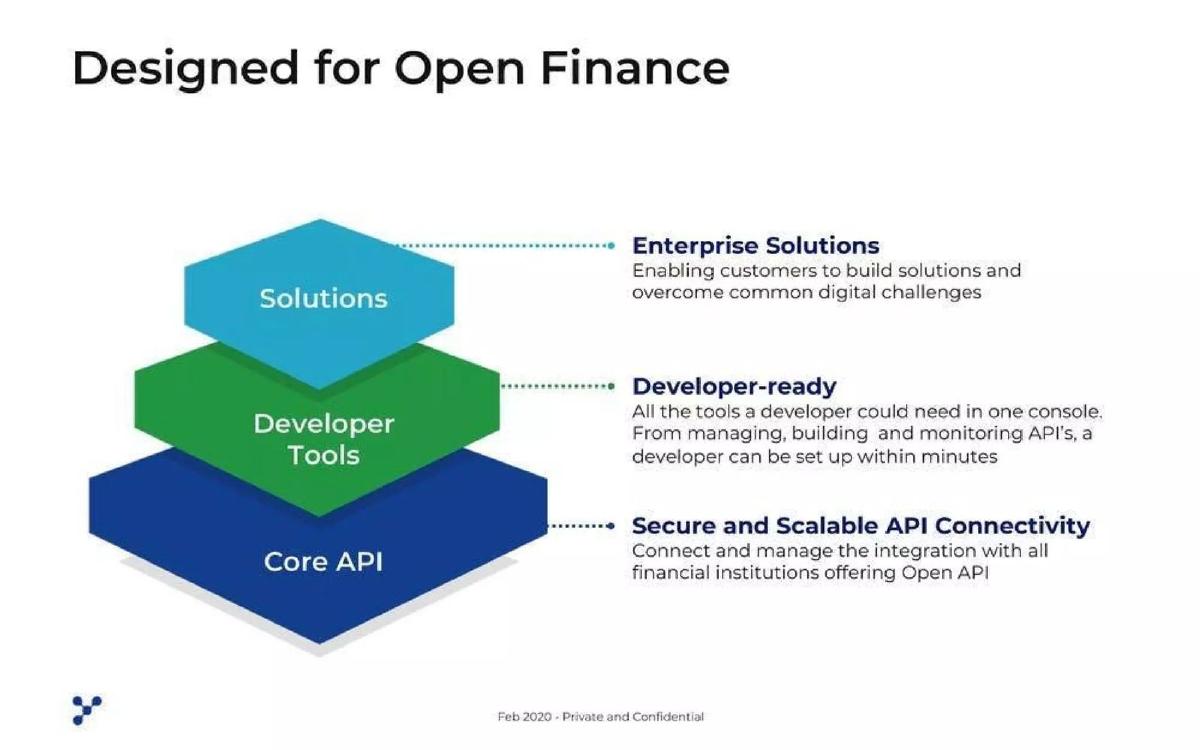
- The product is structured as a three-tier stack: Core API, Developer Tools, and Enterprise Solutions (Slide 6).
- A key technical differentiator is the 'Open API-only' approach, explicitly stating 'No scraping' and 'No private API reverse engineering' (Slide 7).
- The company claims to cover more than 98% of UK bank accounts as of the 2019-2020 period (Slide 9).
- The pricing model is built on a hybrid of Freemium, API volume fees, and monthly minimum commitments (Slide 10).
- The deck lacks a team slide, which is a significant omission for a technical infrastructure play.
The Infrastructure of Open Finance
Yapily’s pitch deck is a focused, 12-slide presentation that prioritizes market timing and technical philosophy over raw financial metrics. In the world of FinTech infrastructure, the 'plumbing' is often more important than the 'porcelain,' and Yapily leans into this by positioning itself as the invisible layer connecting the fragmented world of global banking. The deck, dated February 2020, captures a moment when PSD2 was transitioning from a regulatory hurdle into a massive commercial opportunity.
Slides 1-3: The Disconnected Reality
Slide 1 is a standard title slide featuring the company logo and the tagline: 'Connect to banks, easily.' It sets a minimalist tone that carries through the rest of the presentation. Slide 2 introduces the macro-narrative with the phrase 'We live in an interconnected society,' set against a backdrop of a glowing city at night. This is a classic 'set the stage' slide, designed to contrast the modern world's connectivity with the archaic nature of finance.
Slide 3 delivers the 'Problem' statement with four heavy-hitting statistics. It claims that 2 billion people globally lack access to financial services, it takes 43 days on average to close a home mortgage, and 1 billion current accounts in Europe are 'inaccessible.' Most importantly for investors, it identifies $4.4 trillion in banking and payments yearly revenues that are 'well-protected,' implying that these revenues are ripe for disruption through better connectivity.
Slides 4-5: Vision and Regulatory Catalysts
Slide 4 defines the company's North Star. The vision is 'To become the central nervous system of the global economy,' while the mission is to 'Enable people around the world to share financial data and access payment infrastructure.' By using the term 'central nervous system,' Yapily signals that they aren't just a data aggregator; they intend to be the essential infrastructure through which all financial signals pass.
Slide 5 , titled 'Why now?', is perhaps the most critical slide for a regulatory-tech company. It cites the Payment Service Directive 2 (PSD2) as the primary driver, forcing banks to open up. It notes that 6,000 European banks are already affected and 28,000 global banks will follow. The slide highlights three specific challenges created by this shift: technical barriers, bank friction, and regulatory fragmentation. Yapily positions itself as the solution to these three specific pain points.
Slides 6-7: Product Architecture and Differentiation
Slide 6 visualizes the product as a three-layer stack. The foundation is the 'Core API' for secure and scalable connectivity. Above that are 'Developer Tools' (management, building, and monitoring), and the top layer is 'Enterprise Solutions.' This suggests a strategy of moving up the value chain—starting with connectivity and eventually offering higher-margin tools that help enterprises build entire products on top of Yapily.
Slide 7 addresses the 'How is our offering different?' question. This is a high-conviction slide. It lists five pillars: Invisible enabler, Designed for Open API, Security and data, Deep-domain expertise, and Most trusted provider. The standout point here is the technical stance: 'Yapily is Open API-only. No scraping. No private API reverse engineering.' This is a direct shot at first-generation aggregators that relied on screen scraping, which is often fragile and frowned upon by banks. By being 'Open API-only,' Yapily markets itself as the 'cleaner,' more sustainable choice for the long term.
Slides 8-9: Global Expansion and Coverage
Slide 8 provides a global map showing that '51 countries have already joined the revolution.' It lists specific regulatory milestones in North America, Latin America, Europe, the Middle East, Asia, and Australia/NZ. This slide is designed to prove that while Yapily started in Europe, their addressable market is truly global because the regulatory trend is contagious.
Slide 9 focuses on immediate traction. It claims 98% coverage of UK bank accounts in 2019 and shows a timeline for expanding deep coverage across Europe in 2020 and the 'Rest of the World' in 2021. The use of simple maps and a clear arrow timeline makes the expansion strategy feel inevitable rather than speculative.
Slides 10-12: Business Model and The 'FinTech Everywhere' Thesis
Slide 10 outlines the pricing model. It’s a standard SaaS/API hybrid: Freemium + API Volume fees with a Monthly Minimum Commitment for the core product, and fixed monthly costs for added-value services. This model is attractive to investors because it provides both the stability of recurring revenue and the 'lottery ticket' upside of transaction volume.
Slide 11 uses a famous 1990 Bill Gates quote—'Banking is necessary, banks are not'—to anchor their final thesis. It positions Yapily as the 'Technology enabler' sitting between 'Banking Incumbents' (high cost, slow) and 'Financial Services & Consumer products' (low cost, innovative). The slide features logos for Netflix, Uber, G Pay, and Spotify, accompanied by the bold claim: 'Every company will be a Fintech Company.' This is the ultimate 'TAM' (Total Addressable Market) argument: Yapily isn't just for banks; it's for every digital business that needs to move money or verify data.
Slide 12 is a dense legal disclaimer, which is standard for a 'Private and Confidential' deck in the financial sector.
What Works in this Deck
Regulatory Tailwinds: The deck does an excellent job of tying the company's success to an unstoppable regulatory force (PSD2). Investors love 'inevitability,' and Yapily makes a strong case that the world is legally required to move in their direction.
Technical Purity: By explicitly rejecting screen scraping (Slide 7), Yapily stakes out a 'premium' technical position. This appeals to enterprise clients (banks and large corporations) who are risk-averse and want official, stable connections rather than hacks.
The 'Invisible' Strategy: Positioning themselves as an 'invisible enabler' is a smart move. It tells investors that Yapily isn't trying to win a brand war with consumer apps; instead, they are happy to be the plumbing that everyone else pays for, regardless of which consumer app wins.
What is Missing from this Deck
The Team Slide: This is the most glaring omission. In a $69M raise, the pedigree of the founders and the technical team is usually a top-three factor for investors. The absence of a team slide in this version of the deck suggests it may have been removed for public distribution or was handled in a separate document.
Unit Economics: While Slide 10 explains how they charge, it doesn't show how much they are making. There are no mentions of MRR (Monthly Recurring Revenue), Churn, or CAC (Customer Acquisition Cost). For a company at the 'Other' stage (likely Series A or B given the total raise), these metrics are usually mandatory.
The Ask: There is no slide detailing how much money is being raised or what the specific milestones for the next 18-24 months are. Without an 'Ask' slide, the deck feels more like a general capabilities presentation than a fundraising tool.
What a Founder Should Copy
The 'Why Now' Slide: Slide 5 is a perfect template for any startup operating in a regulated space. It identifies the regulation, quantifies the number of entities affected, and lists the specific new challenges that the regulation creates. It turns a boring legal change into a massive commercial 'opening.'
The Product Stack Visualization: Slide 6 is a great way to show how a complex API product is organized. By breaking it into Core, Developer Tools, and Solutions, it shows a clear path from 'utility' to 'platform.'
Macro-to-Micro Flow: The deck follows a logical progression: Global Problem (Slide 3) -> Company Vision (Slide 4) -> Market Catalyst (Slide 5) -> Product Solution (Slide 6) -> Competitive Edge (Slide 7) -> Growth Plan (Slide 9). This narrative arc is easy to follow and builds a cumulative case for the investment.
Frequently asked questions
- What is Yapily's core product offering?
- Yapily offers a secure open API that connects businesses to thousands of banks. According to Slide 6, their product stack consists of a Core API for scalable connectivity, Developer Tools for managing and monitoring APIs, and Enterprise Solutions to help customers build specific financial products. They emphasize an 'invisible enabler' model where their technology powers applications behind the scenes without consumer-facing branding.
- How does Yapily differentiate itself from competitors like Plaid or Tink?
- Yapily differentiates itself through a strict 'Open API-only' philosophy. Slide 7 explicitly states they do not use screen scraping or private API reverse engineering. They argue this makes them more secure, performant, and scalable. Additionally, they highlight their deep-domain expertise, noting their involvement in the OBIE's Technical Design Authority and the Berlin Group Advisory board to help set industry standards.
- What market tailwinds is Yapily capitalizing on?
- The deck focuses heavily on regulatory shifts, specifically the Payment Service Directive 2 (PSD2) in Europe. Slide 5 notes that this regulation forces banks to give rivals access to customer accounts via API. They also highlight a global trend, with Slide 8 showing 51 countries—including the US, Brazil, Australia, and Singapore—moving toward Open Banking or Open Finance mandates.
- What is the revenue model for Yapily?
- According to Slide 10, Yapily employs a multi-tiered pricing strategy. Their Core API uses a freemium model combined with API volume fees and a monthly minimum commitment. They also generate revenue through 'Added Value Services,' which carry a fixed monthly cost plus additional charges for specific add-ons. This suggests a predictable SaaS-style base with usage-based upside.
- What are the most notable omissions in this pitch deck?
- The most striking omissions are the lack of a Team slide and a specific 'Ask' slide. For a company that raised $69.4 million, the absence of founder backgrounds and technical leadership is unusual in a public deck. Furthermore, the deck does not provide detailed financial projections or specific unit economics, focusing instead on high-level market coverage and regulatory opportunity.