Yac's Series A deck is a masterclass in narrative-driven fundraising, focusing heavily on the 'pain' of synchronous communication. By citing that businesses spend 68 hours a month on communication clarification, Yac establishes a high-stakes problem before introducing their asynchronous voice platform. The deck relies significantly on social proof, featuring testimonials from high-growth companies like Mailchimp and Panther, alongside press validation from the Wall Street Journal and Fast Company. A critical strategic element is their deep integration with Slack, which they use to demonstrate…
Key takeaways
- The problem is quantified early, stating businesses lose 68 hours per month to communication overhead (Slide 2).
- Yac positions itself as a 'podcast-like' experience for internal team messaging to lower the friction of voice (Slide 4).
- Social proof is the primary driver, with quotes from Product Managers at Mailchimp and CEOs at Panther (Slides 3, 6).
- The startup leverages high-authority media validation from TechCrunch, WSJ, and Fast Company to build credibility (Slides 5, 7).
- Product functionality is highlighted through 'one-click async screen sharing' and 'Slack-like channels' (Slides 8, 9).
- A dedicated slide for the Slack integration emphasizes their unique ability to replace the Slack call button (Slide 11).
- The market landscape identifies Yac in the 'Shortform/Async' quadrant, differentiating from Loom (Longform) and Zoom (Sync) (Slide 12).
- The founding team is presented with clear functional roles: Vision/Technical, Growth/Marketing, and Operations/Finance (Slide 13).
The Narrative: Killing the Meeting
Yac’s Series A deck, used to secure $7.5M in 2021, is built on a singular, aggressive premise: meetings are a waste of time. In a post-2020 world where 'Zoom fatigue' became a clinical term, Yac positioned itself not just as a tool, but as a cultural shift toward asynchronous work. The deck is visually minimalist, using high-contrast text and significant white space to drive home its core messaging.
Slide 1: Title Slide
The deck opens with a clear, punchy mission statement: "Eliminate Meetings With Voice Messages." There is no ambiguity here. The branding is clean, and the sub-headline serves as a direct value proposition. It tells the investor exactly what the product does and what problem it solves before they even turn the page.
Slide 2: The Quantified Problem
Slide 2 introduces the 'Why now?' and the scale of the inefficiency. It claims that "Businesses spend on average 68 hours per month clarifying prior communication." By attaching a specific number to the problem, Yac moves the conversation from a vague annoyance to a measurable financial drain. This sets the stage for a solution that promises to reclaim those hours.
Slide 3: User Pain Point
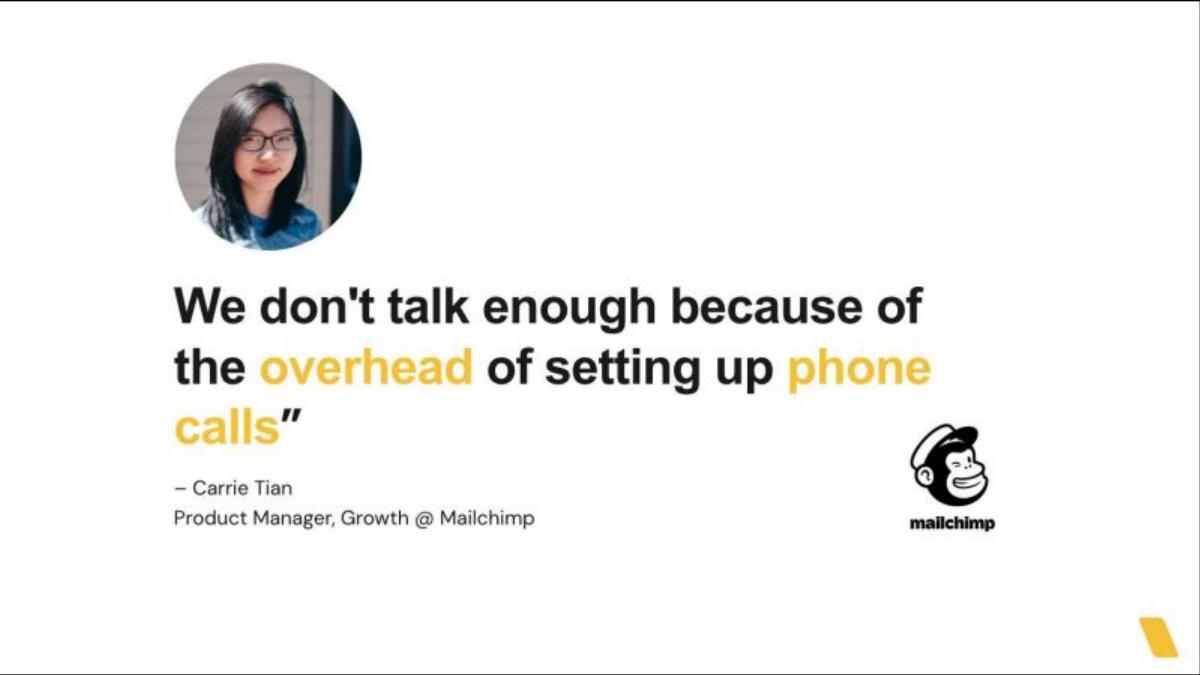
To humanize the data from the previous slide, Slide 3 features a testimonial from Carrie Tian, a Product Manager at Mailchimp. The quote, "We don't talk enough because of the overhead of setting up phone calls," highlights the friction of synchronous communication. This identifies the 'barrier to entry' for collaboration that Yac intends to remove.
Slide 4: The Solution (Product Intro)
Slide 4 introduces the product interface. It describes Yac as "podcast-like voice messages." This is a clever framing; everyone knows how to listen to a podcast on their own time. The mobile UI shown includes features like 1x, 1.5x, and 2x playback speeds, signaling that efficiency is baked into the user experience.
Slide 5: Media Validation
Yac uses a TechCrunch quote to validate its category: "Yac addresses the issue of providing verbal feedback and communication async instead of needing to respond in real time." Using third-party journalistic sources early in the deck helps build a sense of inevitability around the startup's mission.
Slide 6: Remote Work Use Case
Slide 6 targets the 'distributed team' segment. Matt, the CEO of Panther, states that his team "lives and breathes Yac" because they operate across multiple time zones. This slide proves that the product isn't just a 'nice-to-have' but a core infrastructure component for the growing remote-work economy.
Slide 7: Industry Authority
Continuing the trend of social proof, Slide 7 quotes the Wall Street Journal ( "The phone call isn't dead, it's evolving" ) and Fast Company ( "Yac is one of the top new productivity apps for 2020" ). This positions Yac at the forefront of a major technological evolution rather than just being another messaging app.
Slide 8 & 9: Product Features and UI
These slides dive into the 'How.' Slide 8 highlights "Unread inbox" and "One click async screen sharing," showing that Yac is a multi-modal tool. Slide 9 emphasizes "Slack-like channels" and "Heard Status for Messages." By referencing Slack’s UI patterns, Yac suggests a low learning curve for new users. The mention of being "Optimized For Quick Back & Forth" addresses the speed of the platform.
Slide 10: Achievements and Traction
Slide 10 is a 'trust' slide. It lists "2x Golden Kitty Winners" and a "Top 10 in Mac App Store" ranking. More importantly, it displays a logo wall of "Beta Testers & Users" including Google, Spotify, HubSpot, Zapier, and Upwork. For a Series A company, having these names in the 'testing' phase is a massive signal of enterprise interest.
Slide 11: The Slack Moat
This is arguably the most important strategic slide in the deck. It details the "Slack Integration." Yac notes that it is "one of only a few companies allowed to replace the Slack call button." This is a significant competitive advantage. By integrating so deeply into the world's most popular business chat app, Yac creates a frictionless distribution channel and a defensive moat against other voice-messaging startups.
Slide 12: Market Landscape
The competitive matrix on Slide 12 places Yac in the "Shortform / Async" quadrant. It positions itself away from Zoom and Discord (Sync) and Loom (Longform) . This helps investors understand that Yac isn't trying to be a video repository like Loom, but a rapid-fire communication tool that replaces the 'quick sync' meeting.
Slide 13: The Founding Team
The team slide is simple, featuring three founders: Justin Mitchell (Vision & Technical), Hunter McKinley (Growth & Marketing), and Jordan Walker (Operations & Finance). While it lacks specific past-company pedigrees on the slide itself, it shows a balanced leadership structure covering the three pillars of a software startup: product, distribution, and scale.
What Works in the Yac Deck
1. Extreme Focus on the 'Pain': The first seven slides are almost entirely dedicated to the problem and social proof. By the time the investor sees the product, they are already convinced that meetings are a broken system.
2. Strategic Integration: Highlighting the Slack partnership is a brilliant move. It shows that Yac isn't trying to fight the giants; it's trying to become a necessary feature of the existing ecosystem.
3. High-Signal Logos: The inclusion of Google and Spotify as beta testers, combined with GGV and Slack Fund as investors, creates a 'fear of missing out' (FOMO) for other VCs.
What is Missing from the Yac Deck
1. Financials and Unit Economics: There is zero mention of revenue, MRR, or CAC/LTV. While this may have been in the 13 slides not included in this set, its absence here makes the deck feel more like a product pitch than a business pitch.
2. User Retention Data: For a messaging app, 'stickiness' is everything. The deck mentions users 'live and breathe' the app, but it doesn't provide the DAU/MAU (Daily Active User / Monthly Active User) ratios to prove it.
3. The Ask: The provided slides do not state how much money is being raised or how it will be used. A standard pitch deck should conclude with a clear roadmap of what the next 18-24 months of capital will achieve.
What Other Founders Should Copy
1. The 'Podcast' Analogy: If you are building a new category, use a familiar analogy. Calling voice messages 'podcast-like' immediately explains the user behavior without needing a manual.
2. Quantify the Waste: Don't just say your product 'saves time.' Say exactly how much time the current system wastes (e.g., the 68 hours on Slide 2). It makes the ROI of your product much easier to calculate.
3. Leverage Press Early: If you have TechCrunch or WSJ coverage, don't hide it at the end. Use it as a 'seal of approval' early in the deck to validate your market presence.
Frequently asked questions
- What is Yac's core value proposition?
- Yac aims to eliminate time-consuming meetings by replacing them with asynchronous, 'podcast-like' voice messages. According to Slide 4, the goal is to provide verbal feedback without the need for real-time responses, thereby reducing the 'overhead of setting up phone calls' mentioned on Slide 3.
- How does Yac differentiate itself from competitors like Loom or Slack?
- On Slide 12, Yac places itself in the 'Shortform/Async' quadrant. It differentiates from Loom by focusing on shorter, voice-first communication rather than long-form video. It differentiates from Slack by offering a native voice experience that can actually replace the Slack call button, as noted on Slide 11.
- Who are the key investors and how much did Yac raise?
- According to the catalogue facts, Yac raised $7.5M in a Series A round. The round was led by GGV Capital and co-led by The Slack Fund. This institutional backing is hinted at in the deck through the 'Investment from Slack' mention on Slide 10.
- What evidence of traction does the deck provide?
- The deck lists several 'Achievements' on Slide 10, including being a 2x Golden Kitty Winner on Product Hunt and reaching the Top 10 in the Mac App Store. It also lists high-profile beta testers and users such as Google, Spotify, HubSpot, and Bose.
- What critical business information is missing from the deck?
- The provided slides do not include a financial slide, revenue growth charts, user retention data, or a specific 'Ask' slide detailing how the $7.5M will be spent. It focuses almost entirely on the problem, product, and social proof rather than hard unit economics.