Xentral’s 21-slide deck for its 2021 Series B round is a highly functional, product-centric presentation that prioritizes utility over abstract vision. The deck successfully navigates the complexity of the ERP (Enterprise Resource Planning) market by emphasizing modularity—boasting over 300 modules and 60 integrations. It relies heavily on social proof, dedicating five consecutive slides to customer testimonials from high-growth brands like YFood and 3Bears. While the deck lacks traditional financial slides like a detailed P&L or a specific 'Ask' for the $75M raised, its strength lies in demo…
Key takeaways
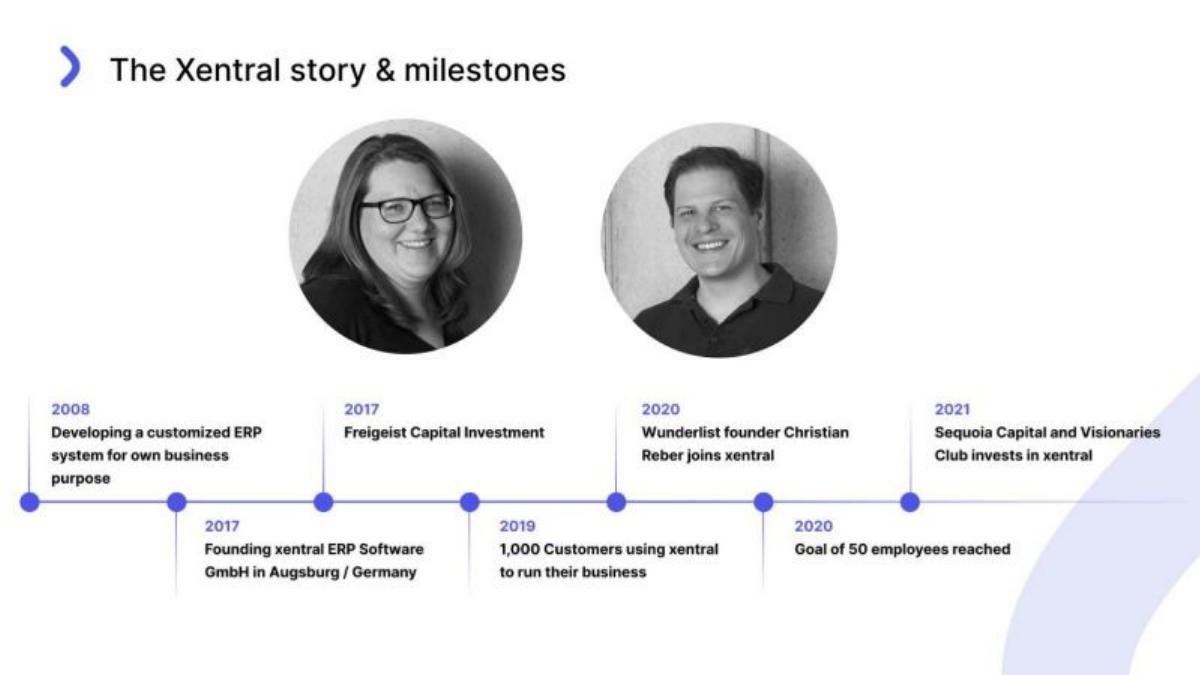
- The company highlights a long-term development history, starting with a customized ERP system in 2008 before officially founding the GmbH in 2017 (Slide 3).
- Xentral emphasizes a significant traction milestone of over 1,000 customers relying on the platform (Slide 4).
- The product architecture is defined by its modularity, featuring over 300 modules and 60+ integrations to cover 'almost any business case' (Slide 7).
- Social proof is a core pillar of the deck, with five individual slides (Slides 8-12) dedicated to specific founder and executive testimonials.
- The deck provides granular visibility into the UI, using multiple screenshots to explain 'Master data overview' and 'Traffic light' order management (Slides 13-14).
- A specific focus on the Shopify ecosystem demonstrates how Xentral automates the 'Pick & Pack' process and updates shop statuses (Slides 17-18).
- The deck omits standard Series B metrics such as MRR/ARR growth rates, churn, CAC, and LTV.
- There is no explicit 'Ask' slide detailing the valuation or the specific allocation of the $75M capital raised (Slide 20).
The Narrative Arc: From Internal Tool to $75M Powerhouse
Xentral’s Series B deck is a masterclass in establishing product-market fit through longevity . Unlike many SaaS startups that pitch a vision of a future product, Xentral spends its opening slides proving that its software has already been battle-tested for over a decade. The story begins in 2008, creating a sense of stability that is crucial for an ERP provider—a category where business continuity is the customer's primary concern.
Slides 1-3: Identity and History
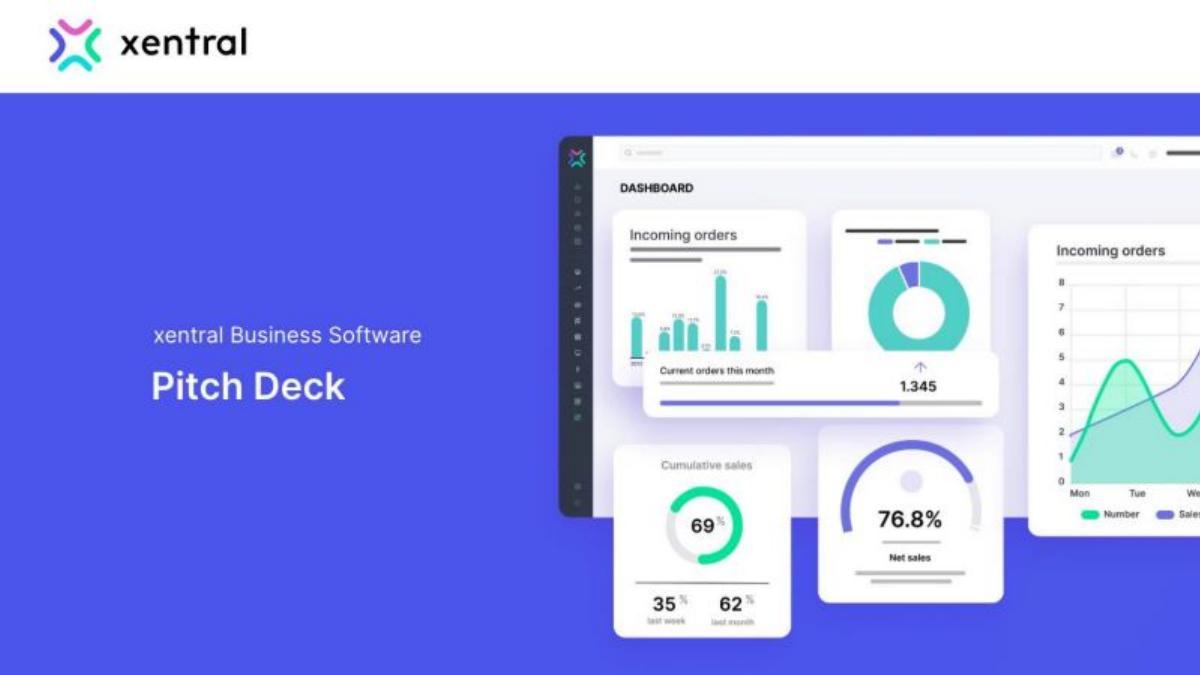
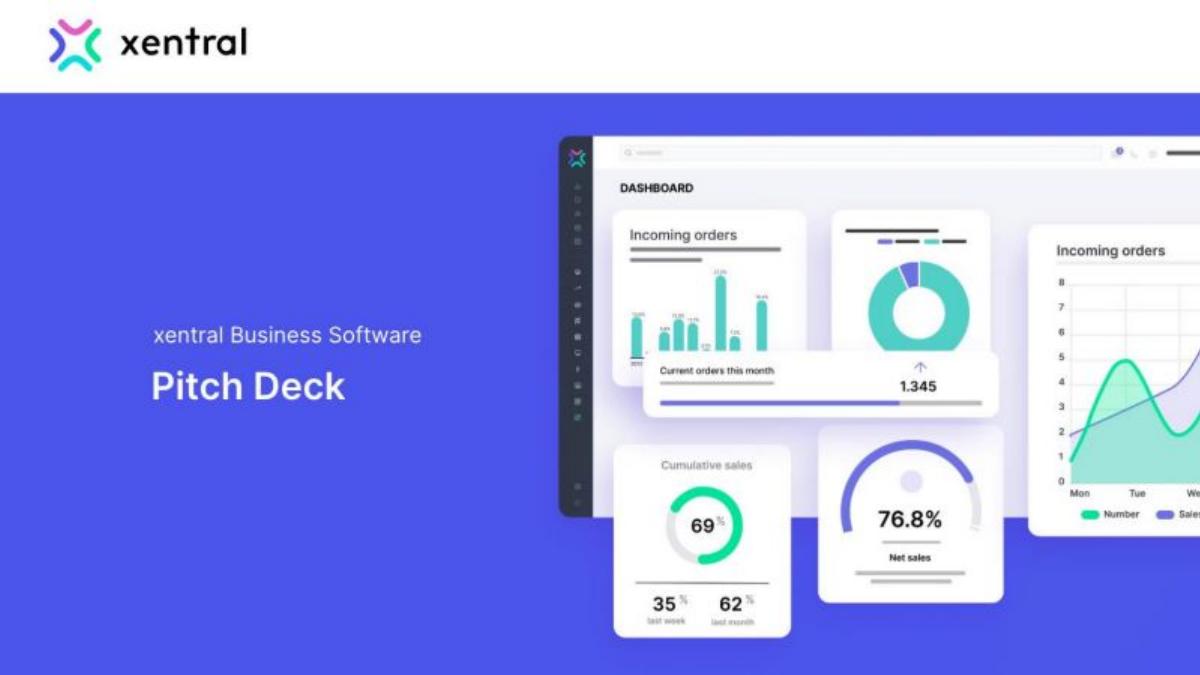
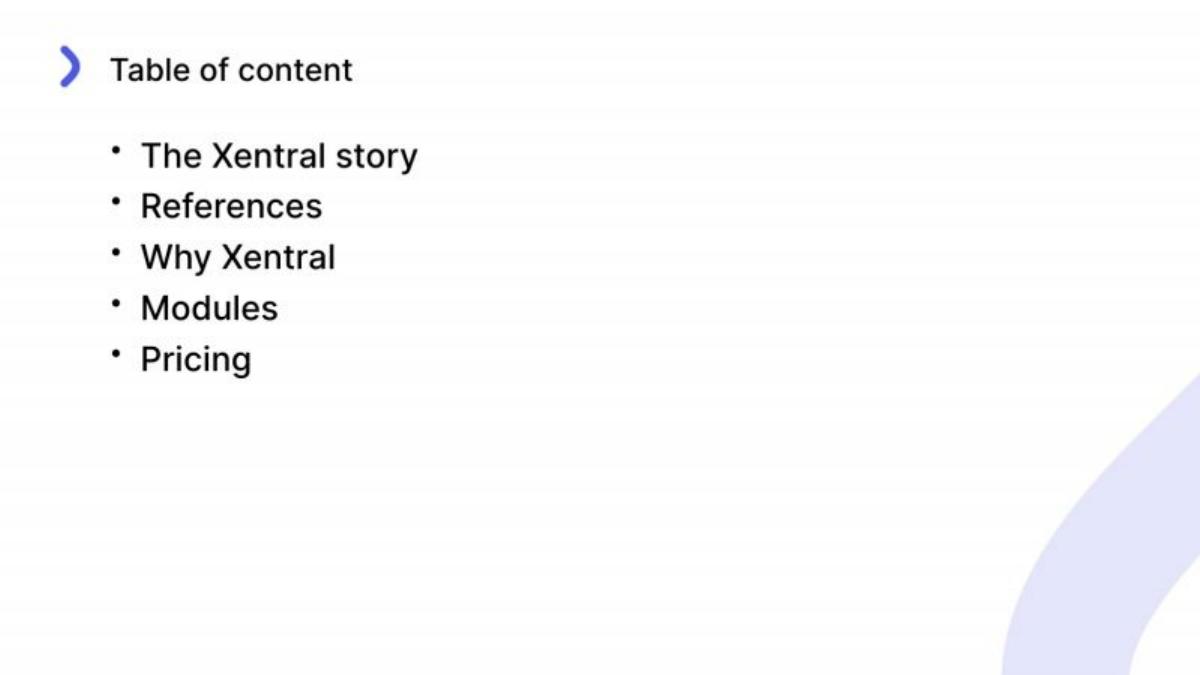
The Title Slide (Slide 1) is clean, featuring a dashboard mockup that immediately signals a modern, data-driven interface. This is followed by a Table of Contents (Slide 2) that outlines a logical flow: Story, References, Why Xentral, Modules, and Pricing. This structure tells the investor exactly what to expect: a journey from the past into the mechanics of the product.
Slide 3 (The Xentral story & milestones) is perhaps the most important slide for establishing credibility. It shows that the founders began developing the system for their own business in 2008. It tracks the formal founding in 2017, the 1,000-customer milestone in 2019, and the 2021 investment from Sequoia Capital. By the time an investor reaches Slide 4, the 'risk' of a nascent product has been largely mitigated by thirteen years of development history.
Slides 4-7: The Value Proposition and Scalability
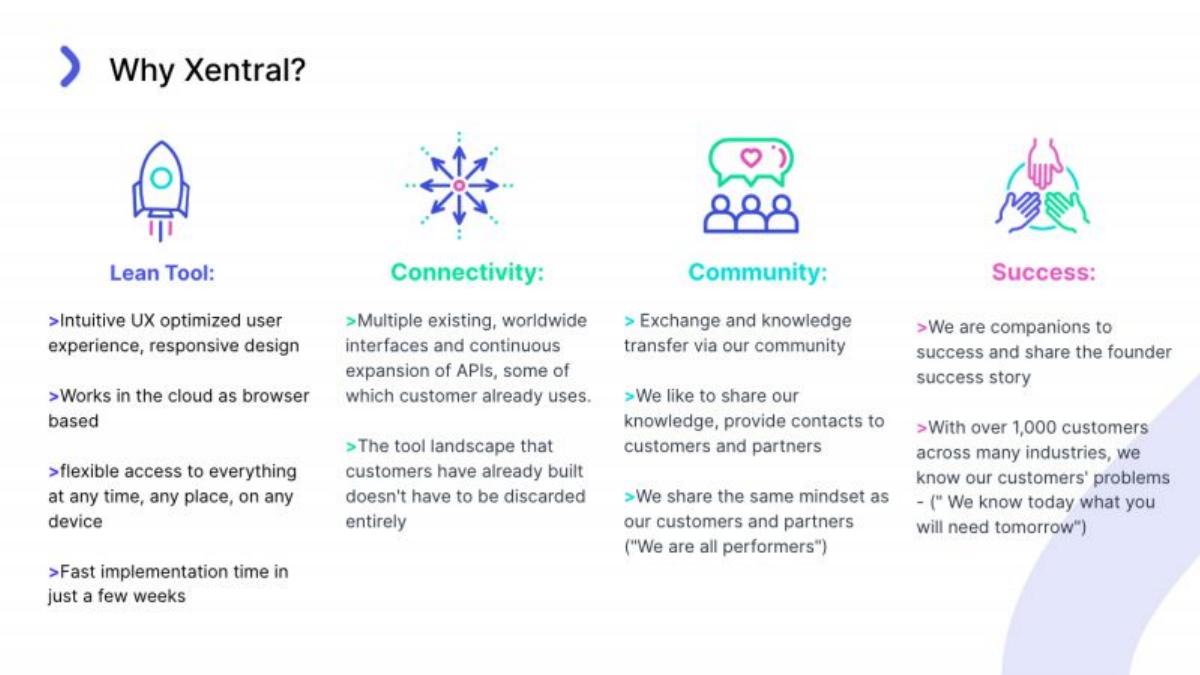
Slide 4 serves as a 'wall of logos,' showcasing more than 1,000 customers. The logos are predominantly high-growth European D2C brands, which sets the stage for Xentral’s niche: the operational 'beating heart' of modern e-commerce. Slide 5 (Why Xentral?) breaks the value down into four pillars: Lean Tool, Connectivity, Community, and Success. Notably, it promises a 'fast implementation time in just a few weeks,' a direct jab at legacy ERP competitors like SAP or Oracle.
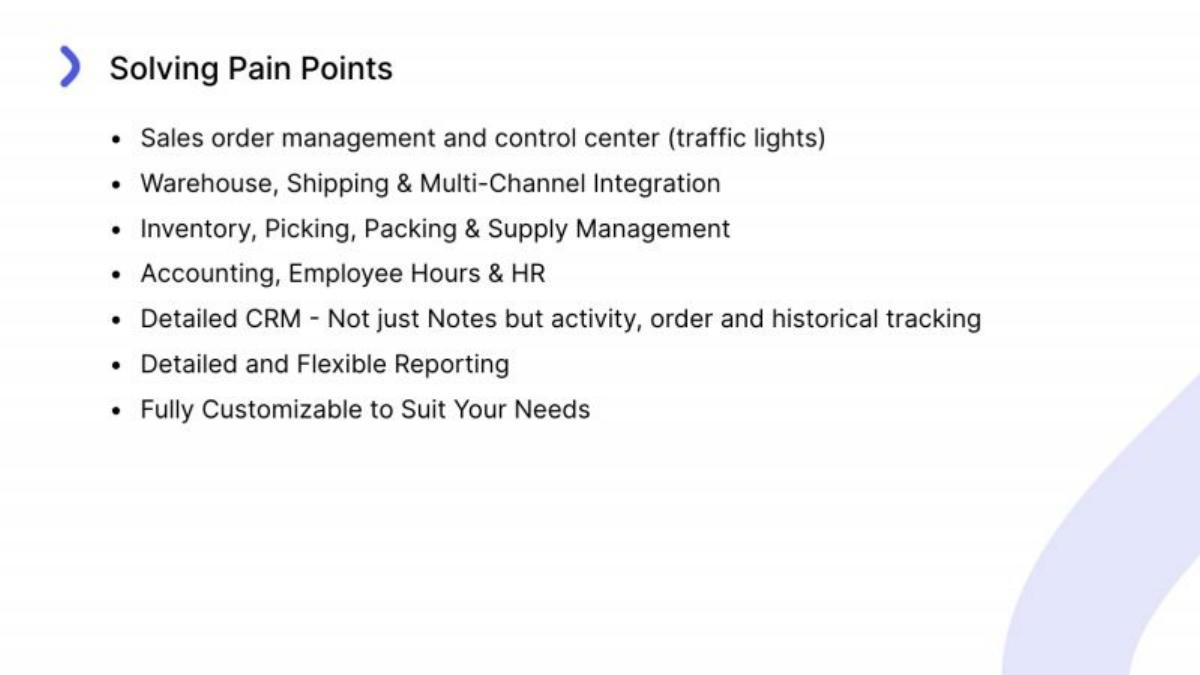
Slide 6 (Solving Pain Points) and Slide 7 (Fully Customizable) transition into the 'How.' Slide 7 is particularly effective, using large-format numbers to highlight 60+ integrations and 300+ modules . This addresses the 'all-in-one' vs. 'best-of-breed' debate by suggesting that Xentral can be both, depending on which modules the customer toggles on.
Slides 8-12: The Power of Social Proof
In an unusual move for a Series B deck, Xentral dedicates nearly 25% of its presentation to individual customer testimonials. Each slide (8 through 12) features a single quote from a CEO or Director. Slide 8 (3Bears) is the standout, with Tim Nichols calling Xentral the "beating heart" of their business. Slide 9 (Buah) emphasizes security, noting that 'Large investors give us the security'—a clever way to use their own fundraising success as a selling point for potential customers. This sequence builds immense psychological momentum; if these category leaders trust Xentral with their entire supply chain, the viewer is led to believe the software is a market standard.
Slides 13-18: The Product Deep Dive
The deck then moves into a technical demonstration. Slide 13 shows the 'Master data overview,' using screenshots with arrows to explain how billing, stock, and orders are navigated from one screen. Slide 14 introduces the 'Traffic lights' system for order management, a visual shorthand for operational efficiency that investors can easily grasp.
Slides 15 and 16 cover Inventory and Warehouse management, while Slides 17 and 18 focus specifically on the Shopify integration. This is a strategic choice. By showing the 'Pick & Pack' process and automatic label printing, Xentral proves it isn't just a database—it’s a functional tool that lives on the warehouse floor. The use of icons and flowcharts in Slide 18 simplifies what is otherwise a complex logistical workflow.
Slides 19-21: The Close
Slide 19 (How it works) summarizes the customer journey from 'pick your plan' to 'success.' It’s a simplified onboarding map that reinforces the 'Lean' messaging from earlier in the deck. Slide 20 is the call to action, offering a 14-day free trial or a sales demo. Interestingly, for a deck used to raise $75M, there is no slide detailing the financial 'Ask' or the specific use of funds. The deck concludes with a standard contact and social media slide.
What Xentral Does Well
Longevity as a Feature: By starting the timeline in 2008, they position themselves as an overnight success that was thirteen years in the making. This is highly attractive to Series B investors looking for stability. · Granular Product Evidence: They don't hide behind high-level abstractions. The use of actual UI screenshots (Slides 13-15) proves the product is mature and functional. · Extreme Social Proof: Dedicating five slides to testimonials is bold. It shifts the narrative from 'what we say we do' to 'what our customers say we do.' · Ecosystem Positioning: The specific focus on Shopify (Slide 17) allows them to ride the wave of the e-commerce boom, positioning Xentral as the necessary 'back-end' to Shopify’s 'front-end.'
What is Missing from the Xentral Deck
The Financials: There is a total absence of revenue figures, growth percentages, or unit economics. While these were likely in a separate data room, their absence in the main deck is notable for a Series B. · The Competitive Landscape: The deck does not mention competitors. In the crowded ERP and 'E-commerce OS' space, a slide explaining their moat against players like Linnworks, Brightpearl, or NetSuite would have been standard. · The Team Slide: Beyond the founders on the timeline, there is no information on the broader leadership team (CFO, CTO, Head of Sales), which is usually a requirement for a $75M round. · The 'Ask': The deck ends with a customer-facing call to action (Free Trial) rather than an investor-facing one (Capital requirements).
What Other Founders Should Copy
The 'Beating Heart' Metaphor: Find the one phrase that describes your product's essential nature and repeat it. Xentral uses customer quotes to reinforce that they are the central nervous system of a business. · Modular Communication: If your product is complex, don't try to explain every feature. Use the 'Module' approach (Slide 7) to show breadth while maintaining a simple narrative. · Visual Workflows: Slide 18’s use of simple icons to explain a 'Pick & Pack' process is much more effective than a wall of text. It allows the investor to visualize the product in use. · Milestone Clarity: Use a timeline (Slide 3) to show a consistent upward trajectory. Investors love to see that a company has hit its previous goals (e.g., 'Goal of 50 employees reached' in 2020).
Frequently asked questions
- What is the primary value proposition of Xentral according to the deck?
- Xentral positions itself as a 'Lean Tool' that provides connectivity and community for SMEs. According to Slide 5, its core strengths are an intuitive UX, cloud-based flexibility, and a fast implementation time of 'just a few weeks,' which contrasts with traditional, heavy ERP systems that often take months or years to deploy.
- How does Xentral handle the complexity of different business needs?
- The deck emphasizes a modular approach. Slide 7 states they have over 300 modules and 60 integrations. This allows customers to 'buy more or remove as needed,' ensuring the software scales with the business without becoming bloated by unnecessary features.
- Who are Xentral's key investors mentioned in the teardown?
- While the deck itself highlights Sequoia Capital and Visionaries Club on its milestone timeline (Slide 3), the catalogue facts confirm a $75M Series B co-led by Tiger Global and Meritech, with participation from Sequoia and Visionaries Club.
- What specific industries does Xentral target?
- The deck showcases a strong lean toward e-commerce and consumer goods. Slide 4 and the subsequent testimonial slides feature brands like KoRo (food), YFood (nutrition), 3Bears (porridge), and FLSK (bottles), suggesting a focus on companies with physical inventory and multi-channel sales needs.
- Does the deck include a team slide?
- The deck features the founders' photos on the 'Story & Milestones' slide (Slide 3) and mentions the addition of Wunderlist founder Christian Reber in 2020. However, it lacks a traditional dedicated team slide that lists the broader executive leadership or their professional backgrounds.