X1’s Series B deck is a study in brevity and momentum. By the time a company reaches a $25M Series B, the narrative is less about 'what if' and more about 'how fast.' X1 answers this by leading with a staggering growth chart showing monthly purchase volume scaling from $800K to $50M in half a year. The deck positions X1 not just as a credit card, but as a 'prime neobank' targeting a $2.4T market, contrasting itself against subprime-heavy competitors like Chime and Cash App. With $15M in annualized revenue and a waitlist of 500,000 signups achieved with $0 in paid marketing, the deck relies on…
Key takeaways
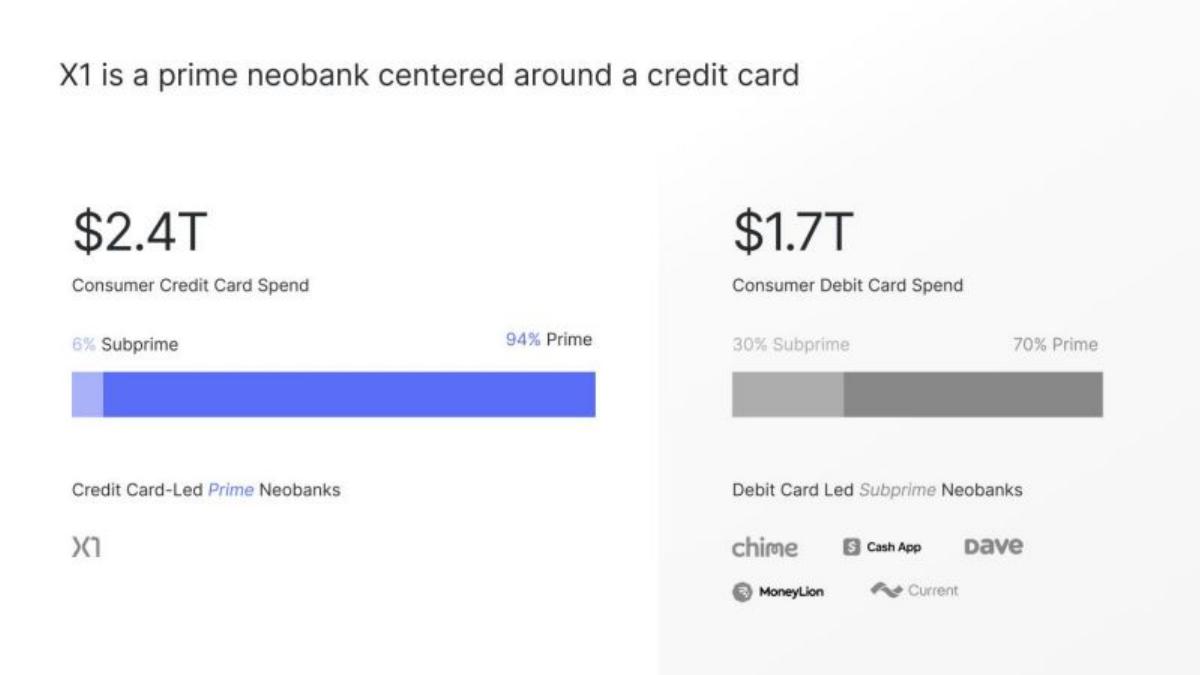
- The company positions itself as a 'prime neobank' to differentiate from debit-led competitors like Chime and Cash App (Slide 2).
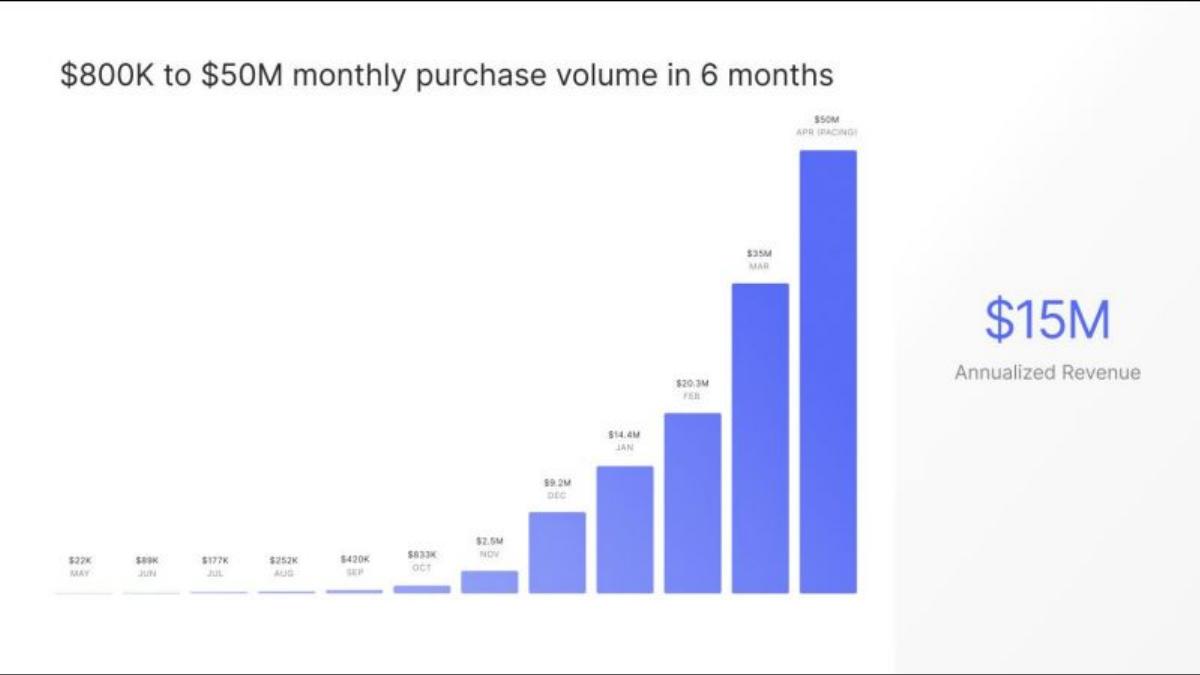
- X1 demonstrates massive scaling, growing monthly purchase volume from $800K to $50M in six months (Slide 3).
- The deck reports $15M in annualized revenue at the time of the raise (Slide 3).
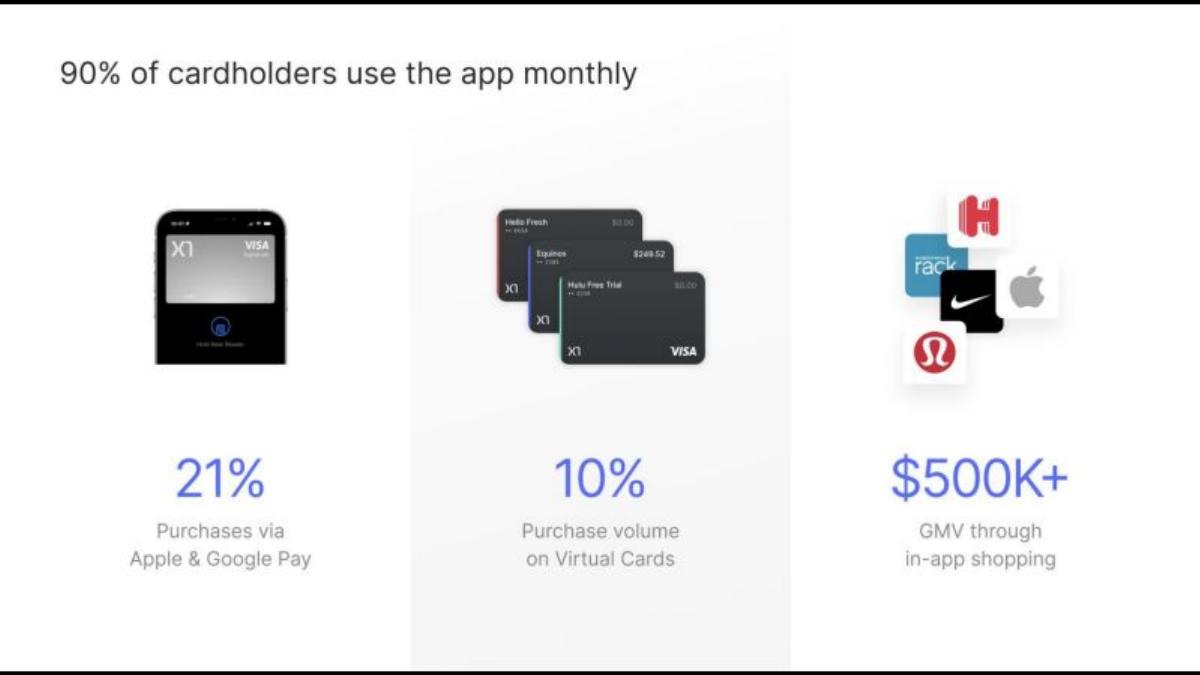
- Engagement is high, with 90% of cardholders using the mobile app monthly (Slide 6).
- The product drives secondary usage through virtual cards, which account for 10% of purchase volume (Slide 6).
- Social features are highlighted as a core growth lever, including account sharing and split requests (Slide 7).
- Growth is entirely organic, citing 500K waitlist signups and $0 spent on paid marketing (Slide 8).
- The investor roster includes high-profile founders like Max Levchin (Affirm), Aaron Levie (Box), and Jeremy Stoppelman (Yelp) (Slide 9).
The Power of Momentum: X1's 10-Slide Series B Deck
When a startup raises a Series B, the burden of proof shifts from vision to execution. X1’s 2022 pitch deck is a lean, data-heavy document that assumes the investor already understands the basic mechanics of a credit card and instead focuses on the sheer velocity of their growth. With only 10 slides, the deck manages to communicate a $15M revenue run rate and a massive organic acquisition engine.
Slide 1: Title
The deck opens with a minimalist title slide featuring only the X1 logo. There is no tagline or mission statement here, setting a tone of efficiency that carries through the rest of the presentation.
Slide 2: Market Positioning and The 'Prime' Thesis
Slide 2 is perhaps the most strategic slide in the deck. It defines X1 as a "prime neobank centered around a credit card." The slide uses a side-by-side comparison to justify why they are building in credit rather than debit. It notes a $2.4T Consumer Credit Card Spend market (which is 94% Prime) versus a $1.7T Consumer Debit Card Spend market (which is 70% Prime). By placing logos like Chime, Cash App, and Dave under the "Debit Card Led Subprime Neobanks" category, X1 positions itself as the premium alternative for a more lucrative demographic.
Slide 3: The Traction 'Hockey Stick'
This is the 'money slide.' It shows a bar chart of monthly purchase volume growing from $22K in May to $50M (pacing) in April . The headline highlights the most impressive window: "$800K to $50M monthly purchase volume in 6 months." To the right, a large callout states "$15M Annualized Revenue." For a Series B investor, this chart represents a business that has found product-market fit and is currently in a vertical takeoff phase.
Slide 4: Social Proof and Mainstream Resonance
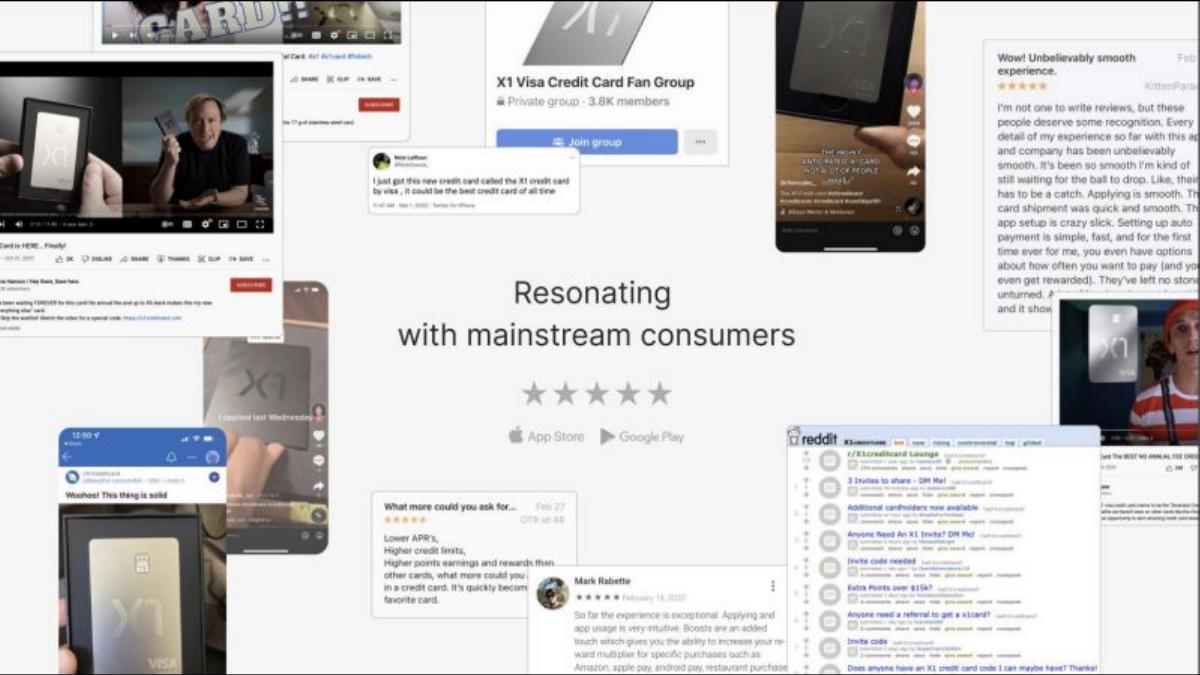
Slide 4 moves away from hard numbers to focus on brand sentiment. It features a collage of YouTube reviews, TikTok videos, Reddit threads, and App Store ratings. The central text, "Resonating with mainstream consumers," is backed by visual evidence of users showing off the physical stainless steel card. This slide addresses the 'defensibility' of the brand—showing that X1 isn't just a financial tool, but a lifestyle object that users are proud to share.
Slide 5: Product Philosophy
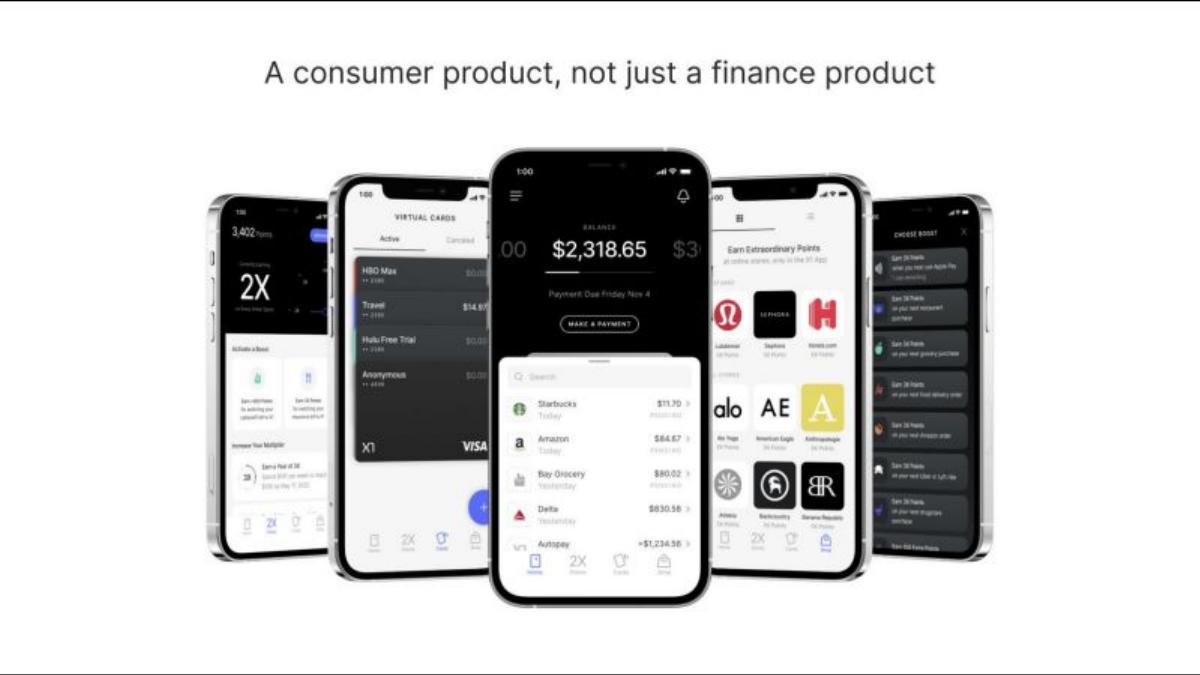
The headline "A consumer product, not just a finance product" reinforces the branding message from the previous slide. It shows five iPhone mockups displaying different parts of the app: rewards, virtual cards, the main balance screen, the shop, and 'boosts.' The UI is dark, sleek, and high-contrast, signaling a modern tech aesthetic rather than a traditional banking interface.
Slide 6: Engagement and Secondary Metrics
Slide 6 provides the 'under the hood' data for the app. It claims "90% of cardholders use the app monthly." It also breaks down how they use it: 21% of purchases via mobile wallets (Apple/Google Pay), 10% of volume on virtual cards, and $500K+ GMV through in-app shopping. These metrics are vital because they prove the app is a daily habit, not just a place to pay a bill once a month.
Slide 7: Social Features and Network Effects
X1 highlights three specific social features: Within Households (sharing accounts with up to 5 cardholders), Among Friends (earning 4X points when a friend joins a 'boost'), and Request Split (splitting transactions). By labeling these as "Social features that drive network effects," X1 is telling investors that their growth is baked into the product's utility, not just a marketing budget.
Slide 8: The Organic Growth Engine
This slide is a direct attack on the high Customer Acquisition Cost (CAC) typically seen in fintech. It claims "100% organic growth through word-of-mouth and earned media." The supporting figures are 1.25M Unique Website Visitors , 500K Waitlist Signups , and $0 In Paid Marketing . For a Series B, showing that you can scale to $50M in monthly volume without spending a dollar on ads is an incredibly strong signal of capital efficiency.
Slide 9: Founders and Investors
The team slide is split between the two founders, Deepak Rao and Siddharth Batra, and a heavy-hitting list of investors. The investor list is a 'who's who' of Silicon Valley, featuring David Sacks (Craft Ventures) , Max Levchin (Affirm CEO) , Aaron Levie (Box CEO) , and Jeremy Stoppelman (Yelp CEO) . This level of institutional and angel backing provides significant social proof for a Series B round.
Slide 10: Conclusion
The final slide is a standard promotional slide for the source of the deck, bestpitchdeck.com, and does not contain company-specific information.
What Works in the X1 Deck
1. The Traction-First Approach: By putting the $800K to $50M growth chart on Slide 3, X1 captures the investor's attention immediately. They don't waste time explaining what a credit card is; they show that people are using their credit card at an accelerating rate.
2. Clear Categorization: The distinction between 'Prime' and 'Subprime' neobanks on Slide 2 is a masterclass in positioning. It allows X1 to claim a massive TAM ($2.4T) while simultaneously explaining why they are different from the existing, well-funded players in the space.
3. Efficiency Metrics: In a market where fintechs often burn through cash to acquire users, the claim of $0 paid marketing spend is a powerful differentiator. It suggests that the $25M they are raising will go toward scaling an already efficient machine rather than subsidizing expensive user acquisition.
What is Missing from the X1 Deck
1. Unit Economics: While the deck mentions $15M in annualized revenue, it does not disclose the contribution margin, CAC (other than saying it is $0), or LTV. Investors at the Series B level usually want to see a deep dive into the profitability of a single user.
2. The 'Ask': There is no slide detailing the amount being raised, the valuation target, or the specific milestones the company intends to hit with the new capital. While this information is often handled in the verbal pitch or a separate data room, its absence in the deck leaves the narrative somewhat unfinished.
3. Risk Factors and Competition: The deck briefly mentions competitors in the 'subprime' space but ignores direct 'prime' competitors or the threat from incumbent banks (Chase, Amex) who are also modernizing their digital offerings. A slide on the competitive landscape beyond just neobanks would have added depth.
What Founders Should Copy
1. Use 'Pacing' Data: If you are in the middle of a high-growth month, use 'pacing' figures (as seen on Slide 3) to show the most current momentum. Just ensure it is clearly labeled so as not to mislead.
2. Visual Social Proof: Instead of just saying "users love us," show the TikToks and Reddit threads. It makes the 'love' feel tangible and proves that your brand has a life of its own outside of your marketing department.
3. Focus on 'Network Effect' Features: If your product has social components, highlight them as growth drivers. Investors love businesses where one user naturally brings in the next, as it implies a lower long-term CAC.
4. Minimalist Design: X1 uses a consistent, high-end aesthetic that matches their physical product. Founders should ensure their deck's design reflects the brand identity they are selling to customers.
Frequently asked questions
- What is X1's primary market positioning?
- X1 positions itself as a 'prime neobank' centered around a credit card. On Slide 2, they contrast the $2.4T consumer credit card spend market (94% prime) against the $1.7T debit card market (70% prime). By doing so, they distance themselves from 'subprime neobanks' like Chime, Dave, and MoneyLion, suggesting a higher-value customer base and better unit economics.
- How did X1 achieve its growth according to the deck?
- According to Slide 8, X1 achieved '100% organic growth through word-of-mouth and earned media.' The deck claims $0 in paid marketing spend while generating 1.25M unique website visitors and 500K waitlist signups. This suggests a highly viral product design and successful social media resonance, as evidenced by the collage of user-generated content on Slide 4.
- What are the key engagement metrics shown?
- X1 highlights a 90% monthly app usage rate among cardholders on Slide 6. They also track specific behavior: 21% of purchases are made via Apple & Google Pay, and 10% of purchase volume occurs through virtual cards. Additionally, they mention over $500K in Gross Merchandise Volume (GMV) through in-app shopping, indicating the app is a commerce hub, not just a utility.
- Does the deck include a financial 'Ask' or use of funds?
- No. The 10-slide deck provided does not include a slide detailing how much capital is being raised or how it will be spent. While the catalogue listing confirms a $25M Series B, the deck itself focuses entirely on traction, product resonance, and team/investor pedigree.
- Who are the founders and notable investors?
- The founders are Deepak Rao and Siddharth Batra. The investor slide (Slide 9) is particularly strong for a Series B, listing David Sacks (Craft Ventures), Michael Dearing (Harrison Metal), and Kevin Thau (Spark Capital), alongside prominent CEOs like Max Levchin (Affirm), Aaron Levie (Box), and Jeremy Stoppelman (Yelp).