The xeem pitch deck is a 12-slide presentation that leans heavily into the B2B value proposition of 'Open Innovation' and 'Digital Recruiting.' Rather than focusing on complex technical architecture, the deck prioritizes the user experience for both companies and 'talents.' It utilizes significant social proof, showcasing logos from major entities like SAP, Vodafone, and Merck to validate its model. While the deck excels at explaining the 'how' and 'why' for potential corporate clients, it is notably light on financial data, market sizing, and competitive analysis. This suggests the deck may…
Key takeaways
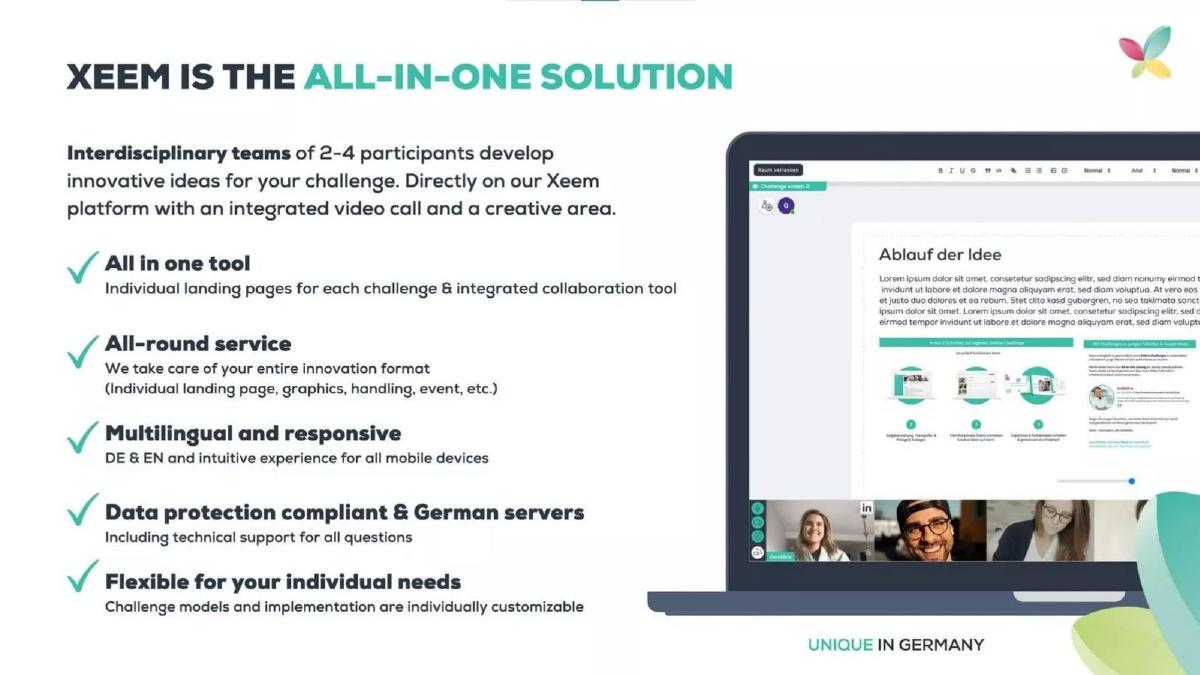
- The platform positions itself as an 'all-in-one solution' for interdisciplinary teams of 2-4 participants to solve corporate challenges (Slide 4).
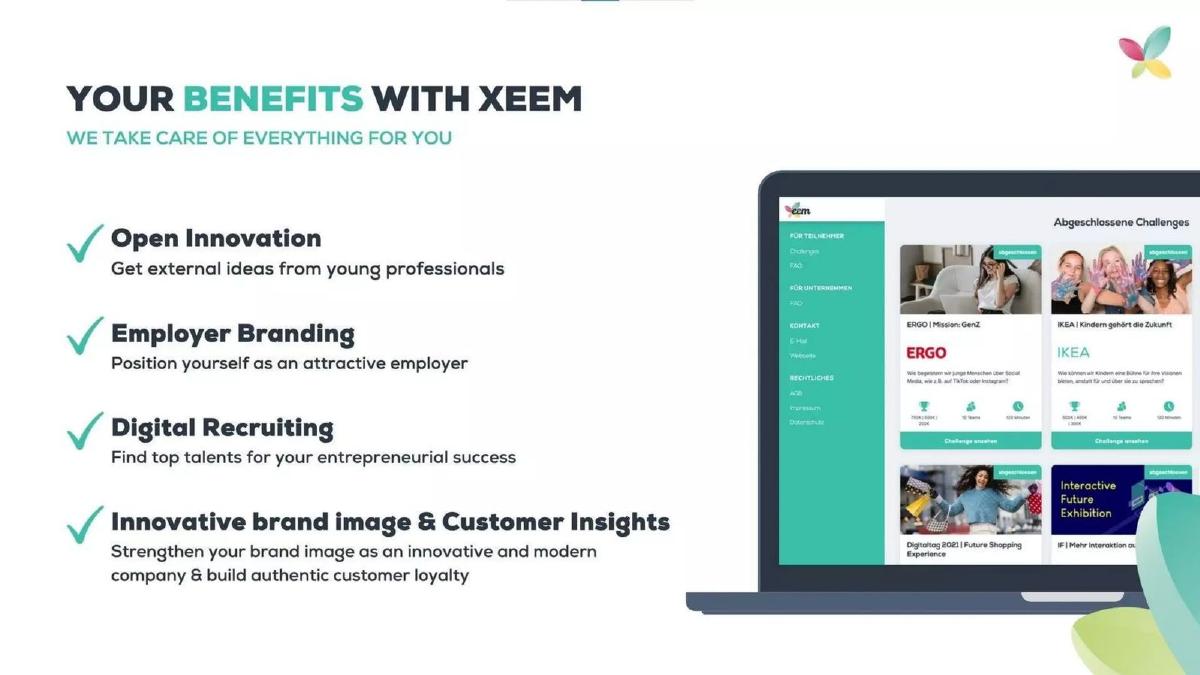
- Xeem emphasizes four core B2B benefits: Open Innovation, Employer Branding, Digital Recruiting, and Customer Insights (Slide 2).
- The deck features high-profile corporate logos including SAP, Vodafone, Merck, and DB Schenker to establish immediate credibility (Slide 9).
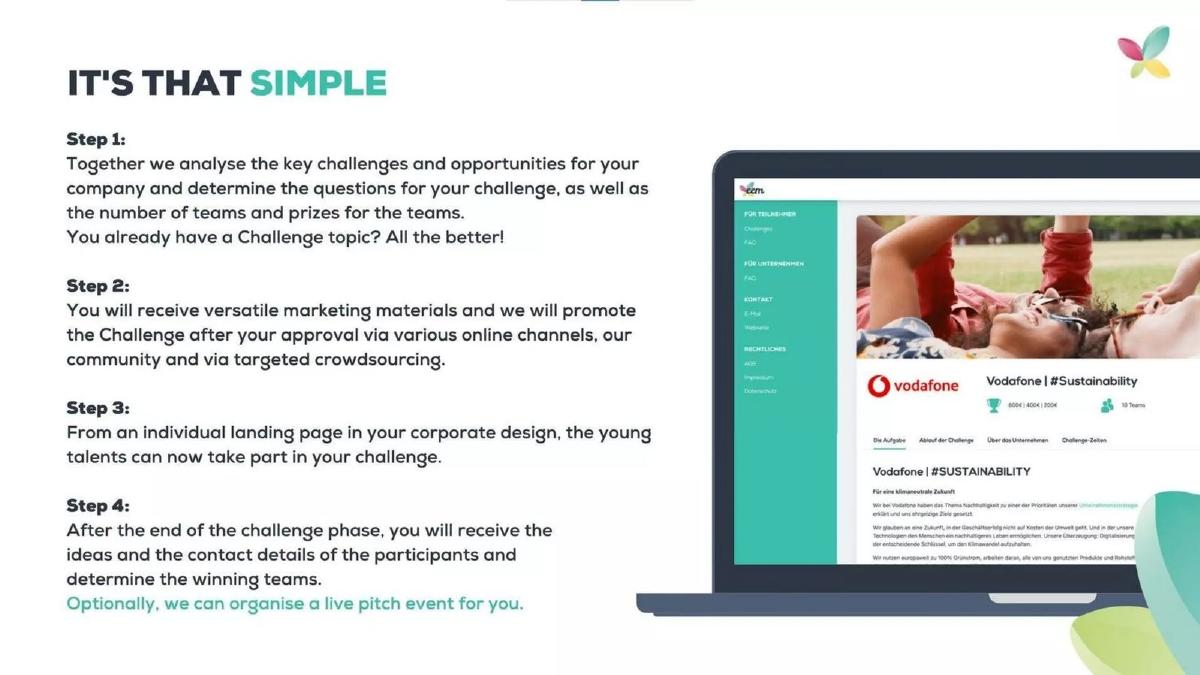
- A four-step process explains the workflow from challenge analysis to receiving participant contact details and ideas (Slide 5).
- The deck includes specific testimonials from HR managers at Evonik and managing directors at Commerz Business Consulting (Slides 7 and 8).
- The 'talent' side of the marketplace is addressed through benefits like 'attractive prizes' and 'exclusive job opportunities' (Slide 10).
- Xeem highlights a unique selling point of being 'Unique in Germany' with data protection compliant German servers (Slide 4).
- The deck omits standard fundraising slides such as a formal 'Ask,' financial projections, or a detailed market size (TAM/SAM/SOM) analysis.
The xeem Pitch Deck: A Sales-First Approach to Seed Funding
The xeem pitch deck is a 12-slide presentation that functions more like a high-end sales brochure than a traditional venture capital stack. It focuses intensely on the 'what' and the 'who,' leaving the 'how much' and 'how big' for later conversations. In 2020, this approach helped the company secure $300,000 in Seed funding. The deck is characterized by clean design, a focus on the German market, and an impressive roster of early corporate adopters.
The Value Proposition and Core Benefits (Slides 1-3)
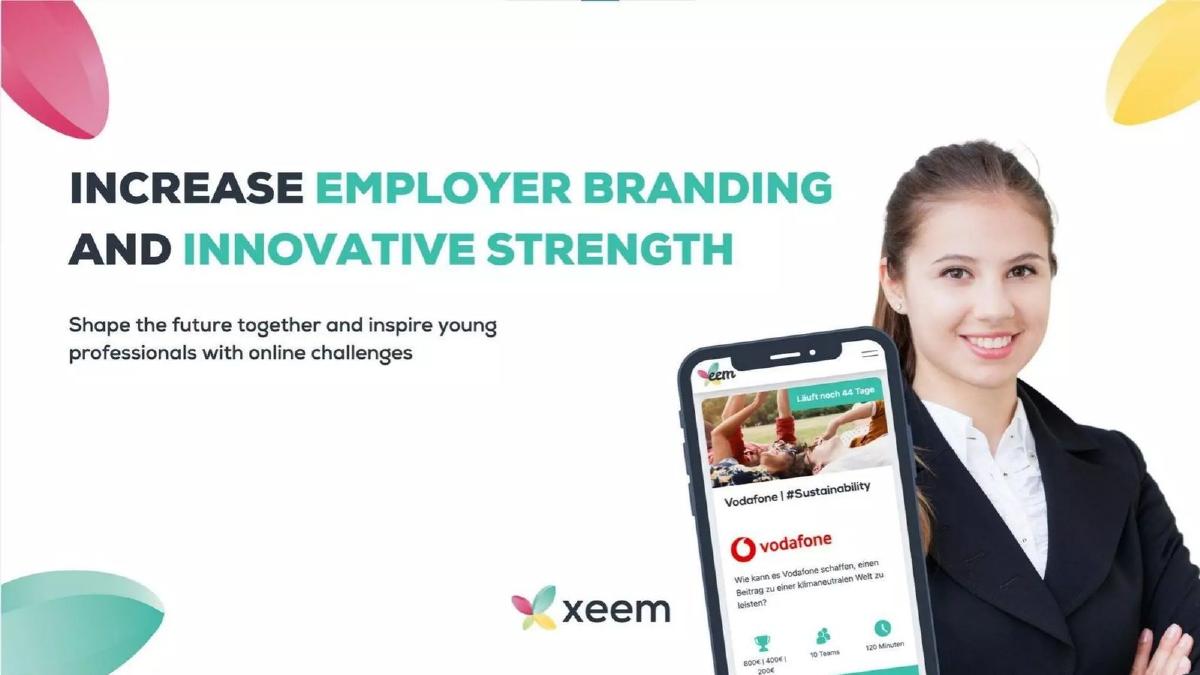
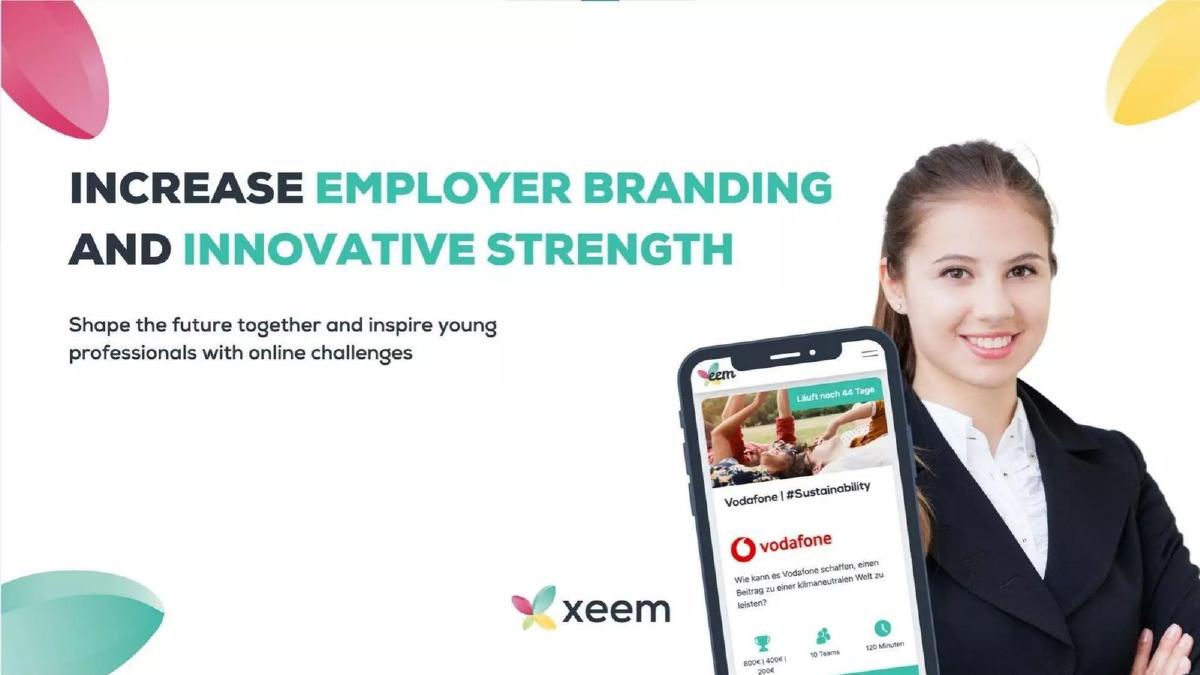
Slide 1: Title Slide The deck opens with a clear mission statement: "Increase Employer Branding and Innovative Strength." It immediately identifies the target audience—young professionals—and the method—online challenges. A mobile mockup shows a Vodafone sustainability challenge, signaling that the platform is already live and used by major brands.
Slide 2: Your Benefits with xeem This slide breaks down the B2B value proposition into four pillars: Open Innovation, Employer Branding, Digital Recruiting, and Innovative Brand Image. By using a laptop mockup showing challenges from ERGO and IKEA, the company reinforces its existing traction. The tagline "We take care of everything for you" suggests a managed service model rather than a pure self-service SaaS platform.
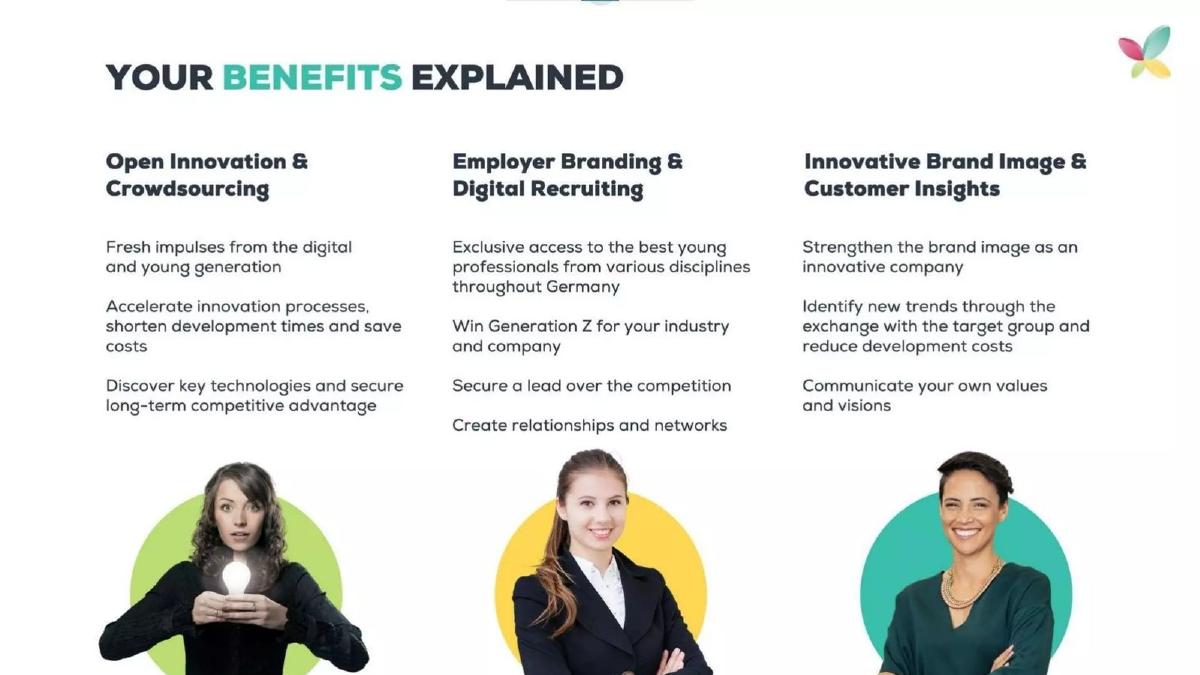
Slide 3: Your Benefits Explained This slide expands on the previous points with more granular detail. It mentions "exclusive access to the best young professionals throughout Germany" and the ability to "win Generation Z for your industry." This is a strategic pivot; xeem isn't just selling 'ideas,' they are selling a recruitment pipeline disguised as an innovation workshop.
The Product and Process (Slides 4-6)
Slide 4: xeem is the All-in-One Solution This is the primary product slide. It defines the team structure (2-4 participants) and the platform features: integrated video calls, a creative area, and individual landing pages. Crucially for the German market, it highlights "Data protection compliant & German servers," a major selling point for enterprise clients in the DACH region. The label "Unique in Germany" attempts to establish a moat based on local compliance and language (DE & EN).
Slide 5: It's That Simple Xeem outlines a four-step workflow. Step 1 involves challenge analysis and prize determination. Step 2 covers marketing and crowdsourcing. Step 3 is the live challenge phase on a custom landing page. Step 4 is the delivery of ideas and participant contact details. This slide clarifies that xeem is a lead-generation tool for HR departments, as the "contact details of the participants" are a core deliverable.
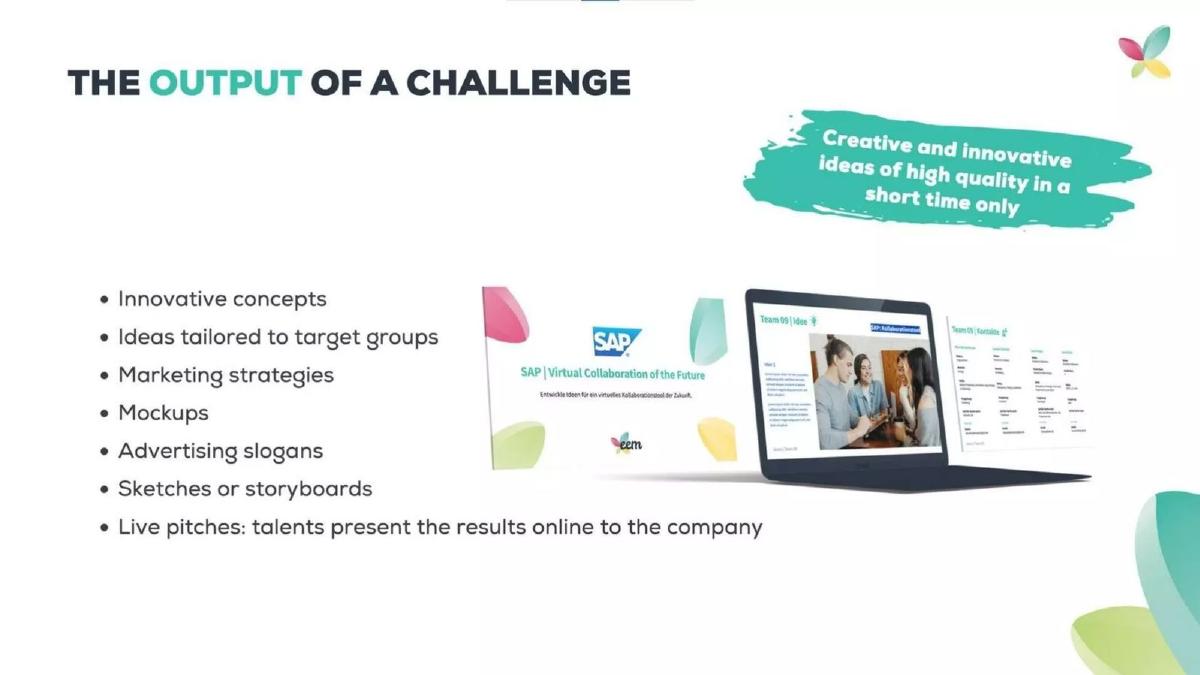
Slide 6: The Output of a Challenge What does a company actually get? This slide lists deliverables: innovative concepts, marketing strategies, mockups, advertising slogans, and sketches. It also mentions "Live pitches," where talents present results online. This reinforces the idea that the platform facilitates a high-engagement event rather than just a static submission form.
Social Proof and Traction (Slides 7-9)
Slide 7: Fresh Ideas & Exclusive Access to Talents This slide features a testimonial from Derya Bozkurt, HR Talent Management at Evonik. The quote emphasizes the ability to "strategically integrate" student wishes into employer branding. Using a specific name and title from a multi-billion dollar chemical company provides massive credibility.
Slide 8: Our Customers Are Thrilled Two more testimonials are provided: Britta Gayko of Commerz Business Consulting and Norbert Weichele of Zentis. These testimonials focus on "co-creation" and "valuable input on a strategically important topic." The inclusion of these photos and logos suggests deep relationships with established German industry players.
Slide 9: Various Companies Already Use xeem This is the 'logo soup' slide, and it is impressive for a Seed stage company. It includes Vodafone, Merck, SAP, DB Schenker, and Red Bull Basement. For an investor, this slide validates that the product-market fit has been tested with enterprise-level procurement departments.
The Talent Side and The Team (Slides 10-12)
Slide 10: How Talents Benefit A marketplace needs two sides. This slide addresses the participants, offering teamwork, practical experience, prizes, and job opportunities. It frames the platform as a "Career Boost."
Slide 11: Young Talents Are Thrilled To mirror the corporate testimonials, xeem provides two student testimonials. Sophie Schmidt (27) and Niklas Sprenger (24) discuss the ease of collaboration and the financial rewards. Niklas specifically mentions winning €333 for two hours of work, which provides a concrete data point on the participant incentive structure.
Slide 12: Start Your Challenge Now The final slide introduces the co-founders, Janine Weirich (Business Development) and Géraldine Ulrichs (Marketing). It includes a direct call to action to "Arrange a meeting." However, it lacks any information regarding their professional backgrounds, education, or previous successes.
What Works in the xeem Deck
Exceptional Social Proof: For a $300k seed round, the level of corporate validation is the deck's strongest asset. Listing SAP, Merck, and Vodafone (Slide 9) effectively de-risks the investment by proving that the founders can sell into complex organizations.
Clear B2B Value Proposition: The deck doesn't get bogged down in technical jargon. It speaks the language of HR and Marketing departments, focusing on "Employer Branding" and "Digital Recruiting" (Slide 2). It identifies a specific pain point—reaching Gen Z—and offers a direct solution.
Process Transparency: By breaking the service down into four simple steps (Slide 5), xeem removes the 'black box' mystery of how an online challenge actually works. This is essential for B2B sales where the buyer needs to understand the internal time commitment required.
What is Missing from the xeem Deck
The Business Model: There is no mention of how xeem makes money. Do they charge a flat fee per challenge? A subscription? A percentage of the prize pool? A fee per hire? This is a significant omission for a fundraising deck.
Market Sizing (TAM/SAM/SOM): The deck fails to quantify the opportunity. While it mentions being "Unique in Germany," it doesn't state how many companies in Germany or Europe are looking for these services or what the total addressable spend on employer branding is.
Financials and Traction Metrics: Beyond logos, there are no hard numbers. Investors typically want to see Monthly Recurring Revenue (MRR), growth rates, number of challenges completed to date, or the size of the talent pool. The deck relies entirely on qualitative proof.
Competitive Landscape: Xeem does not acknowledge competitors like HackerRank (for tech), Agorize, or traditional recruitment agencies. Failing to position themselves against the status quo makes it harder for an investor to judge their unique advantage.
What a Founder Should Copy
The 'Benefits Explained' Structure: Slide 3 is an excellent example of how to take high-level marketing buzzwords and translate them into concrete business outcomes. Founders should copy this layout to ensure their value prop is understood at both a strategic and tactical level.
Dual-Sided Testimonials: If you are building a marketplace, you must prove both sides are happy. Xeem’s inclusion of both HR managers (Slide 8) and students (Slide 11) shows a balanced ecosystem. The specific mention of a student winning €333 is a great way to show the 'earning potential' for the supply side of the market.
Localized Compliance as a Feature: If you are operating in a region with strict regulations (like the EU/Germany), making data privacy and local hosting a core feature (Slide 4) is a smart way to build a defensive moat against larger US-based competitors.
Frequently asked questions
- What is the primary product offered by xeem?
- Xeem offers an online platform where companies can host 'challenges' for young professionals. These challenges are solved by interdisciplinary teams of 2-4 participants. The platform includes integrated video calls, a creative collaboration area, and individual landing pages for each corporate client, as detailed on Slide 4.
- How does xeem generate value for corporate clients?
- According to Slide 2 and Slide 3, the value is four-fold: it provides 'Open Innovation' by crowdsourcing ideas, improves 'Employer Branding' by positioning the company as attractive to Gen Z, facilitates 'Digital Recruiting' by providing direct access to talent, and offers 'Customer Insights' by identifying new trends through target group exchange.
- Which major companies have used the xeem platform?
- Slide 9 lists several prominent partners and users, including Commerz Business Consulting, Vodafone, Merck, Evonik, Volksbank Kurpfalz, Barmer, DB Schenker, SAP, Zentis, and Red Bull Basement.
- What do participants (talents) get out of using the platform?
- As shown on Slide 10 and Slide 11, participants benefit from teamwork and practical experience, the ability to shape future corporate projects, attractive prizes (one student mentions winning €333 for two hours of work), certificates for their CV, and exclusive job opportunities.
- What critical information is missing from this pitch deck?
- The deck is missing several standard investor requirements: there is no slide detailing the business model (how xeem charges), no financial history or projections, no market size analysis, no competitive landscape, and no specific funding 'ask' or use of proceeds.