The Flux pitch deck is a narrative-driven presentation that leans heavily on the 'why now' of HR technology. By framing employee growth as business growth, Flux identifies a massive market gap: the $30.5B annual cost of millennial turnover due to lack of engagement (Slide 2). The deck is notable for its lack of traditional fundraising elements—there is no team slide, no financial projections, no competitive landscape, and no specific 'ask' for capital. Instead, it functions as a product vision document, using three high-fidelity UI mockups (Slides 6-8) to demonstrate how internal mobility can…
Key takeaways
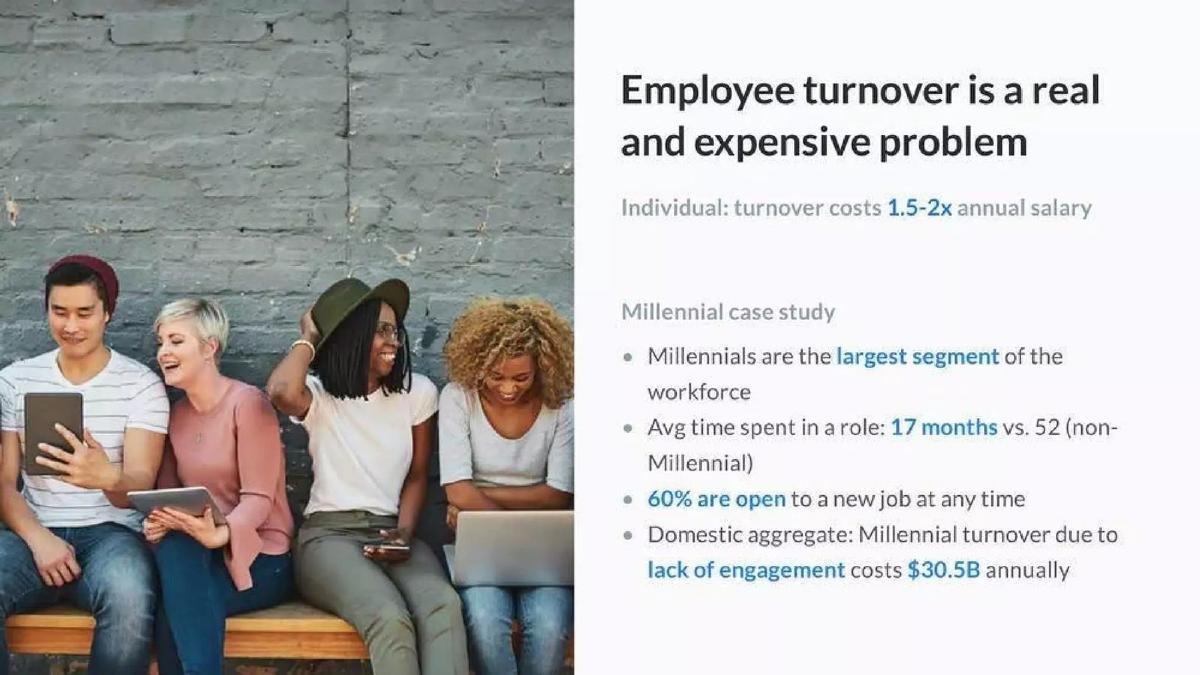
- Millennial turnover due to lack of engagement costs $30.5B annually (Slide 2).
- Individual employee turnover costs between 1.5x and 2x their annual salary (Slide 2).
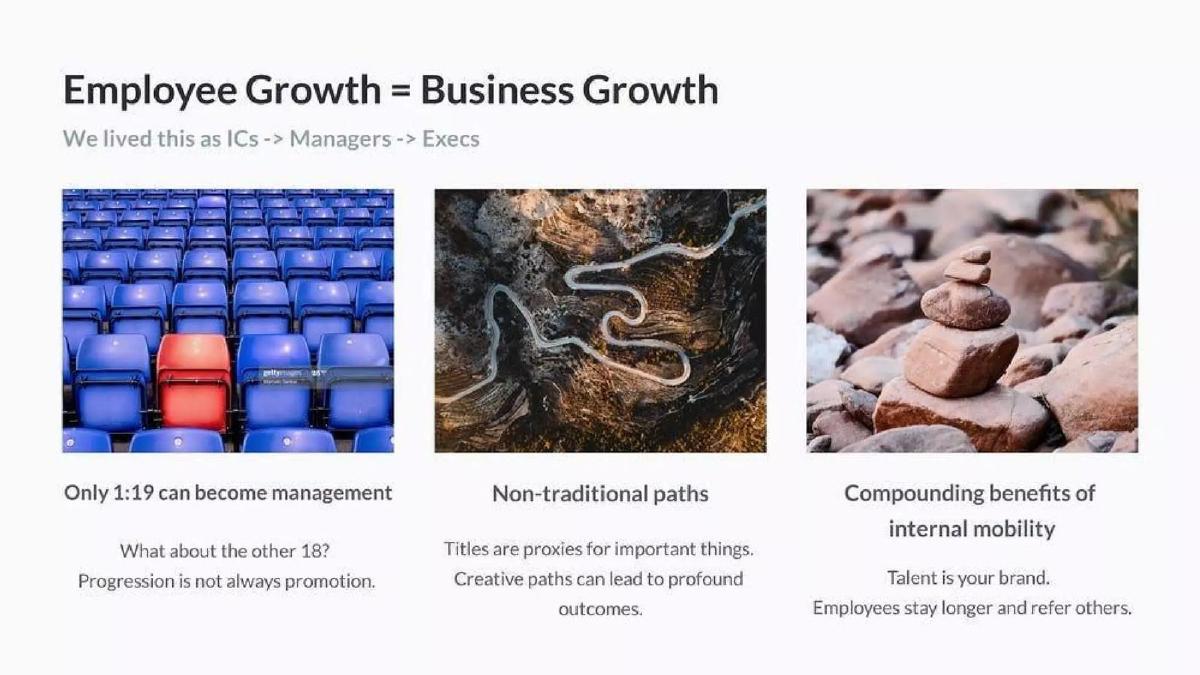
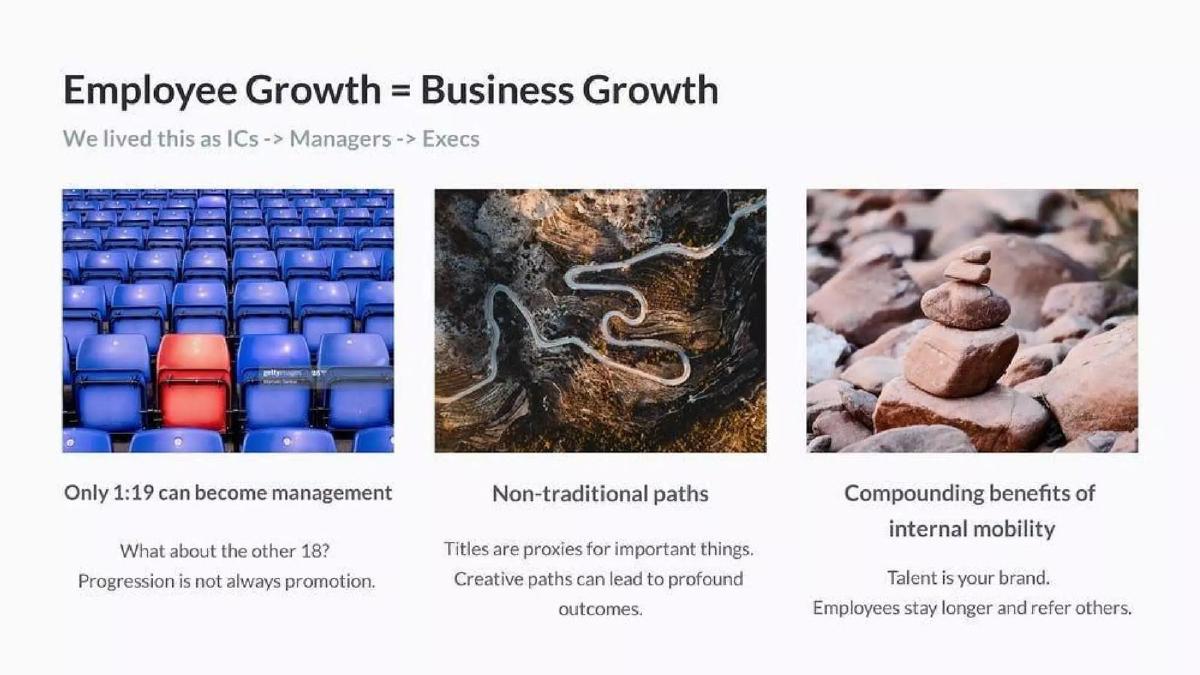
- Only 1 in 19 employees can typically become management, necessitating non-traditional career paths (Slide 1).
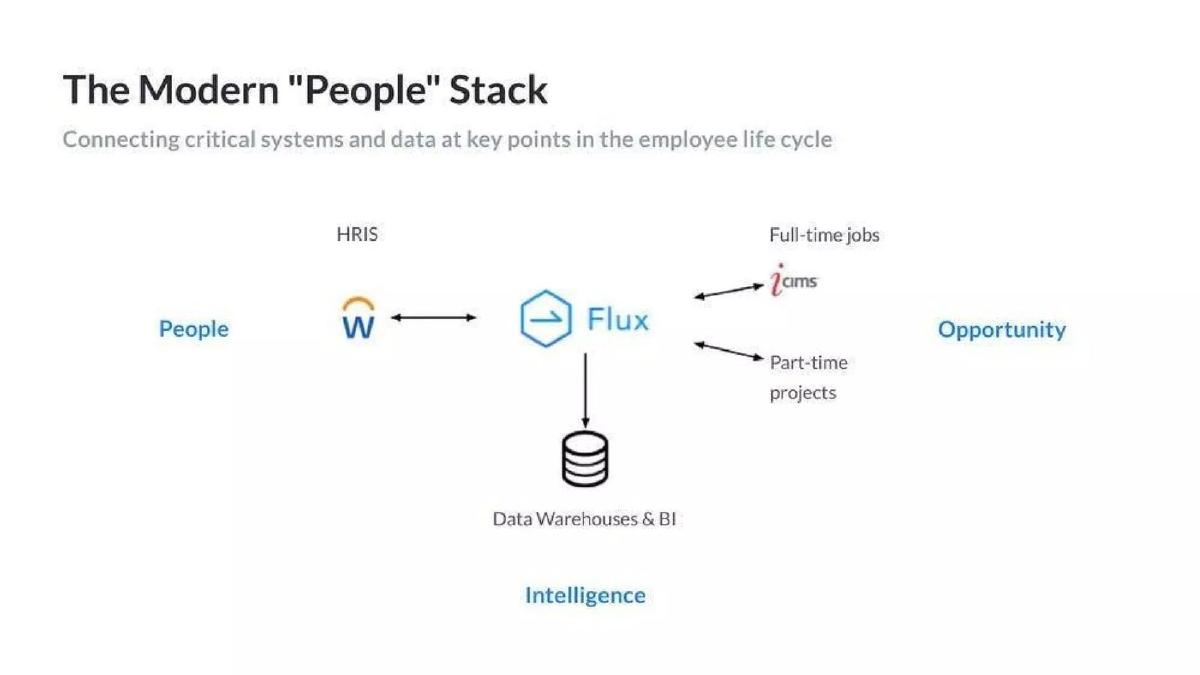
- Flux positions itself as the connective tissue between HRIS (Workday) and ATS (iCIMS) systems (Slide 5).
- The platform uses a 'Work Genome' combined with predictive intelligence to match employees to opportunities (Slide 8).
- A reported 97% of employees using Flux feel confident in navigating their internal career paths (Slide 9).
- The deck completely omits a team slide, financial history, and a specific funding ask.
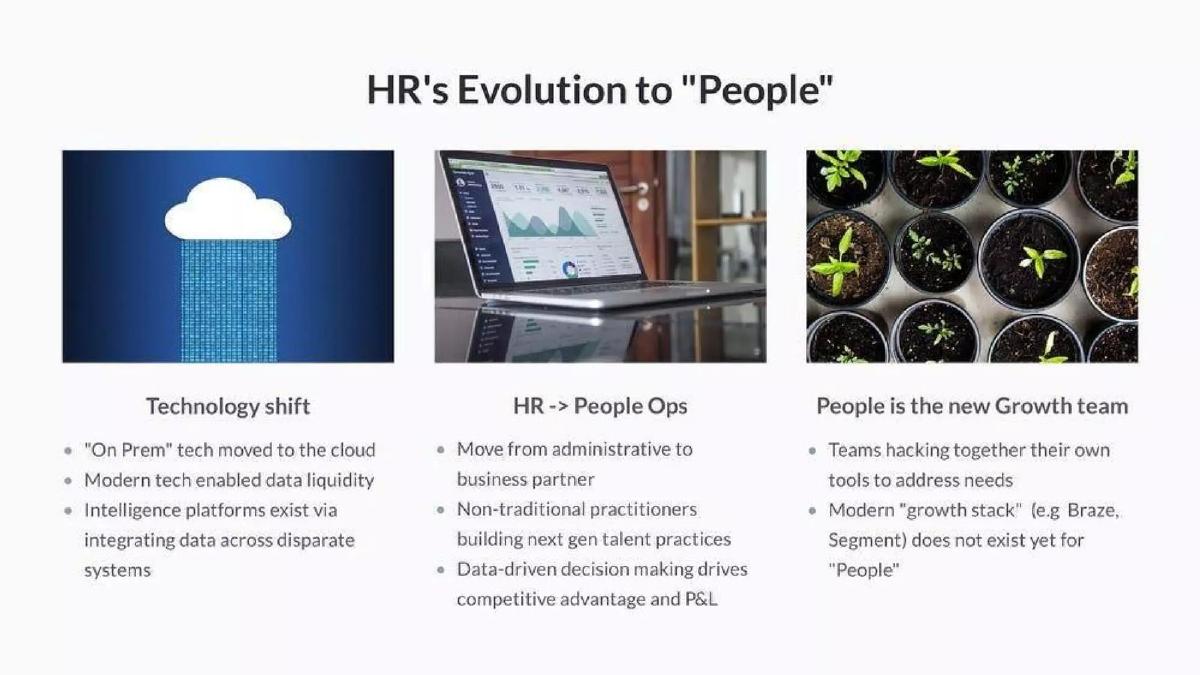
- Flux targets the 'People Ops' shift, comparing the need for a 'People' growth stack to tools like Braze or Segment (Slide 4).
The Vision of Internal Mobility
The Flux pitch deck, produced in 2020 according to the slide footers, is a masterclass in narrative-driven problem identification, though it leaves significant gaps in business execution details. The company, which raised $1.3 million in 2014 (per catalogue facts), uses this specific deck to pivot the conversation away from administrative HR and toward 'People Ops' as a growth engine. The deck is brief, consisting of only 10 slides, and relies heavily on high-quality photography and clean UI mockups to tell its story.
Slides 1-3: The Macro Problem of Talent Retention
Slide 1: Employee Growth = Business Growth Flux opens with a philosophical stance rather than a product shot. The slide establishes the founders' perspective ('We lived this as ICs -> Managers -> Execs') and highlights a structural bottleneck: only 1:19 employees can reach management. The slide argues that 'Progression is not always promotion,' setting the stage for a tool that facilitates lateral movement and 'non-traditional paths.'
Slide 2: Employee turnover is a real and expensive problem This is the 'villain' of the pitch. Flux provides concrete, painful metrics: turnover costs 1.5-2x an annual salary. The 'Millennial case study' section is particularly dense with data, noting that millennials stay in roles for only 17 months (versus 52 for others) and that 60% are open to new jobs at any time. The slide concludes with a massive market figure: $30.5B in annual domestic costs due to lack of engagement. This slide successfully validates the 'pain' for a potential enterprise customer.
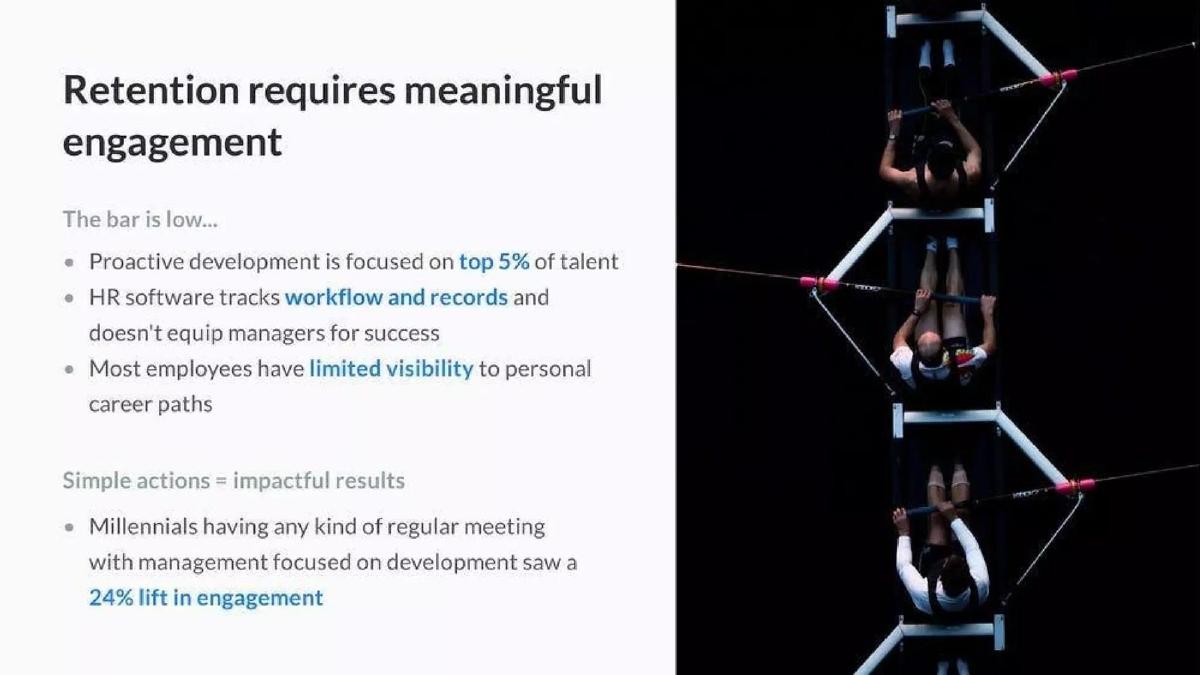
Slide 3: Retention requires meaningful engagement Flux critiques the status quo here. They claim the 'bar is low' because proactive development is currently reserved for the 'top 5% of talent.' They argue that existing HR software is merely a system of record ('tracks workflow and records') rather than a tool for manager success. The key takeaway is a 24% lift in engagement when millennials have regular development-focused meetings, providing a bridge to the Flux solution.
Slides 4-5: The Market Shift and Technical Integration
Slide 4: HR's Evolution to "People" This slide attempts to create a 'Why Now' urgency. It compares the current state of HR to the evolution of marketing and sales stacks. Flux points out that while modern 'growth stacks' (citing Braze and Segment) exist for customer data, a similar stack 'does not exist yet for People.' This positions Flux not just as a tool, but as a category creator in the 'People Ops' space.
Slide 5: The Modern "People" Stack This is the only architectural slide in the deck. It shows Flux as a central hub. To the left, it connects to 'People' data via Workday (HRIS). To the right, it connects to 'Opportunity' via iCIMS (for full-time jobs) and internal 'Part-time projects.' Below, it feeds 'Intelligence' into Data Warehouses and BI tools. This slide is critical because it reassures IT buyers and investors that Flux integrates with, rather than replaces, expensive legacy systems.
Slides 6-8: Product Deep Dive
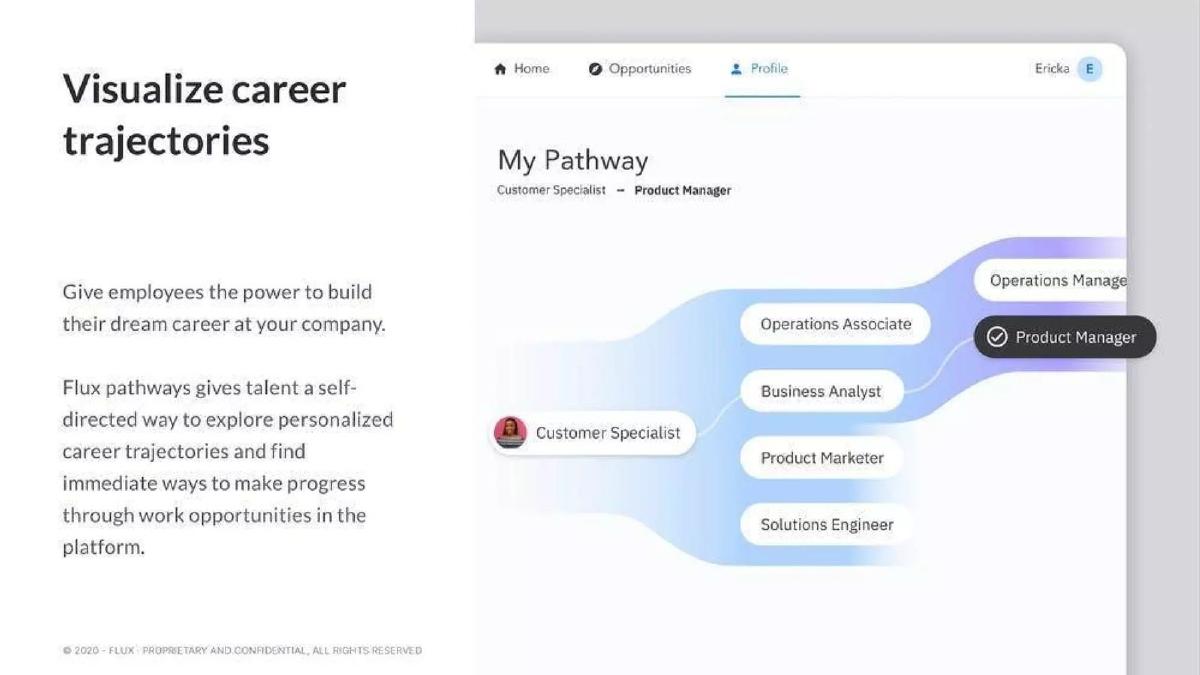
Slide 6: Visualize career trajectories The first product mockup shows 'My Pathway.' It is a clean, node-based visualization showing how a 'Customer Specialist' can move toward becoming a 'Product Manager.' This visualizes the 'non-traditional paths' mentioned in Slide 1. The text emphasizes 'self-directed' exploration, suggesting a bottom-up adoption model within companies.
Slide 7: Connect development to productivity This slide shows the 'Latest opportunities' feed. It lists a 'New Product Launch Team' (a 25% time project) and a 'Business Analyst' role (full-time). This demonstrates the platform's versatility in handling both micro-gigs and internal transfers. It frames these opportunities as 'low commitment ways to flex skills,' which directly addresses the millennial 'engagement' problem cited earlier.
Slide 8: Personalize opportunity Here, Flux introduces its 'Work Genome.' The mockup shows a 'Product Management Bootcamp' with a 'Skills required' vs. 'Skills matched' interface. It lists specific skills like 'Data Analysis' and 'Project Management' and shows how the employee's interests (e.g., 'Go-to-market') align with the role. This is the 'secret sauce' slide, explaining how the predictive intelligence actually functions to create a 'fit.'
Slides 9-10: Social Proof and Contact
Slide 9: 97% Confidence The deck ends its narrative with a single, powerful statistic: '97% of employees who have completed work on Flux report confidence in their ability to navigate their career within their company.' By citing 'Source: Flux,' the company indicates they already have a user base and are collecting feedback, though they do not disclose the number of users or names of pilot customers.
Slide 10: Thank you A standard closing slide with an email (info@fluxwork.co), website (www.fluxwork.co), and Twitter handle (@fluxworkdotco). Notably, the branding on the final slides uses 'Flux' with a hexagon logo, distinct from the 3D printing company description in the catalogue, suggesting a significant pivot or a different entity under the same name.
What Works in the Flux Pitch Deck
The deck excels at problem framing . By using specific dollar amounts ($30.5B) and specific timeframes (17 months for millennials), they turn a 'soft' HR problem into a 'hard' financial problem. The visual consistency is also high; the transition from the rowing imagery on Slide 3 to the software mockups on Slide 6 feels professional and intentional. Furthermore, the integration map on Slide 5 is a vital inclusion for any B2B SaaS company, as it answers the 'how does this fit with our existing tools' question immediately.
What is Missing from the Flux Pitch Deck
The omissions in this deck are substantial and would likely require a second, more detailed document for serious due diligence. There is no Team slide. In a crowded HR tech market, knowing who is building the 'Work Genome' is essential. There are no Unit Economics or Revenue figures. We don't know if they charge per seat, per 'match,' or a flat enterprise fee. The 'Ask' is absent. A pitch deck is a tool to raise money, yet this deck fails to mention how much they want or what they will do with it. Finally, there is no competitive analysis . Companies like LinkedIn (InnerMobility), Gloat, and Fuel50 operate in this exact space, and Flux offers no counter-positioning against them.
What a Founder Should Copy
Founders should emulate the 'Pathway' visualization on Slide 6. Instead of listing features, Flux shows the outcome of the feature: an employee seeing their future. The comparison to other 'stacks' (Slide 4) is also a clever way to help investors categorize a new product by anchoring it to successful existing categories like Marketing Automation. Lastly, the use of a single, high-impact stat to close the deck (Slide 9) is much more memorable than a generic 'Summary' slide.
Final Summary
Flux presents a compelling case for the 'Internal Talent Marketplace.' The deck is highly effective at selling a vision of the future where employees are empowered to navigate their own careers through data-driven matching. However, as an investment document, it is incomplete. It functions better as a 'teaser' deck designed to secure a first meeting rather than a 'full' deck designed to close a round. The lack of team, traction (beyond one percentage), and financial data means the founders are relying entirely on the strength of the 'People Ops' trend and their product design to carry the day.
Frequently asked questions
- What is the core problem Flux is trying to solve?
- Flux addresses the high cost and frequency of employee turnover, particularly among millennials. According to Slide 2, millennials spend an average of only 17 months in a role compared to 52 months for non-millennials, and 60% are open to a new job at any time. Flux argues that this is driven by a lack of visibility into internal career paths and a management focus that only prioritizes the top 5% of talent.
- How does the Flux product actually work based on the slides?
- The product acts as an internal opportunity marketplace. Slide 6 shows a 'Pathway' visualizer where a 'Customer Specialist' can see trajectories to roles like 'Product Manager' or 'Solutions Engineer.' Slide 7 displays a feed of 'Latest Opportunities,' including part-time projects (25% time) and full-time rotations. Slide 8 explains that its 'Work Genome' matches employees to these roles based on skills, work styles, and ambitions.
- What is missing from this pitch deck that an investor would usually expect?
- This deck is missing almost all standard 'business' slides. There is no Team slide to verify founder expertise, no Market Size (TAM/SAM/SOM) slide beyond a single turnover cost stat, no Business Model slide explaining how they charge, and no Competition slide. Most importantly, there is no 'Ask' slide detailing how much money they are raising or what the milestones for that capital will be.
- What is the 'Work Genome' mentioned in the deck?
- The 'Work Genome' is Flux's proprietary term for their data-driven matching engine. As described on Slide 8, it combines predictive intelligence with a holistic view of the employee. It doesn't just look at hard skills; it incorporates 'work styles,' 'goals,' 'interests,' and 'ambitions' to match workers with internal projects or new full-time roles, aiming for a better 'fit' than traditional HR methods.
- How does Flux fit into the existing HR technology ecosystem?
- Flux positions itself as an integration layer rather than a replacement for core HR systems. Slide 5 shows Flux sitting in the center of a 'Modern People Stack,' bi-directionally sharing data with HRIS platforms like Workday, pushing/pulling from recruitment tools like iCIMS, and feeding data into Data Warehouses and BI tools. It aims to be the 'intelligence' layer that connects people to opportunities.