How HR tech and recruiting startups present the problem in a pitch deck: name who inside the company carries the pain, cost it per hire or per case.
HR Tech Problem Slide: Real Pitch Deck Examples
Eight problem slides from HR tech and recruiting startups, shown in full, compare how each names who inside the company carries the problem, what it costs per hire, per employee or per case, and what the company uses today.
TL;DR
An HR tech problem slide should answer three questions: who inside the company carries the problem (the HR team, managers, finance or the employee), what it costs in hours or money per hire, per employee or per case, and what the company uses today? Disclo says HR managers spend "3-5 hours on each accommodation request" costing "~$140 - $200 per case" and that companies track disclosures "on sticky notes and spreadsheets." Comprehensive says compensation is "80% of company's total expense" and still runs on spreadsheets. Omnipresent lists the five things a company must set up to hire one person abroad. Peoplewave opens with "$550 billion" of worldwide turnover cost, which names no buyer and no cost a single company would recognise.
HR tech problem slides from real pitch decks
Each example shows the exact stored slide above its analysis and links to the full teardown. Claims are as shown on the slides; we have not verified them.
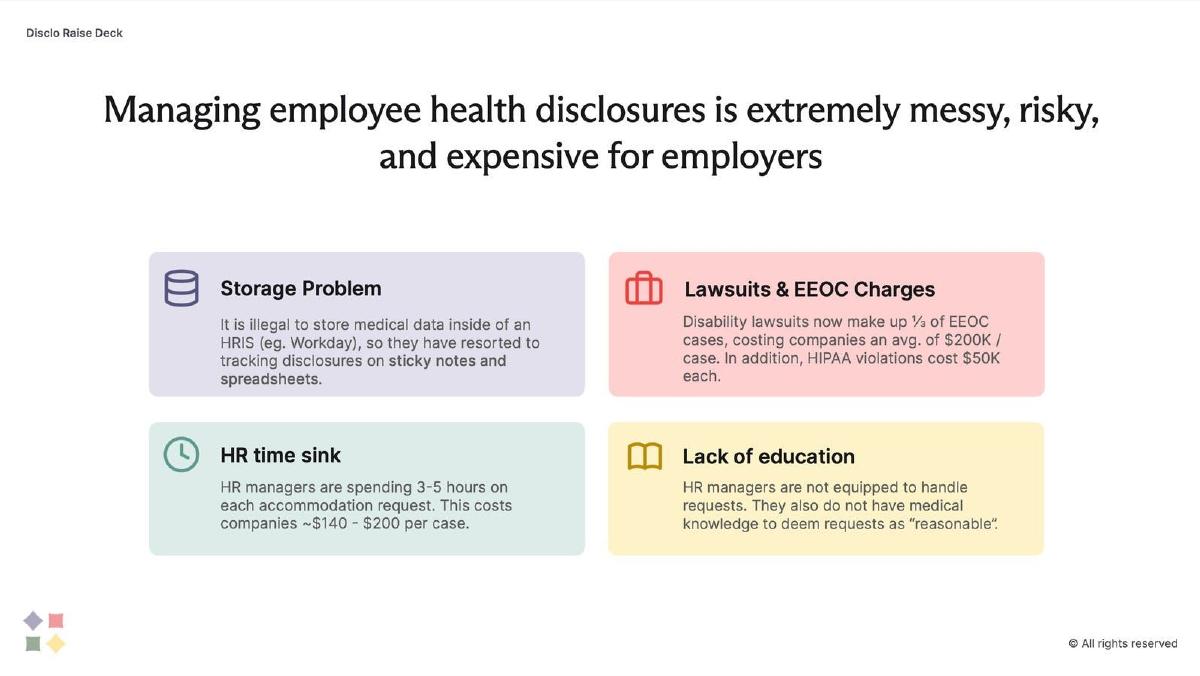
Disclo problem slide — slide 3
Software for handling employee health disclosures and workplace accommodations. Four cards, each with a cost or a risk.
Disclo deck, slide 3. Exact stored slide matched to this analysis.
Our analysis: It gives a cost per case, a legal risk and the reason the existing HR system cannot be used.
Evidence and limitation: Figures shown without sources on the slide.
What a founder can adapt: Cost the problem per case, and say why the buyer's existing system cannot handle it.
Supporting analysis
What the deck claims: "Managing employee health disclosures is extremely messy, risky, and expensive for employers." "It is illegal to store medical data inside of an HRIS (eg. Workday), so they have resorted to tracking disclosures on sticky notes and spreadsheets." "HR managers are spending 3-5 hours on each accommodation request. This costs companies ~$140 - $200 per case." "HIPAA violations cost $50K each."
Presentation choice: "Illegal to store medical data inside of an HRIS" explains why the buyer's current software cannot solve this, which is the question investors ask first.
When it does not fit: Add sources for the per-case cost and the lawsuit figures; a compliance buyer will check them.
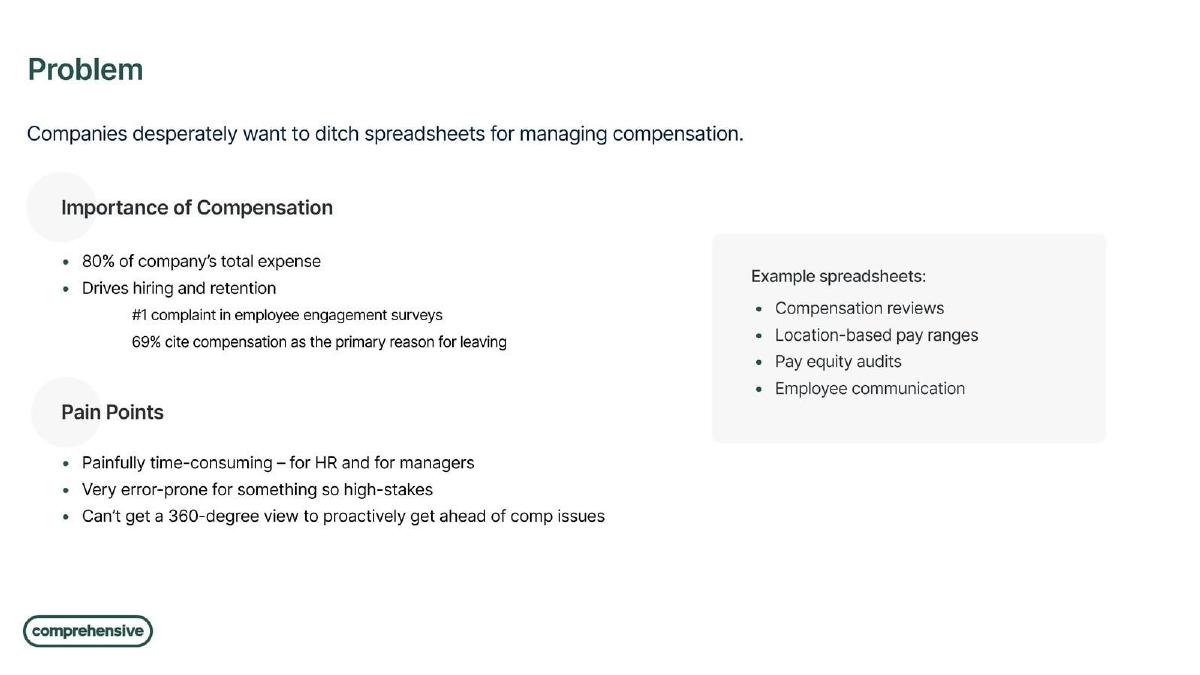
Compensation management software. Why pay matters, what goes wrong, and the spreadsheets companies use.
Comprehensive deck, slide 6. Exact stored slide matched to this analysis.
Our analysis: It shows why the process matters (the largest cost line) and names the tool used today (spreadsheets), with examples.
Evidence and limitation: Percentages shown without sources.
What a founder can adapt: List the specific spreadsheets or manual steps your buyer uses now.
Supporting analysis
What the deck claims: "Companies desperately want to ditch spreadsheets for managing compensation." "80% of company's total expense." "#1 complaint in employee engagement surveys." "69% cite compensation as the primary reason for leaving." Pain points: "Painfully time-consuming – for HR and for managers", "Very error-prone for something so high-stakes", "Can't get a 360-degree view." Example spreadsheets: compensation reviews, location-based pay ranges, pay equity audits.
Presentation choice: Listing the actual spreadsheets makes the workaround concrete; any HR leader will recognise them.
When it does not fit: Put a number on "painfully time-consuming": hours per review cycle for HR and for each manager.
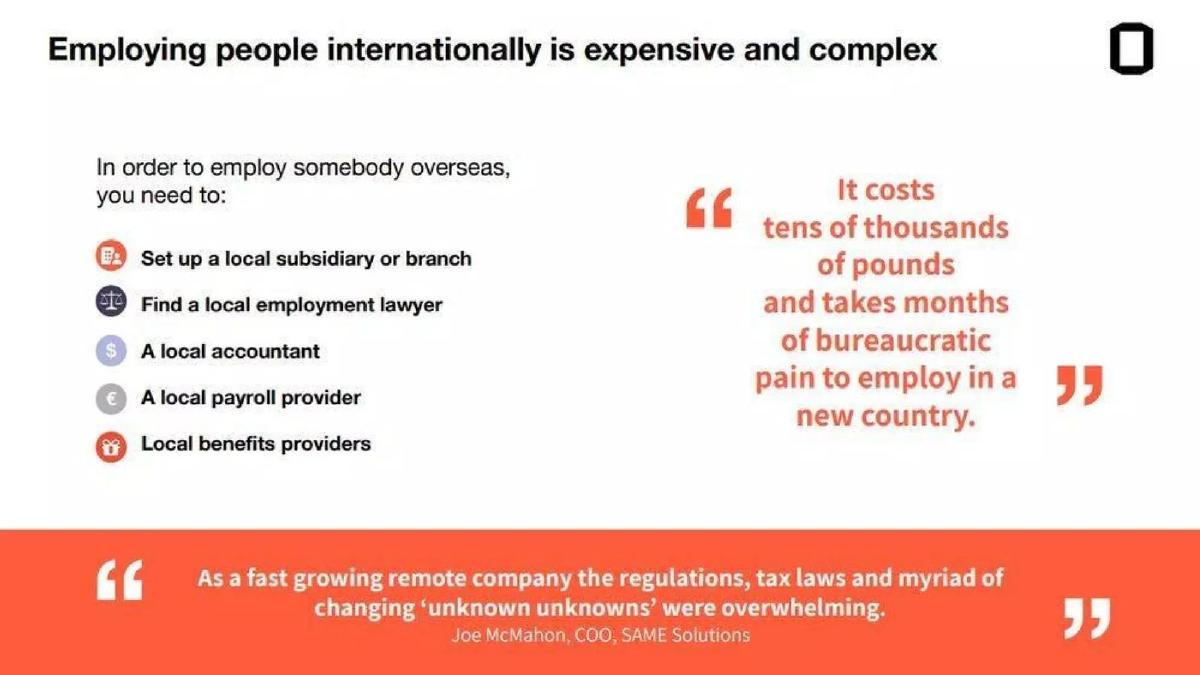
Global employment for remote teams. A checklist of what hiring abroad requires, plus a customer quote.
Omnipresent deck, slide 3. Exact stored slide matched to this analysis.
Our analysis: The five-item checklist shows the current process step by step, which makes the cost feel real.
Evidence and limitation: A named customer quote; the cost is a range, not a figure.
What a founder can adapt: List every step your buyer has to take today, and add one named customer quote.
Supporting analysis
What the deck claims: "Employing people internationally is expensive and complex." "In order to employ somebody overseas, you need to: Set up a local subsidiary or branch, Find a local employment lawyer, A local accountant, A local payroll provider, Local benefits providers." "It costs tens of thousands of pounds and takes months of bureaucratic pain to employ in a new country." Quote: "…the regulations, tax laws and myriad of changing 'unknown unknowns' were overwhelming." – Joe McMahon, COO, SAME Solutions.
Presentation choice: A named operator's quote is evidence a buyer trusts more than a market statistic.
When it does not fit: Replace "tens of thousands" and "months" with a typical figure for one country.
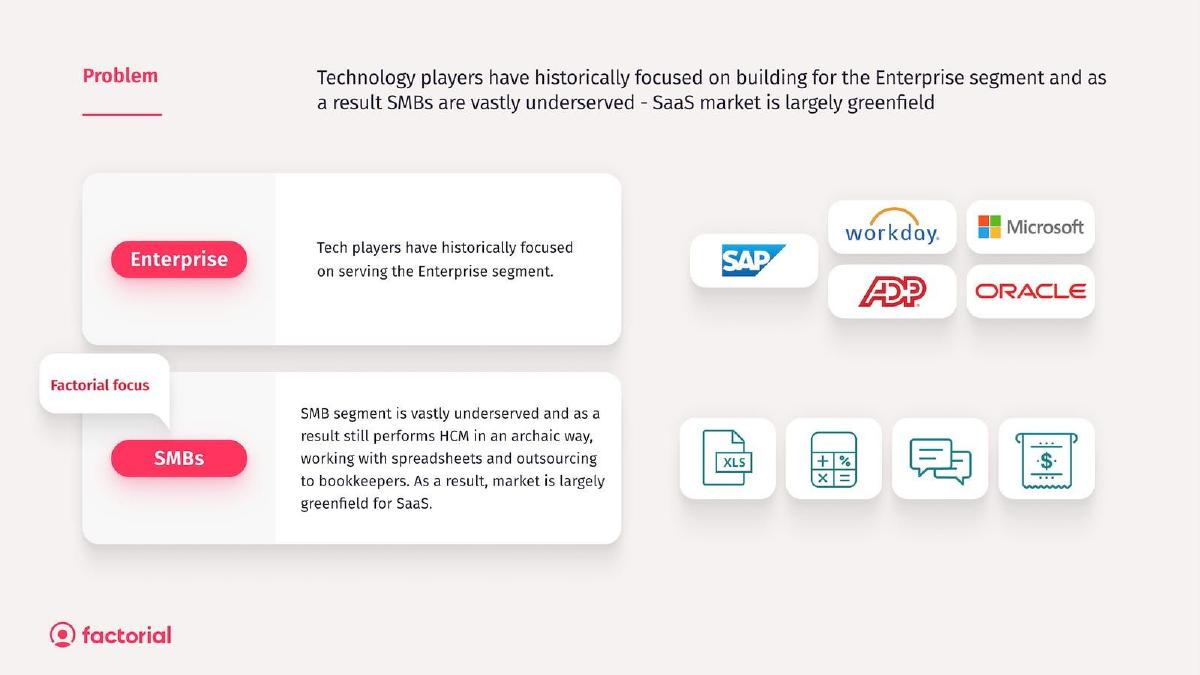
HR software for small businesses. Two segments side by side: enterprise, served by named vendors, and small businesses, served by spreadsheets.
Factorial deck, slide 4. Exact stored slide matched to this analysis.
Our analysis: It defines the buyer by company size and shows what each size uses today.
Evidence and limitation: No figures.
What a founder can adapt: Name who serves the segment above yours, and what your segment does instead.
Supporting analysis
What the deck claims: "Technology players have historically focused on building for the Enterprise segment and as a result SMBs are vastly underserved - SaaS market is largely greenfield." Enterprise: SAP, Workday, Microsoft, ADP, Oracle. SMBs: "still performs HCM in an archaic way, working with spreadsheets and outsourcing to bookkeepers."
Presentation choice: Naming the enterprise vendors explains why the gap exists: they build for large companies.
When it does not fit: Add how many small businesses there are in the target market and what share still use spreadsheets.
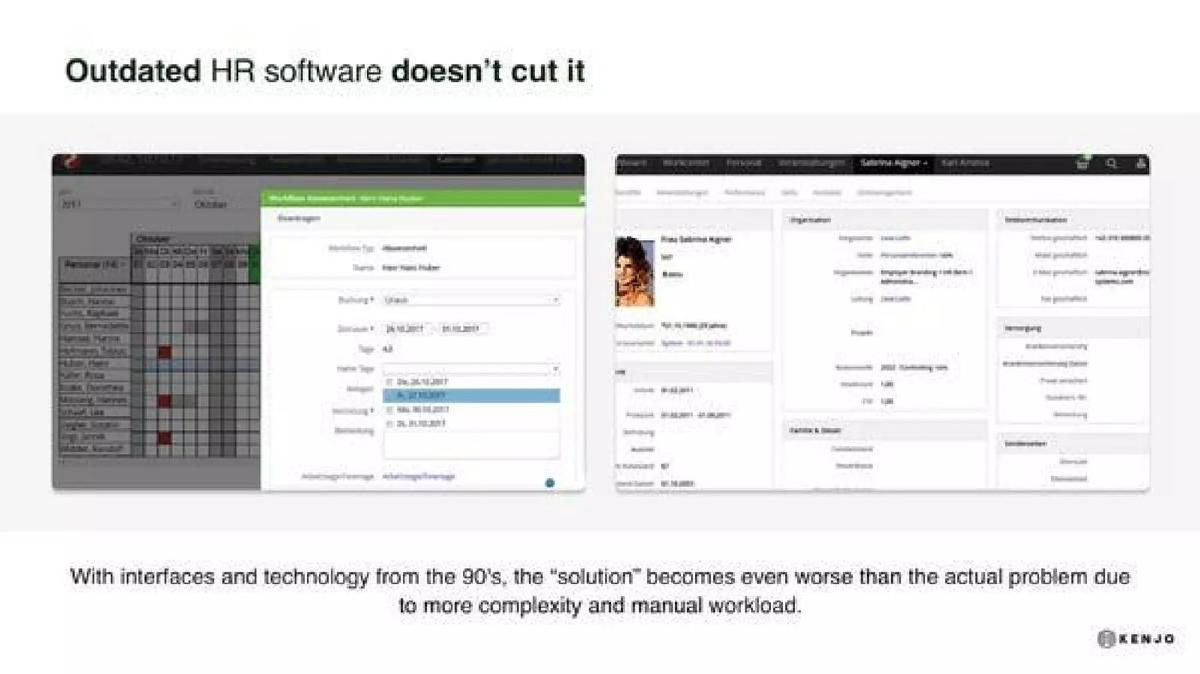
HR software for mid-sized companies. Two screenshots of legacy HR software and one sentence.
Kenjo deck, slide 4. Exact stored slide matched to this analysis.
Our analysis: Showing the current software is more persuasive than describing it.
Evidence and limitation: Screenshots of existing software; no figures.
What a founder can adapt: If the current tool is the problem, show a screenshot of it.
Supporting analysis
What the deck claims: "Outdated HR software doesn't cut it." "With interfaces and technology from the 90's, the 'solution' becomes even worse than the actual problem due to more complexity and manual workload."
Presentation choice: Investors can see the problem in two seconds without reading.
When it does not fit: Say who uses these screens (HR admins, managers) and how many hours a week they lose to them.
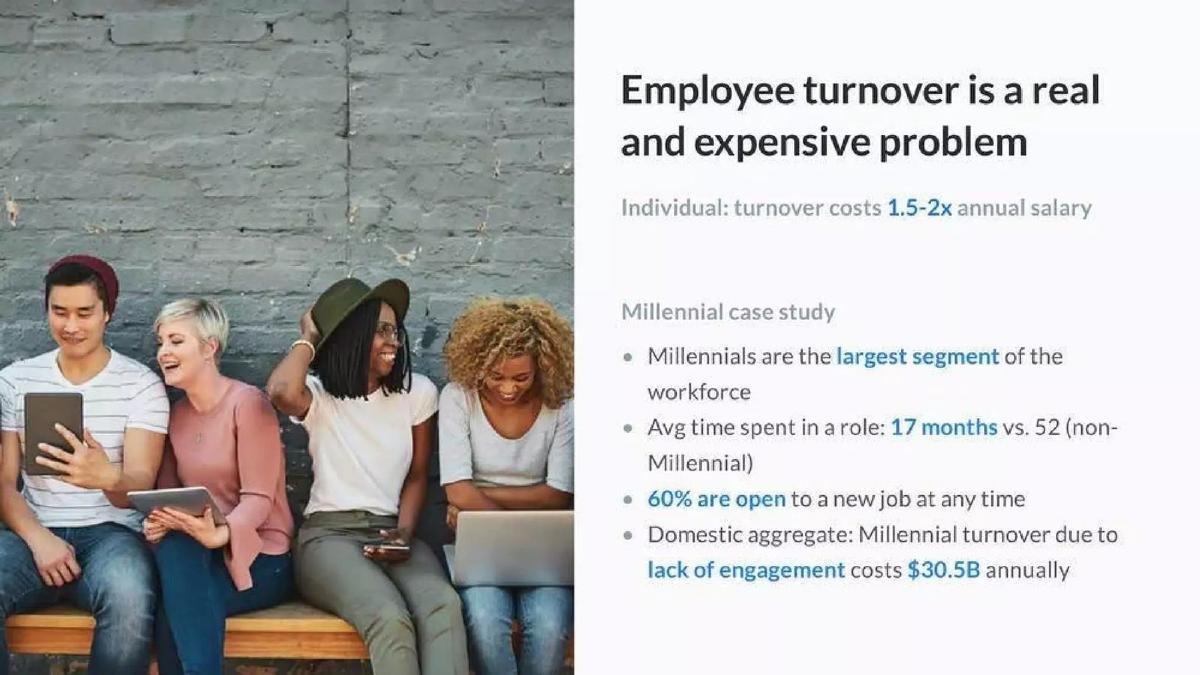
Internal job moves and talent mobility. A cost per departure plus a case study of one group of workers.
Flux deck, slide 2. Exact stored slide matched to this analysis.
Our analysis: It starts with a cost per departure a company can check, then narrows to one group.
Evidence and limitation: Figures shown without sources.
What a founder can adapt: Give a cost per employee, then narrow to the group that has the problem most.
Supporting analysis
What the deck claims: "Employee turnover is a real and expensive problem." "Individual: turnover costs 1.5-2x annual salary." Millennial case study: "Millennials are the largest segment of the workforce", "Avg time spent in a role: 17 months vs. 52 (non-Millennial)", "60% are open to a new job at any time", "Millennial turnover due to lack of engagement costs $30.5B annually."
Presentation choice: "1.5-2x annual salary" lets any buyer work out their own cost of turnover.
When it does not fit: Drop the $30.5B national figure or replace it with the cost for a typical company of your target size.
AI recruiting and interview coaching. A partial example: three footnoted figures, then three pains for different parties.
Claire deck, slide 2. Exact stored slide matched to this analysis.
Our analysis: The top row is costed per job opening, which an employer budgets; the bottom row switches to the candidate.
Evidence and limitation: Footnote markers on each figure; sources are not visible on the slide image.
What a founder can adapt: If you serve both sides, give each side its own cost, or lead with the side that pays.
Supporting analysis
What the deck claims: "The recruitment industry is costly." "$4,000 Spent per job opening." "52 Days To fill a job opening." "99% Candidates go through multi-interview processes." "Interviews are inefficient": "Jobs are harder to get", "Interviews are biased", "Career coaching avg =$161/hr."
Presentation choice: It shows the risk of a two-sided product: the slide serves employers and candidates and fully convinces neither.
When it does not fit: Connect the coaching price to the employer's problem, or move it to a separate candidate slide.
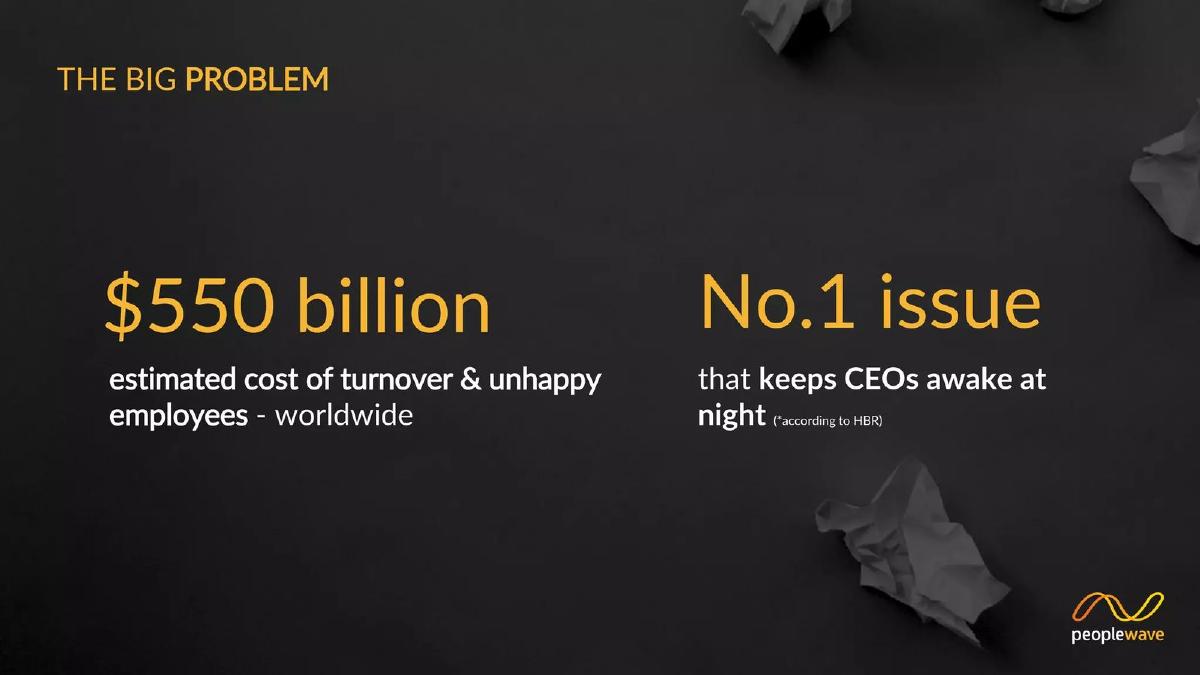
Employee feedback and performance software. A weaker example, included on purpose: two headline figures and nothing else.
Peoplewave deck, slide 6. Exact stored slide matched to this analysis.
Our analysis: Both claims are true of every HR product, so they say nothing about this one.
Evidence and limitation: HBR is named for the second claim; the $550 billion figure has no source.
What a founder can adapt: Replace the global figure with what turnover costs a 200-person company and what it uses to spot it today.
Supporting analysis
What the deck claims: "THE BIG PROBLEM." "$550 billion estimated cost of turnover & unhappy employees - worldwide." "No.1 issue that keeps CEOs awake at night (according to HBR)."
Presentation choice: It shows the minimum an HR problem slide needs: a buyer, a cost per employee and today's workaround.
When it does not fit: Don't lead with a worldwide figure; investors discount it immediately.
Whether each slide names the buyer, costs the problem per unit, and names what the company uses today.
Example
Buyer named
Cost per unit
Today's workaround
Disclo
Yes (HR managers)
Yes ($140–200 per case)
Yes (sticky notes, spreadsheets)
Comprehensive
Yes (HR and managers)
No
Yes (named spreadsheets)
Omnipresent
Yes (companies hiring abroad)
Partly (tens of thousands)
Yes (lawyer, accountant, payroll)
Factorial
Yes (small businesses)
No
Yes (spreadsheets, bookkeepers)
Kenjo
Partly
No
Yes (legacy HR software)
Flux
Partly (employers)
Yes (1.5–2x salary)
No
Claire
Partly (employers and candidates)
Yes ($4,000 per opening)
No
Peoplewave
No
No
No
Key Takeaways
Name the buyer, not just the employee. HR software is bought by HR, finance or operations; say whose day gets worse.
Cost the problem per unit the buyer budgets: per hire, per employee, per case or per country.
Name today's workaround: spreadsheets, a legacy HR system, an outside lawyer or a staffing agency.
A global turnover or engagement figure is a headline, not a problem; bring it down to one company.
Source every statistic. HR buyers read the same reports and will recognise invented figures.
Build your HR tech problem slide
One buyer, one cost per unit, one workaround.
Buyer. Who pays for the fix: HR, finance, operations or line managers? Is that the same person who feels the problem?
Unit cost. What does it cost per hire, per employee, per case or per country? What is your source?
Workaround. What do they use today (spreadsheets, a legacy system, an agency, a lawyer), and why can't it fix this?
Company size. For what size of company is this true? Costs and tools differ at 50, 500 and 5,000 employees.
Copyable framework: [Buyer] at [company size] spend [cost per unit, source] on [task] because [current workaround] [specific failure].
Illustrative example 1 — written by us
Before: Employee disengagement costs the global economy trillions.
After: HR teams at 200-person companies spend about 12 hours per quarterly review cycle chasing manager feedback by email, because their HR system has no review workflow.
What improved: Our illustrative rewrite; the figures are invented for the example. It names a buyer, a company size, a cost per cycle and why today's tool fails.
What this guide adds
The general problem slide guide covers any business, and the B2B SaaS problem guide covers business software broadly. HR is different in one way investors watch for: the person who feels the problem (an employee, a candidate) is rarely the person who pays (the HR team, finance, a line manager). Strong HR problem slides say which of those they are selling to and cost the problem in that buyer's terms.
The field also leans on a few very large, widely quoted figures for turnover and disengagement. This guide shows the difference between those headline numbers and costs a single company can check.
Three things an HR problem slide proves
Who pays: the named team or role that carries the cost (Disclo's HR managers, Comprehensive's HR and managers, Factorial's small businesses).
How much: hours or money per hire, employee or case (Disclo, Omnipresent, Flux, Claire).
What they use today: the spreadsheet, legacy system or outside provider that fails them (Comprehensive, Kenjo, Omnipresent, Factorial).
Common mistakes
Global headline figures. Trillions in lost productivity describes every HR product; cost it per employee instead.
Selling to the employee. Employees feel the pain but rarely pay; name the buyer.
No workaround named. Say what the company uses today, or investors assume nothing needs replacing.
Two sides at once. Recruiting products serve employers and candidates; lead with the one that pays.
Unsourced statistics. HR buyers read the same reports; cite each figure.
Diagnostic checklist
The buyer inside the company is named.
The cost is per hire, per employee, per case or per country.
Today's workaround is named.
The company size is clear.
Every figure has a source.
Frequently asked questions
How we chose these examples
Corpus: published pitch deck teardowns on StartupFundraising.com. Founder-uploaded private decks are excluded.
Selection (2026-09-25): we searched extracted text of slides 2–6 for problem and challenge slides in decks whose recorded sector is HR, recruiting, talent, workforce, staffing or payroll. About sixty candidates were listed and eighteen stored images inspected. 10KC's problem slide was set aside because it is marked "Please keep confidential". June 27th's slide carries a "For personal use only" watermark and was set aside. Heron, BetterManager, Cleary, Hive, Emplu, Jomla, CareerApp and Ever Job were set aside as weaker than those chosen or already used elsewhere. Peoplewave is kept as a weaker contrast.
Overlap check: none of these eight slides appears in another guide. Comprehensive appears in the team slide guide with a different slide.
Review: all eight stored slide images were inspected on 2026-09-25 and matched to company, deck and slide number (editorial model review). No person has yet completed an editorial review of this page.
Claims are as shown on the slides; we have not verified them. We make no claim that any slide caused a fundraising outcome.