Omnipresent’s 8-slide deck is a masterclass in brevity, focusing on the 'Employer of Record' (EOR) model during a period of rapid market shift. The deck identifies a specific, high-friction problem—the cost and complexity of setting up local entities—and positions its tech platform as the frictionless solution. While the deck lacks traditional financial projections, unit economics, or a competitive landscape, it leans heavily on the founders' unique backgrounds, including special forces leadership and Oxford innovation awards, to build credibility. The presentation successfully captures the u…
Key takeaways
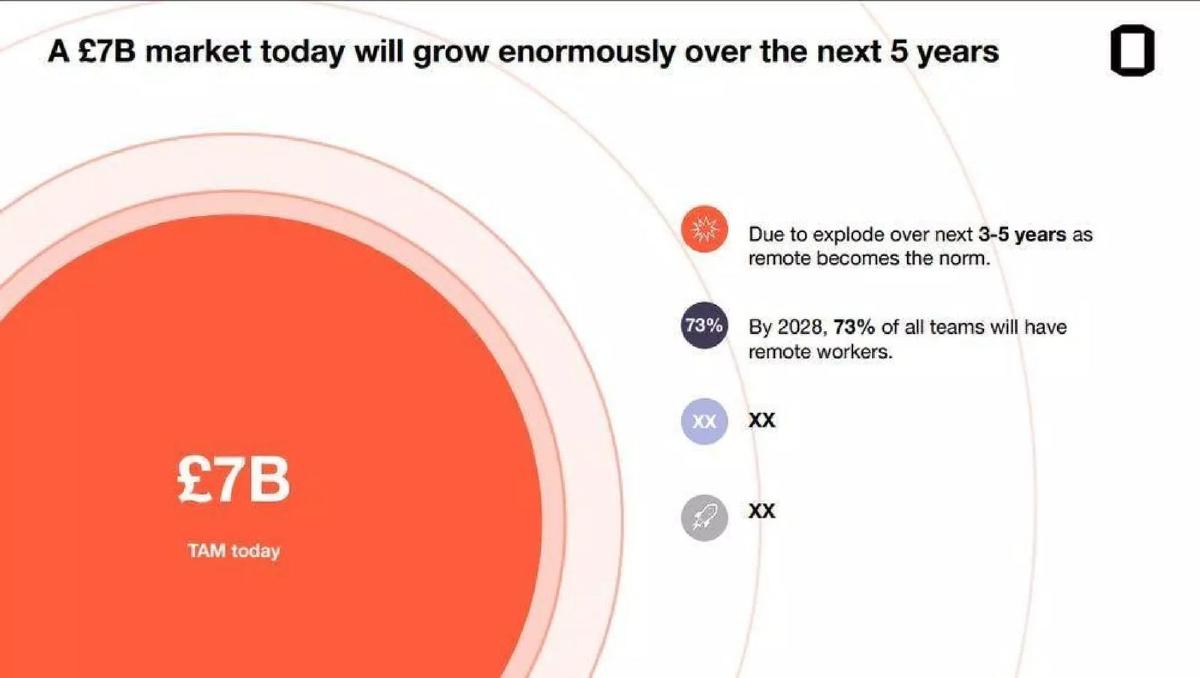
- The deck identifies a £7B current market with a prediction that 73% of all teams will have remote workers by 2028 (Slide 6).
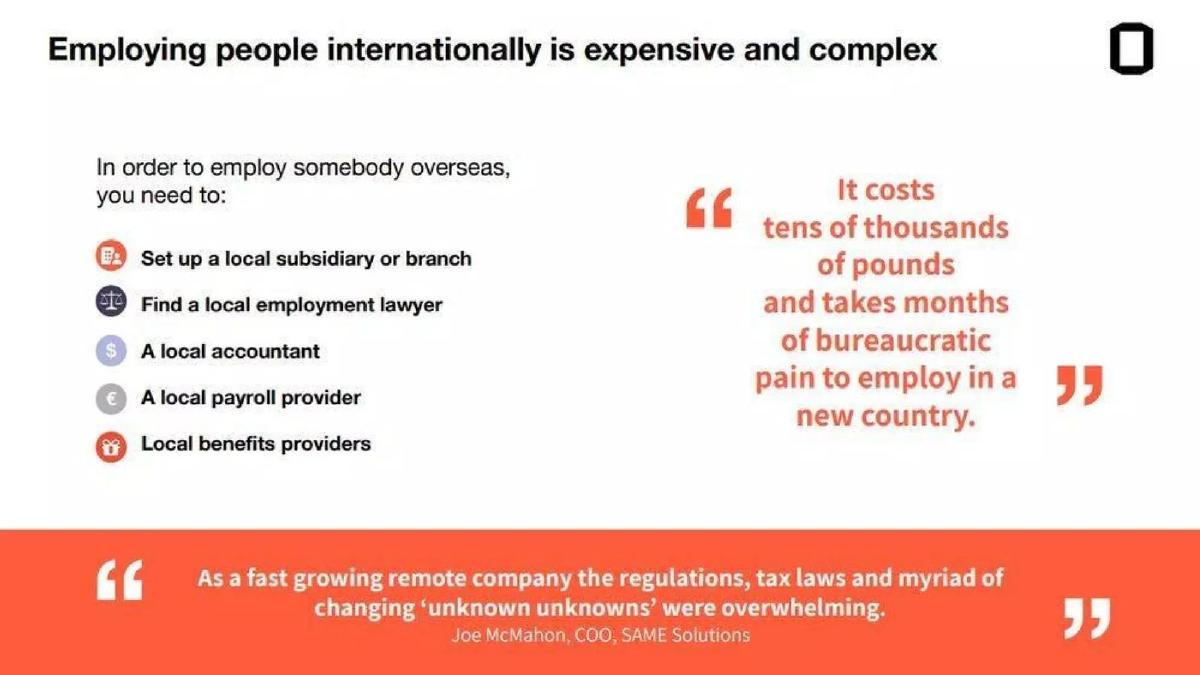
- It quantifies the problem by stating international employment costs 'tens of thousands of pounds' and takes months of bureaucratic pain (Slide 3).
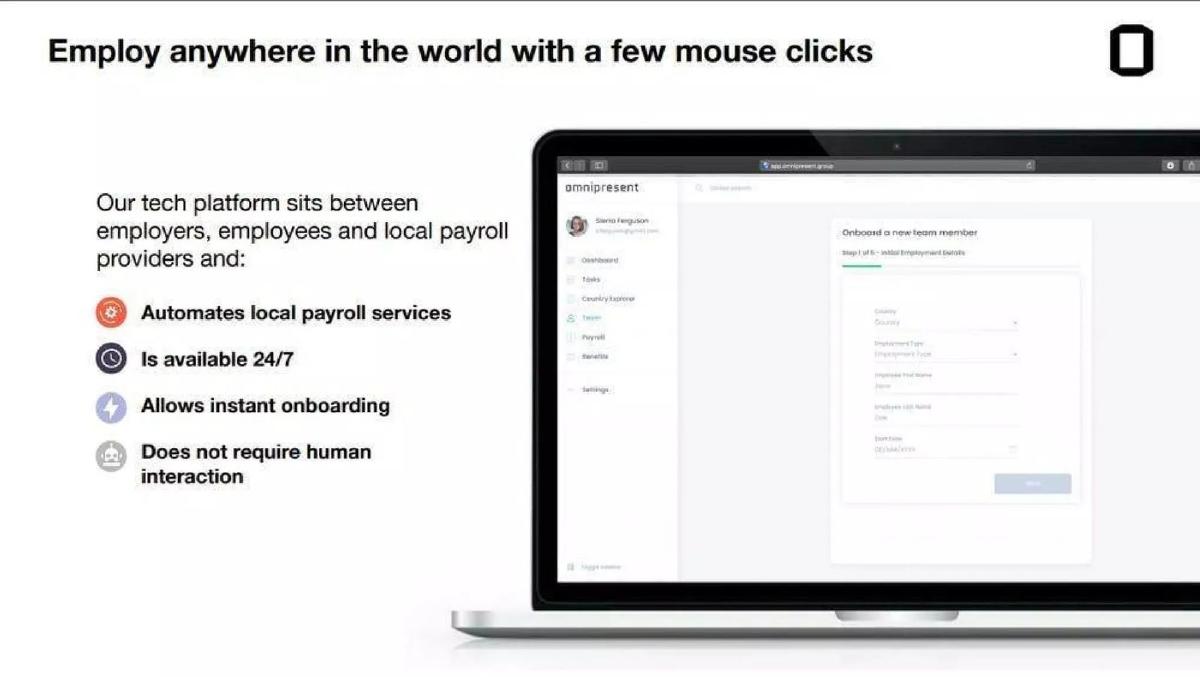
- The solution is positioned as a tech platform that 'does not require human interaction' and allows for 'instant onboarding' (Slide 4).
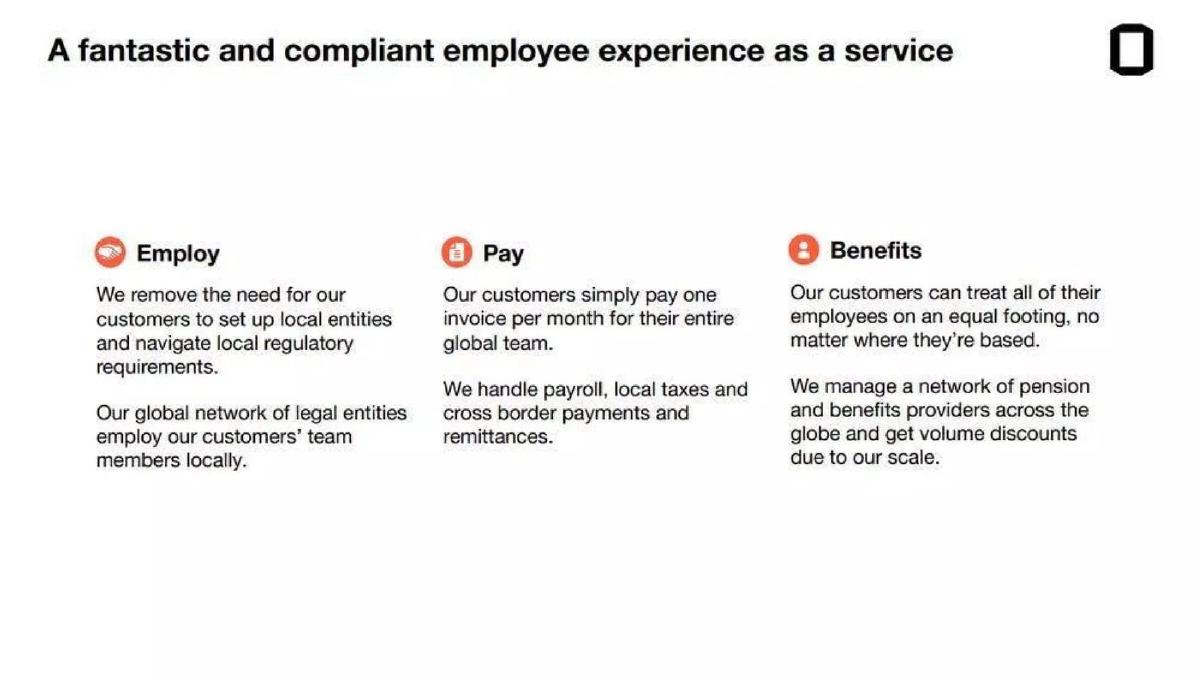
- The business model is simplified into three pillars: Employ, Pay, and Benefits, managed via a single monthly invoice (Slide 5).
- Founder credibility is a focal point, highlighting Guenther Eisinger's experience as a Special Forces officer and Matthew Wilson's Forbes 30 under 30 status (Slide 7).
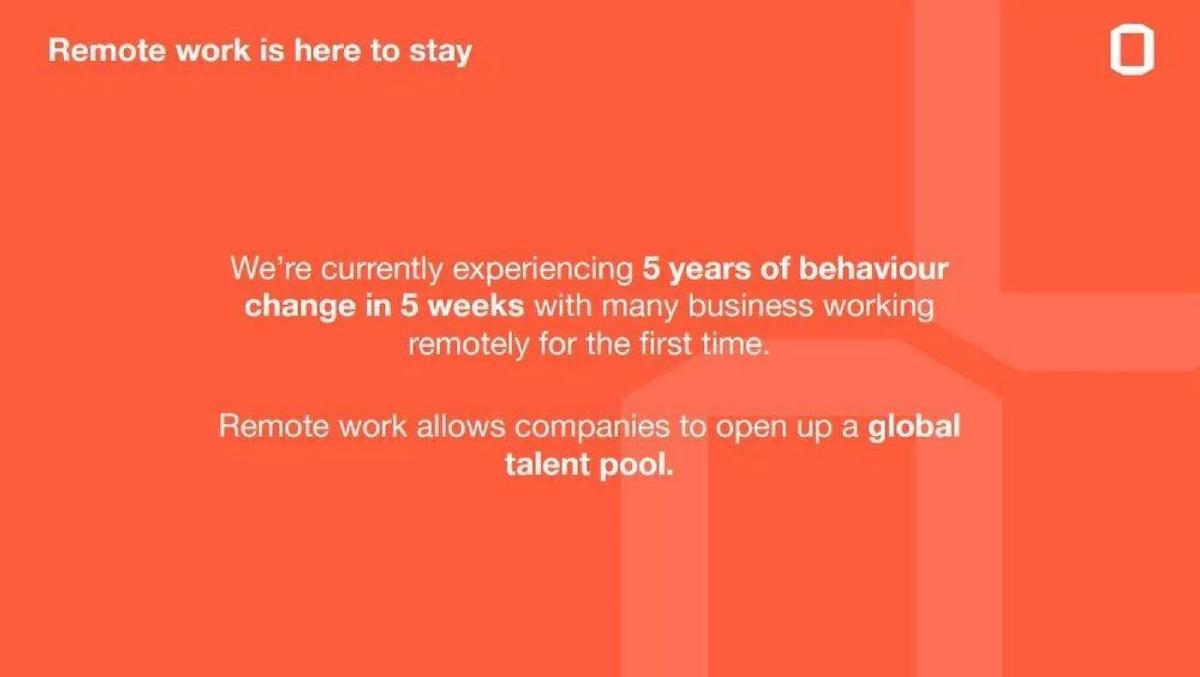
- The deck uses a 'why now' catalyst, citing a 5-year behavior change occurring in just 5 weeks (Slide 2).
- There is a complete absence of a specific 'Ask' slide, financial history, or a roadmap for the capital raised.
- The market slide contains placeholder 'XX' values for two of its four key growth metrics, suggesting a draft or redacted version (Slide 6).
The Lean Strategy of a Global EOR Giant
Omnipresent entered the market at a pivotal moment for global employment. Their 8-slide deck, used during their early stages leading up to a massive $137.8 million total raise, focuses on clarity and the removal of friction. The deck does not get bogged down in the minutiae of international labor law; instead, it promises to make those laws invisible to the customer through automation. By framing the problem as a 'bureaucratic pain' that costs 'tens of thousands of pounds,' they establish a high-value proposition that justifies a SaaS-style premium.
Slides 1-2: The Macro Shift
Slide 1: Title The deck opens with a monochrome image of a globe, establishing the company's international scope immediately. The tagline, 'Global Business. Local Employment,' is a concise summary of the Employer of Record (EOR) model. The sub-headline, 'Employ anywhere in the world with a few mouse clicks,' sets the expectation for a technology-first solution rather than a service-heavy agency.
Slide 2: The Catalyst Slide 2 addresses the 'Why Now?' question. It states, 'Remote work is here to stay.' The most compelling claim on this slide is that the market is 'currently experiencing 5 years of behaviour change in 5 weeks.' This refers to the rapid acceleration of remote work adoption, likely influenced by the global events of 2019-2020. The slide concludes by noting that remote work allows companies to access a 'global talent pool,' which serves as the primary driver for Omnipresent's services.
Slides 3-5: Problem, Solution, and Service Model
Slide 3: The Problem This slide breaks down the complexity of international hiring into five distinct requirements: local subsidiaries, lawyers, accountants, payroll providers, and benefits providers. By listing these, Omnipresent highlights the fragmented nature of the current solution. The slide uses a quote from Joe McMahon (COO, SAME Solutions) to validate the emotional and financial toll: 'It costs tens of thousands of pounds and takes months of bureaucratic pain to employ in a new country.' This slide effectively builds the 'pain' before introducing the 'aspirin.'
Slide 4: The Solution The solution slide features a laptop mockup showing the Omnipresent dashboard. The text explicitly positions the 'tech platform' as the intermediary between employers and local providers. Four key value points are listed: automation of payroll, 24/7 availability, instant onboarding, and—crucially—that it 'does not require human interaction.' This last point is vital for investors, as it suggests a high-margin software business rather than a low-margin services business.
Slide 5: The Service Pillars Slide 5 explains the 'Employee experience as a service.' It divides the offering into three categories: Employ (removing the need for local entities), Pay (consolidating global payroll into one monthly invoice), and Benefits (providing equal footing for employees regardless of location). The mention of 'volume discounts due to our scale' in the benefits section hints at a secondary competitive advantage: as Omnipresent grows, its ability to offer cheaper benefits than a small company could get on its own increases.
Slides 6-8: Market, Team, and Contact
Slide 6: Market Size The market slide uses a large red circle to represent a '£7B market today.' It makes a bold prediction that by 2028, 73% of all teams will have remote workers. However, this slide appears incomplete or redacted, as two of the bullet points are simply marked with 'XX.' Despite the missing data, the narrative of an 'exploding' market over the next 3-5 years is clear. The choice to use GBP (£) reflects the company's London roots.
Slide 7: The Team For a company dealing with complex international regulations and 'extreme risk environments,' the team slide is exceptionally strong. Matthew Wilson (Co-CEO) brings Oxford credentials and SaaS experience. Guenther Eisinger (Co-CEO) offers a unique profile: a PhD combined with Special Forces leadership in Afghanistan and Africa. This suggests a team capable of handling high-stakes operational complexity. Chris Mason (Tech Lead) rounds out the trio with a background in fintech and expense management, providing the necessary technical foundation.
Slide 8: Contact The final slide mirrors the first, providing a simple 'Get in touch!' call to action with an email address and website URL. There is no summary of the investment opportunity or a closing 'big vision' statement, keeping the deck strictly functional.
What Works in the Omnipresent Deck
The primary strength of this deck is its radical simplicity . In an industry (HR compliance) that is notoriously boring and complicated, Omnipresent manages to explain their value proposition in under 10 slides. They successfully frame a service-heavy industry as a software-driven one, which is exactly what venture capitalists look for in 'unsexy' sectors.
The founder-market fit is also highly evident. By highlighting Guenther Eisinger’s Special Forces background alongside Matthew Wilson’s Oxford Innovation awards, they signal to investors that they have the discipline to navigate the 'unknown unknowns' of global regulation. The use of a third-party testimonial on the problem slide (Slide 3) adds immediate credibility, proving that the pain point isn't just theoretical—it is costing real companies tens of thousands of pounds.
What is Missing from the Omnipresent Deck
While the deck is effective for a high-level pitch, it omits several standard components that most founders would be required to include:
The Ask: There is no mention of how much capital is being sought, the valuation, or the intended use of funds. · Traction and Metrics: Aside from one quote, there is no data on current revenue, number of employees managed, or growth rates. · Competition: The EOR space is crowded with players like Deel, Remote, and Papaya Global. This deck completely ignores the competitive landscape. · Unit Economics: There is no information on Customer Acquisition Cost (CAC) or Lifetime Value (LTV), which are critical for a Series B stage company. · Product Roadmap: The deck shows one screen of the platform but does not explain how the technology will evolve or what new features are planned.
What a Founder Should Copy
Founders should emulate the problem-solution bridge found in slides 3 and 4. By listing the five specific 'pains' of international hiring and then immediately showing how the software automates those specific tasks, they create a very tight narrative loop.
Another element to copy is the 'Why Now' urgency . Slide 2’s claim of '5 years of behavior change in 5 weeks' is a powerful way to create FOMO (Fear Of Missing Out) in investors. It suggests that the window to capture this market is opening rapidly, and only those with a scalable tech solution will win. Finally, the clean, high-contrast design (using bold orange and white) makes the deck easy to read and professional, proving that you don't need 40 slides to tell a compelling story.
Frequently asked questions
- What is the primary problem Omnipresent solves according to the deck?
- According to slide 3, the primary problem is that employing people internationally is 'expensive and complex.' Specifically, it requires companies to set up local subsidiaries, find local lawyers, accountants, payroll providers, and benefits providers. The deck quotes Joe McMahon, COO of SAME Solutions, stating that the 'unknown unknowns' of international tax and regulation are overwhelming for fast-growing companies.
- How does Omnipresent describe its technical solution?
- On slide 4, the company describes its tech platform as a layer that sits between employers, employees, and local payroll providers. Key features include 24/7 availability, automated local payroll services, and instant onboarding. Notably, it emphasizes that the process 'does not require human interaction,' positioning the service as a scalable SaaS product rather than a manual consultancy.
- What market size and growth projections are provided?
- Slide 6 identifies a '£7B market today' (as of the 2019/2020 period). It projects significant growth, stating that by 2028, 73% of all teams will have remote workers. The slide suggests the market is 'due to explode over the next 3-5 years as remote becomes the norm,' though two specific data points on the slide are left as 'XX' placeholders.
- What are the key credentials of the founding team?
- The team slide (Slide 7) highlights high-level academic and operational achievements. Co-CEO Matthew Wilson is an Oxford graduate and Forbes 30 under 30 recipient. Co-CEO Guenther Eisinger holds a PhD and served as a Special Forces officer leading units in Afghanistan. Tech Lead Chris Mason is a repeat founder with experience in fintech and expense management apps.
- What critical fundraising elements are missing from this deck?
- This deck is exceptionally lean and omits several standard components. There is no 'Ask' slide detailing how much money is being raised or how it will be spent. It also lacks a competition slide, a detailed financial model, unit economics (CAC/LTV), a product roadmap, and a list of current customers or traction metrics beyond a single quote.