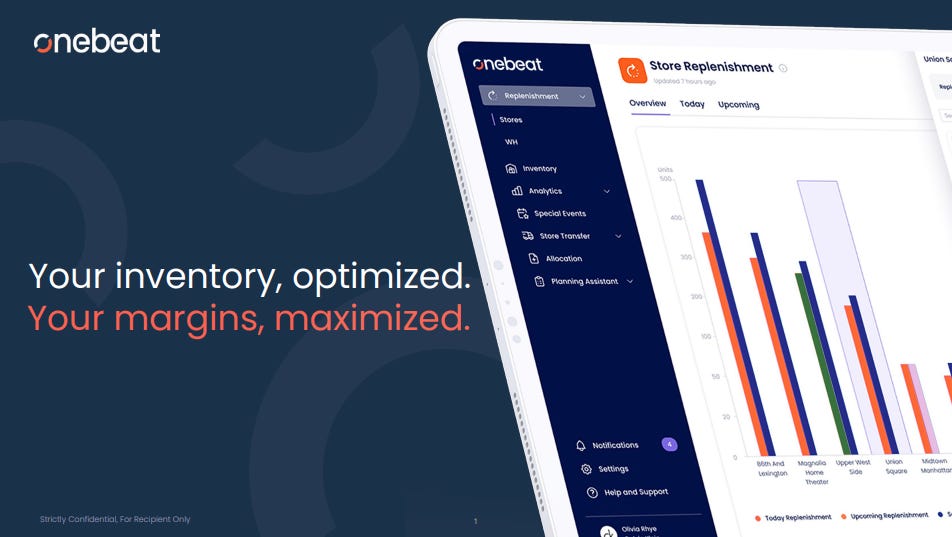
Onebeat’s 19-slide Series B deck successfully bridges the gap between academic management theory and modern AI application. By positioning itself as the software evolution of Goldratt Consulting—famed for the 'Theory of Constraints'—the company establishes immediate credibility with enterprise retailers. The deck highlights a significant market pain point: 15% of retail stock is wasted, contributing to high-profile bankruptcies. Onebeat counters this with impressive performance metrics, including a 25% reduction in inventory and a target sell-through rate of 95%. While the deck is light on sp…
Key takeaways
- The company claims its software can reduce inventory by 25% while improving availability to 75%-95% (Slide 15).
- Onebeat targets a massive efficiency gap, stating that 15% of retail stock currently goes to waste (Slide 9).
- The deck leverages the 'Theory of Constraints' and the book 'The Goal' to establish a philosophical and operational foundation for its AI (Slide 3).
- Onebeat reports a global footprint with 220 clients across 24 countries as of the Series B round (Slide 15).
- The software aims to shift retail management from seasonal predictions to daily, SKU-level dynamic actions (Slide 11).
- Competitive positioning places Onebeat as the only solution offering both 'Fast and easy implementation' and 'Generating bottom line results' (Slide 17).
- The company emerged directly from Goldratt Consulting, which has worked with brands like Coca-Cola and Adidas (Slide 5).
- The deck omits a specific 'Ask' slide detailing the exact use of the $15M Series B funds.
Executive Summary: The Evolution of the Theory of Constraints
Onebeat’s Series B pitch deck is a masterclass in using institutional heritage to sell modern technology. As reported by Business Insider, the company raised $15M in 2024 to further its AI-driven retail optimization platform. The deck does not lead with algorithms; it leads with a philosophy. By rooting its origin in Goldratt Consulting and the Theory of Constraints, Onebeat bypasses the 'why should we trust your AI' hurdle that many startups face. The deck presents a clear narrative: retail is failing because it is too complex for humans, and Onebeat is the only proven, scalable solution that can be implemented quickly to save margins.
Slides 1-6: The Philosophical Foundation
The deck opens with a bold value proposition on Slide 1 : 'Your inventory, optimized. Your margins, maximized.' This is immediately followed by a deep dive into the company's intellectual pedigree. Slide 2 and 3 focus on 'The Goal,' the seminal business novel by Eliyahu M. Goldratt. By noting that the book is trusted by Jeff Bezos and is mandatory reading at Harvard and MIT, Onebeat positions its software as the natural successor to a globally recognized management standard.
Slide 5 provides the concrete link between theory and practice, stating that Onebeat 'emerged from Goldratt Consulting.' It lists a 'proven track record' with massive brands like P&G, Coca-Cola, Adidas, and Panasonic. This is a strategic move for a Series B deck; it suggests that while the software company might be relatively new, the underlying logic has been battle-tested for decades at the highest levels of global commerce.
Slides 7-10: The Retail Crisis
After establishing credibility, the deck pivots to the 'Big Problem' on Slide 7 . Slide 8 uses 'fear' effectively by listing iconic retailers that have gone bankrupt, including Sears, JCPenney, and Pier1. This creates a sense of urgency—optimization isn't just a luxury; it's a survival requirement.
Slide 9 quantifies the pain. It notes that '15% of stock goes straight to waste' and highlights the tension between customers wanting 'more assortment' and the 'shorter time to sell' driven by the need for freshness. Slide 10 concludes this section by asserting that 'humans can't manage inventory efficiently alone,' setting the stage for the AI solution.
Slides 11-14: The Solution and Product
Slide 11 defines the Onebeat approach. It advocates for a shift from 'rule-based action plans' to 'demand-driven actions' and from 'seasonal predictions' to 'short-term predictions.' Crucially, it emphasizes management at the 'SKU level' rather than the 'style and product' level. This granularity is the core of their technological advantage.
Slide 12 defines the mission as 'unlocking real-time inventory optimization,' and Slide 13 sets a clear target: moving the average sell-through rate (STR) from 75% to 95%. Slide 14 provides visual proof of the software, showing a clean, dashboard-driven interface that includes modules for 'Store Replenishment,' 'Inventory Analytics,' and a 'Planning Assistant.'
Slides 15-19: Traction, Competition, and Team
Slide 15 is the 'money slide' for investors. It lists 220 clients across 24 countries and provides four hard metrics: a 25% reduction in inventory, 75%-95% improvement in availability, a 10% increase in full sale price, and 3%-5% additional net margins. The logos displayed include American Eagle, Crocs, and Calvin Klein, which validates the platform's ability to handle enterprise-scale retail.
Slide 17 addresses the competitive landscape. Onebeat places itself in the 'Top Right' quadrant of a matrix defined by 'Generating bottom line results' and 'Fast and easy implementation.' It explicitly names legacy giants like Oracle and BlueYonder as 'Expensive & Complex,' while positioning newer players like Antuit.ai and Increff as either harder to implement or providing 'naive' solutions. Slide 18 introduces the leadership team, though it focuses on titles (CEO, CRO, CFO) rather than detailed resumes, relying instead on the earlier Goldratt association to carry the weight of their expertise.
What Onebeat Does Well
The deck is exceptionally strong at establishing authority . Most AI startups struggle to prove their algorithms work in the messy real world of retail. By tying themselves to the Theory of Constraints, Onebeat inherits the trust built by Goldratt over thirty years. The use of specific, high-impact metrics on Slide 15 is also excellent. They don't just say they improve margins; they give a range (3%-5%) that an investor can use to model the potential ROI for a large retailer.
Furthermore, the competitive positioning on Slide 17 is aggressive but necessary. In a crowded 'Retail AI' market, claiming the 'Fast and easy implementation' niche is a direct response to the primary complaint retailers have about legacy ERP and optimization suites: that they take years to deploy and rarely deliver the promised results.
What is Missing from the Onebeat Deck
Despite the $15M raise, the deck has several notable omissions. First, there is no 'Ask' slide . While we know from publisher reports that they raised $15M, the deck itself does not specify how much they were seeking or how they intended to allocate that capital (e.g., R&D vs. sales expansion). There is also a lack of unit economics . While they show what they do for clients, they don't show their own CAC (Customer Acquisition Cost), LTV (Lifetime Value), or churn rates, which are standard requirements for a Series B teardown.
Additionally, the technical 'how' is glossed over. The deck mentions 'AI' and 'Algorithms' in the summary, but the slides themselves stay very high-level. For a Series B, investors often want to see a bit more detail on the data sources they ingest or the specific machine learning models that allow them to outperform legacy systems like Oracle.
Founder's Guide: What to Copy
Founders should emulate Onebeat's 'Origin Story' strategy . If your company is a spin-off from a consultancy or a research lab, use that history to build immediate trust. Don't just show your product; show the 'shoulders of giants' you are standing on. This is particularly effective in conservative industries like retail or manufacturing.
Another takeaway is the use of 'Anti-Logos.' By listing bankrupt companies on Slide 8, Onebeat makes the problem feel visceral. It’s not just about 'doing better'; it’s about 'not dying.' If you can frame your solution as a hedge against a well-known industry catastrophe, your value proposition becomes much more urgent. Finally, the clear KPI targets on Slide 13 (75% to 95% STR) are a great way to give investors a 'north star' metric to track your success.
Frequently asked questions
- What is the core problem Onebeat solves?
- Onebeat addresses the inefficiency of manual inventory management in retail. According to slide 9, retailers face 'skyrocketing inventory' and 'tied-up capital,' leading to 15% of stock being wasted. Slide 10 argues that humans cannot manage these complexities alone, necessitating an AI-driven approach to handle daily, SKU-level optimizations that dynamic market conditions require.
- How does Onebeat differentiate itself from legacy providers like Oracle?
- On slide 17, Onebeat uses a 2x2 matrix to position itself against legacy players like Oracle and BlueYonder. It characterizes these competitors as 'Expensive & Complex solutions' with 'Hard and long implementation.' Onebeat claims the top-right quadrant, offering 'Fast and easy implementation' while still 'Generating bottom line results,' unlike 'Inexpensive & Naive solutions' at the bottom-right.
- What specific metrics does Onebeat promise retailers?
- The deck provides several key performance indicators on slide 15. These include a 25% reduction in inventory, an improvement in product availability to between 75% and 95%, a 10% increase in full sale price realization, and an additional 3% to 5% in net margins. Slide 13 also sets a specific goal of increasing average sell-through rates from 75% to 95%.
- What is the significance of 'The Goal' in this pitch?
- Slide 3 features the book 'The Goal' by Eliyahu M. Goldratt. By citing it as 'mandatory reading' at MIT and Harvard and 'trusted' by Jeff Bezos, Onebeat aligns its software with the Theory of Constraints. This establishes the company not just as a tool, but as the digital implementation of a proven business philosophy used by the world's largest retailers.
- Who are Onebeat's notable clients and investors?
- Slide 15 lists high-profile retail clients including American Eagle, Crocs, Calvin Klein, and Esprit. The company also highlights its investor base, which includes Surround Ventures, Schooner Capital, and Renuar. This slide serves as the primary evidence of market traction, noting 220 clients across 24 countries.