One Lonely Outpost’s 13-slide deck is a highly effective example of a vertical-specific pitch. By positioning the game as a successor to massive hits like Stardew Valley and Harvest Moon, the team at Aurorian Studios immediately establishes market viability. The deck excels in its granular breakdown of gameplay features—specifically the 'Organic vs. Synthetic' choice—and provides a refreshing level of financial transparency with 'Minimum' and 'Optimal' budget tiers. While it lacks a traditional 'Ask' slide and exit strategy, the depth of the team’s experience (citing work for Valve and DOTA 2…
Key takeaways
- The deck uses a high-impact 'X meets Y' hook on Slide 1, comparing the game to Stardew Valley and The Martian.
- Social proof is established on Slide 3 with 3,500 Facebook likes, 3,500 Twitter follows, and a 1,200-person mailing list.
- The team demonstrates 'skin in the game' by citing $50,000 in monetary investment and $250,000 in sweat equity on Slide 3.
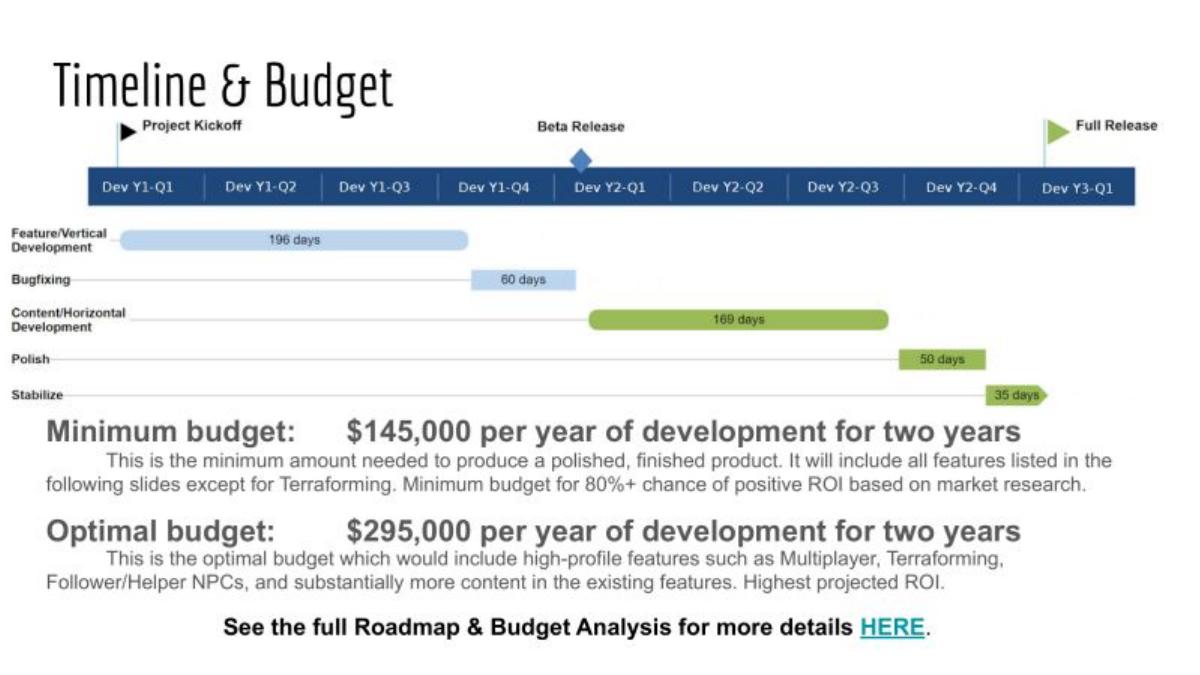
- Financial transparency is a highlight, with Slide 4 offering two budget tiers: a $145k/year 'Minimum' and a $295k/year 'Optimal' budget.
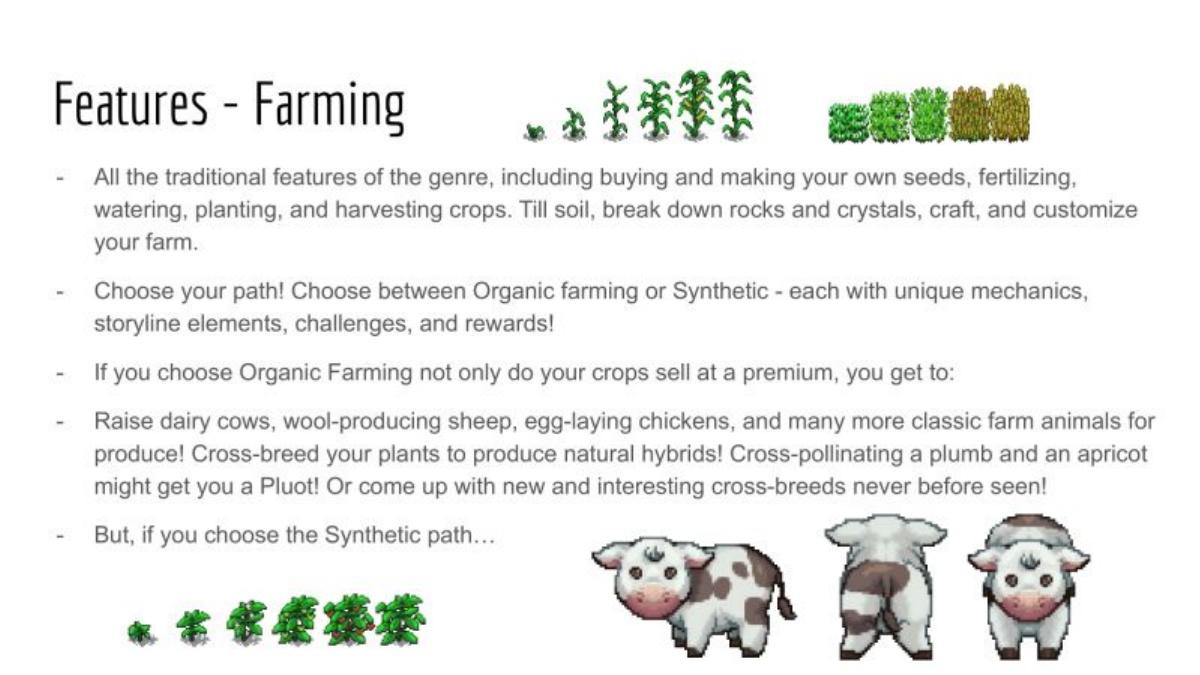
- The core gameplay loop is differentiated through a binary choice between 'Organic' and 'Synthetic' farming paths (Slides 5-6).
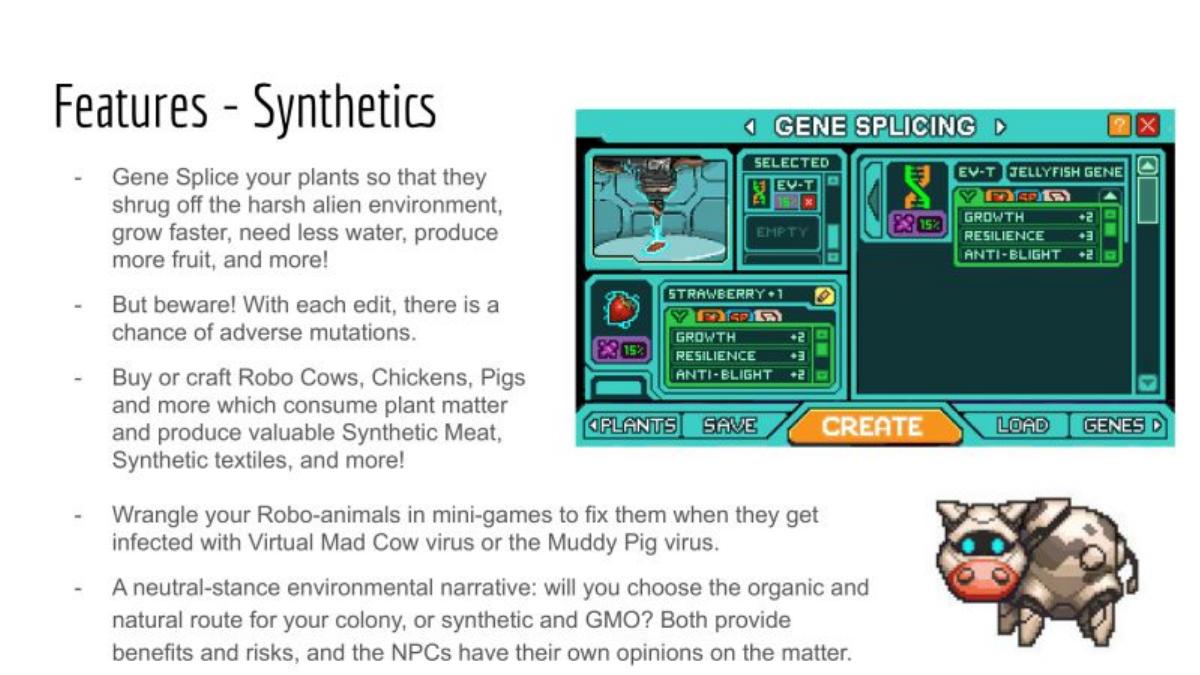
- The 'Synthetics' slide (Slide 6) introduces complex mechanics like Gene Splicing and 'Virtual Mad Cow virus' to appeal to hardcore sim fans.
- The team slide (Slide 10) leverages impressive credentials, including a Lead Artist with 10 years of experience working for Valve and DOTA 2.
- Visual progress is proven through a mix of concept art (Slide 11) and actual Alpha screenshots (Slide 12) showing UI and environment assets.
The Hook: Stardew Valley in Space
Slide 1: Title and High-Concept Pitch
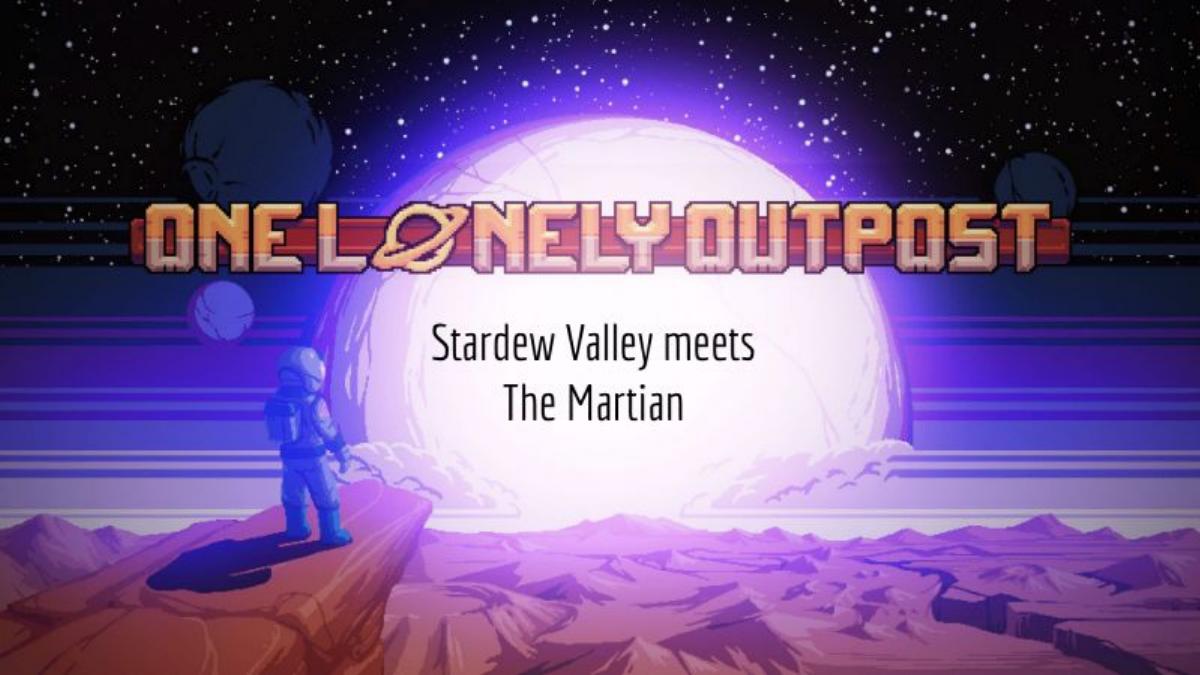
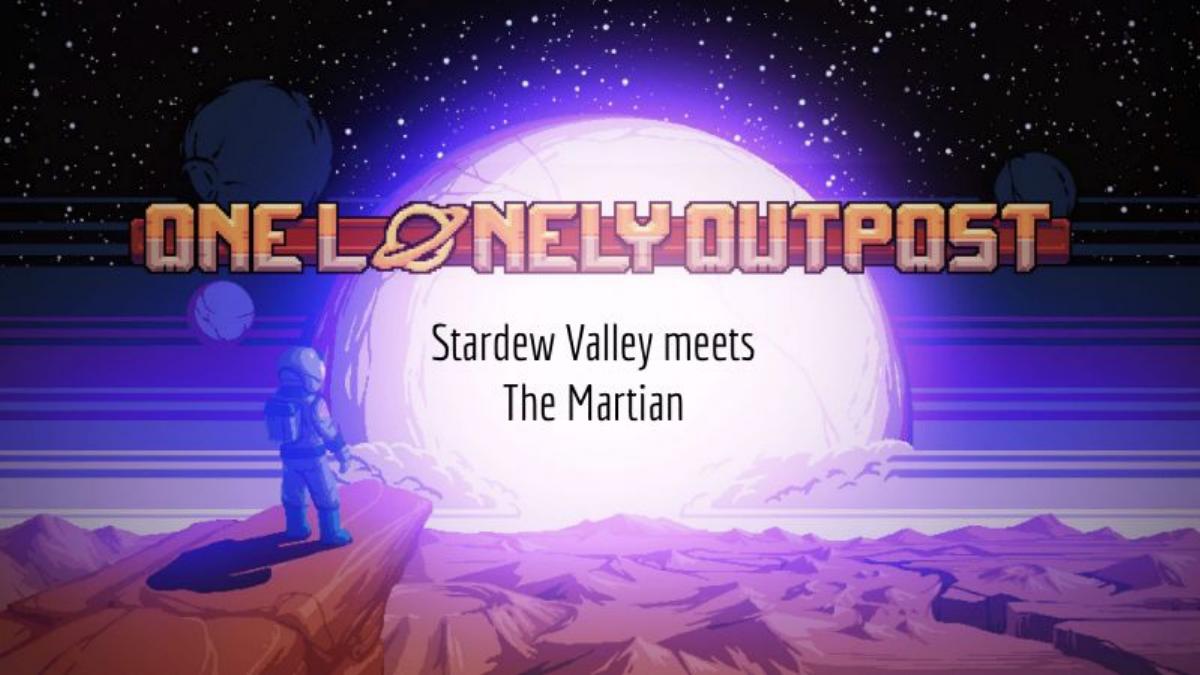
The deck opens with a vibrant title slide featuring the game's logo and a clear, concise tagline: "Stardew Valley meets The Martian." This is a textbook example of a high-concept pitch. By referencing two massive cultural touchstones—one in gaming and one in film/literature—the founders immediately communicate the genre, the setting, and the expected gameplay loop without requiring the reader to process a single paragraph of text. The pixel art background establishes the aesthetic tone from the outset.
Slide 2: Game Concept and Core Narrative
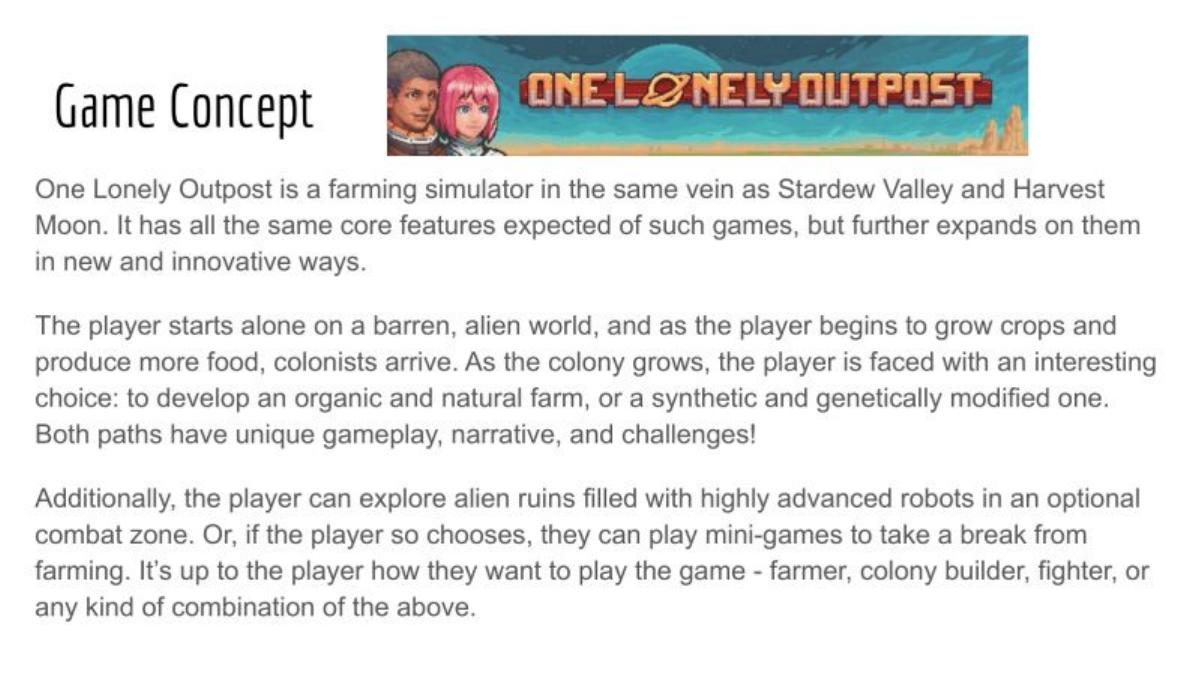
Slide 2 expands on the title slide by explicitly naming its inspirations: Stardew Valley and Harvest Moon. It describes the game as a "farming simulator" that "expands on [core features] in new and innovative ways." The slide introduces the central conflict: starting alone on a barren world and growing a colony. It also introduces the first major mechanical hook: the choice between an "organic and natural farm" or a "synthetic and genetically modified one." This slide effectively sets the stage for the detailed feature breakdown that follows.
Slide 3: The 'Why' and Social Proof
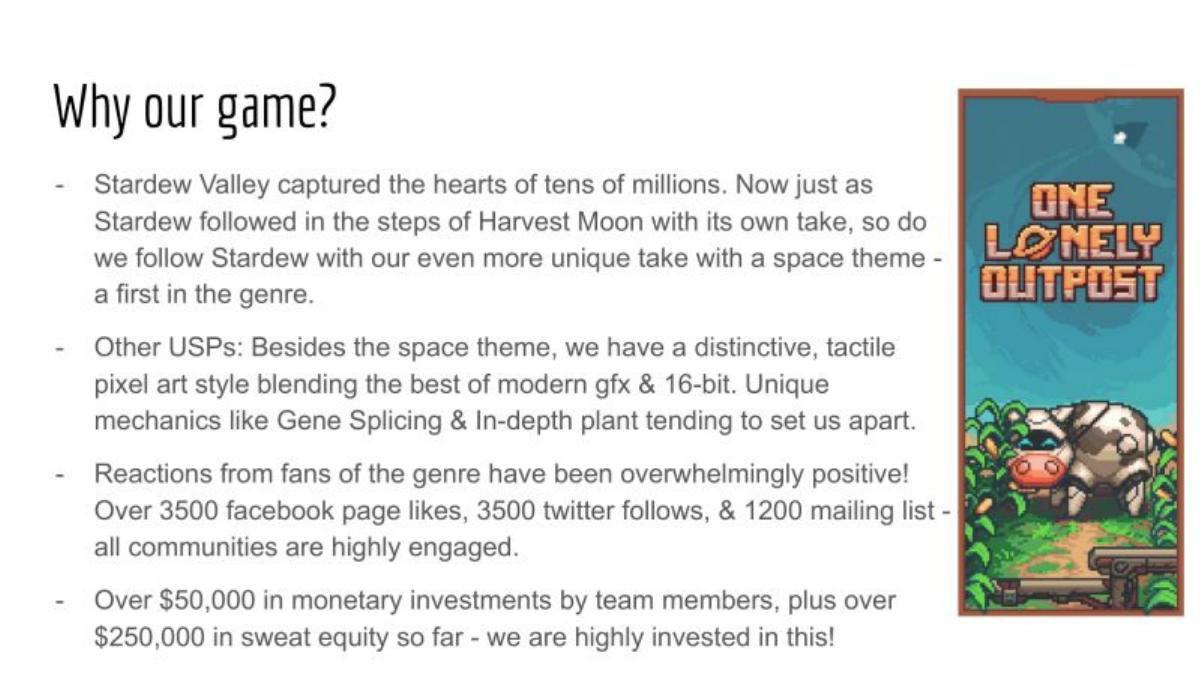
Slide 3 addresses the market opportunity and the team's progress. It claims the space theme is a "first in the genre" for farming sims. Crucially, this slide provides the first set of hard metrics: 3,500 Facebook likes, 3,500 Twitter follows, and a 1,200-person mailing list. This social proof is vital for indie games, as it demonstrates a pre-existing community. Furthermore, the slide mentions that team members have invested $50,000 in cash and $250,000 in "sweat equity," signaling to potential investors that the founders are fully committed.
Slide 4: Timeline and Tiered Budgeting
This is perhaps the most transparent slide in the deck. It features a development timeline spanning from "Project Kickoff" to "Full Release" in Year 3, Quarter 1. Below the timeline, the team presents two budget options. The "Minimum budget" is set at $145,000 per year for two years ($290,000 total), which excludes terraforming. The "Optimal budget" is $295,000 per year ($590,000 total) and includes "high-profile features such as Multiplayer, Terraforming, [and] Follower/Helper NPCs." Providing these tiers allows a publisher or investor to see exactly what their capital buys in terms of scope and potential ROI.
Slide 5: Features - Farming and the Organic Path
Slide 5 dives into the "Organic" gameplay path. It lists traditional genre features (seeds, fertilizing, watering) but highlights unique elements like cross-breeding plants (e.g., crossing a plumb and an apricot to get a "Pluot"). The inclusion of pixel art for crops and animals (cows, sheep, chickens) helps the reader visualize the finished product. This slide reinforces the "Stardew Valley" half of the pitch.
Slide 6: Features - Synthetics and Gene Splicing
Slide 6 covers the "Synthetic" path, which serves as the game's primary mechanical differentiator. It introduces "Gene Splicing" to make plants grow faster or need less water, though with a "chance of adverse mutations." It also mentions "Robo Cows" and "Virtual Mad Cow virus." This level of detail suggests a deep, systems-driven game that will appeal to fans of simulation games who find traditional farming sims too simplistic.
Slide 7: Features - NPCs and Narrative
Character relationships are a cornerstone of the farming sim genre, and Slide 7 confirms their presence here. It mentions "fully fledged NPCs with dialogue, cutscenes, and storylines." It also touches on the social mechanics: NPCs can be dated, married, and even have children who help on the farm. The inclusion of character portraits demonstrates the high quality of the game's art assets.
Slide 8: Features - Ruins and Mini-games
To address the "The Martian" and exploration side of the pitch, Slide 8 introduces "alien ruins" filled with robots. This adds a combat/puzzle element to the game. It also mentions an "Asteroid mining/racing mini-game," suggesting a variety of gameplay styles beyond just farming. The vertical layout of the ruin art on the right side of the slide is particularly striking.
Slide 9: Features - Terraforming
Slide 9 focuses on the "Terraforming" feature, which the team previously identified as an "Optimal budget" item. It describes the player as an "agent of change" who can turn a desert into a "lush biome." The concept art provided here is more painterly and atmospheric than the pixel art seen elsewhere, emphasizing the visual transformation of the game world.
Slide 10: The Core Team
The team slide is strong, focusing on professional experience rather than just passion. Brad Petry (Project Manager) is credited with 12 released titles. Christopher Bayliss (Programmer) is currently employed by Broadcom. Most impressively, Narongdej Teo (Lead Artist) is noted for having over 10 years of experience and performing contract work for Valve and DOTA 2. This high-level industry experience significantly de-risks the project for an investor.
Slide 11 & 12: Concept Art and Alpha Screenshots
The final content slides provide visual proof of progress. Slide 11 shows "Additional Concept Art," including building designs and character sketches. Slide 12, "Alpha Screenshots," is critical because it shows the game actually running. We see the UI (User Interface), the inventory bar, the "Spacebucks" currency, and character dialogue boxes. This proves that the project is well past the "idea phase" and has a functional codebase.
Slide 13: Closing
The deck ends with a simple "Thank you" and a group shot of the game's characters. While it lacks a specific contact slide or a final call to action, the preceding 12 slides have already made a comprehensive case for the game's potential.
What Works and Why
1. Clear Positioning: The use of "Stardew Valley meets The Martian" is an incredibly effective shorthand. It tells the investor exactly who the target audience is and what the core gameplay loop entails without needing a deep dive into mechanics.
2. Financial Granularity: Most indie game decks are vague about their needs. By offering "Minimum" and "Optimal" budget tiers on Slide 4, the team shows they have a deep understanding of their development costs and how different funding levels impact the final product's scope.
3. High-Quality Art: In the gaming industry, visuals are a primary selling point. The mix of polished pixel art, detailed character portraits, and atmospheric concept art throughout the deck proves that the team has the talent to deliver a commercially viable product.
4. Proven Team: Citing work for Valve and DOTA 2 on Slide 10 is a major "trust signal." It suggests that the team can handle the technical and artistic rigors of a full-scale game release.
What is Missing
1. A Specific 'Ask': While the budget needs are outlined on Slide 4, there is no slide that explicitly says "We are looking for $X in exchange for Y." It is unclear if they are seeking a publisher, a VC investment, or a project-based loan.
2. Competitive Analysis: While they mention Stardew Valley as an inspiration, they don't discuss other contemporary competitors in the "cozy sim" or "space sim" space. A slide showing how they stack up against other recent indie hits would have been beneficial.
3. Marketing and Distribution Plan: The deck mentions social media followers, but it doesn't detail how they plan to reach the "tens of millions" of players they cite as the market. There is no mention of Steam wishlists, influencer strategies, or platform-specific (Switch, PlayStation, etc.) plans.
4. Exit Strategy: For a venture investor, the lack of an exit strategy (e.g., acquisition by a larger studio or publisher) is a notable omission, though this is less critical if the deck was intended primarily for publishers.
What a Founder Should Copy
1. The Tiered Budget: If you are building a product where features can be added or removed based on funding (like a game or a modular SaaS platform), use the "Minimum vs. Optimal" approach. It shows you are a realist who can deliver a product even if you don't get your dream funding amount.
2. The 'X meets Y' Hook: Don't be afraid to use successful predecessors to explain your concept. It’s not "unoriginal"; it’s a way to leverage existing market data to prove your idea has a built-in audience.
3. Social Proof Early: Don't wait until the end of the deck to show your traction. Putting your follower counts and mailing list size on Slide 3 (as seen here) builds immediate credibility before you even get into the product features.
4. Visual Proof of Work: If you have a prototype, show it. The "Alpha Screenshots" on Slide 12 are worth more than any amount of descriptive text because they prove the team can actually execute the vision they've pitched.
Frequently asked questions
- What is the primary value proposition of One Lonely Outpost?
- The game positions itself as a 'space farming sim' that takes the proven mechanics of Stardew Valley and Harvest Moon and applies them to a sci-fi setting. According to Slide 3, it aims to be the first in the genre to utilize a space theme while offering unique mechanics like Gene Splicing and a choice between organic or synthetic farming paths.
- How does the team justify their budget requirements?
- On Slide 4, the team provides two distinct funding scenarios. The 'Minimum' budget of $145,000 per year for two years covers a polished product with most features. The 'Optimal' budget of $295,000 per year adds high-profile features like Multiplayer and Terraforming, which the team claims will result in the 'Highest projected ROI' based on market research.
- What evidence of market demand does the deck provide?
- The deck relies on social media engagement and genre trends. Slide 3 notes that the game has garnered over 3,500 likes on Facebook, 3,500 followers on Twitter, and a mailing list of 1,200 subscribers. It also references the 'tens of millions' of players captured by Stardew Valley as evidence of the genre's massive addressable market.
- Who are the key members of the development team?
- Slide 10 lists a four-person core team: Brad Petry (Project Manager with 12 released titles), Christopher Bayliss (Programmer from Broadcom), Narongdej Teo (Lead Artist with experience at Valve/DOTA 2), and Richard Schmidbauer (Pixel Artist with 8 years of experience). This combination of management, technical, and high-end artistic talent is a significant selling point.
- What is the 'Organic vs. Synthetic' mechanic mentioned in the deck?
- This is a core narrative and gameplay choice detailed on Slides 5 and 6. Players can choose 'Organic Farming,' which involves traditional animals and cross-breeding plants for premium prices, or the 'Synthetic' path, which involves Gene Splicing, Robo-animals, and 'Synthetic Meat' production. This choice affects gameplay, challenges, and how NPCs perceive the player.