OneKloud's 2016 Seed deck is a study in extreme minimalism. Spanning only 9 slides, the deck relies on large-scale market figures and a visceral problem statement to justify its existence. By highlighting that 96% of CFOs face unpredictable cloud costs and that overspend on AWS ranges from 15% to 50%, the company creates a clear economic mandate for its 'Cloud Budget Enforcement' solution. While the deck lacks traditional components like a detailed product walkthrough, business model, or competitive analysis, it successfully raised $1.3 million. The strategy appears to have been built on the…
Key takeaways
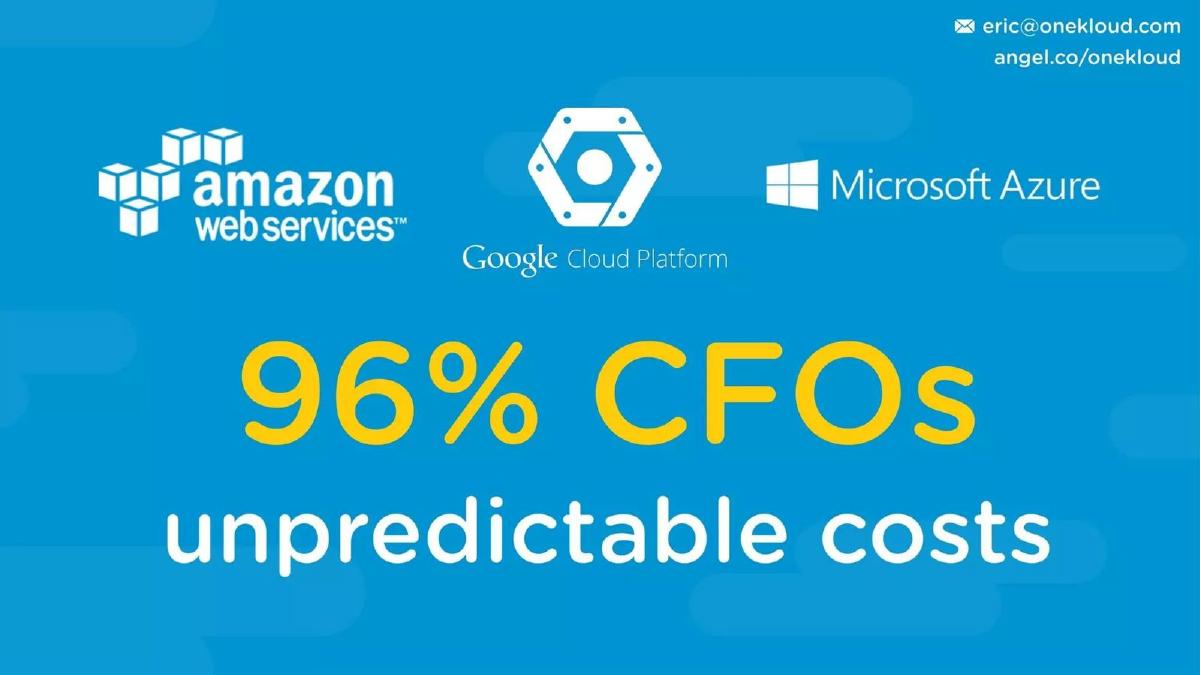
- The deck identifies a specific pain point: 96% of CFOs experience unpredictable cloud costs (Slide 2).
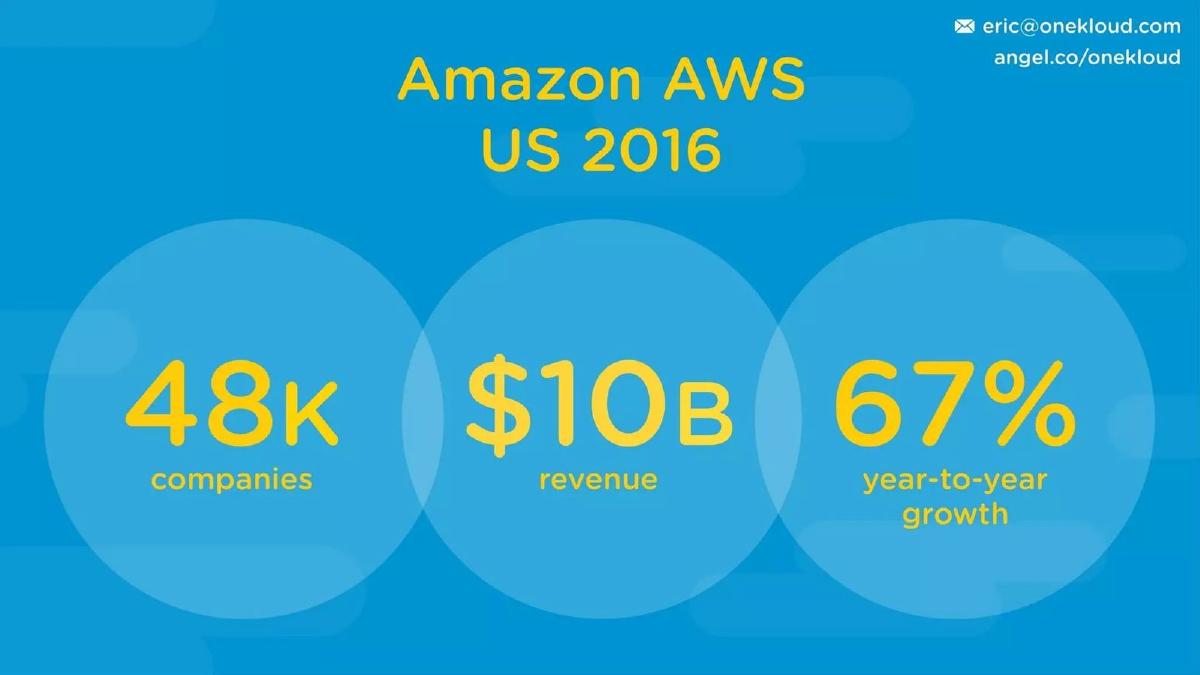
- It quantifies the market opportunity by citing 48,000 companies spending $10 billion on AWS in the US alone (Slide 3).
- The core value proposition is defined as 'Cloud Budget Enforcement,' moving beyond simple reporting (Slide 8).
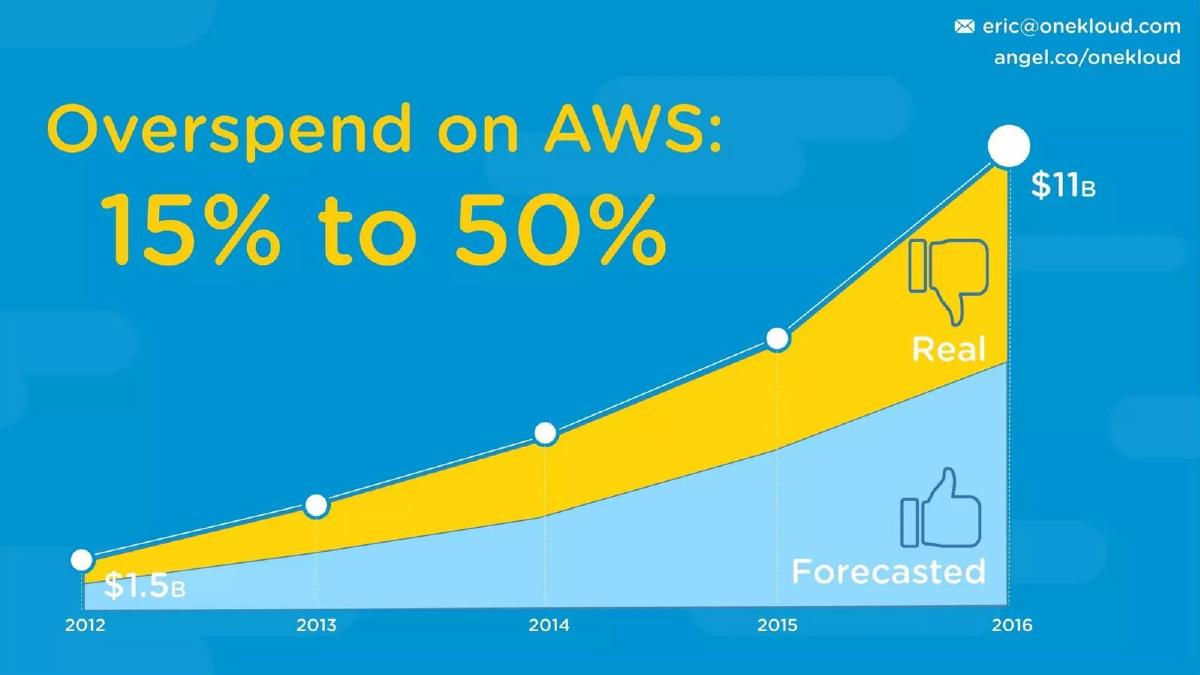
- The deck claims cloud overspend typically ranges from 15% to 50% above forecasted levels (Slide 4).
- The management team is presented with four senior roles, including a CEO, CTO, EVP Sales, and VP Engineering (Slide 9).
- The presentation uses a 'less is more' approach, omitting revenue, business model, and competition slides entirely.
- It utilizes a visual metaphor (a table full of empty beer cans) to illustrate the 'hangover' of over-provisioning (Slide 7).
- The deck emphasizes the 67% year-over-year growth of the cloud sector to establish urgency (Slide 3).
The 9-Slide Seed Deck: OneKloud's Minimalist Pitch
OneKloud’s pitch deck is an anomaly in the world of venture capital. At only nine slides, it bypasses the traditional 15-20 slide narrative in favor of a high-impact, low-word-count approach. Raised in 2016, the $1.3 million Seed round was predicated on a simple premise: cloud spending is out of control, and CFOs are the ones suffering. The deck is designed to be presented in person, acting as a visual aid for a spoken narrative rather than a standalone document.
The Hook and the Problem (Slides 1-2)
Slide 1 is a standard title slide featuring the company logo and the name of the presenter, Eric Didier. The branding is clean, using a cloud motif that aligns with the company name.
Slide 2 immediately pivots to the target persona and the primary pain point. It displays the logos of the 'Big Three' cloud providers—Amazon Web Services, Google Cloud Platform, and Microsoft Azure. Below these, a large, bold statistic claims that 96% of CFOs face unpredictable costs . This is a classic 'hair on fire' problem statement. By framing the issue around the CFO rather than the DevOps engineer, OneKloud signals that its solution is about financial governance and bottom-line impact.
Market Dynamics and the Cost of Inaction (Slides 3-4)
Slide 3 narrows the focus to the Amazon AWS market in the US for the year 2016. It presents three key figures: 48k companies , $10B revenue , and 67% year-to-year growth . This slide serves two purposes: it establishes a massive Total Addressable Market (TAM) and highlights the velocity of that market. The implication is that as the market grows by 67% annually, the problem of unpredictable costs will scale at the same rate.
Slide 4 quantifies the 'waste' in the system. It features a line graph showing the divergence between 'Forecasted' spend and 'Real' spend from 2012 to 2016. The gap is highlighted in yellow, with a 'thumbs down' icon labeled 'Real' and a 'thumbs up' icon labeled 'Forecasted.' The slide states that overspend on AWS ranges from 15% to 50% . By the end of the graph in 2016, the real spend is marked at $11B against a lower forecasted baseline. This slide effectively turns a technical problem into a mathematical certainty of lost capital.
Root Causes and Visual Metaphors (Slides 5-7)
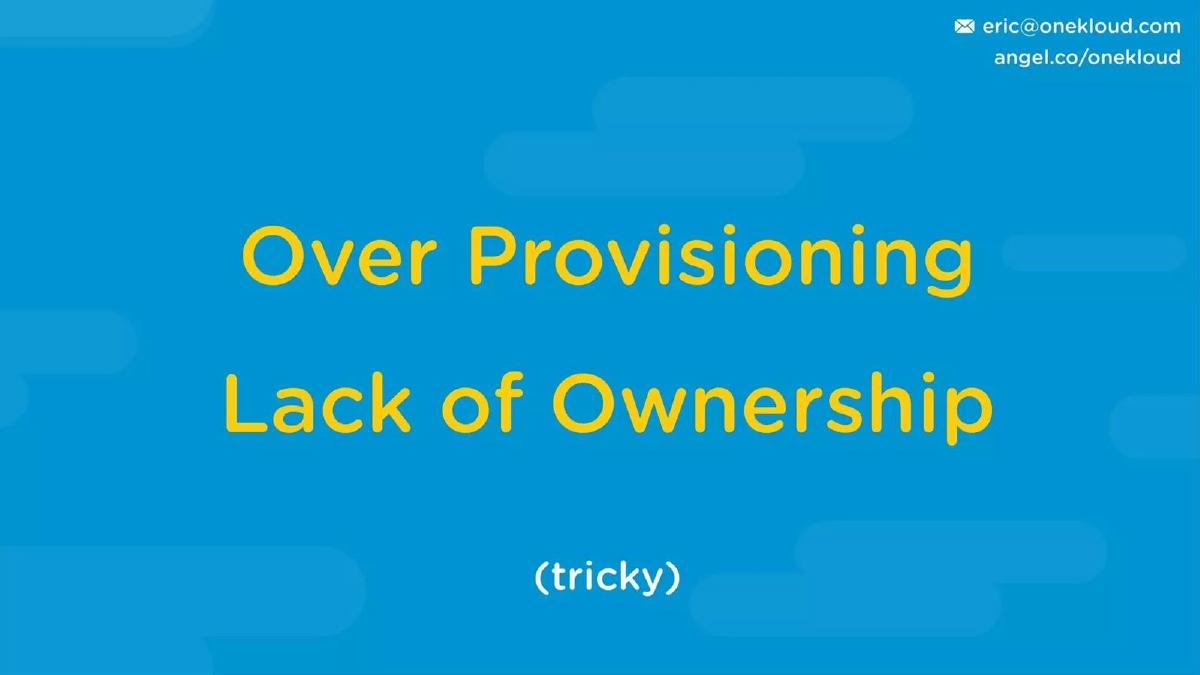
Slide 5 identifies the 'why' behind the overspend. It lists two primary culprits: Over Provisioning and Lack of Ownership . The word '(tricky)' is added in parentheses at the bottom, perhaps acknowledging that while the problem is easy to identify, it is difficult to solve within existing organizational structures.
Slide 6 is the most unconventional slide in the deck. It contains no text, only a photo of several young men passed out at a table covered in dozens of empty beer cans. In a professional pitch setting, this serves as a visceral metaphor for the 'cloud hangover'—the result of an unmonitored 'party' of provisioning resources without regard for the bill that arrives the next morning. It is a risky slide that relies entirely on the presenter's ability to tie the image back to the business case.
Slide 7 transitions from the problem to the solution. It simply states the company name OneKloud and the category Cloud Budget Enforcement . The use of the word 'Enforcement' is critical here. It suggests that OneKloud is not just another dashboard for viewing costs (which many competitors offered at the time) but a tool that takes action to stop spending.
The Team and the Final Word (Slides 8-9)
Slide 8 introduces the Management Team . It features four individuals: Eric Didier (CEO), Xavier Garcia (CTO), John Tripier (EVP Sales), and Uriel Chemouni (VP Engineering). The slide is purely visual, providing photos and titles but no biographical text. This suggests that the founders likely relied on their reputations or verbal introductions to establish credibility during the pitch.
Slide 9 serves as the conclusion, repeating the company logo and contact information. It adds a final punchline: "Block Cloud infrastructure overspend... before it happens!" This reinforces the 'Enforcement' value proposition mentioned earlier, positioning the product as a preventative measure rather than a reactive one.
What Works in the OneKloud Deck
Extreme Focus: The deck does not get bogged down in technical specifications. It stays focused on the financial pain felt by the buyer (the CFO). · Clear Market Sizing: Slide 3 provides specific, dated, and sourced-sounding figures for the AWS market, making the opportunity feel tangible. · Urgency: By showing the 67% growth rate and the widening gap between forecasted and real spend, the deck creates a sense of 'now or never' for investors. · Category Creation: By using the term 'Cloud Budget Enforcement,' they attempt to carve out a niche distinct from 'Cloud Cost Management.'
What is Missing from the OneKloud Deck
Product Demonstration: There are no screenshots, diagrams of how the software works, or explanations of how it integrates with AWS/Azure/GCP. · Business Model: The deck never mentions how OneKloud makes money. Is it a percentage of savings? A flat SaaS fee per user? A tiered subscription based on cloud spend? · Competitive Landscape: In 2016, the cloud cost management space was already becoming crowded. The deck fails to mention how it wins against incumbents or other startups. · Traction: There is no mention of current customers, pilots, or revenue. For a Seed round, showing even early validation is usually expected. · The Ask: The deck does not state how much money is being raised or what the milestones for the next 18 months are.
What a Founder Should Copy
The 'Persona' Problem: Identifying that 96% of CFOs have a specific problem is a great way to frame a B2B pitch. It tells the investor exactly who will sign the check. · Visualizing the Gap: The graph on Slide 4 is an excellent way to show the 'Value Gap.' If your product closes a gap between expectation and reality, chart it. · Minimalist Design: While this deck might be too sparse for an email-first 'teaser' deck, it is a great example of a 'presentation' deck that keeps the audience's eyes on the speaker rather than reading walls of text.
Frequently asked questions
- What is the primary problem OneKloud solves?
- OneKloud addresses the lack of control over cloud infrastructure spending. According to Slide 2, 96% of CFOs struggle with unpredictable costs. Slide 4 further specifies that companies typically overspend on AWS by 15% to 50% compared to their original forecasts. The deck positions this as a result of 'Over Provisioning' and a 'Lack of Ownership' (Slide 5).
- How does OneKloud differ from other cloud cost management tools?
- While the deck does not include a feature list, it distinguishes itself through the term 'Enforcement' on Slide 8. Most tools in this category provide visibility or recommendations; OneKloud’s branding suggests a proactive blocking mechanism to prevent overspend before it occurs, as stated on the final slide.
- What market data does the deck provide?
- The deck focuses on the US Amazon AWS market in 2016. It cites 48,000 companies contributing to $10 billion in revenue with a 67% year-over-year growth rate (Slide 3). It also mentions Google Cloud Platform and Microsoft Azure as relevant platforms on Slide 2, though it does not provide specific metrics for them.
- Who are the founders and management team?
- The management team consists of Eric Didier (CEO), Xavier Garcia (CTO), John Tripier (EVP Sales), and Uriel Chemouni (VP Engineering). The deck provides their photos and titles on Slide 9 but omits their professional backgrounds or previous company exits.
- What is missing from this pitch deck?
- This deck is missing several standard elements: a business model/pricing slide, a competitive landscape, a product demonstration or screenshots, a roadmap, and a specific 'Ask' slide detailing how much capital is being raised and how it will be spent.