OneD Battery Sciences' Series C deck is a highly technical, industrial-focused presentation that successfully bridges the gap between lab-scale innovation and mass-market EV manufacturing. By focusing on the SINANODE process—a method of growing silicon nanowires directly onto graphite particles—the company addresses the primary bottlenecks of the EV industry: range, charging speed, and cost. The deck emphasizes a long-term R&D pedigree, citing $125M in prior investment and a patent portfolio dating back to 2000. Rather than pitching a new battery cell, OneD positions itself as a critical mate…
Key takeaways
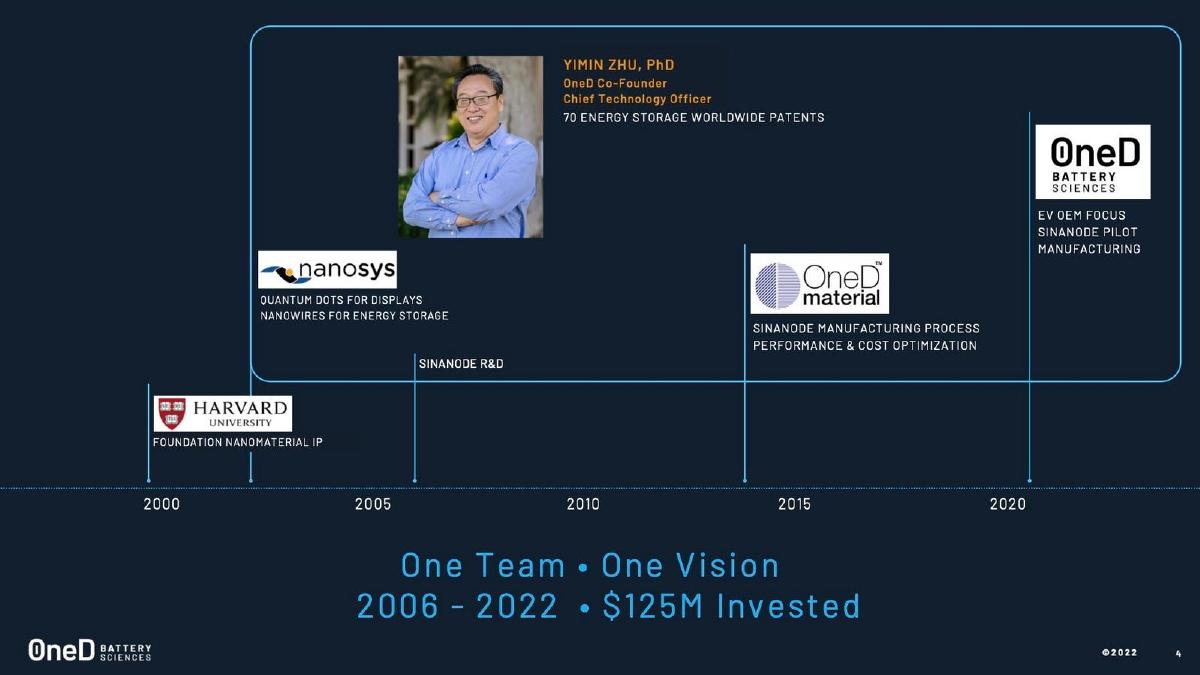
- The company highlights a long R&D history, noting $125M invested between 2006 and 2022 (Slide 4).
- Technical validation is provided through high-resolution microscopy showing nanowires fused to graphite surfaces (Slide 11).
- The SINANODE process is designed for cost-efficiency, targeting less than $2 per kWh of silicon capacity (Slide 17).
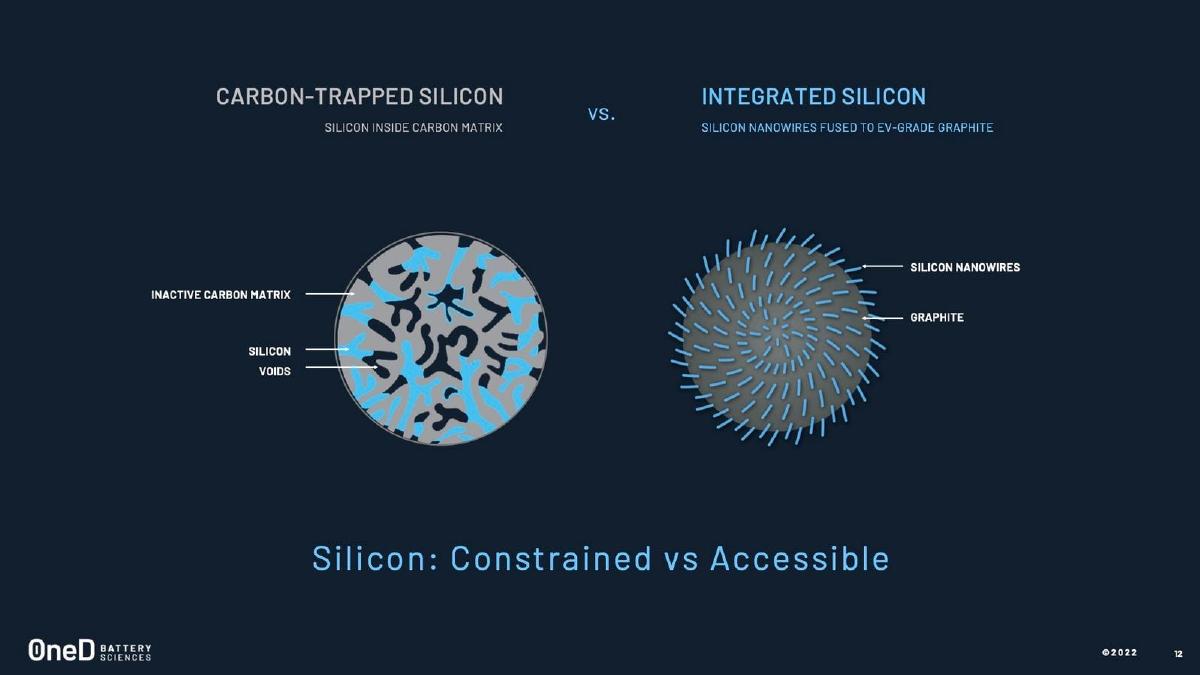
- The business model focuses on 'Silicon Simplified,' integrating into existing EV-grade graphite supply chains rather than replacing them (Slide 11).
- A global footprint is established with specific locations in Moses Lake, WA, and Yulin, China, to ensure supply chain localization (Slide 24).
- The deck identifies a clear problem-solution fit: the need for affordable EVs with longer range and faster charging (Slide 8).
- The corporate structure slide explicitly outlines the role of new strategic investors in the current financing round (Slide 30).
- The technology is positioned as compatible with various cell designs, including semi-solid and solid electrolytes (Slide 14).
OneD Battery Sciences: Industrializing the Silicon Anode
The transition to electric vehicles (EVs) is currently limited by the energy density and cost of lithium-ion batteries. While silicon has long been recognized as a superior anode material compared to pure graphite, its tendency to expand and contract during charging has historically led to battery failure. OneD Battery Sciences addresses this with their SINANODE technology. This teardown examines the Series C deck that helped the company secure $25M in 2024, as reported by Business Insider.
Slide 1-3: Branding and Identity
The opening slides establish the brand identity: 'SINANODE – Silicon Simplified.' The subtitle, 'Advancing the EV Battery,' immediately narrows the focus to the automotive sector. The visual language uses abstract blue filaments, which likely represent the silicon nanowires that are central to their value proposition. The date 'Fall 2022' on Slide 1 suggests this deck was used for a prolonged period or updated for the 2024 round.
Slide 4: The $125M Pedigree
Slide 4 is a critical 'Trust Slide.' It traces the company's lineage back to 2000, starting with foundation nanomaterial IP from Harvard University. It highlights the involvement of Co-Founder and CTO Yimin Zhu, PhD, who holds 70 energy storage patents. Most importantly, it states that $125M has been invested between 2006 and 2022. For a Series C investor, this demonstrates that the 'heavy lifting' of basic R&D has already been funded and completed, reducing technical risk.
Slide 8: Problem and Solution
The deck uses a classic split-screen format for the problem and solution. The problem is defined as the 'exploding demand for affordable EVs with longer range and faster charging.' The solution is SINANODE, which 'unlocks silicon’s full potential.' By framing the solution as an 'unlock' rather than a replacement, OneD positions itself as an enabler for the entire battery industry.
Slide 11: The Technical 'Money Shot'
Slide 11 provides the most important technical evidence in the deck. It features three high-resolution electron microscopy images. The first shows nanowires fused to the surface of graphite particles; the second shows nanowires growing inside pores; the third shows a 1.9 nm coating. The caption, 'The Only Technology Fusing Nano-Silicon Into Commercial Graphites,' is a bold competitive claim that differentiates them from competitors who might be using silicon additives or pure silicon anodes.
Slide 14: Integration and Compatibility
Deep tech startups often fail because their solution requires the rest of the industry to change. Slide 14 combats this by showing 'SINANODE Innovations' across three categories: Anode Material Designs, Anode Layer Designs, and Cell Designs. It explicitly mentions compatibility with 'Natural & Synthetic' graphite and 'Semi-Solid & Solid Electrolytes.' This tells the investor that OneD is future-proof and can work with whatever battery architecture wins the market.
Slide 17: The Economics of Scale
Hardware rounds live or die by unit economics. Slide 17 introduces 'The SINANODE Step,' a process flow using a CVD (Chemical Vapor Deposition) system. The headline metric is ' Slide 21 features a map of the United States, highlighting a location in Moses Lake, Washington. The slide emphasizes 'Renewable Energy @ Lowest Cost Logistics.' Slide 24 expands this to a global view, showing 'Localization Within the Global Supply Chain' with entities in North America, China (Yulin, Shaanxi), and Europe (in progress). This is a sophisticated move for a Series C company, showing they understand the geopolitical and logistical requirements of serving global OEMs (Original Equipment Manufacturers).
Slide 30: The Strategic Ask
The final slide in this set (labeled 30) outlines the corporate structure for the 'Strategic Financing Round.' It shows OneD Material, Inc. as the parent company in Palo Alto, with subsidiaries for each geographic region. The inclusion of a green box for 'New Strategic Investors' clearly signals the intent of the round: to bring in partners (likely automotive OEMs or Tier 1 suppliers) who can provide more than just capital.
What OneD Battery Sciences Does Well
The deck excels at technical validation. In the battery space, 'vaporware' is a constant concern for investors. By showing actual microscopy of the nanowires (Slide 11) and a clear process flow for the CVD system (Slide 17), OneD provides tangible proof that their technology exists and is manufacturable. Furthermore, the emphasis on the $125M already spent (Slide 4) suggests a high barrier to entry for competitors.
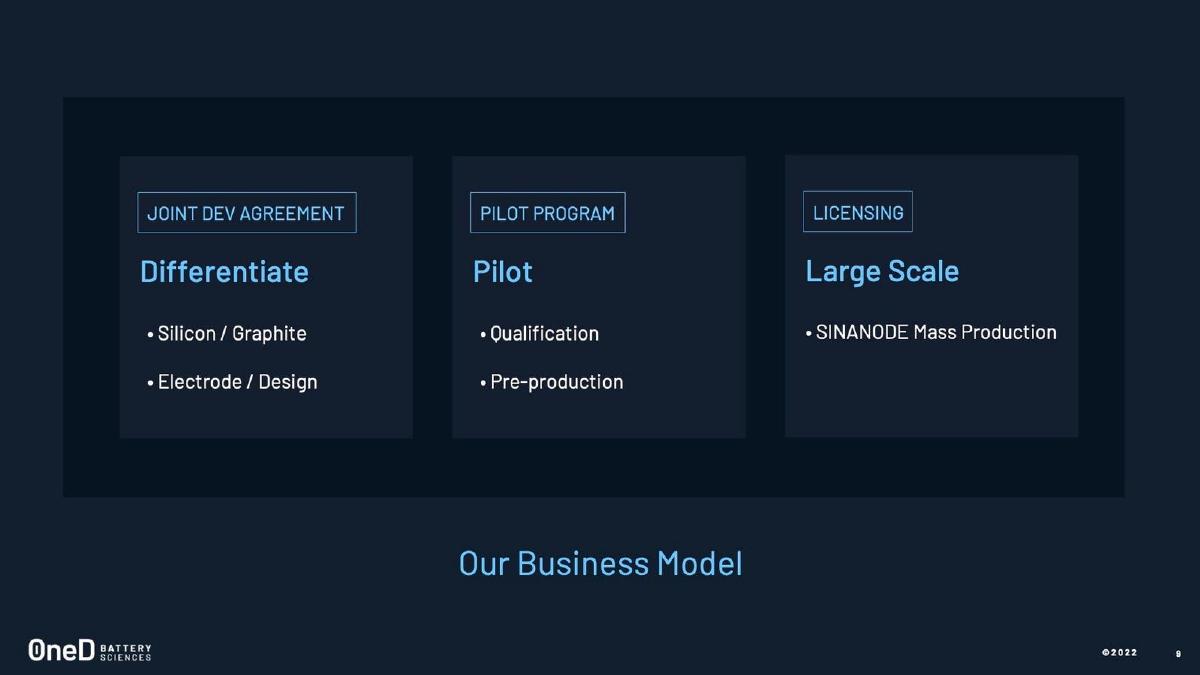
The business model is also a strength. OneD is not trying to build their own battery cells or their own EVs. They are a materials and process technology provider. This 'Intel Inside' model is generally more scalable and less capital-intensive than full-scale cell manufacturing, which requires billions in CapEx. They are positioning themselves as a necessary ingredient for the existing giants of the industry.
What is Missing from the Deck
While the technical and strategic slides are strong, there are notable omissions in the provided set. There is no explicit 'Competition' slide comparing SINANODE to other silicon anode players like Sila Nanotechnologies or Group14 Technologies. Investors at the Series C level would certainly be asking how OneD's nanowire approach compares to the silicon-carbon composites of their rivals.
Additionally, the deck lacks a detailed 'Traction' slide. While it mentions 'EV OEM Focus' on Slide 4, it does not list specific partnerships, joint development agreements (JDAs), or pilot programs with named automotive brands. In a Series C round, investors typically look for 'revenue-adjacent' milestones, such as successful cell testing by a major manufacturer.
Lessons for Founders
1. Lead with your R&D legacy: If you have spent years and millions of dollars in the lab, make that a headline. OneD’s Slide 4 is a powerful way to show that they aren't a 'fly-by-night' operation.
2. Show, don't just tell: The microscopy on Slide 11 is worth more than a dozen slides of bullet points. For hardware and biotech startups, visual proof of the 'magic' is essential.
3. Solve for the existing supply chain: OneD’s focus on 'Commercial Graphites' and 'Commercial Silane Gas' shows they understand how to scale. Founders should always highlight how their innovation fits into the world as it currently exists, rather than requiring a total industry overhaul.
4. Geography is strategy: Especially in the energy and hardware sectors, where you build matters. Highlighting Moses Lake for its renewable energy (Slide 21) shows a commitment to ESG and operational efficiency that appeals to modern institutional and strategic investors.
Frequently asked questions
- What is the core technology behind OneD Battery Sciences?
- The core technology is called SINANODE. It involves growing silicon nanowires directly onto and inside the pores of commercial EV-grade graphite particles. This process, detailed on Slide 11, uses Chemical Vapor Deposition (CVD) to fuse nano-silicon to graphite, which increases energy density and charging speed without the typical expansion issues associated with bulk silicon.
- How does OneD address the cost concerns of EV manufacturers?
- OneD claims a significant cost advantage on Slide 17, stating their process is designed for EV scale at a cost of less than $2 per kWh of silicon capacity. By utilizing commercial silane gas and existing graphite supplies, they minimize the 'green premium' usually associated with advanced battery materials.
- What is the significance of the company's timeline?
- Slide 4 shows a timeline starting in 2000 with foundation nanomaterial IP from Harvard. This emphasizes that the technology is not a recent 'hype' play but the result of over two decades of development, including R&D at Nanosys and $125M in cumulative investment, which builds significant investor trust in the hardware sector.
- Where are OneD's primary operations located?
- The deck highlights a strategic global presence. Slide 21 and 24 show a North American headquarters in Palo Alto, CA, with a pilot manufacturing facility in Moses Lake, WA (chosen for renewable energy and logistics), and a Chinese subsidiary in Yulin, Shaanxi, to serve the Asian market.
- What was the objective of this specific pitch deck?
- As shown on Slide 30, the deck was designed for a 'Strategic Financing Round.' It outlines a corporate structure intended to bring in 'New Strategic Investors' alongside current backers to fund the expansion of SINANODE North America, SINANODE China, and the development of SINANODE Europe.