Kluster’s Series A deck is a lean, 10-slide presentation that prioritizes product utility and traction over abstract vision. By framing the problem as a failure of planning and the solution as a continuous revenue strategy loop, Kluster positions itself as a critical infrastructure layer for scaling companies. The deck relies heavily on high-fidelity product screenshots (Slides 5, 6, and 7) to demonstrate how the platform replaces spreadsheets and manual forecasting. The most compelling evidence is found on Slide 9, which showcases an exponential revenue growth curve starting in 2021, paired…
Key takeaways
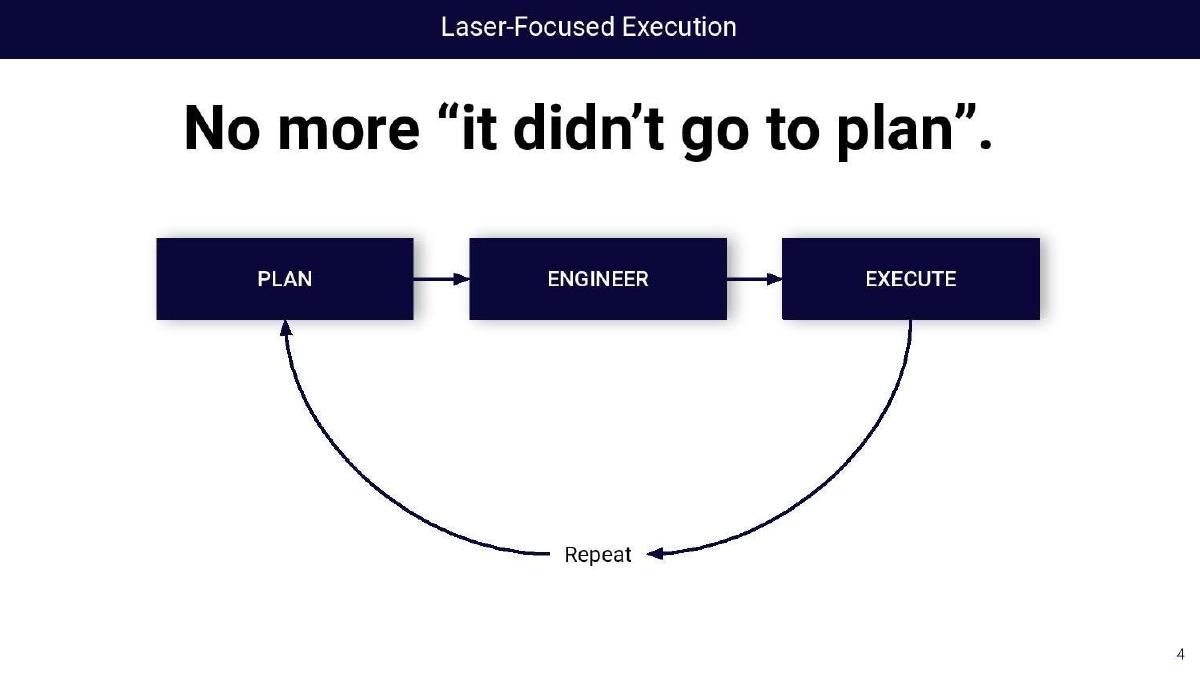
- The deck uses a simple three-step framework—Plan, Engineer, Execute—to categorize its product features (Slide 4).
- Kluster claims to be the 'only platform for planning and executing revenue strategy' (Slide 3).
- Product screenshots on Slides 5-7 show specific metrics like Sales Velocity, Win Rate Trends, and AI-driven predictions ($700,000 vs a $680,000 manager forecast).
- The company highlights a Net Revenue Retention (NRR) of >100%+, a key metric for SaaS health (Slide 9).
- Global expansion is evident with 50% of the business coming from the US and Canada (Slide 9).
- Organic growth is a significant driver, with 40% of business coming from 'Word of mouth' (Slide 9).
- The revenue chart on Slide 9 shows a distinct inflection point and rapid acceleration beginning in early 2021.
- The deck omits a specific financial 'Ask' slide, focusing instead on the 'Join Us' invitation (Slide 10).
Introduction
Kluster’s Series A pitch deck is a study in brevity and data-backed confidence. Raising $5M in a competitive AI and RevOps landscape requires more than just a good idea; it requires proof of execution. Kluster, based in London, provides an AI-driven platform for revenue strategy. Their deck, consisting of only 10 slides, moves quickly from the problem of failed plans to the evidence of their own explosive growth. This teardown examines how they used product-centric storytelling to secure their 2024 funding round.
Slide 1: Title and Vision
The deck opens with a clean, dark-themed slide featuring the Kluster logo and a clear value proposition: "Driving the top line of companies from Series A to IPO, and beyond." This immediately sets the stage for the company's ambition. They aren't just a tool for startups; they are a scaling partner for the entire lifecycle of a high-growth business.
Slide 2: The Problem
Slide 2 identifies a universal pain point in business: "Every quarter. Every year. Every fundraise. Starts with a plan. Most plans fail." By highlighting the failure rate of revenue planning, Kluster creates an immediate need for a solution that ensures plans are actually realized. The simplicity of the text forces the viewer to focus on the gravity of the statement.
Slide 3: The Solution
Kluster positions itself as the definitive answer to the problem stated on the previous slide. They claim to be "The only platform for planning and executing revenue strategy." The subtext notes that the platform is "Relied upon by c-suite, revenue leaders and revenue teams around the world daily." This establishes the user base and the frequency of use, which is critical for SaaS valuations.
Slide 4: The Framework
Titled "Laser-Focused Execution," Slide 4 introduces the "Plan -> Engineer -> Execute" loop. This is the intellectual property of the pitch—a repeatable process that promises "No more 'it didn't go to plan'." This slide serves as the transition into the product demonstration, showing how the software actually functions within a business workflow.
Slide 5: The 'Plan' Phase
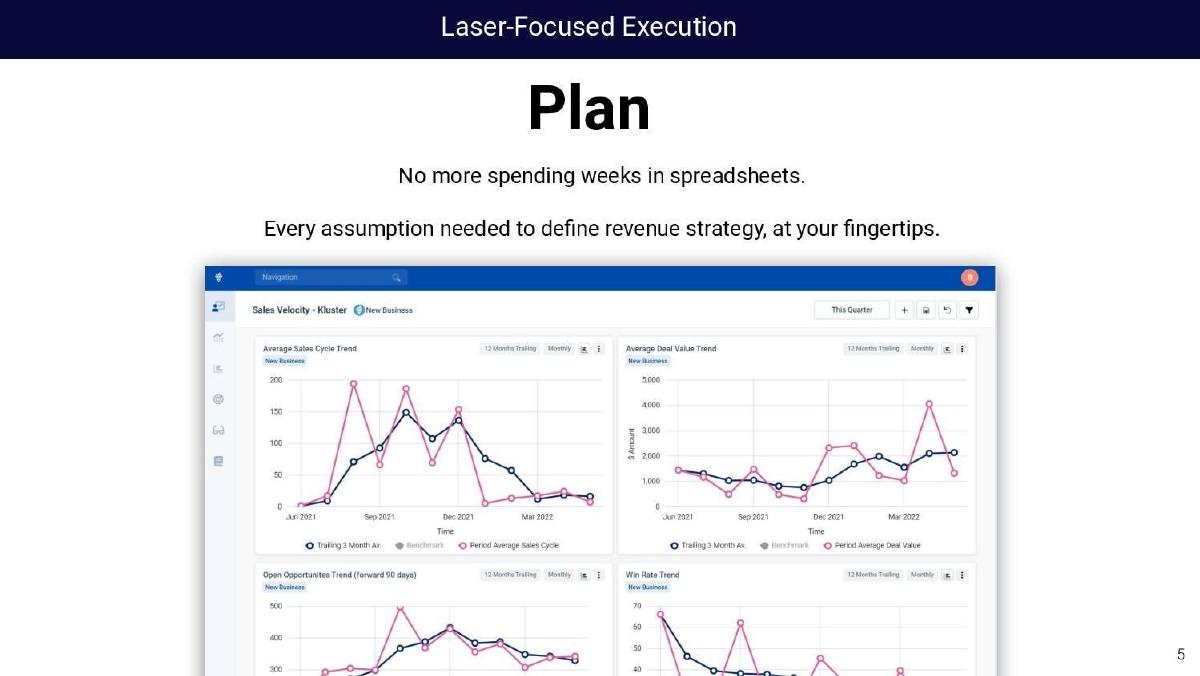
This slide focuses on the first step of their framework. The headline "No more spending weeks in spreadsheets" targets a specific, time-consuming activity for sales operations teams. The screenshot shows a "Sales Velocity" dashboard with metrics for "Average Sales Cycle Trend" and "Average Deal Value Trend." It emphasizes having every assumption needed for revenue strategy at the user's fingertips.
Slide 6: The 'Engineer' Phase
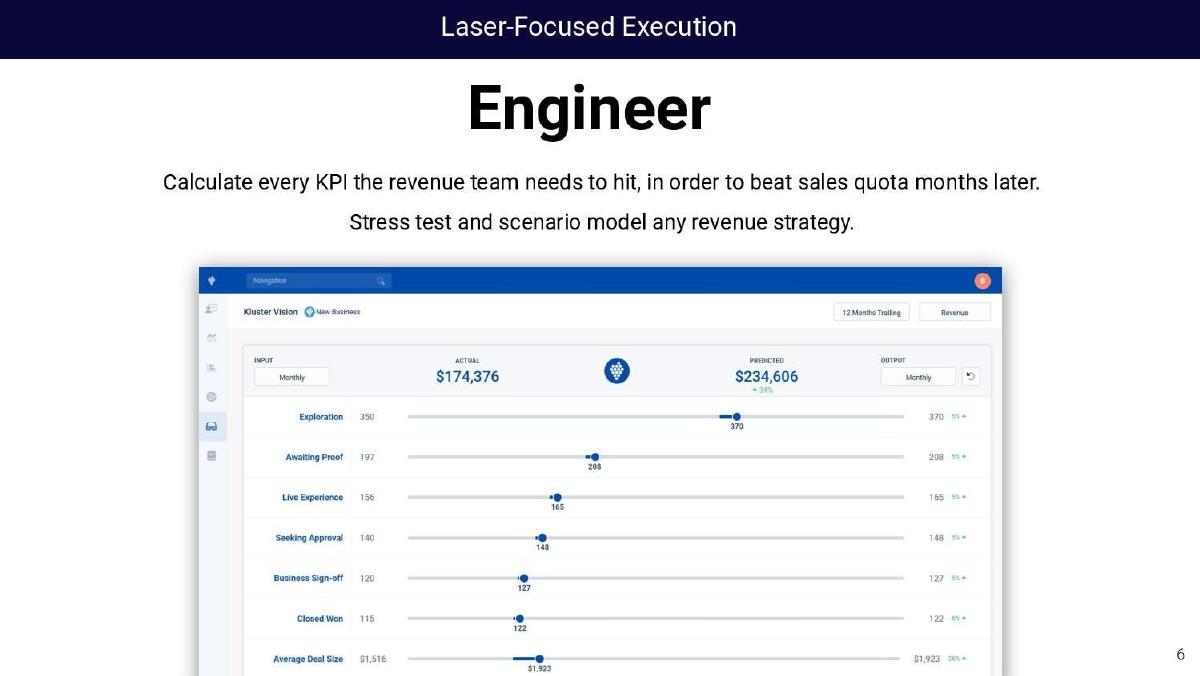
Slide 6 moves to the "Engineer" phase. The platform allows users to "Calculate every KPI the revenue team needs to hit" and "Stress test and scenario model any revenue strategy." The screenshot displays a "Kluster Vision" interface where users can adjust inputs like "Exploration," "Seeking Approval," and "Average Deal Size" to see predicted outputs. This demonstrates the platform's predictive capabilities.
Slide 7: The 'Execute' Phase
The final product slide focuses on "Execute." It claims the platform powers every sales meeting and board meeting, helping teams "Call the right shots, sooner." The screenshot is dense with data, showing a "Kluster AI Prediction" of "$700,000" compared to a "CRO/Manager Forecast" of "$680,000." This comparison highlights the added value of the AI's accuracy over human intuition.
Slide 8: Product Validation
Slide 8 uses third-party social proof to bolster its claims. It lists "Fastest Integration," "#1 Forecasting," "Best dashboarding and analytics," and "Only KPI engineering on the market." At the bottom, it cites G2 badges as the source for these rankings, providing objective evidence that the market prefers their product over competitors.
Slide 9: Product-Market Fit (The Traction Slide)
This is the most important slide in the deck. It features a revenue chart showing a massive spike in growth starting in 2021 and continuing through 2022. Beside the chart, three key metrics are listed: ">100%+ Net Revenue Retention," "50% US and Canada" (showing geographic diversification), and "40% Word of mouth" (showing organic growth efficiency). This slide proves that the product is not just functional, but highly sought after and sticky.
Slide 10: The Team and Conclusion
The final slide, "Join Us," features a group photo of the Kluster team. Interestingly, it does not include individual names, titles, or pedigrees. It serves more as a cultural closing than a formal team introduction. There is also no specific 'Ask' slide detailing the $5M round, which suggests this deck may have been a version used for initial interest or that the terms were discussed separately.
What Kluster Does Well
The deck excels at visualizing the product . Instead of using icons or abstract diagrams, Kluster uses high-resolution screenshots of their actual dashboards. This allows investors to see the depth of the data and the sophistication of the UI. By the time an investor reaches Slide 7, they have a clear understanding of how a CRO would use this tool on a Tuesday morning.
Furthermore, the traction slide (Slide 9) is exceptionally strong. In a Series A raise, investors are looking for a 'T-shape' growth curve, and Kluster provides exactly that. The inclusion of 40% word-of-mouth growth is a subtle but powerful way to signal that their Customer Acquisition Cost (CAC) is likely very low compared to peers who rely solely on paid sales and marketing.
What Is Missing
The most glaring omission is a detailed Team slide . While the group photo is nice, Series A investors typically want to see the specific expertise of the founders—have they scaled sales teams before? Do they have deep AI backgrounds? Without this, the deck relies entirely on the product and the numbers.
Additionally, there is no Competitive Landscape slide. The RevOps and Sales Forecasting space is crowded with players like Gong, Clari, and InsightSquared. Kluster claims to be the "only" platform for revenue strategy, but they don't explicitly show how they differ from these multi-billion dollar incumbents. Finally, the lack of an "Ask" slide means the deck doesn't communicate what the $5M will be used for—whether it's for engineering, US expansion, or marketing.
Founder Takeaways
Show, Don't Just Tell: If your product is data-heavy, use screenshots that show real-world scenarios (like the AI vs. Manager forecast on Slide 7). It builds immediate credibility. · Focus on Retention: Highlighting >100% NRR is the fastest way to an investor's heart in SaaS. It proves that your existing customers are not only staying but growing. · Simplify the Framework: Kluster's "Plan-Engineer-Execute" loop is easy to remember and easy to pitch. Founders should aim for a 3-step process that explains their product's lifecycle. · Leverage Organic Growth: If you have significant word-of-mouth traction, call it out. It is a massive indicator of product-market fit that goes beyond just revenue numbers.
Frequently asked questions
- What is Kluster's core value proposition?
- Kluster positions itself as the essential tool for driving a company's top line from Series A to IPO. It aims to eliminate the common failure of revenue plans by providing a platform that integrates planning, KPI engineering, and execution monitoring, effectively replacing manual spreadsheets with AI-driven insights.
- How does Kluster demonstrate product-market fit?
- The deck uses Slide 9 to show three powerful indicators: an exponential revenue growth curve from 2018 to 2022, a Net Revenue Retention rate exceeding 100%, and the fact that 40% of their new business is generated through word of mouth, suggesting high customer satisfaction.
- What specific product features are highlighted in the deck?
- The deck highlights three phases: 'Plan' (defining strategy without spreadsheets), 'Engineer' (calculating KPIs and stress-testing scenarios), and 'Execute' (AI-powered forecasting for board meetings and sales reviews). Screenshots show dashboards for sales cycle trends, deal values, and weighted pipelines.
- Who is the target audience for Kluster's platform?
- According to Slide 3, the platform is designed for the C-suite, revenue leaders, and revenue teams. The messaging focuses on high-level strategic planning and the granular execution required to hit sales quotas, making it relevant for both executives and managers.
- What is missing from the Kluster Series A deck?
- The deck is notably missing a detailed 'Team' slide with individual backgrounds, a 'Competition' slide comparing them to other RevOps tools, and a specific 'Use of Funds' or 'Ask' slide detailing how the $5M will be spent.