The 2008 AirBed&Breakfast pitch deck is a foundational example of early-stage marketplace storytelling. Comprising 14 slides, it presents a clear solution to the 'expensive hotel' problem by creating a platform for locals to rent out their spare rooms. The deck stands out for its aggressive market sizing—targeting 84 million trips and $2.1 billion in revenue—while grounding its growth strategy in a clever 'dual-posting' integration with Craigslist and event-based marketing. The founders, Joe Gebbia, Brian Chesky, and Nathan Blecharczyk, lean heavily on their design backgrounds and early techn…
Key takeaways
- The deck focuses on a '10% commission' model, projecting $2.1B in revenue by 2011 based on capturing 15% of the budget travel market.
- Market validation is built on the existing success of CouchSurfing and Craigslist, proving people already engage in peer-to-peer lodging.
- The 'Adoption Strategy' highlights a clever hack: targeting high-traffic events like Octoberfest and integrating with Craigslist listings.
- The team emphasizes a 'Design & Brand' advantage, leveraging the founders' backgrounds from the Rhode Island School of Design (RISD).
- Safety and trust are addressed through 'Profiles' and '3-click' booking, aiming to be 'less creepy' than Craigslist.
- The financial ask is $500k for 12 months of runway to reach 80,000 trips booked.
What this deck actually is
The AirBed&Breakfast pitch deck is a 14-slide seed-stage presentation designed to secure a $500,000 angel investment. It is the quintessential example of the "Problem-Solution" framework, focusing heavily on a massive market gap created by the price inefficiency of hotels and the lack of a transactional platform for peer-to-peer lodging. The most important finding in this deck is its hyper-focus on market arbitrage : it doesn't just pitch a new service; it pitches a way to formalize and monetize existing behavior found on Craigslist and CouchSurfing by adding a 10% transaction fee.
Slide-by-slide walkthrough
Slide 1: Welcome
The title slide for AirBed&Breakfast (now Airbnb) is remarkably minimalist. It features the original logo—a bubble-font wordmark in blue and pink—and the core value proposition: "Book rooms with locals, rather than hotels." Beneath this, it provides a physical address in San Francisco, a website URL, a toll-free phone number, and a direct email for "joe@airbedandbreakfast.com."
This slide sets an immediate tone of simplicity and utility. By positioning the company directly against "hotels" in the very first sentence, the founders establish a David vs. Goliath narrative. The inclusion of a physical address (19 Rausch Street) and a 1-888 number suggests a level of operational legitimacy and accessibility that is often missing from early-stage tech pitches. It tells the investor that this isn't just a digital concept; it's a functioning business you can call or visit.
The strongest version of a cover slide usually includes a "Why Now" hook or a slightly more evocative tagline, but for a 2008-era deck, this is highly effective. It avoids the "mystery box" problem where investors have to guess what the company does. The "TM" next to the name also signals a professional intent to own the category they are creating.
Slide 2: Problem
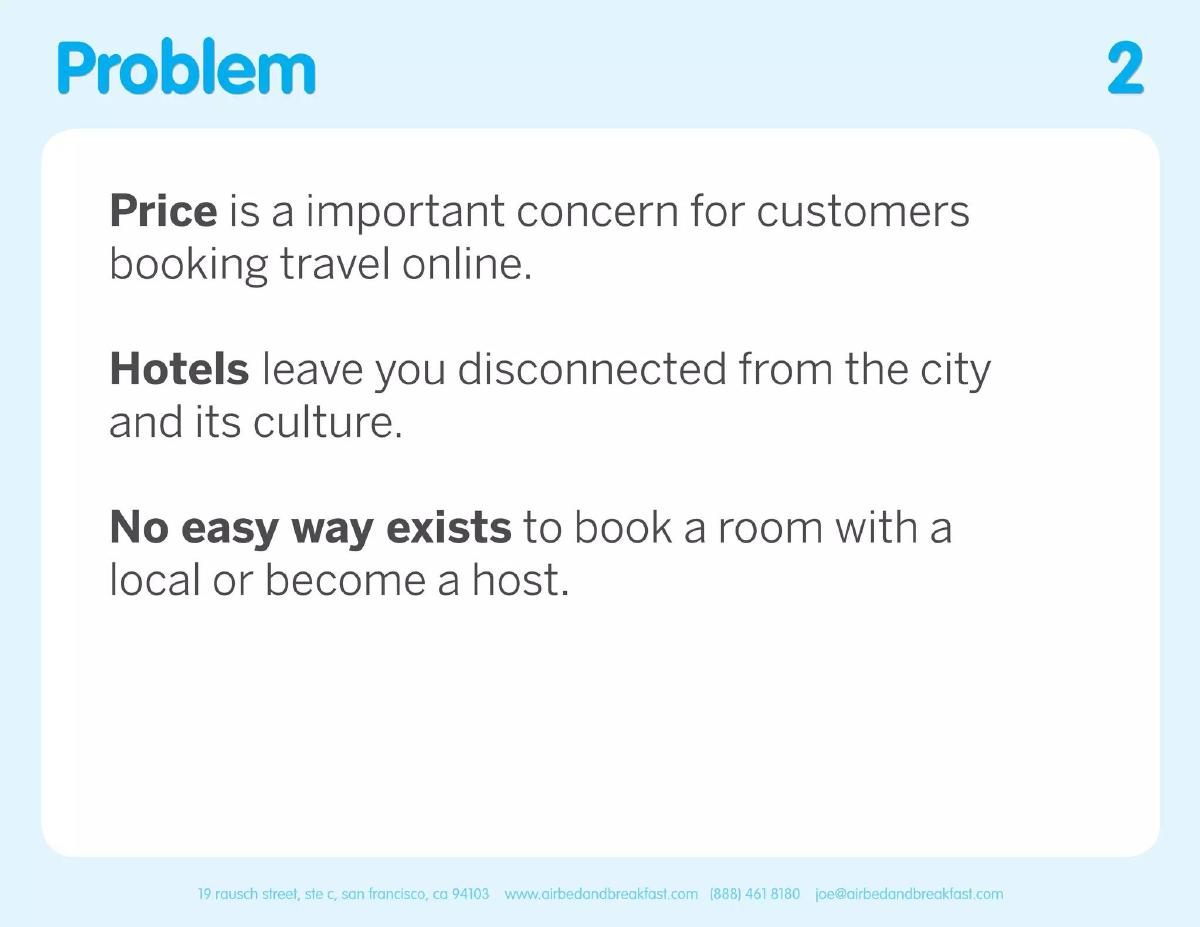
The problem slide identifies three distinct pain points: price concerns for online travel bookers, the cultural "disconnection" of hotels, and the lack of an easy way to book with locals or become a host. It uses dark gray text on a white background, keeping the focus entirely on the logic of the argument.
Investors read this as a two-sided market failure. First, there is a financial barrier (hotels are too expensive). Second, there is a social/experiential barrier (hotels are sterile). By identifying the lack of an "easy way" to host, the slide hints that there is latent supply—people who want to rent their space but find current methods (like Craigslist) too difficult or unsafe. It frames the problem as a missing piece of infrastructure rather than a lack of demand.
To make this slide even stronger, the founders could have included a data point on the rising cost of hotels in major cities or a metric showing the growth of "experiential" travel. However, by keeping it to three bullets, they ensure the investor doesn't get bogged down in data before the solution is presented.
Slide 3: Solution
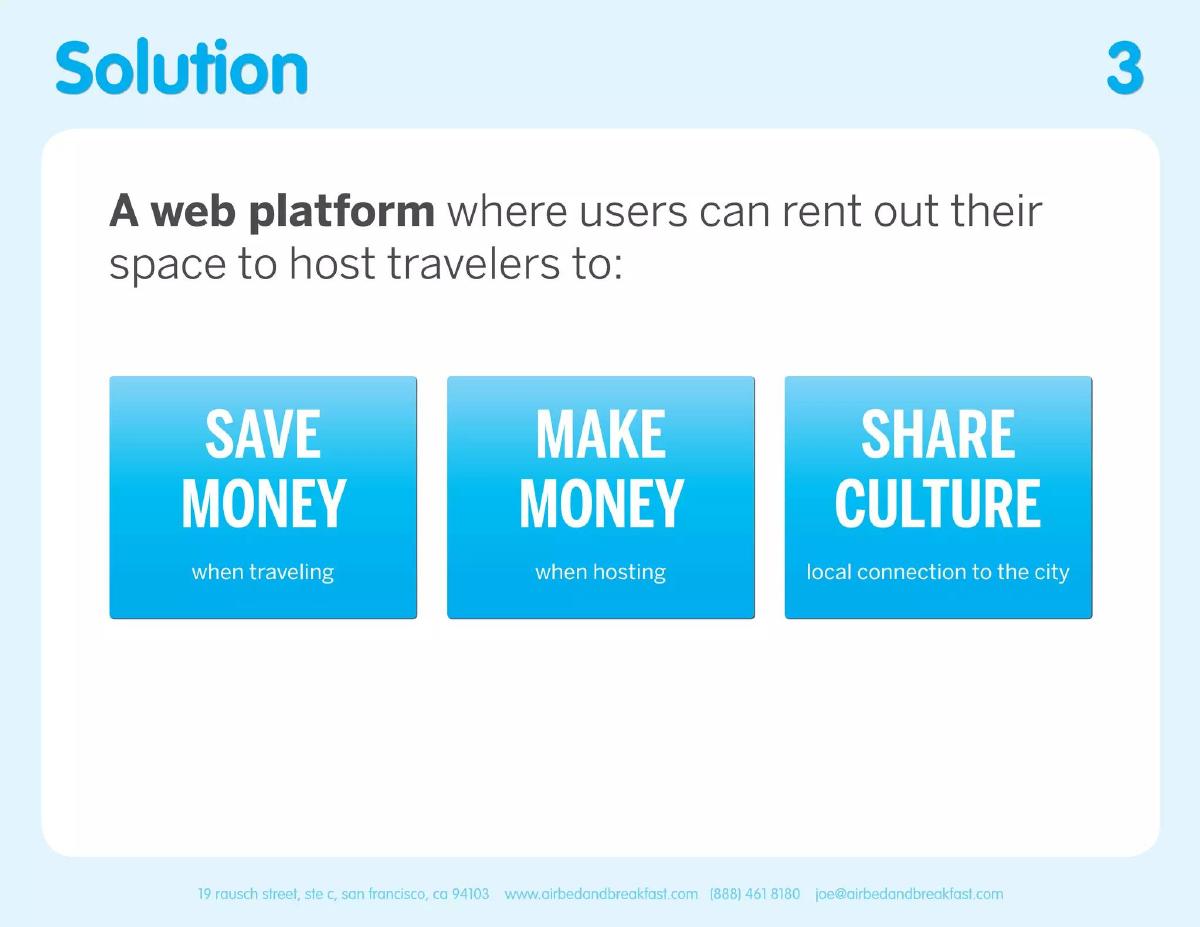
The solution is described as a "web platform where users can rent out their space to host travelers." The slide breaks the benefits into three buckets: "SAVE MONEY" for travelers, "MAKE MONEY" for hosts, and "SHARE CULTURE" for both. These are housed in blue gradient boxes that pop against the white background.
This slide effectively addresses every problem raised on the previous slide. It demonstrates a clear understanding of the "Value Exchange" in a marketplace. By highlighting "Make Money" for hosts, it positions the platform as a source of supplemental income—a powerful motivator during the economic climate of 2008. The phrase "local connection to the city" addresses the "disconnected" hotel problem mentioned earlier.
A stronger version of this slide might have included a single-sentence "How it works" to bridge the gap between the concept and the product. However, the simplicity of the three pillars makes the business model feel intuitive and low-friction.
Slide 4: Market Validation
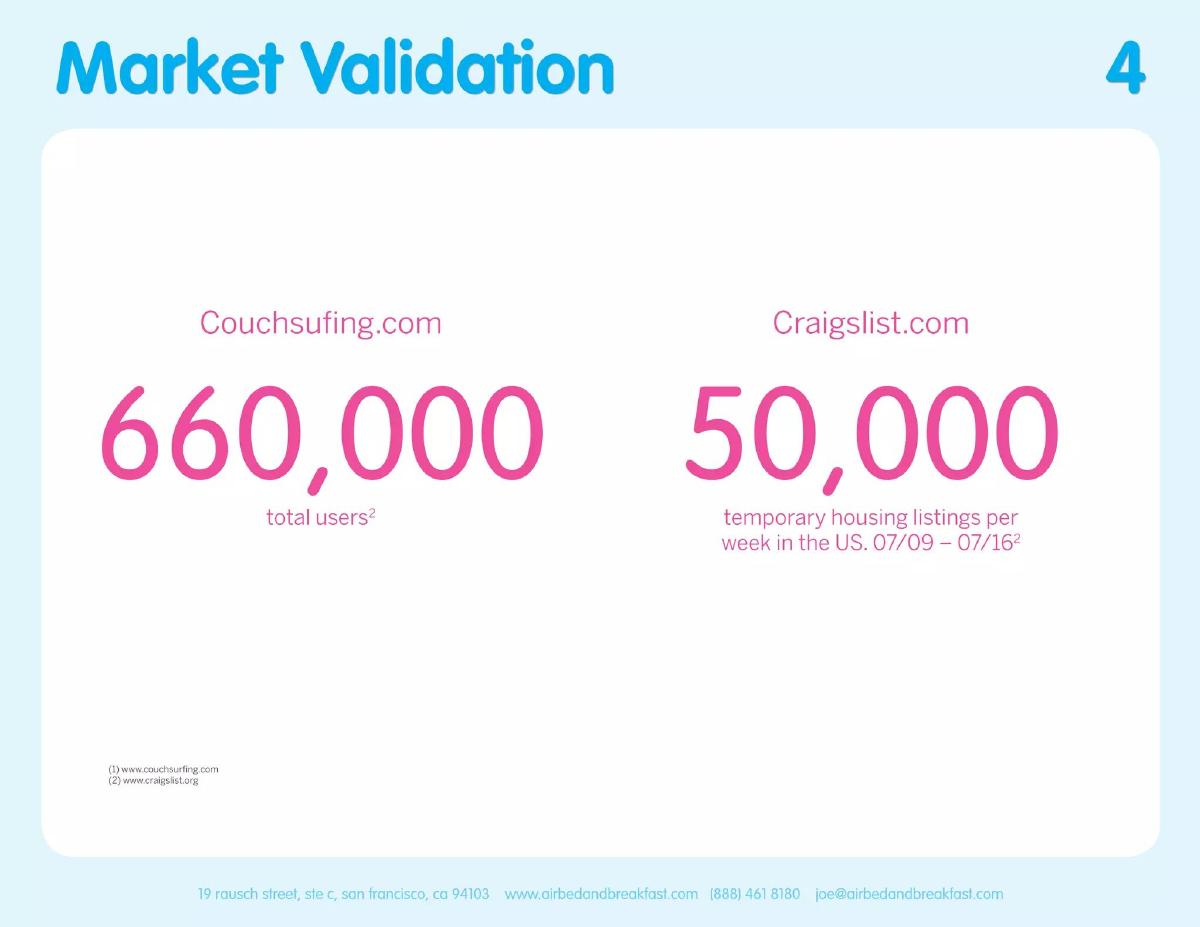
This slide uses two existing platforms to prove that the behavior they are targeting already exists. It cites CouchSurfing.com (660,000 total users) and Craigslist.com (50,000 temporary housing listings per week in the US). It specifically notes a data range of "07/09 – 07/16" for the Craigslist stats.
This is a masterclass in market validation. Instead of guessing if people want to sleep in strangers' homes, the founders point to two massive communities already doing it. The message to the investor is: "The market is already there; it's just fragmented and poorly served." Using Craigslist as a benchmark is particularly clever because it highlights a massive volume of "temporary housing" that is currently being transacted in an unsafe, non-monetized way.
The slide could be improved by clarifying the Craigslist "50,000 per week" stat—does this include sublets or just short-term vacation rentals? Regardless, the sheer scale of the numbers (660k and 50k) provides the "Social Proof" needed to move to the market size discussion.
Slide 5: Market Size
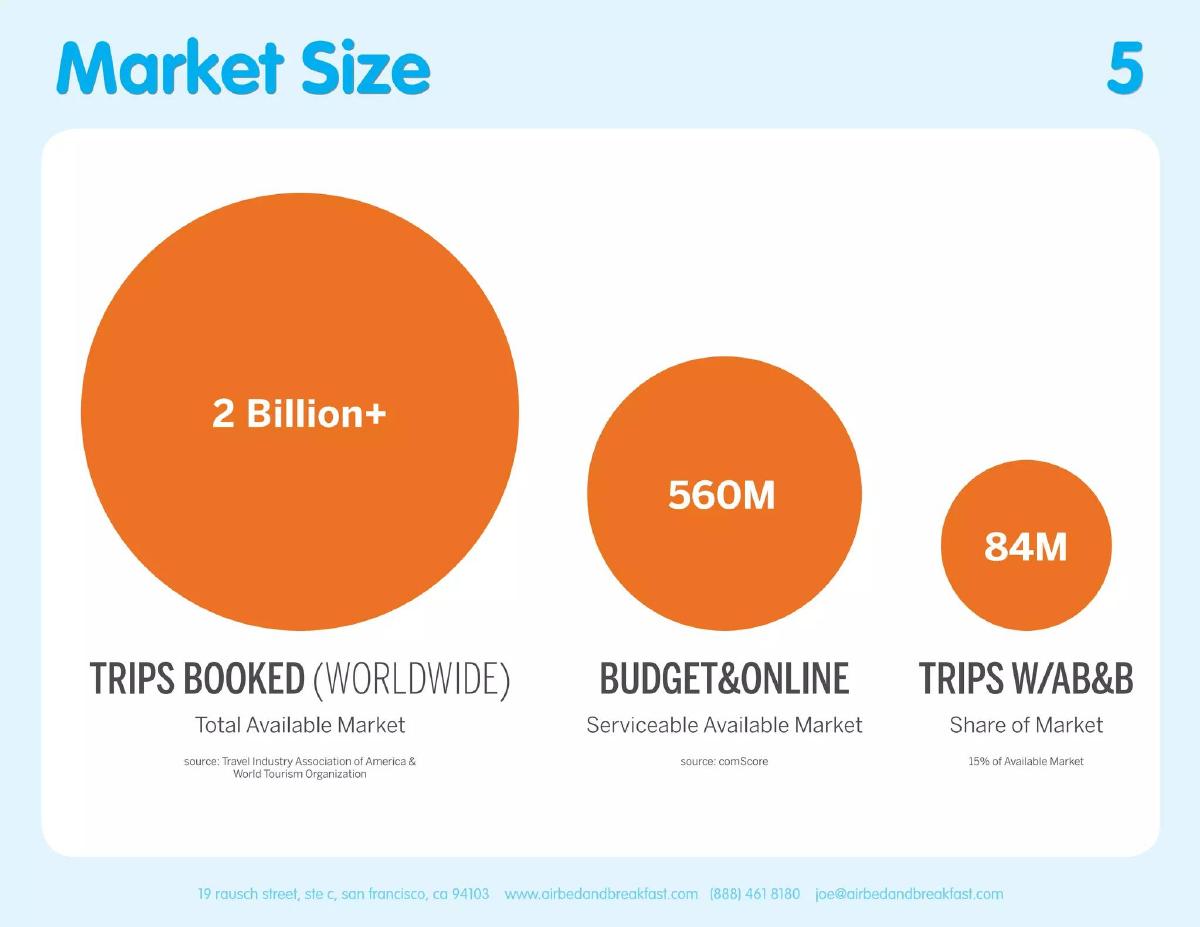
Using the classic TAM/SAM/SOM funnel, this slide presents three orange circles. The Total Available Market (TAM) is "2 Billion+ TRIPS BOOKED (WORLDWIDE)." The Serviceable Available Market (SAM) is "560M BUDGET&ONLINE" trips. The Share of Market (SOM) is "84M TRIPS W/AB&B," which they define as 15% of the SAM.
The logic here is top-down. By citing the Travel Industry Association of America and comScore, they ground their massive numbers in credible third-party data. The jump from 560M to 84M (the 15% target) is the "Bet" of the deck. It tells the investor exactly what the founders believe their ceiling is in the near term. The use of "trips" as the unit of measurement rather than dollars at this stage helps the investor visualize the volume of transactions.
The math here is bold. Capturing 15% of all budget/online trips globally is an incredibly high bar for a seed-stage startup. A more conservative SOM or a more specific definition of "Budget & Online" might have felt more grounded, but in the context of a "big swing" VC pitch, these numbers are designed to excite.
Slide 6: Product
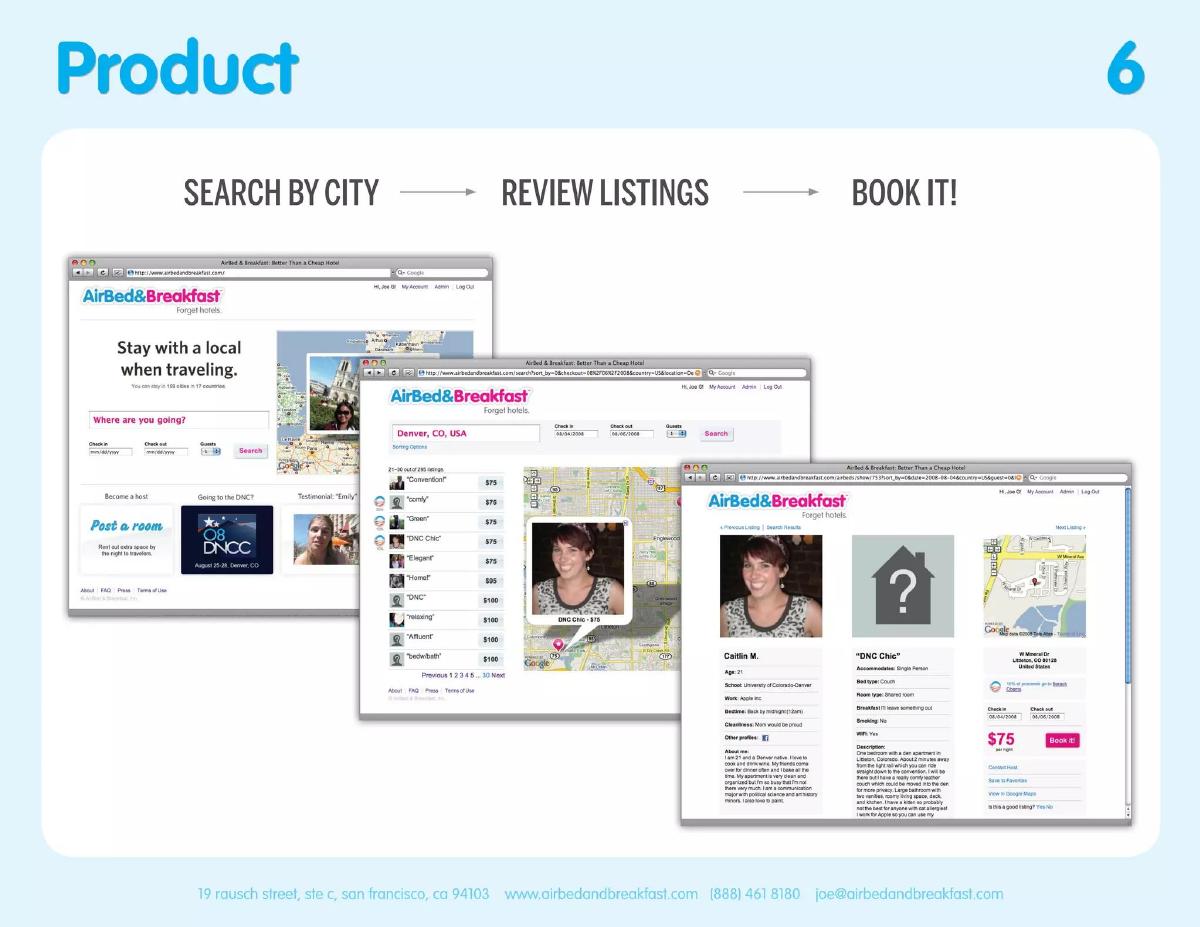
The product slide shows a three-step user flow: "SEARCH BY CITY," "REVIEW LISTINGS," and "BOOK IT!" It features a screenshot of a Denver, CO listing for "Caitlin M." at "$75" with a "Book it!" button. The interface looks clean, featuring a photo of the host and the room.
This slide proves the product is more than "vaporware." By showing a listing for the "DNC" (Democratic National Convention), the founders are likely referencing their early pilot success. The emphasis on "3 clicks" (implied by the three steps) highlights the "Ease of Use" advantage mentioned later in the deck. It makes the transaction feel as simple as booking a hotel, which is the core product innovation.
To improve this, the founders could have shown the host's side of the interface. Since marketplaces are supply-constrained, showing how easy it is to "List your space" would have been a strong addition to the "Book it!" traveler flow.
Slide 7: Business Model
The business model is a simple 10% commission. The slide breaks down the math: 84M trips (SOM) x $25 average fee (based on an $80/night stay for 3 nights) = $2.1B in projected revenue by 2011. They note that $70 is the average room price on AB&B.
This is the most critical slide for an investor's ROI calculation. The math is transparent: 84,000,000 25 = 2,100,000,000. It ties the market size directly to the revenue potential. By stating the average fee is $25, they make the $2.1B figure feel achievable through high-volume, low-friction transactions. It frames AirBed&Breakfast as a high-margin software business with no inventory costs.
The "Projected by 2011" timeline is extremely aggressive, given the deck is from 2008. To go from zero to $2 billion in three years is a "unicorn" trajectory. The deck doesn't explain the ramp-up period or the customer acquisition cost (CAC) required to reach 84 million trips, which is a significant omission for a business model slide.
Slide 8: Adoption Strategy
The "Adoption Strategy" (Go-To-Market) focuses on two prongs: "EVENTS" and "PARTNERSHIPS." Events listed include Octoberfest (6M people), Summerfest (1M), and Mardi Gras (800,000). For partnerships, they list Kayak, Orbitz, and Craigslist, specifically highlighting a "dual posting feature" for Craigslist.
This is a very clever "hacker" approach to growth. By targeting massive events where hotels are guaranteed to be sold out, AirBed&Breakfast solves an immediate supply-demand crisis. The Craigslist "dual posting" feature is the highlight here; it suggests they will siphon users directly from their largest unorganized competitor. It shows they aren't just waiting for people to find them; they are going where the "unmet need" is most acute.
The partnership list (Kayak, Orbitz) feels aspirational rather than secured. A stronger slide would distinguish between "Current Integrations" and "Future Partners." However, the Craigslist integration visual provides a concrete look at their primary growth engine.
Slide 9: Competition
The competitive matrix uses two axes: "Offline vs. Online Transaction" and "Affordable vs. Expensive." AirBed&Breakfast is placed in the top-left quadrant (Affordable + Online). Competitors like Hostels.com and CouchSurfing are Affordable but "Offline" (in terms of transaction), while VRBO and Hotels.com are "Online" but "Expensive."
This slide visually carves out a "White Space" in the market. It argues that while you can find cheap rooms (CouchSurfing) or book online (Hotels.com), no one is doing both at scale for this specific segment. By placing Craigslist in the "Offline Transaction" category, they reinforce their value prop: Craigslist helps you find a room, but it doesn't help you pay for it or guarantee the stay.
The 2x2 matrix is a standard pitch deck trope, but it works here because the axes are actually meaningful to the customer's experience. The strongest version would perhaps include "Trust/Safety" as a factor, as that is the primary hurdle for this business model.
Slide 10: Competitive Advantages
This slide lists six advantages: 1st to Market, Host Incentive (making money), List Once (vs. daily on Craigslist), Ease of Use, Profiles (safety/trust), and Design & Brand. It notes they will launch at the "historic DNC" to gain share of mind.
This slide addresses the "defensibility" of the business. "List Once" is a direct attack on the user experience of Craigslist, which requires frequent reposting to stay visible. The mention of "Profiles" is the first real nod to the safety and identity layer that makes peer-to-peer lodging viable. The "Design & Brand" box reflects the founders' backgrounds as RISD graduates, suggesting that a superior UI/UX will be their moat.
The "1st to Market" claim is a bit weak, as CouchSurfing existed, but the founders qualify it as the first "transaction-based" site. A stronger version of this slide would focus more on the "Network Effects"—the idea that more hosts attract more travelers, making the platform harder to displace over time.
Slide 11: Team
The team consists of Joe Gebbia (UI & PR), Brian Chesky (Biz Dev & Brand), and Nathan Blecharczyk (Developer). The slide highlights their RISD backgrounds, Joe’s patent for "CritBuns," and Nathan’s history of creating Facebook apps with 75,000 users. Michael Seibel (CEO of Justin.tv) is listed as an advisor.
This is a classic "Hacker, Hipster, Hustler" trio. The founders' design pedigree (RISD) supports the "Design & Brand" advantage mentioned earlier. Nathan’s technical background, specifically building apps with significant user bases, gives the investor confidence that the platform can scale. Michael Seibel’s presence as an advisor adds "Silicon Valley Credibility," as he was already a venture-funded founder.
While the bios are strong, the slide lacks "Team Momentum." It shows who they are, but not necessarily what they have achieved together yet, other than the concept. Including a "Founded in [Year]" or "Working together since..." would help establish their collaborative history.
Slide 12: Press
The press slide features quotes from Webware, Josh Spear, Mashable, and Springwise. The quotes are generally positive, with Josh Spear calling it "Craigslist meets Hotels.com, but a lot less creepy," and Springwise noting the "fee-based service could help alleviate concerns about quality."
Press slides are about validation and "buzz." By quoting Mashable and Webware, the founders show that the tech community is already paying attention. The Springwise quote is particularly important because it validates the business model—the idea that charging a fee actually improves the service by acting as a quality filter.
A more powerful version of this slide would include the dates of these articles. "Recent Press" is more impressive than undated quotes. However, for a seed round, these four snippets are sufficient to prove that the "AirBed&Breakfast" name is starting to circulate in the industry.
Slide 13: User Testimonials
This slide provides four testimonials from users in Washington DC, Atlanta, Austin, and Ontario. The quotes focus on price ("found something in my price-range"), ease of use, making money, and the social experience ("It’s about the ideas, the interactions, the people").
This slide humanizes the data. It proves that the "Problem" (price) and "Solution" (saving/making money and culture) are landing with real people. The inclusion of a host testimonial ("it made me money") is crucial for proving the supply side of the marketplace works. It confirms that people are actually willing to let strangers into their homes for a fee.
The slide is visually a bit cluttered with the speech bubbles. A stronger version might show a "User Rating" or a metric like "X% of users would recommend us," but the authentic, slightly raw quotes like "freaking rocks!" add a layer of genuine enthusiast sentiment that investors often look for in early consumer startups.
Slide 14: Financial
The final slide is the "Ask." They are looking for "$500K ANGEL ROUND" to reach "80,000 transactions." They project that these 80k trips at a $25 fee will generate "$2M REVENUE over 12 months."
This is a clear, concise ask. It ties the investment directly to a milestone (80,000 transactions) rather than just a time period. It shows the investor exactly how their money will be used to scale the unit economics of the business. The 12-month horizon is standard for a seed round, providing enough runway to reach the next inflection point.
The jump from the "Business Model" slide (which projected $2.1B by 2011) to this "Financial" slide (which projects $2M over 12 months) creates a massive discrepancy in expectations. The deck doesn't reconcile how they go from $2M to $2B in approximately two years. Clarifying the "Phase 1" vs. "Phase 2" growth expectations would make the financial narrative more cohesive.
Concrete fixes in priority order
Reconcile Revenue Projections: The gap between the $2M revenue target in the "Ask" slide and the $2.1B revenue projection in the "Business Model" slide is mathematically jarring. The deck needs a bridge explaining how the 15% market share is captured over time. · Define the Craigslist "Hack" Mechanics: While the Craigslist dual-posting is mentioned, it’s a high-risk/high-reward strategy. Explaining the technical feasibility or the sustainability of this "Adoption Strategy" would reassure investors concerned about platform risk. · Expand on Trust and Safety: The deck mentions "Profiles" and "less creepy" press quotes, but for a business involving sleeping in strangers' homes, a dedicated slide on verification, reviews, or insurance would address the biggest investor objection. · Clarify Market SOM: Capturing 15% of all worldwide budget/online trips (84 million trips) is a massive claim. Providing a breakdown of this by city or by specific "Event" targets (e.g., "We will capture 10% of the 6M Octoberfest visitors") would feel more realistic. · Show Host Side Product: The product slide only shows the guest experience. Since the business lives and dies by its supply, showing the "List your room in 5 minutes" interface is essential. · Add Team History: Explicitly state how long the founders have worked together or highlight a shared project to mitigate "founder conflict" risk.
Frequently asked questions
- How does AirBed&Breakfast make money?
- AirBed&Breakfast takes a 10% commission on each transaction. Based on an average room price of $70 and an average stay of 3 nights, they calculate a $25 fee per booking.
- What problem is the startup solving?
- The deck identifies three main problems: high hotel prices, the cultural disconnection of traditional hotels, and the lack of an easy platform for locals to host travelers.
- How does the deck prove market demand?
- The founders use two primary benchmarks: CouchSurfing.com (660,000 users) and Craigslist (50,000 temporary housing listings per week in the US).
- What is the plan for user acquisition?
- The strategy focuses on two areas: targeting large events like Octoberfest and Mardi Gras where hotel capacity is low, and implementing a "dual posting" feature with Craigslist to siphon existing traffic.
- How much money is the company raising?
- They are seeking a $500,000 angel investment to fund 12 months of operations and reach a goal of 80,000 transactions, which they project will generate $2 million in revenue.