U-Pump presents a hardware-centric solution to diabetes management, focusing on a tubeless insulin patch pump that integrates AI for personalized dosing. The deck identifies a significant market gap, noting that only 20% of insulin-dependent individuals currently use a pump. U-Pump aims to capture this untapped 80% with a device that emphasizes 'Swiss precision' and ease of use. Financially, the company is aggressive, projecting $127M in revenue in its first year of stable operations and scaling to over $1.3B by year five. The unit economics are a highlight, showing strong 74-80% margins acro…
Key takeaways
- The company is seeking $1.5M in pre-seed funding via SAFEs to finalize the product and submit a dossier to the FDA (Slide 13).
- U-Pump claims a significant market opportunity, stating that 80% of insulin-dependent people do not currently use a pump (Slide 2).
- The product features a proprietary 'OneMove' system for painless, one-movement installation, which is currently patent-pending (Slide 4).
- Financial projections are highly ambitious, forecasting $1.3B in revenue by the fifth year of operations (Slide 7).
- Unit economics for direct sales show a 78% margin in the first month, with a $2,800 price point against a $620 cost (Slide 17).
- A subscription model is also proposed, offering the pump for 'free' with a $280 monthly fee, yielding a 74% annual margin (Slide 18).
- The roadmap requires an additional $30M (Round 2) for clinical trials, FDA certification, and building a production unit (Slide 10).
- The team includes founders with experience in capital markets and medical device development, supported by a diabetologist advisor (Slide 12).
Executive Summary and Market Context
Slide 1: Title Slide
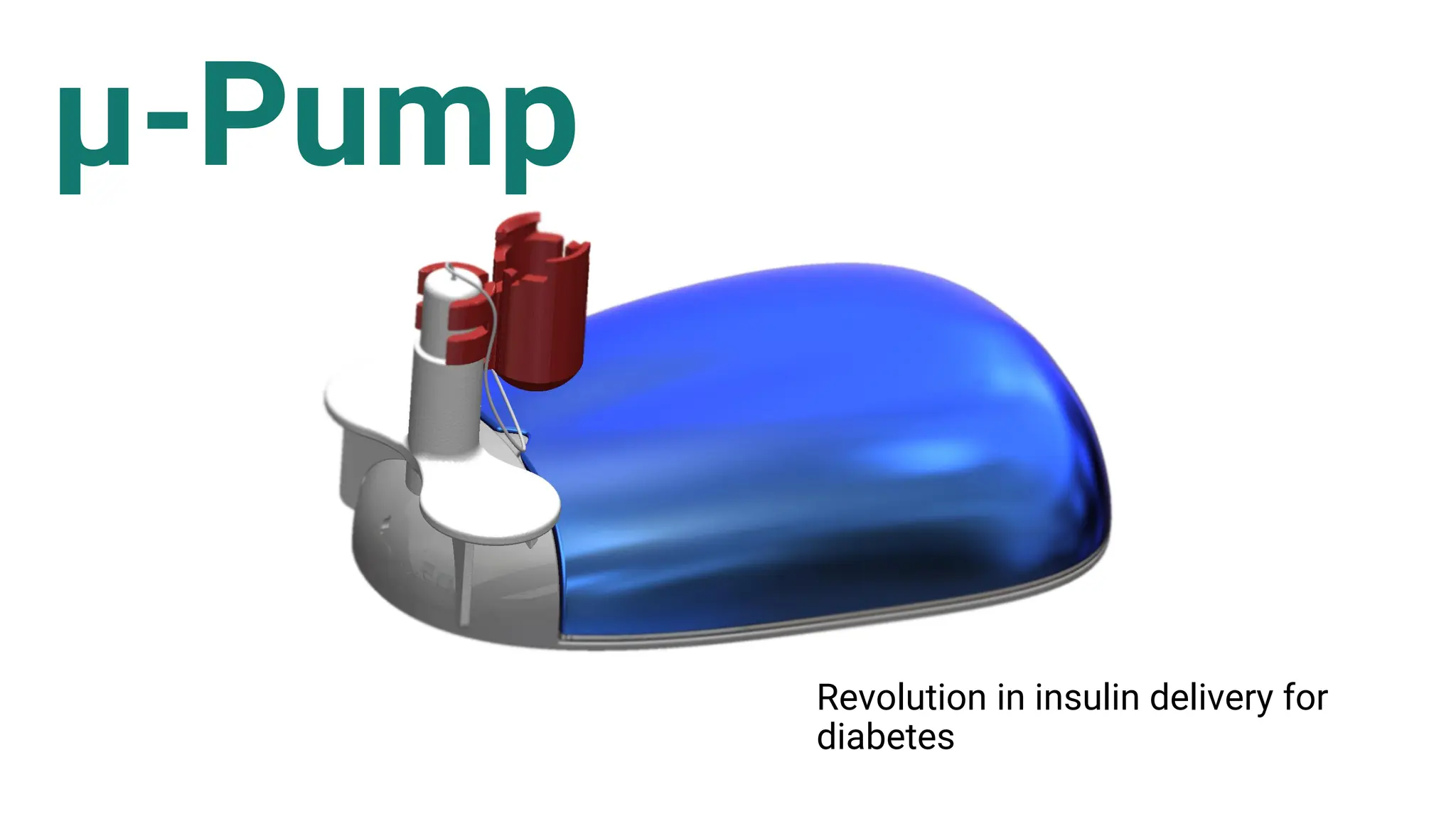
The deck opens with the brand name μ-Pump (U-Pump) and the tagline "Revolution in insulin delivery for diabetes." The visual features a 3D render of a blue, pebble-shaped patch pump with a red and white mechanical interface. The design appears compact and tubeless, signaling a direct challenge to traditional tethered pump systems.
Slide 2: Diabetes Management Challenge
This slide establishes the problem and the Total Addressable Market (TAM). It breaks down the diabetic population across three regions: USA (38M) , Europe (60M) , and MENA (73M) . Crucially, it highlights that only a small fraction of these populations currently use insulin pumps: 500,000 in the USA, 1.4M in Europe, and 4.5M in MENA. The core thesis is stated plainly: "Only 20% of insulin-dependent people with diabetes use a pump for insulin delivery," citing cost and inconvenience as the primary barriers.
Slide 16: Company Overview (Appendix)
Though placed in the appendix, this slide provides a high-level summary. It defines μ-Pump, INC as a "development stage medical device company." It claims a $4.2 Billion unmet market need and emphasizes a portfolio of technologies designed to make delivery systems affordable and easy to use. The slide lists "High accuracy" and "Less components" as key value drivers.
Product and Technology Deep Dive
Slide 3: U-Pump: New Generation Insulin Pump
This slide introduces the specific value propositions of the hardware. It lists five key features: Swiss precision for a discreet design, an AI bolus calculator for personalized dosing, the OneMove™ system for painless installation, replaceable cartridges for economy, and integration with leading CGMs like Dexcom. The slide notes that 2 provisional patents have been filed.
Slide 4: Product Innovations
This slide focuses on the mechanical innovations. The OneMove™ system is described as having "No setter, everything on board!" allowing for installation in a single movement. It also highlights the Replaceable Cartridges , which are intended to provide flexibility and convenience. Both features are marked as "Patent pending."
Slide 5: Technical Details
Further technical details are provided here. The Swiss Watch Precision is cited as the reason for the device's reliability and durability, accompanied by renders of internal gears. The AI Bolus Calculator is explained via a flowchart showing inputs from CGM devices, Apple Watch, and manual entries (carbs, sport activity) to generate dosage recommendations. The device uses BLE (Bluetooth Low Energy) for connectivity.
Market Opportunity and Competition
Slide 6: Insulin Pump Market
The deck provides specific market sizing data. The global market size in 2023 is stated as $5.3 BN , with a projected CAGR of 12.4% leading to a $15 BN market by 2032. It segments the 2023 market into Devices (>$4.5 BN), Home Care ($3 BN), and North America ($2.3 BN). Sources cited include Seagrove Partners LLC and Global Market Insight.
Slide 11: Comparison with Competitors
This is a comprehensive feature-by-feature comparison table against Omnipod 5 , Medtronic 780G , and Tandem T-Slim Control IQ . U-Pump claims superiority in several areas: it is tubeless (unlike Medtronic/Tandem), offers full control via a phone app (unlike Medtronic), and has a lower minimum basal delivery rate (0.005 vs 0.01-0.025 for competitors). It also highlights the OneMove™ setter as a differentiator against the "Required" or "Possible" external setters of competitors.
Go-to-Market and Financials
Slide 7: Traction and Revenue
The company defines its Ideal Customer Profile (ICP) as insulin-dependent individuals aged 18-65 who value convenience. The slide presents a bar chart showing revenue scaling from $127M in Year 1 to $1.3B in Year 5 . It lists an Average Value per Customer (AVC) of $3,541 and an Estimated CAC of $200 . Acquisition strategies include digital marketing and healthcare provider partnerships.
Slide 8: Go-to-Market Strategy
The GTM strategy is split into three pillars: Channel Strategy (online platforms, retail pharmacies), Market Expansion (initial focus on 1% penetration of the USA market), and Scaling Strategy (international distribution and telemedicine partnerships).
Slide 9: Financial Forecasts
This slide provides more granular detail on the projections. Year 1 revenue of $127M is based on selling 36,000 units (1% of the market). It claims EBITDA growth will be 232% over five years. The funding requirements are explicitly stated: $1.5M for the current stage and approximately $30M for the next stage (production unit and clinical trials). It projects breakeven within 1.5 years .
Slides 17 & 18: Unit Economics
These slides break down the two business models. The Direct Sales model (Slide 17) shows a pump price of $2,800 against a $600 cost, and consumables at $10 against a $2 cost, resulting in a 78-80% margin . The Subscription Model (Slide 18) offers the pump for free but charges $280/month for a year, resulting in a 74% margin ($2,493 gross profit on $3,357 annual revenue).
Roadmap and Team
Slide 10: Roadmapping
The development timeline is divided into four stages. Stage 1 (Tech documentation) is complete. Stage 2 (MVP) is a 12-month phase requiring $1.5M. Stage 3 (Go to Market) is a 24-month phase requiring $30M for production and FDA certification. Stage 4 (Business Development) is a 24-month phase for international expansion, funded by a third round or credit line.
Slide 19: Future Production Roadmap
This slide outlines a decentralized manufacturing strategy. It envisions a Centralized Production Facility for the pump itself (high precision mechanics) and Regional Mini-factories for consumables to allow for localized customization and market adaptation.
Slide 12: Team
The team is led by Alexander Senkevich (CEO) , who has 15 years of experience in public equity and has launched 3 projects. Mikhail Zeppelin (CTO) brings 15 years of device development experience, specifically in insulin delivery systems. The team includes IT and MISRA specialists, a Diabetologist advisor ( Elena Omelchenko, MD ), and a regulatory advisor ( Mikhail Pliss ).
The Ask
Slide 13: Ask
The formal request is for $1.5M in pre-seed funding using SAFEs . The funds are earmarked for "finalizing and PreFDA submission."
Slide 14: Contact
The deck concludes with a "Thank you" slide providing the company website (u-pump.com), the CEO's email, and two phone numbers (USA and Israel country codes).
What U-Pump Does Well
Clear Market Gap: The deck does an excellent job of quantifying the "untapped" market (80% of patients) and explaining exactly why they aren't using current solutions. · Detailed Unit Economics: Providing two distinct business models (Direct vs. Subscription) with specific COGS and margin data is highly professional and gives investors a clear view of the path to profitability. · Competitive Benchmarking: Slide 11 is a standout. It doesn't just list competitors; it compares them on technical specifications that matter to users, such as basal delivery increments and app control. · Hardware Visualization: The renders and internal gear diagrams help demystify the "Swiss precision" claim and make the product feel tangible.
What Is Missing from the U-Pump Deck
Regulatory Detail: While the deck mentions FDA submission, it lacks a detailed regulatory roadmap. For a Class II or III medical device, the specific pathway (e.g., 510(k) vs. PMA) and the status of clinical trial designs are critical omissions. · IP Status: The deck mentions "provisional patents filed" and "patent pending." Investors would likely want to know the specific claims covered and if they have a Freedom to Operate (FTO) analysis, given the crowded space. · Validation Data: There is no mention of bench testing, animal studies, or early human factor studies. For a $1.5M ask to reach "Pre-FDA," some proof of functional prototype performance is usually expected. · Burn Rate and Runway: While the total capital needs are stated, a monthly burn rate or a more detailed breakdown of how the $1.5M will be spent (beyond a high-level list) is missing.
What Other Founders Should Copy
The "Problem" Slide Structure: Slide 2 is a masterclass in using regional data to build a narrative of global opportunity while identifying a specific, addressable segment of non-users. · The Comparison Table: Founders in crowded markets should emulate Slide 11. It uses objective technical metrics rather than vague marketing terms to show differentiation. · Subscription Model Analysis: Even for hardware companies, showing a recurring revenue alternative (Slide 18) is a great way to appeal to modern VC preferences for SaaS-like predictability. · Regional Manufacturing Strategy: The idea of a centralized "brain" factory and regional "consumable" factories (Slide 19) is a smart way to address the logistics of global scaling.
Frequently asked questions
- What is the primary innovation U-Pump is pitching?
- U-Pump's core innovation is a tubeless insulin patch pump that combines 'Swiss watch precision' with an AI bolus calculator. Key technical features include the 'OneMove' system for painless installation and replaceable cartridges. The deck emphasizes that these features address the cost and inconvenience barriers that prevent 80% of insulin-dependent patients from using current pump technology.
- How does U-Pump plan to generate revenue?
- The company outlines two primary business models: Direct Sales and a Subscription Model. In the direct sales model, the pump is priced at $2,800 with consumables at $10 each. The subscription model offers the pump for free with a $280 monthly fee covering 132 consumables per year. Both models project high gross margins between 74% and 80%.
- What are the funding requirements and milestones?
- U-Pump is currently raising a $1.5M pre-seed round to reach the pre-FDA submission stage. Following this, they anticipate needing a $30M Round 2 to fund a production unit, hire staff, conduct clinical trials, and obtain final FDA certification. They project reaching breakeven within 1.5 years of starting stable operations.
- Who are the competitors mentioned in the deck?
- Slide 11 provides a detailed comparison against three major incumbents: Omnipod 5, Medtronic 780G, and Tandem T-Slim Control IQ. U-Pump differentiates itself by offering a tubeless design (unlike Medtronic and Tandem), BLE communication with meters, and a lower minimum basal delivery rate of 0.005 units.
- What is the current stage of the product?
- According to Slide 16, U-Pump is a 'development stage medical device company.' They have completed 'Stage 1: Tech documentation' using $200k of own investment. They are currently entering 'Stage 2: MVP,' which involves creating a laboratory mini-fab and seeking pre-FDA approval.