Connected Analytics presents a compelling case for a localized loyalty and data platform in a market where cash still dominates 80% of transactions. By positioning themselves as the 'first to African market' with deep technical integrations—specifically citing over 170,000 terminal connections—they differentiate themselves from global giants like Rakuten and Ibotta. The deck successfully illustrates a clear user journey from a cash payment to an SMS-based reward, bridging the gap between offline retail and digital analytics. However, the deck is notably light on hard financial traction, unit…
Key takeaways
- Cash remains the primary hurdle and opportunity, accounting for 80% of business transactions according to Slide 2.
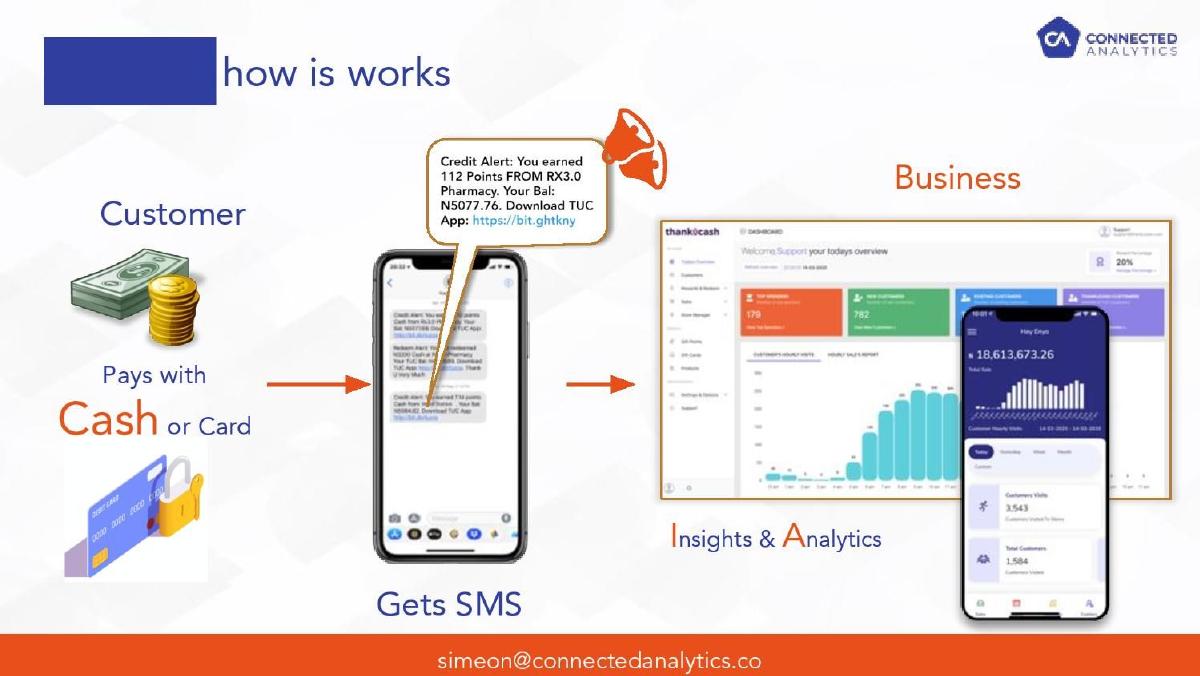
- The product functions as a bridge where customers pay with cash or card and receive rewards via SMS (Slide 5).
- The company claims a significant technical moat with over 170,000 terminal integrations (Slide 9).
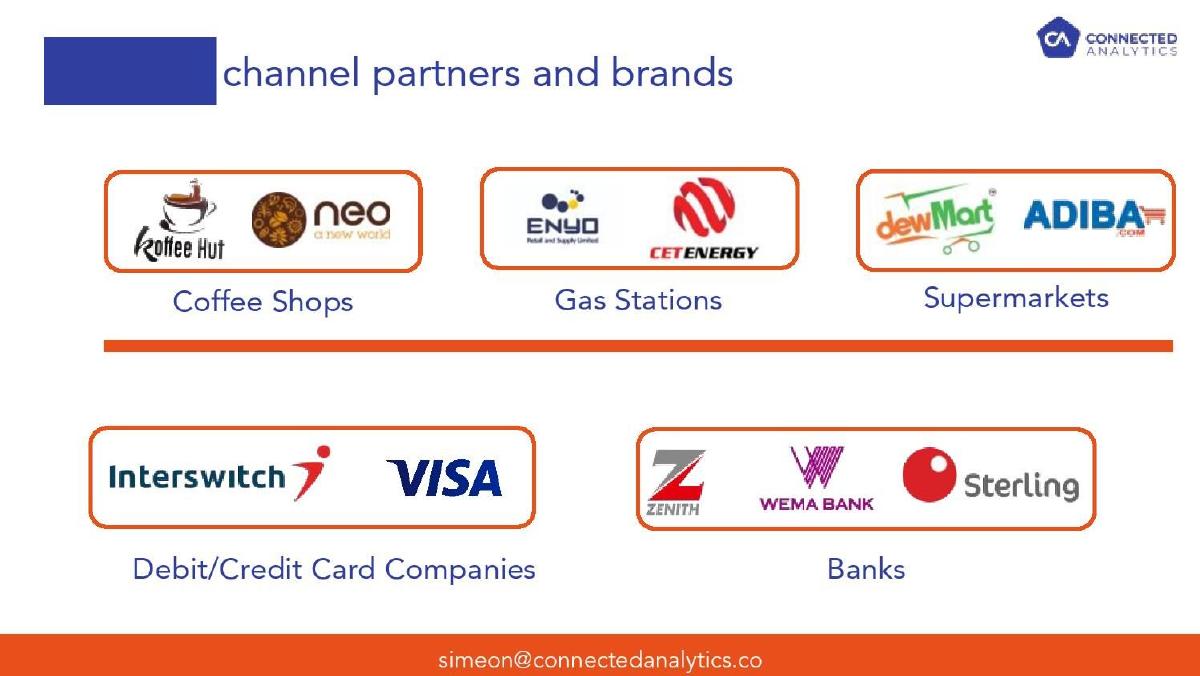
- Strategic channel partnerships are a core pillar, featuring major names like Visa, Interswitch, and Zenith Bank (Slide 7).
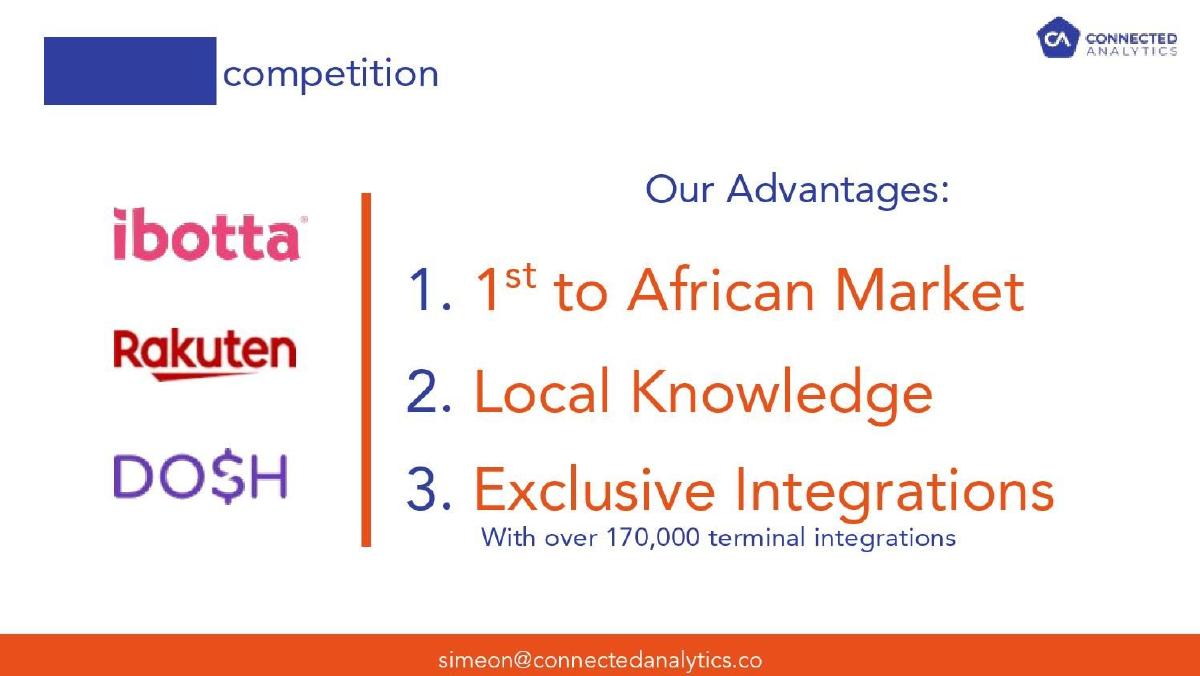
- The competitive strategy is based on 'Local Knowledge' and being the first mover in the African market (Slide 9).
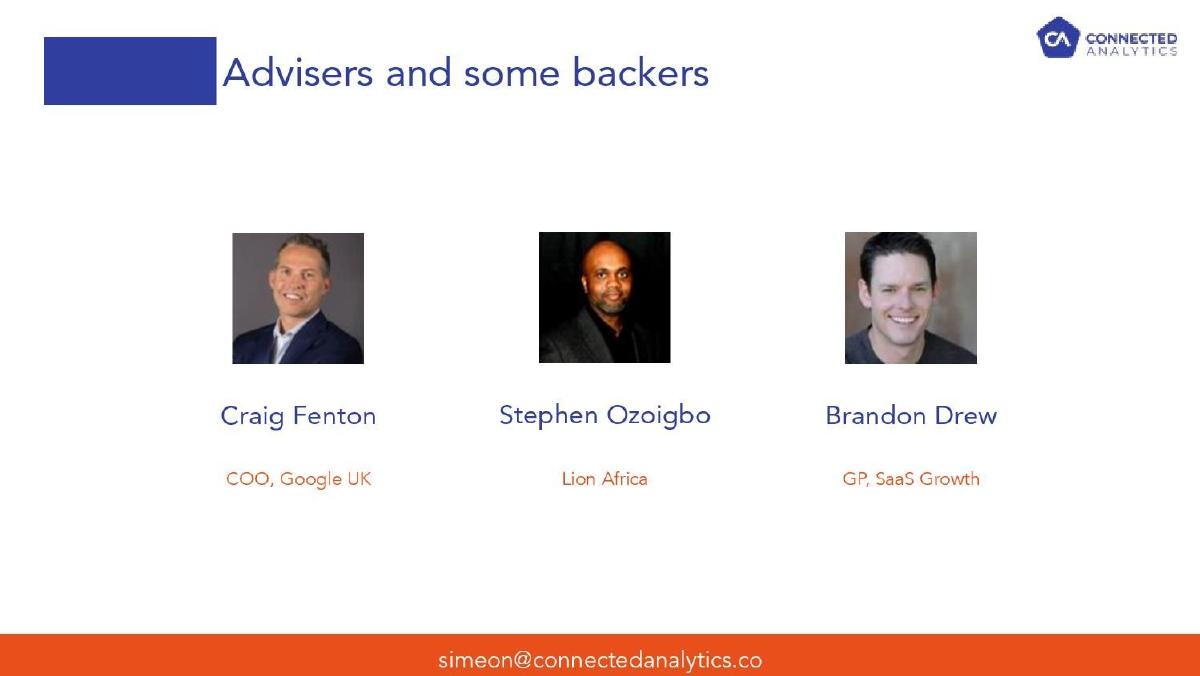
- The deck highlights high-profile advisors from Google UK and SaaS Growth to build institutional trust (Slide 11).
- There is a total absence of a 'The Ask' slide, leaving investors unclear on the specific capital requirements or valuation.
- The deck lacks a dedicated traction slide with revenue or user growth metrics, despite mentioning 'Insights & Analytics' (Slide 5).
The Challenge of the Cash-Heavy Economy
Connected Analytics, operating under the brand ThankUCash, enters the market with a very specific thesis: in emerging markets, you cannot ignore cash. While Western loyalty platforms are built on top of digital-first payment rails, the African retail landscape requires a hybrid approach. The deck focuses on the friction between high-volume cash transactions and the need for data-driven customer retention.
Slide 1: Cover Page
The cover slide is functional but leans heavily on imagery of small business owners—a fruit vendor, a shopkeeper, and a supermarket worker. This immediately signals that the company is targeting the 'real economy' rather than just high-end digital consumers. The tagline, 'Providing customer engagement and insights to drive business growth,' is a standard B2B value proposition, but the contact information for CEO Simeon Ononobi is clearly displayed, which is a best practice for accessibility.
Slide 2: The Problem Statement
Slide 2 identifies a dual-pronged problem. First, it notes that 'Cash Accounts for 80% of Business Transactions.' This is the 'why now' and 'why here' of the pitch. In a market where 80% of activity is invisible to traditional digital tracking, there is a massive data gap. Second, it states that 'Loyalty Infrastructure Is Very Expensive.' By combining these two points, the company suggests that current solutions are both blind to the majority of transactions and too costly for the average merchant to implement.
Slide 5: Product and Workflow
The 'How it works' slide is one of the most effective in the deck because it simplifies a complex technical integration into a three-step visual flow. Step 1: The customer pays with cash or card. Step 2: The customer receives an SMS alert with their point balance and a download link. Step 3: The business receives 'Insights & Analytics' via a dashboard. The inclusion of a real SMS mockup—'You earned 112 Points FROM RX3.0 Pharmacy'—makes the product feel tangible and ready for use. The dashboard screenshot shows a balance of over 18 million Naira, hinting at the scale of transactions being processed, though it isn't explicitly labeled as a case study.
Slide 7: Channel Partners and Brands
This slide serves as the primary source of social proof for the deck. It categorizes partners into four buckets: Coffee Shops (Koffee Hut, Neo), Gas Stations (Enyo, CET Energy), Supermarkets (DewMart, Adiba), and the 'Big Four' of their ecosystem: Debit/Credit Card Companies (Interswitch, Visa) and Banks (Zenith, Wema, Sterling). For a Seed stage company, having Visa and Interswitch logos on a partner slide is a significant validator of their technical infrastructure and market viability.
Slide 9: Competition and Moat
Slide 9 addresses the competitive landscape by listing US-based giants Ibotta, Rakuten, and Dosh. The company doesn't try to out-feature these giants; instead, they focus on geography and infrastructure. They list three advantages: 1. 1st to African Market , 2. Local Knowledge , and 3. Exclusive Integrations . The most important figure on this slide is the claim of 'over 170,000 terminal integrations.' This is their 'moat.' If they are already baked into the hardware/software of 170k point-of-sale terminals, it becomes incredibly difficult for a competitor to displace them.
Slide 11: Advisors and Backers
Interestingly, the deck provides more detail on its advisors than its founders. Slide 11 features Craig Fenton (COO, Google UK), Stephen Ozoigbo (Lion Africa), and Brandon Drew (GP, SaaS Growth). While these are impressive names that suggest a strong network in both the UK and US, the lack of a detailed 'Founding Team' slide with specific past exits or technical achievements is a missed opportunity to sell the 'execution' side of the business.
What Works in This Deck
The 'Cash' Angle: By highlighting the 80% cash transaction metric on Slide 2, the company creates a sense of urgency and a unique market niche. Most fintech decks focus on the transition to digital; this deck focuses on capturing the value of the existing cash economy.
Infrastructure as a Moat: Citing 170,000 terminal integrations (Slide 9) is a powerful way to demonstrate scale without showing a traditional revenue hockey stick. It tells an investor that the 'pipes' are already laid, and the investment is likely for turning on the flow of data and transactions.
Visual Simplicity: The deck avoids 'wall of text' syndrome. It uses icons and clear headers to move the reader through the narrative quickly. The product flow on Slide 5 is particularly strong in this regard.
What Is Missing
The Financials: There is no slide detailing current Revenue, GMV (Gross Merchandise Volume), or CAC (Customer Acquisition Cost). While the dashboard on Slide 5 shows a large Naira figure, it isn't presented as a formal metric. Investors at the Seed stage need to see the unit economics of how a loyalty point translates into revenue for Connected Analytics.
The Ask: The deck ends without telling the investor what the company needs. There is no mention of the round size, the valuation, or the intended use of funds. This makes the deck feel more like a partnership presentation than a fundraising tool.
Founding Team Depth: While the CEO is listed on the cover and advisors are shown on Slide 11, the 'Team' slide (Slide 10, though text was not captured) needs to work harder to show why this specific group of people is uniquely qualified to navigate the complex regulatory and technical landscape of African retail.
Founder Takeaways
Quantify your moat early: If you have a technical integration that is hard to replicate, put the number front and center. The '170,000 terminals' figure is the strongest piece of data in this deck. · Bridge the physical and digital: If your product interacts with the real world (like cash payments), use a 'How it Works' slide to show the exact point of contact. The SMS mockup is a great example of this. · Leverage 'Local Knowledge' as a feature: When competing against global incumbents, your understanding of local payment habits (like the 80% cash stat) is a competitive advantage, not just a market fact. · Don't forget the 'Ask': Every pitch deck should clearly state what you are looking for. Even if the specific dollar amount changes, the 'Use of Funds' (e.g., 'Hiring 10 engineers,' 'Expanding to Kenya') should be clear.
Frequently asked questions
- What problem is Connected Analytics solving?
- They address two primary issues: the fact that 80% of business transactions are still conducted in cash, making them hard to track, and the high cost of traditional loyalty infrastructure. By digitizing the rewards process through SMS and terminal integrations, they allow businesses to gain insights from both cash and card customers.
- How does the product actually work for a consumer?
- As shown on Slide 5, the process is straightforward. A customer pays at a merchant using cash or a card. They then receive an SMS alert notifying them of points earned (e.g., '112 Points FROM RX3.0 Pharmacy') and a link to download the app to manage their balance.
- Who are the main competitors and how does the company differentiate?
- The deck identifies global players like Ibotta, Rakuten, and Dosh as competitors. Connected Analytics differentiates itself through its 'First to African Market' status, local market expertise, and exclusive integrations with over 170,000 payment terminals, which creates a high barrier to entry for foreign firms.
- What kind of partnerships does the company have?
- They have a robust network of channel partners across multiple verticals. This includes retail brands like Koffee Hut and Neo, gas stations like Enyo, and supermarkets like Adiba. Crucially, they are integrated with financial heavyweights including Visa, Interswitch, Zenith Bank, and Sterling Bank.
- What is missing from this pitch deck?
- The deck is missing several critical components for a Seed round: a clear 'Ask' (how much money they are raising), a detailed financial slide (revenue, burn, margins), and a roadmap for future expansion. It also lacks a slide detailing the core founding team's specific backgrounds, opting to show advisors instead.