Concreate is a hardware-focused startup developing 'smart heating solutions' centered on conductive concrete. The deck positions the product as a superior alternative to traditional snow removal methods—like plowing and shoveling—and complex multi-layer heated flooring systems. By reducing a four-layer installation process down to a single layer of conductive concrete, the company claims significant cost and efficiency gains. The technology is currently at the research prototype stage, with a proof-of-concept installed at HTWK Leipzig. While the deck identifies massive total addressable marke…
Key takeaways
- The company aims to replace traditional snow removal, which currently takes between 2-3 hours to 7-8 days to clear streets (Slide 2).
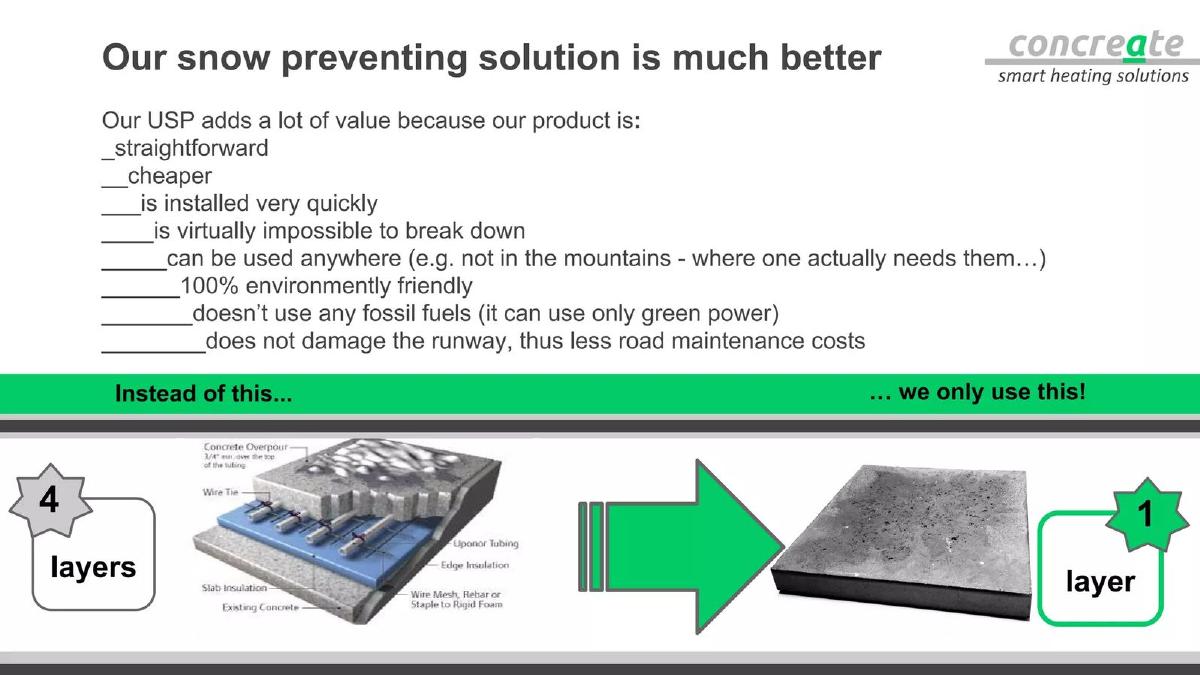
- Concreate's core value proposition is simplifying heated surfaces from a 4-layer system to a single conductive layer (Slide 3).
- The product is marketed as 100% environmentally friendly and capable of running on green power without fossil fuels (Slide 3).
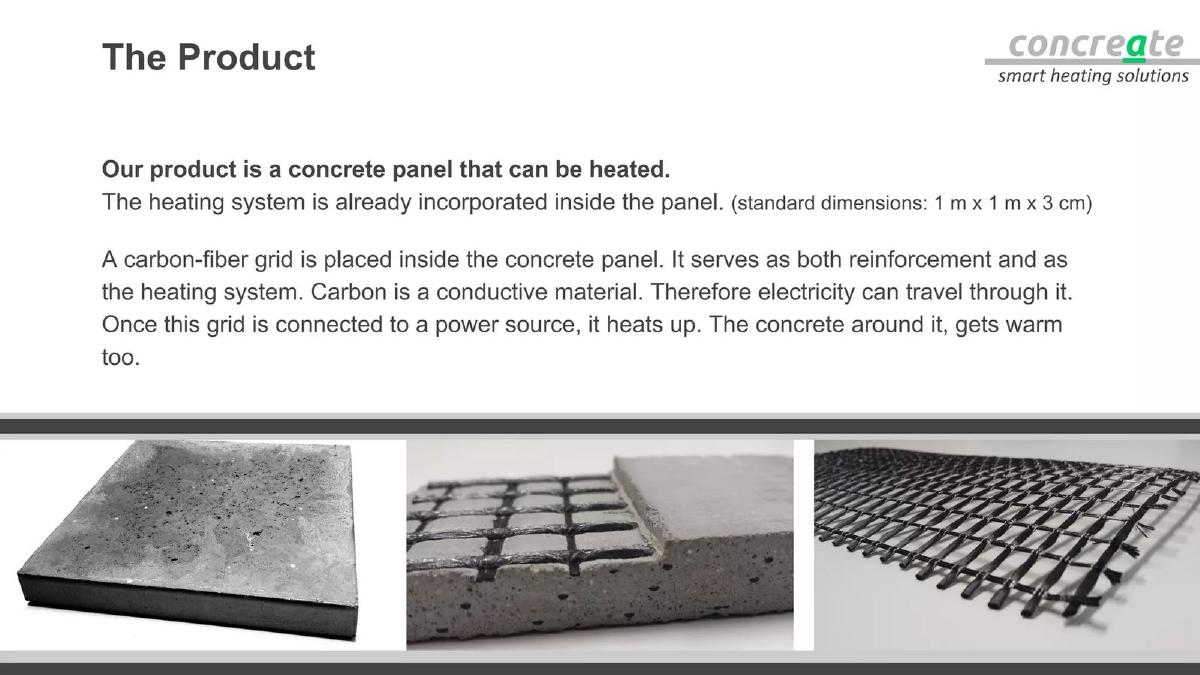
- Development is at the prototype stage, featuring a panel that warms in approximately 5 minutes using a lab power supply (Slide 4).
- A physical proof-of-concept has been established in the new HTWK Leipzig building (Slide 4).
- The intellectual property strategy is built around the development of a market-ready power connection system (Slide 4).
- The product has dual-use cases: indoor heating (walls, furniture) and outdoor snow melting for homes, cities, and roads (Slide 5).
- Market potential is anchored in the 80 million people living in snowy conditions for 6 months of the year (Slide 6).
Executive Summary: The Case for Conductive Concrete
Concreate presents a hardware-centric solution to a perennial infrastructure problem: snow management and indoor climate control. The deck focuses heavily on the technical simplification of heated surfaces, moving from complex, multi-component assemblies to a singular, functional material. While the technical promise is clear, the deck functions more as a product introduction than a comprehensive investment vehicle, omitting several key business metrics.
Slide 1: Title and Branding
The cover slide introduces the company name, concreate , with the tagline "smart heating solutions." The branding uses a lowercase aesthetic with a green accent on the letter 'a,' signaling an environmental focus. The layout is minimal, focusing entirely on the brand identity without providing a specific location or date.
Slide 2: The Problem of Traditional Snow Removal
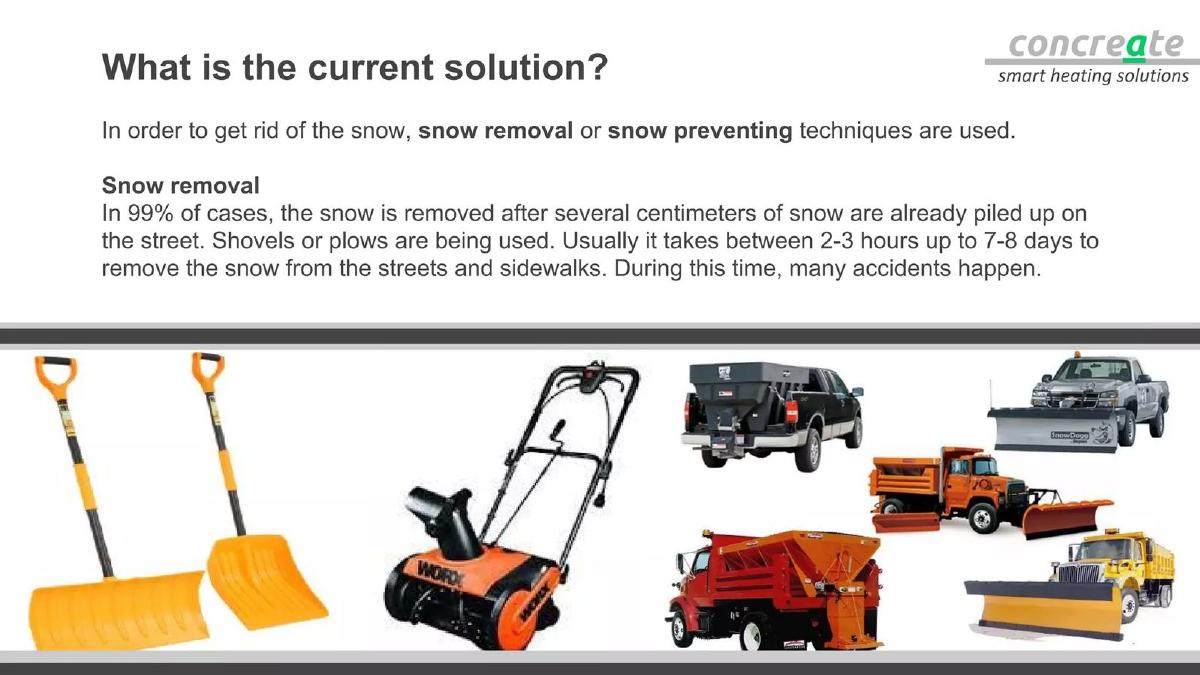
Slide 2 defines the status quo. It identifies two current methods: snow removal and snow prevention. The slide notes that in 99% of cases, removal only happens after several centimeters have accumulated. The pain points are clearly articulated: it takes between 2-3 hours up to 7-8 days to clear streets, during which time accidents occur. The visual aids show standard equipment like shovels, snowblowers, and plow trucks, framing them as reactive and inefficient.
Slide 3: The Unique Selling Proposition (USP)
This is the core technical slide of the deck. Concreate claims its solution is "much better" based on several factors: it is straightforward, cheaper, installed quickly, and virtually impossible to break down. The most compelling visual is the comparison between the "4 layers" of traditional systems (Slab insulation, Wire Tie, Uponor Tubing, and Concrete Overpour) versus the "1 layer" offered by Concreate. The slide also emphasizes environmental benefits, stating the product doesn't use fossil fuels and reduces road maintenance costs by preventing runway damage.
Slide 4: Development Status and IP Strategy
Slide 4 provides a transparent look at the company's progress. They currently possess a research prototype (a panel that warms in 5 minutes) and a proof-of-concept test room at HTWK Leipzig. Crucially, the slide lists what they "still need": a market-ready power connection and a system to connect multiple panels. The founders note that these missing pieces form the basis of their Intellectual Protection (IP) strategy, indicating that the patentable value lies in the electrical integration rather than just the concrete mix itself.
Slide 5: Product Versatility
This slide expands the use case beyond just snow melting. It categorizes the "End Product" into six basic examples:
Indoors heating device ("visible") · Indoors heating walls ("invisible") · Heated furniture ("mobile") · Outdoors snow melting for homes · Outdoors snow melting for cities · Outdoors snow melting for roads
This suggests a broad horizontal market, though it risks diluting the focus of a seed-stage startup by suggesting they can tackle residential furniture and municipal road infrastructure simultaneously.
Slide 6: Market Potential and Geography
The final slide in this set quantifies the opportunity. It states that 80 million people live in snowy conditions for 6 months per year. It breaks down the market into three primary regions:
Canada & northern US: Citing $800M/year in city budgets and $500M/month in residential potential. · Scandinavia: Highlighted as a key geographic target. · The Alps region: Citing a 100M Euro/year snow removal budget in Germany for 2013.
The use of 2013 data suggests this deck was likely produced around 2014 or 2015. While the numbers are large, they represent the total spent on the problem, not necessarily the addressable market for a concrete replacement.
What Concreate Does Well
The deck excels at visualizing the technical advantage . The side-by-side comparison of a 4-layer system versus a 1-layer system (Slide 3) is a classic "better, faster, cheaper" argument that is easy for a non-technical investor to grasp. By focusing on the reduction of installation complexity, they address a major barrier to entry for heated infrastructure.
The transparency regarding development status (Slide 4) is also a strength. Many early-stage decks attempt to hide the fact that they are still in the lab. By listing exactly what they have and what they still need to build, Concreate builds credibility and clearly defines what the next round of funding would be used for (i.e., moving from a lab power supply to a market-ready connection system).
What Is Missing From the Deck
The most glaring omission is the Team Slide . In early-stage hardware, the pedigree of the material scientists and electrical engineers is paramount. Without knowing who is behind the "smart heating solutions," it is impossible to gauge the technical feasibility of the claims.
Furthermore, there is no Business Model or Unit Economics slide. While they claim the product is "cheaper," they provide no data on the cost per square meter compared to traditional concrete or existing hydronic heating systems. There is also no mention of the Ask —how much money are they raising, and what milestones will that capital achieve? Finally, a Competition slide is missing; conductive concrete is a known field of research, and failing to acknowledge other players or existing patents is a red flag for investors.
Founder's Takeaway: Simplifying the Complex
Founders building complex hardware should look at Slide 3 as a template for simplifying a value proposition . If your product removes steps from a traditional process, show those steps being deleted. However, founders should avoid the mistake of using outdated market data (Slide 6) or omitting the team. In hardware, the "how" is important, but the "who" and the "how much" are what close the deal. A deck that ends on a market slide without a call to action or a funding request leaves the investor with nowhere to go.
Frequently asked questions
- What is the primary technology behind Concreate?
- Concreate utilizes conductive concrete to create 'smart heating solutions.' Unlike traditional heated floors that require four distinct layers (insulation, tubing, wire mesh, and a concrete overpour), Concreate simplifies this into a single functional layer that generates heat when connected to a power source. This reduction in complexity is the company's primary Unique Selling Proposition (USP).
- What stage of development is the company currently in?
- Based on slide 4, the company is in the early prototype and proof-of-concept stage. They have a research prototype panel that heats up in 5 minutes and a test room at HTWK Leipzig. However, they explicitly state they still need to develop a market-ready solution to connect panels to power and a system to link multiple panels together.
- How does Concreate define its market opportunity?
- The company targets regions with heavy snowfall, specifically Canada, the northern US, Scandinavia, and the Alps. They estimate 80 million people live in these conditions. They cite 2013 data showing $800M spent on city snow removal in Canada and 100M Euro in Germany, suggesting a large B2G and B2C replacement market.
- What are the environmental claims made in the deck?
- Concreate claims their solution is '100% environmently friendly' because it does not use fossil fuels and can be powered entirely by green energy. Additionally, they argue that by preventing snow buildup rather than removing it mechanically, they reduce damage to runways and roads, leading to lower long-term maintenance costs.
- What critical information is missing from this pitch deck?
- The deck is missing several standard components required for an investment decision. There is no team slide detailing engineering or business expertise, no financial projections, no specific 'ask' (amount of capital needed), and no competitive analysis against other conductive concrete or carbon-fiber heating competitors.