ComplYant’s Seed deck is a textbook example of how to leverage personal expertise to validate a complex regulatory problem. By framing the founder’s journey from corporate tax manager to firm owner, the deck establishes immediate credibility in the 'unsexy' world of tax compliance. The most striking element is the inclusion of specific CAC figures across five different channels, a level of transparency rarely seen in early-stage decks. While the company ceased operations in 2023, the deck itself remains a high-quality reference for B2B fintech startups. It successfully argues that the $60B+ i…
Key takeaways
- The founder's background is used as a narrative hook, showing a progression from Technicolor and Intuit to owning a firm with 300+ clients (Slide 2).
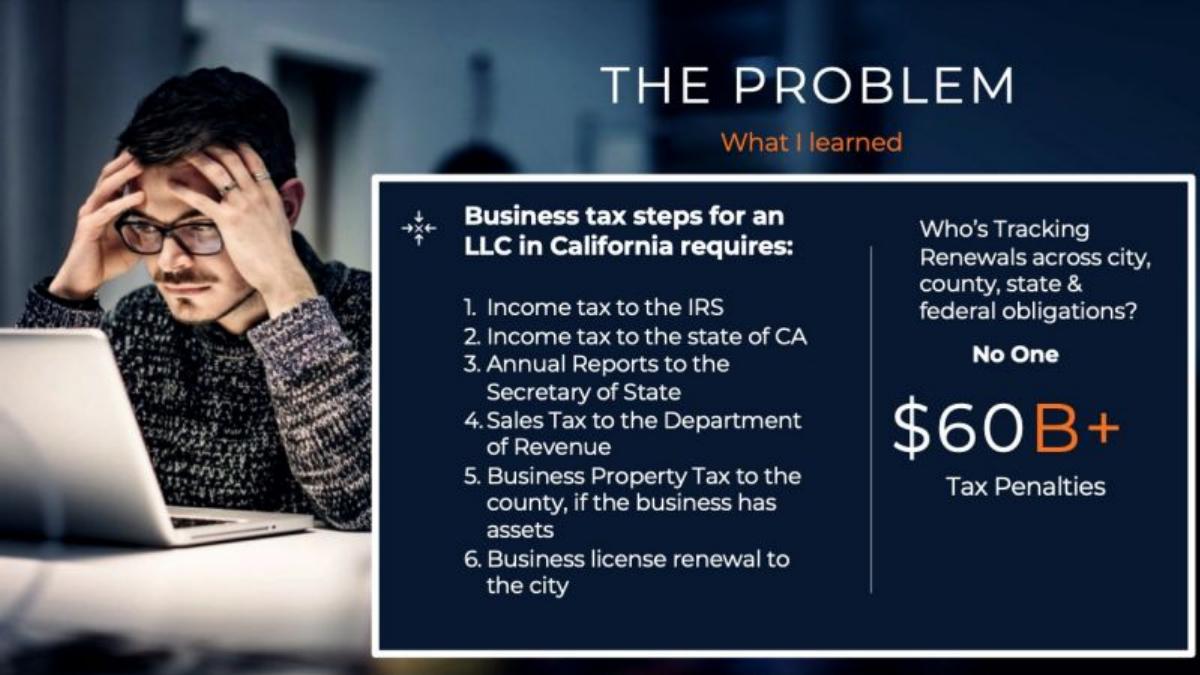
- The problem is quantified by a specific $60B+ figure in annual tax penalties paid by businesses (Slide 3).
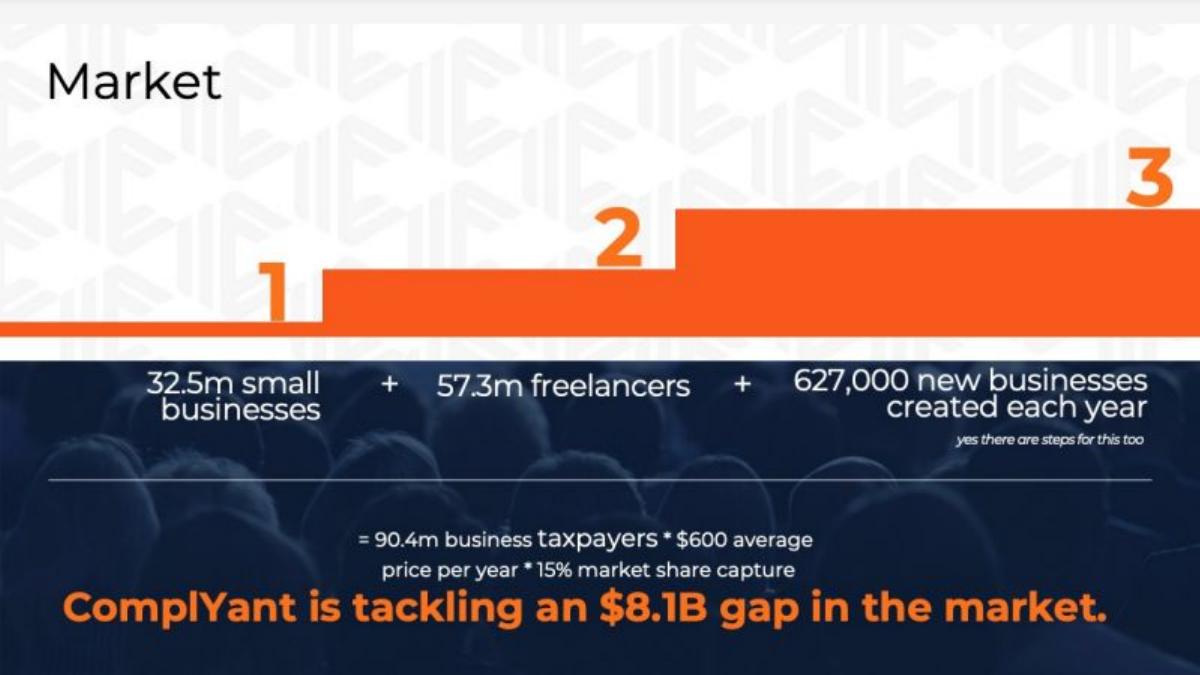
- The deck identifies a massive total addressable market of 90.4m business taxpayers, including 57.3m freelancers (Slide 5).
- A detailed competitive matrix explicitly positions ComplYant as the only player covering all tax types, including property tax and business licenses (Slide 8).
- The team slide highlights deep domain expertise with specific mentions of 'Corp Tax' and 'Prop Tax' experience at firms like AH4R and Heinz (Slide 9).
- Market strategy is unusually transparent, listing five specific acquisition channels with CAC ranging from $15 to $100 (Slide 10).
- Traction is evidenced by a milestone of reaching the 1,200th paid subscriber (Slide 11).
- The 'Use of Funds' slide lists six categories but omits the specific dollar amount being raised in this round (Slide 12).
Introduction: The Power of Domain Expertise
ComplYant’s 2022 Seed deck is a masterclass in establishing authority. In the fintech sector, particularly in tax and compliance, investors are wary of 'tourist' founders who don't understand the labyrinthine nature of government regulations. ComplYant avoids this trap by leading with a narrative of deep, hands-on experience. The deck, which secured $4M from top-tier investors like Craft Ventures, focuses on the 'unsexy' but lucrative problem of small business tax penalties.
Slide 1: The Cover
The cover slide is minimalist, featuring the brand name and the tagline: Business Tax Easier. Cheaper. Faster. The imagery of a small business owner (a baker or shopkeeper) immediately identifies the target demographic. It sets a professional, accessible tone for a product meant to simplify a stressful topic.
Slide 2: The Path to ComplYant
This is arguably the most important slide in the deck. Instead of a standard 'Team' slide at the end, ComplYant uses Slide 2 to establish Founder-Market Fit . It tracks the founder's journey through four stages: 1. Tax Manager at Technicolor, 2. Tax Supervisor at Aramark, 3. Accounting Compliance at Intuit, and 4. owning a Tax Firm. The slide notes that in her firm, she 'Saw over 300 clients in 3 years' and 'Grew business to 250k Annualized Revenue.' This tells investors the founder isn't guessing about the problem; she lived it and solved it manually before automating it.
Slide 3: The Problem
Slide 3 visualizes the complexity of tax compliance. It uses a specific case study: a California LLC. It lists six distinct filing requirements, from IRS income tax to city business license renewals. The 'hook' is the question: 'Who’s Tracking Renewals across city, county, state & federal obligations?' The answer provided is 'No One,' followed by a staggering metric: '$60B+ Tax Penalties.' This frames the problem not just as an annoyance, but as a massive financial drain on the economy.
Slide 4: The Solution
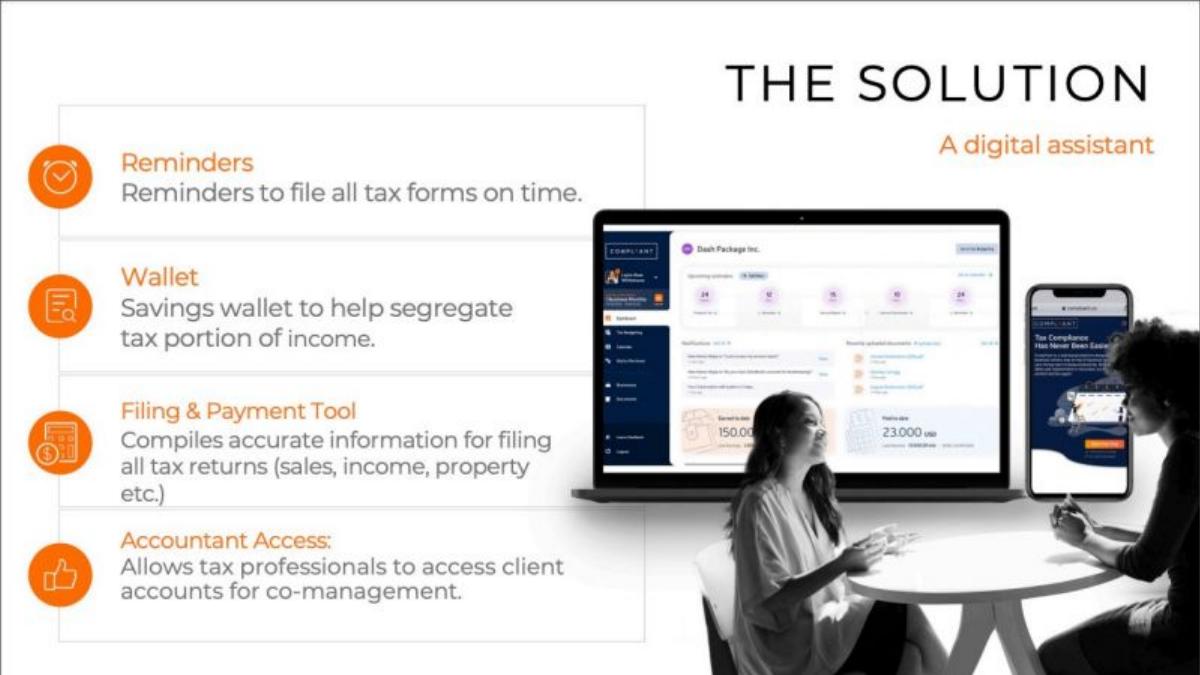
The solution is described as a 'digital assistant.' The slide breaks the product down into four pillars: Reminders , a Wallet for segregating tax income, a Filing & Payment Tool , and Accountant Access . The inclusion of a mobile and desktop mockup demonstrates that the product is already built and functional, moving the conversation from 'idea' to 'execution.'
Slide 5: Market Size
ComplYant calculates its market by summing 32.5m small businesses, 57.3m freelancers, and 627,000 new businesses created annually. The resulting figure is 90.4m business taxpayers . By applying a '$600 average price per year' and a '15% market share capture,' they arrive at an '$8.1B gap in the market.' This bottom-up calculation is much more persuasive than a generic top-down 'Trillion Dollar Market' claim.
Slide 6: Tax Market Context
This slide provides additional macro context. It notes that 77M people prepare their own tax returns and the Tax Software Market is $11B and growing at 5% annually. It reiterates the $60B penalty figure, reinforcing the idea that current software is failing to prevent late filings.
Slide 7: Vision
The vision slide outlines a roadmap for expansion. It moves from Tax payment processing (1) to Accountant to client CRM (2), Improved Education (3), and finally Banking as a service to better bookkeeping (4). This shows investors that ComplYant isn't just a reminder app; it has the potential to become a central financial hub for small businesses.
Slide 8: Competition
The competitive matrix is exceptionally detailed. It compares ComplYant against giants like Quickbooks, Xero, Tax Jar, Avalara, and Turbotax . ComplYant claims the only 'checkmarks' across all categories, including Business Property Tax Tools and Annual Report Management . This slide effectively argues that while competitors handle payroll or sales tax, none offer a holistic compliance dashboard.
Slide 9: The Team
The team slide reinforces the domain expertise theme. It features illustrations of the key members and highlights their backgrounds: Microsoft for engineering, Heinz for property tax, and AH4R for corporate tax. This diverse mix of 'Big Tech' and 'Big Tax' talent suggests the company has the technical and regulatory chops to succeed.
Slide 10: Market Strategy
This is a standout slide for a Seed deck. ComplYant lists five specific 'Cold outreach testing workable channels' and provides the CAC (Customer Acquisition Cost) for each. The costs range from $15 for Small Business Events to $100 for an Accountant Affiliate Program . Providing this level of data-driven transparency at the Seed stage is rare and highly attractive to VCs like Craft Ventures, who prioritize unit economics.
Slide 11: Milestones and Accolades
The traction slide lists several key wins: closing a pre-seed round from Mucker and Slauson & Co , growing to 9 FTEs , receiving a $25k grant , and being backed by Techstars '21 . The most critical metric is the final one: 'Acquired our 1200th paid subscriber.' This proves product-market fit and revenue generation.
Slide 12: Use of Funds
The 'Use of Funds' slide is a simple checklist: Engineering, Customer Service, Tax Research, Marketing spend, Employee Benefits, Increased software stack, and Equipment. Notably, the deck does not state the amount being raised . While the catalogue listing confirms a $4M raise, the slide itself remains vague, which is a common tactic to allow for flexibility during negotiations.
Slide 13 & 14: Contact and Outro
The deck ends with the founder's contact information and a standard promotional slide for the platform where the deck was hosted. The contact slide includes LinkedIn and Twitter handles, encouraging further engagement.
What ComplYant Did Well
The deck’s greatest strength is its specificity . By breaking down the exact filings required for a California LLC, the founders turned an abstract problem into a tangible one. Furthermore, the CAC transparency on Slide 10 is a bold move that signals a mature, data-driven management style. Most Seed founders guess at their acquisition costs; ComplYant showed they had already started testing and measuring.
The Founder-Market Fit narrative is also exceptionally strong. Shiloh Johnson is presented not just as a CEO, but as a subject matter expert who has already successfully navigated the tax landscape for hundreds of clients. This significantly de-risks the investment in the eyes of a VC.
What Was Missing
The Ask: As mentioned, the deck does not explicitly state the dollar amount being raised or the intended runway this capital would provide. · Unit Economics: While CAC is provided, the LTV (Lifetime Value) is missing. Without knowing how long a $600/year customer stays, it's hard to judge the true health of the acquisition channels. · Churn/Retention: For a subscription business with 1,200 users, investors would typically want to see retention data to ensure the 'digital assistant' is actually sticky. · Financial Projections: The deck lacks a forward-looking financial slide showing projected revenue growth over the next 18-24 months.
Founder Takeaways
Founders building in regulated industries should take note of how ComplYant handled complexity . They didn't shy away from the boring details of tax law; they used those details to prove their expertise. If you are building in a 'boring' space, use that to your advantage by showing you understand the nuances better than anyone else.
Additionally, the Market Strategy slide is a template every Seed founder should copy. Even if your numbers are early, showing that you are testing specific channels and measuring the cost of acquisition demonstrates a level of operational rigor that sets you apart from the competition. Finally, remember that traction isn't just revenue —ComplYant listed partnerships, grants, and team growth as milestones, creating a sense of momentum even before they hit massive scale.
Conclusion
ComplYant’s deck is a high-quality example of a Seed-stage presentation that balances vision with granular detail. While the company ultimately ceased operations in 2023, the deck itself remains a testament to how to pitch a complex B2B solution. It successfully argued that tax compliance is a data problem, and that the team had the right background to build the solution. For founders today, the lesson is clear: lead with expertise, validate with data, and never underestimate the power of a well-explained 'boring' problem.
Frequently asked questions
- How much did ComplYant raise with this deck?
- According to the catalogue listing, ComplYant raised $4 million in a Seed round in 2022. The round was led by Craft Ventures, with participation from Mucker Capital, Slauson & Co., Tale Venture Partners, and Techstars. Interestingly, the deck itself (Slide 12) lists the categories for the use of funds but does not state the specific $4M target or the valuation sought.
- What was the core problem ComplYant aimed to solve?
- ComplYant focused on the administrative burden of multi-layered tax compliance. Slide 3 illustrates this using a California LLC as an example, requiring six different filings across federal, state, county, and city levels. The deck argues that no one is currently tracking these renewals, leading to over $60 billion in annual tax penalties.
- How did the deck demonstrate founder-market fit?
- Slide 2, titled 'The Path to ComplYant,' tracks founder Shiloh Johnson’s career through Technicolor, Aramark, and Intuit, culminating in her own tax firm. By noting she saw over 300 clients in three years and grew her business to $250k in annualized revenue, the deck proves she experienced the problem firsthand before building the software solution.
- What was the company's customer acquisition strategy?
- ComplYant provided a very granular 'Market Strategy' on Slide 10. They tested five channels: Secretary of State data access (CAC $35), Small Business Events (CAC $15), Google Ad/SEO (CAC $78), Hosted Tax Workshops (CAC $17), and an Accountant Affiliate Program (CAC $100). This level of data-driven go-to-market planning is a strong signal for Seed-stage investors.
- Why did ComplYant cease operations in 2023?
- The pitch deck does not provide information regarding the company's closure. The deck was used for a successful 2022 fundraise. The information regarding the cessation of operations in 2023 comes from the editorial context of the listing. Often, startups in the fintech space face challenges related to high burn rates, regulatory shifts, or difficulties in scaling unit economics despite successful initial fundraising.