Commute Call is a relationship management application targeting the idle time of daily commuters. The deck positions the product as a solution for maintaining an 'outer circle' of contacts through automated reminders and canned email invites. Seeking a $400k seed round in exchange for 10% equity, the founders project reaching 160,000 users and generating $350,000 in revenue within 12 months. The presentation relies heavily on product mockups and high-level market behavior data, specifically noting that 23% of people currently use their phones while in the car. While the team brings experience…
Key takeaways
- The company is seeking a $400k seed round for marketing and product development in exchange for 10% investor ownership (Slide 6).
- The product aims to convert 'idle time' during commutes into productive social outreach (Slide 5).
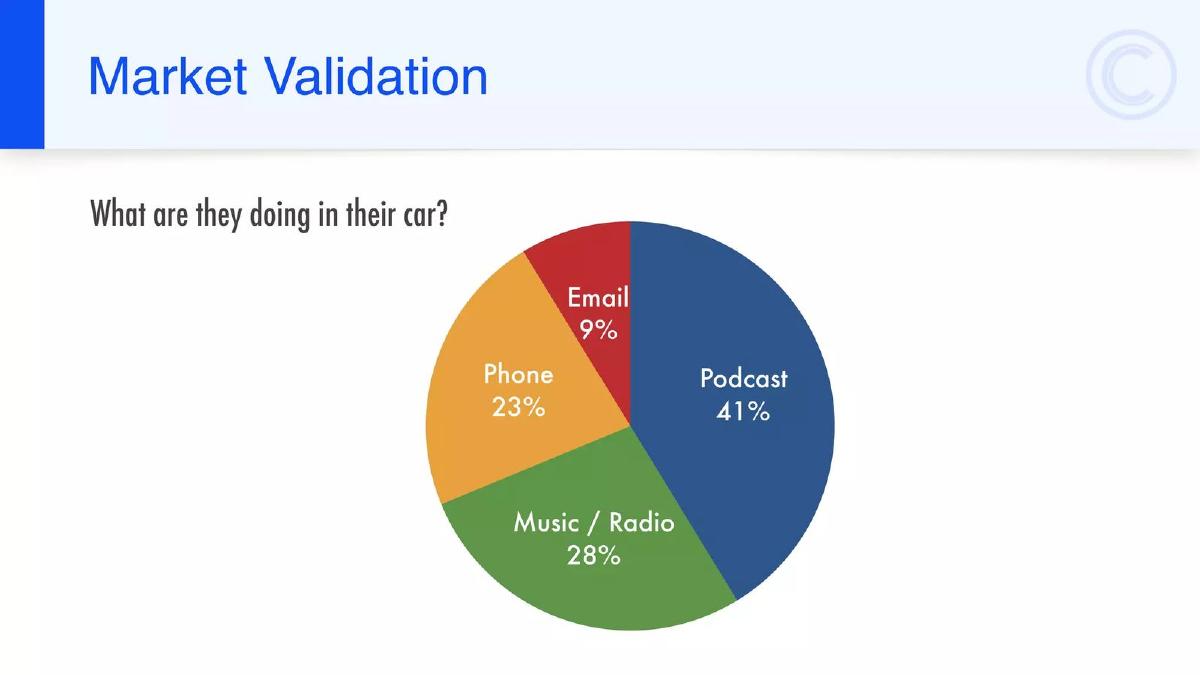
- Market validation data shows that 23% of people use their phones and 9% use email while in their cars (Slide 3).
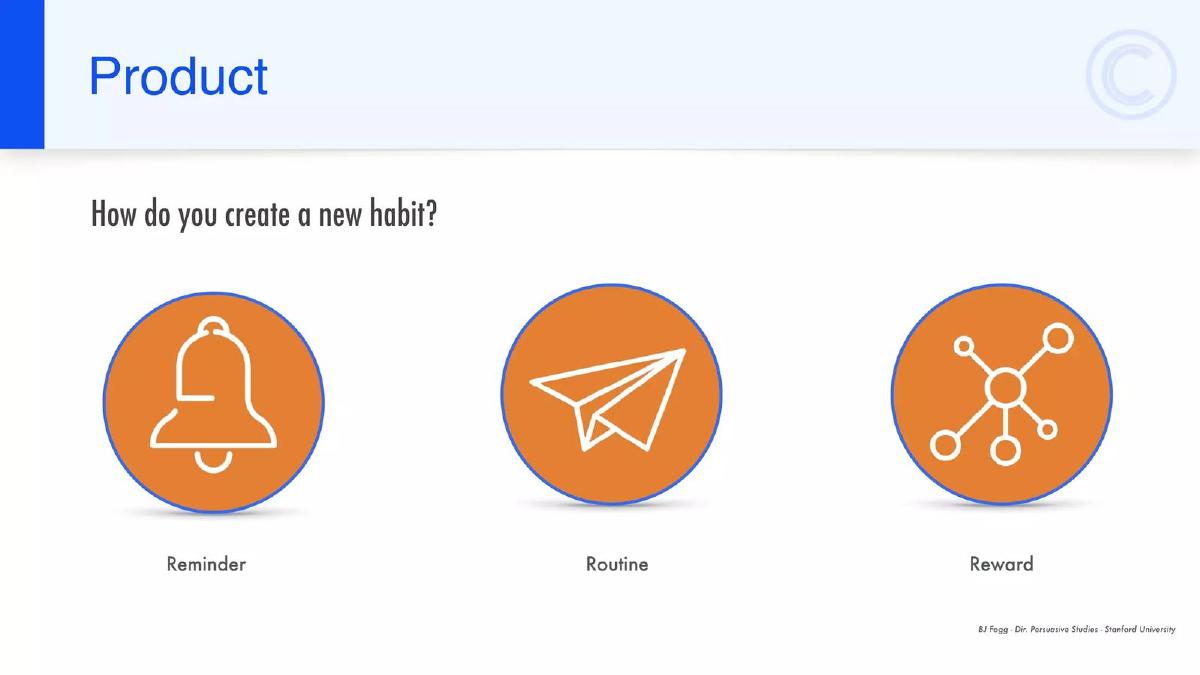
- The app features a three-step workflow: Reminder, Routine, and Reward (Slide 4).
- Financial projections target $350k in revenue over 12 months based on a 5% market penetration (Slide 6).
- The user goal is set at 160k individuals within the first year of the seed round (Slide 6).
- The founding team consists of a CEO/Product Designer based in Los Angeles and a CTO/Full Stack Developer based in Boston (Slide 7).
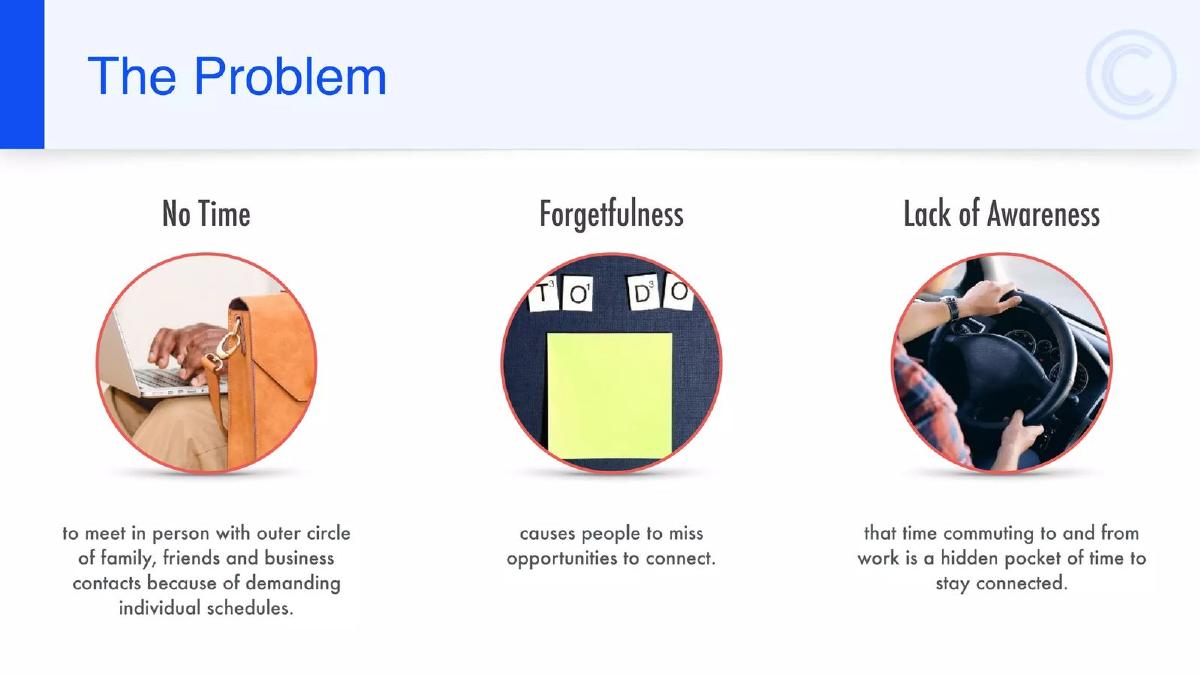
- The deck omits a formal 'Problem' slide, moving directly from the title to the 'Solution' (Slide 1, Slide 2).
Commute Call Pitch Deck Analysis
Commute Call is a mobile application designed to solve the problem of social drift by utilizing the time people spend commuting. The deck is concise, focusing on the product interface and the financial ask. However, it leaves several critical questions regarding monetization and competition unanswered.
Slide 1: Title Slide
The deck opens with a high-resolution image of a woman using a smartphone, overlaid with the Commute Call logo—a stylized 'C' inside a circle. The tagline is clear and descriptive: "Stay Connected On Your Commute." This slide establishes the brand identity and the primary use case immediately.
Slide 2: The Solution
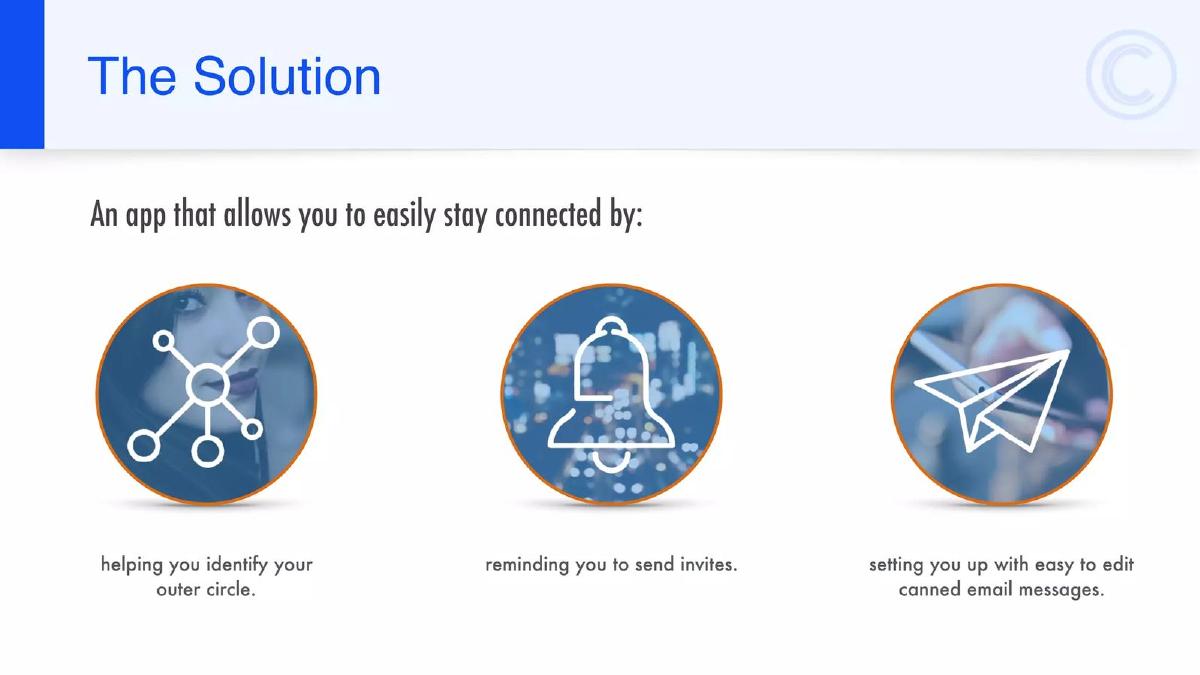
Interestingly, the deck skips a dedicated 'Problem' slide and moves straight to 'The Solution.' It defines the app's functionality through three pillars: helping you identify your outer circle , reminding you to send invites , and setting you up with easy to edit canned email messages . This suggests the founders believe the problem (loneliness or loss of contact) is self-evident to the audience.
Slide 3: Market Validation
This slide attempts to quantify the opportunity by looking at current commuter behavior. It asks, "What are they doing in their car?" and provides the following breakdown:
By highlighting that 32% of commuters are already engaging in communication-based tasks (Phone and Email), the deck argues there is an existing habit to tap into. However, the source of this data is not cited on the slide.
Slide 4: Product (Workflow)
Slide 4 showcases the user interface across three screens, labeled Reminder, Routine, and Reward:
Reminder: A lock-screen notification telling the user they haven't spoken to a specific contact (e.g., "Martha Snow") in 3 months. · Routine: An in-app prompt asking if the user would like to send an invite to that contact, with simple 'Yes' or 'No' buttons. · Reward: A scheduling screen where the user can select their availability (e.g., 8-9 am or 6-7 pm) to facilitate the call.
The use of the word "Reward" for a scheduling screen is an unusual choice, as scheduling is typically seen as a utility rather than a dopamine-inducing reward.
Slide 5: Product (Calendar)
This slide provides a secondary view of the product, showing a calendar interface. The text states, "Now, instead of just idle time on your commute..." and shows a weekly view with contact photos placed in specific time slots (8 AM and 6 PM). This reinforces the idea that the app is a scheduling layer specifically for transit windows.
Slide 6: Business Model
This slide functions as both the 'Ask' and the 'Projections' slide. It contains three main figures:
$400k Seed Round: Stated to be for Marketing and Product Development. · 10% Investor Ownership: This implies a post-money valuation of $4 million. · $350k 12-month revenue projection: Based on 160k users and a 5% target market penetration.
The math here is worth noting. If 160,000 users generate $350,000 in revenue, the revenue per user is roughly $2.18 per year. This suggests either a very low-cost subscription or a model based on aggregate data or advertising, though the specific mechanism is not explained.
Slide 7: Team
The final slide presented introduces the two founders. Denis Lesak (CEO) is based in Los Angeles and brings a background as a Senior Product Designer for major brands like Nordstrom, Toyota, and Subaru. David McIntyre (CTO) is based in Boston and is described as a Full Stack Developer with a history at Fidelity, US Bank, and Mass Mutual. The team appears to have the necessary design and technical skills to build and launch a mobile app, though there is no mention of previous startup exits or specific domain expertise in social networking or telecommunications.
What Works in This Deck
The deck is visually clean and follows a logical flow from the solution to the team. The product mockups are professional and make the app's utility easy to understand. By focusing on the 'outer circle,' the founders have identified a specific niche within the broader social media landscape—maintaining 'weak ties' that often fall through the cracks of daily life. The 'Ask' is also very specific, giving investors a clear understanding of the valuation and the intended use of funds.
What Is Missing
The most significant omission is a detailed Revenue Model . While a revenue target of $350k is provided, the deck does not explain how that money is collected. Is it a $0.99 app? Is it ad-supported? Without this, the $350k figure feels arbitrary. Additionally, there is no Competitor Analysis . The app competes not just with other social tools, but with the 69% of commuters who are currently listening to music or podcasts. The deck fails to address why a user would choose a phone call over their favorite podcast. Finally, there is no Go-To-Market (GTM) strategy . Reaching 160,000 users requires a significant acquisition engine, and 'Marketing' is too broad a term to satisfy a sophisticated investor.
Founder Takeaways
Founders should emulate the clarity of the product workflow seen on Slide 4. Breaking an app down into 'Reminder, Routine, Reward' is a great way to communicate the user experience without needing a live demo. However, founders should avoid omitting the 'How' of their revenue . If you put a dollar amount on a slide, you must be prepared to show the unit economics that lead to that number. Lastly, always cite your market data; the pie chart on Slide 3 is compelling, but its lack of attribution weakens the 'Market Validation' claim.
Frequently asked questions
- What is the primary value proposition of Commute Call?
- Commute Call positions itself as a tool to help users 'stay connected' during their commute. It specifically targets the 'outer circle' of a user's social network—people they might otherwise lose touch with—by providing automated reminders, canned email templates, and a scheduling interface to facilitate phone calls or meetings during travel time.
- How does the company plan to use the $400k investment?
- According to Slide 6, the $400k seed round is earmarked for two primary areas: Marketing and Product Development. The deck suggests that this capital will be the catalyst to reach their 12-month target of 160,000 users and a 5% market penetration rate.
- What is the revenue model for Commute Call?
- The deck is notably vague on the specific revenue model. While Slide 6 projects $350,000 in revenue for the first 12 months, it does not specify if this comes from a subscription fee, advertising, a 'freemium' model, or data licensing. The math implies a low Average Revenue Per User (ARPU) of approximately $2.18.
- Who are the founders and what is their background?
- The team consists of Denis Lesak (CEO) and David McIntyre (CTO). Lesak is a Senior Product Designer with experience at Nordstrom, Toyota, and Subaru. McIntyre is a Full Stack Developer who has worked with financial institutions including Fidelity, US Bank, and Mass Mutual. This suggests a balance of UX/design and enterprise-grade engineering.
- What market data does the deck provide to justify the product?
- Slide 3, titled 'Market Validation,' provides a pie chart of in-car activities. It claims 41% of commuters listen to podcasts, 28% to music/radio, 23% use their phones, and 9% use email. The startup aims to capture a portion of this time, specifically targeting the phone and email segments.