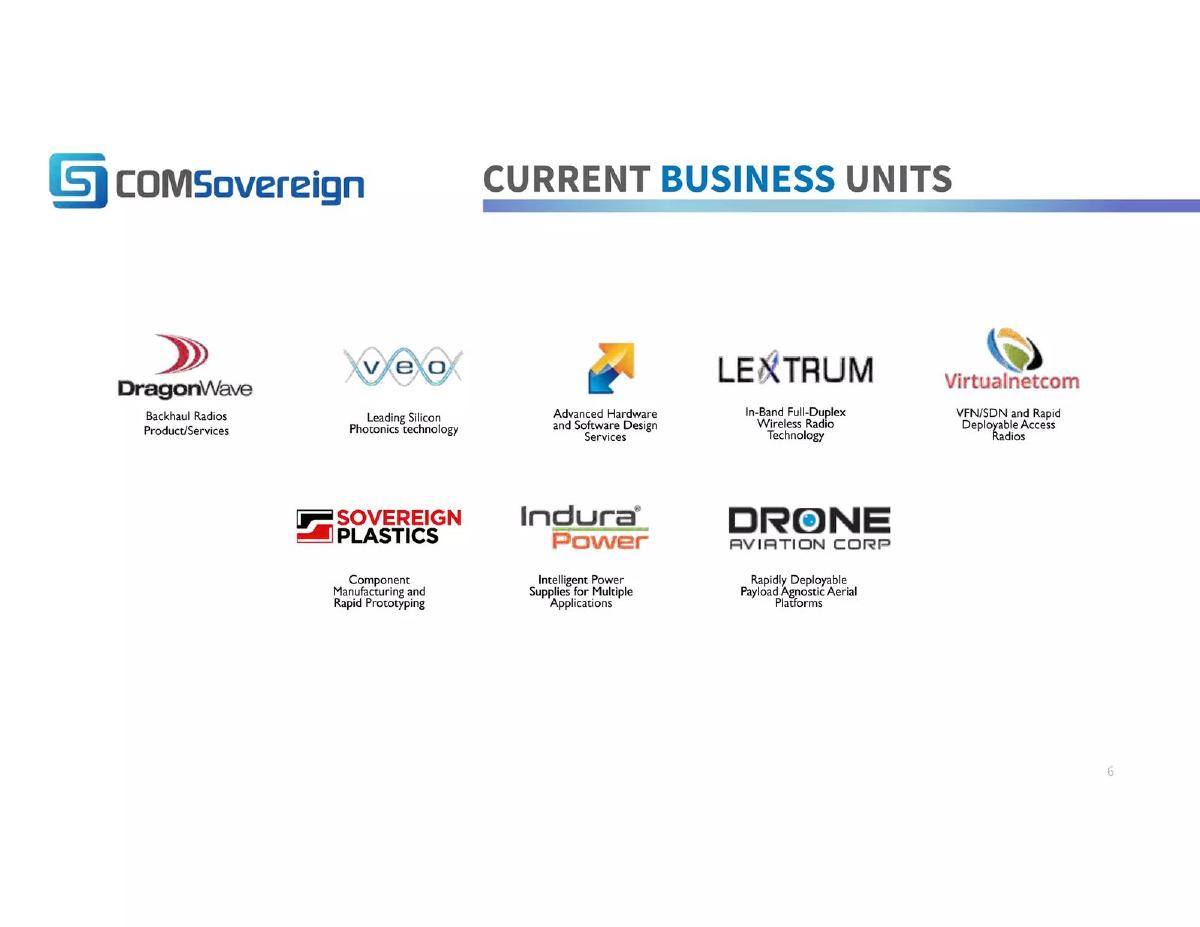
COMSovereign’s February 2021 investor presentation positions the company as a critical domestic alternative in the global race for 5G dominance. By leveraging a complex corporate structure of acquired specialized entities—including DragonWave, Virtualnetcom, and Sovereign Plastics—the company claims total control over its supply chain and a robust IP portfolio of 112 granted patents. The deck emphasizes technical superiority, citing 10x improvements in battery life and 1000x increases in data volume for 5G networks. While the presentation successfully communicates a massive scale of operation…
Key takeaways
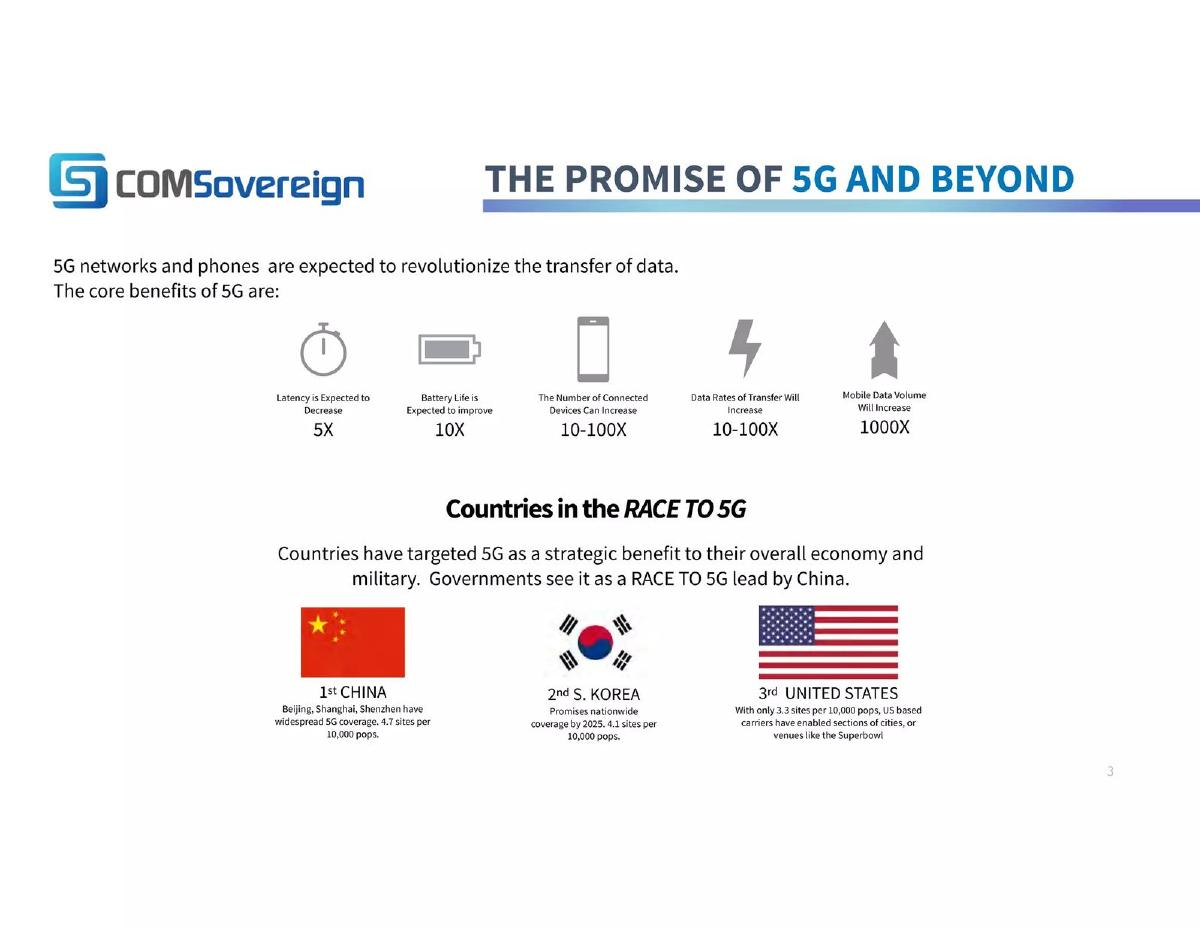
- The company positions 5G as a strategic geopolitical race, noting the U.S. trails China and South Korea in sites per 10,000 population (Slide 3).
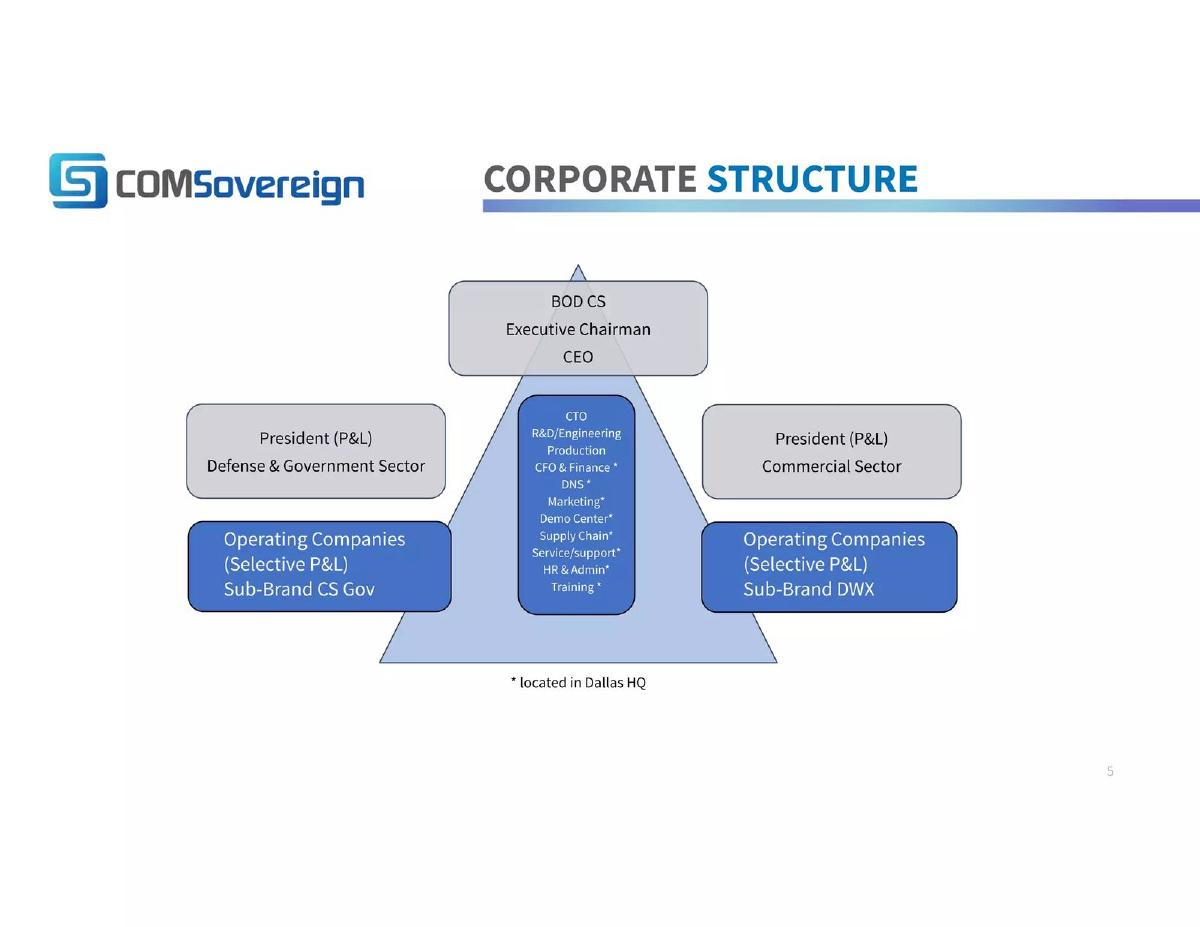
- COMSovereign utilizes a highly decentralized corporate structure with separate presidents for Defense & Government and Commercial sectors (Slide 5).
- The product ecosystem is built on a 'puzzle' of acquired brands including Drone Aviation, Virtualnetcom, DragonWave, and Fastback Networks (Slide 7).
- Technical claims include the world's first miniaturized, fully virtualized 5G network Core (vCore) and instant standup of private LTE networks (Slide 9).
- Supply chain security is a core value proposition, with 100% owned U.S.-based plastics and metals fabrication reducing lead times by up to 90% (Slide 13).
- The company holds a significant IP moat, reporting 112 granted patents, 20 pending, and 21 to be filed as of the presentation date (Slide 15).
- Revenue traction is significant, with a stated projection of over $119 million for 2021 and existing equipment in over 100 countries (Slide 17).
- The deck omits a specific capital request, use of funds breakdown, or detailed executive team biographies (Omitted).
Introduction: The Domestic 5G Alternative
COMSovereign’s February 2021 investor presentation is a high-level overview of a company attempting to solve a geopolitical and infrastructure challenge: the lack of a dominant, end-to-end American 5G provider. The deck, titled "The American 5G Story," leans heavily into the strategic importance of telecommunications sovereignty, positioning the company as a vertically integrated powerhouse capable of competing with global giants.
Slide 1: Title and Positioning
The cover slide establishes the brand identity with the tagline "Connecting Tomorrow" and the subtitle "The American 5G Story." It prominently displays the NASDAQ ticker COMS , indicating that at the time of this presentation, the company was already publicly traded. The imagery of the United States map reinforces the domestic focus of their mission.
Slide 3: The Macro Opportunity and The Race to 5G
This slide serves as the "Problem/Opportunity" section. It quantifies the benefits of 5G, claiming a 5X decrease in latency , 10X improvement in battery life , and a 1000X increase in mobile data volume . More importantly, it frames 5G as a global race. It cites that China leads with 4.7 sites per 10,000 population, followed by South Korea at 4.1, while the United States lags at 3.3 sites per 10,000 population . This data creates a sense of urgency for domestic investment in 5G infrastructure.
Slide 5: Corporate Structure
Slide 5 reveals a complex organizational hierarchy. COMSovereign operates as a holding company with two primary pillars: Defense & Government Sector and Commercial Sector . Each has its own President with P&L responsibility. The central pyramid shows a shared services model located in the Dallas HQ , covering R&D, Finance, Marketing, and Supply Chain. This structure suggests a company built through acquisitions, attempting to centralize administrative functions while keeping sales and operations specialized.
Slide 7: The Telecom Network Ecosystem
This slide explains "Where do we come in?" using a puzzle piece graphic. It identifies four key brands: Virtualnetcom, Drone, DragonWave, and Fastback . The accompanying diagram maps these brands onto a standard telecom architecture, showing their presence in the Core (vCore, Wireless Core), Macro (with CU/DU), and Edge (Small Cell) segments of the network. This visualizes the "end-to-end" claim made later in the deck.
Slide 9: Integrated Access Solutions
Focusing on hardware, slide 9 lists the company's technological "firsts." It claims the world’s first miniaturized, fully virtualized 5G network Core (vCore) . The slide emphasizes flexibility, noting that their systems allow for the "instant standup of private LTE and 5G networks anywhere on the globe." It also highlights compliance with all 3GPP / 5G standards and support for CBRS frequency ranges. The bottom of the slide displays six distinct hardware units, ranging from small cells to ruggedized outdoor equipment.
Slide 11: Backup Power and Network Reliability
Reliability is a key selling point for telecom infrastructure. Slide 11 introduces InduraPower , a COMSovereign company focused on AI-driven intelligent battery management. They claim their lithium power units have a long-life of up to 10x and a recharge time 7 times faster than lead-acid units. The technology is described as environmentally friendly (LiFePO4 chemistry) and capable of operating in extreme heat and cold weather conditions.
Slide 13: Supply Chain Control
In a move toward total vertical integration, slide 13 highlights Sovereign Plastics . The company claims "Total Control of its Supply Chain" through U.S.-based, 100% owned plastics and metals fabrication. Key metrics include the production of >20MM parts in 2019 and the ability to reduce lead times by up to 90% . This is a significant differentiator for a hardware company, as it mitigates the risks associated with overseas manufacturing and global logistics disruptions.
Slide 15: Intellectual Property Portfolio
Slide 15 provides a breakdown of the company's "Grassroots Value." The IP table is impressive, showing a total of 112 granted patents , 20 pending , and 21 to be filed . The Dragonwave/Fastback division accounts for the vast majority of these (100 granted), while other divisions like VEO and InduraPower contribute smaller numbers. This slide is designed to prove the company has a defensible moat built on proprietary technology rather than just white-labeled components.
Slide 17: Summary and Traction
The final content slide summarizes the "American 5G Story." It provides the most compelling traction metrics in the deck: >700 telco network customers , >$1B of equipment in customer networks across >100 countries , and an anticipated consolidated revenue of >$119 million for 2021 . It also mentions that the first full 5G system was delivered in December 2020, signaling that the company is moving from R&D and legacy LTE support into active 5G deployment.
What COMSovereign Does Well
The deck excels at framing a macro-economic and geopolitical narrative . By positioning 5G as a "race" that the U.S. is currently losing, they tap into national security concerns that resonate with both government contractors and institutional investors. The emphasis on vertical integration (Slide 13) is also a strong point; in a world of supply chain fragility, owning the plastics and metal fabrication for your own radios is a massive competitive advantage.
Furthermore, the IP breakdown (Slide 15) is exceptionally clear. Many tech decks vaguely reference "patented technology," but COMSovereign provides a specific tally across its various business units, which adds significant credibility to their valuation.
What is Missing from the Deck
Despite the technical and operational detail, there are notable omissions. First, there is no specific "Ask." While this is an investor presentation for a public company, it fails to specify if they are looking for a secondary offering, debt financing, or simply providing a general update. Second, the Team slide is missing from this selection. While slide 5 mentions an "Executive Chairman" and "CEO," it does not provide names, backgrounds, or track records of the leadership team.
Additionally, the deck lacks unit economics . We see a large revenue projection ($119M), but we don't see the margins on the hardware versus the software, nor do we see the cost of acquisition for their 700+ customers. For a company built on acquisitions, a slide explaining the integration strategy or the historical performance of these individual units before they were rolled up would have been beneficial.
Founder's Guide: What to Copy
Founders building complex hardware or infrastructure businesses should look at slide 7 and slide 13. Slide 7 does a great job of mapping a complex product suite onto a standard industry diagram. If your product is a small part of a larger ecosystem, showing exactly where you fit in the "puzzle" is vital for clarity.
Slide 13 is a masterclass in turning a boring operational detail (manufacturing) into a strategic asset . Most startups hide their manufacturing details in the appendix; COMSovereign makes it a headline feature, emphasizing speed, control, and domestic security. If you have a unique way of building your product that reduces risk, it deserves its own slide.
Finally, the use of geopolitical context on slide 3 is a powerful way to elevate a pitch from a simple product sale to a "must-win" mission. If your company aligns with broader national or global trends, use data to prove that your success is tied to the success of the industry or the country as a whole.
Frequently asked questions
- What is COMSovereign's primary market positioning?
- COMSovereign positions itself as the 'American 5G Story,' focusing on providing a U.S.-based, end-to-end LTE and 5G+ network solution. This is framed as a strategic necessity because the U.S. currently ranks third in 5G deployment density behind China and South Korea, as shown on slide 3. They emphasize domestic manufacturing and supply chain control to appeal to government and defense sectors.
- How does the company handle manufacturing and supply chain?
- Unlike many fabless tech companies, COMSovereign emphasizes 'Total Control' of its supply chain through its subsidiary, Sovereign Plastics. According to slide 13, they own U.S.-based plastics and metals fabrication facilities that produced over 20 million parts in 2019. They claim this vertical integration allows for 'Just-in-Time' control and reduces lead times by up to 90%.
- What are the core technical advantages claimed for their 5G hardware?
- The deck highlights several key performance metrics on slide 3, including a 5x decrease in latency and a 1000x increase in mobile data volume. On slide 9, they claim to have the world's first miniaturized, fully virtualized 5G network Core (vCore) and the ability to deploy private LTE/5G networks 'anywhere on the globe' instantly.
- What does the company's intellectual property portfolio look like?
- COMSovereign boasts a substantial IP portfolio, detailed on slide 15. The company reports a total of 112 granted patents, with the majority (100) coming from the Dragonwave/Fastback division. They also list 20 pending patents and 21 additional patents 'to be filed,' suggesting a heavy emphasis on protecting their hardware and software innovations.
- What are the financial highlights mentioned in the deck?
- While the deck does not provide a full historical P&L, slide 17 notes that the company has over 700 telco network customers globally and more than $1 billion of equipment currently in customer networks across 100+ countries. Most notably, they projected a consolidated revenue of over $119 million for the year 2021.