PrimaryBid’s 13-slide deck is a masterclass in establishing institutional credibility. Operating in the highly regulated and traditionally closed-off world of public equity raises, the company uses this presentation to showcase its deep integration with the London Stock Exchange and Euronext. The deck highlights a significant milestone—crossing $1.2bn in Total Transaction Value (TTV)—while maintaining a 2.5x year-over-year growth rate. Rather than focusing on granular app features, the narrative emphasizes regulatory tailwinds, high-profile issuer testimonials from FTSE 100 CEOs, and a blue-c…
Key takeaways
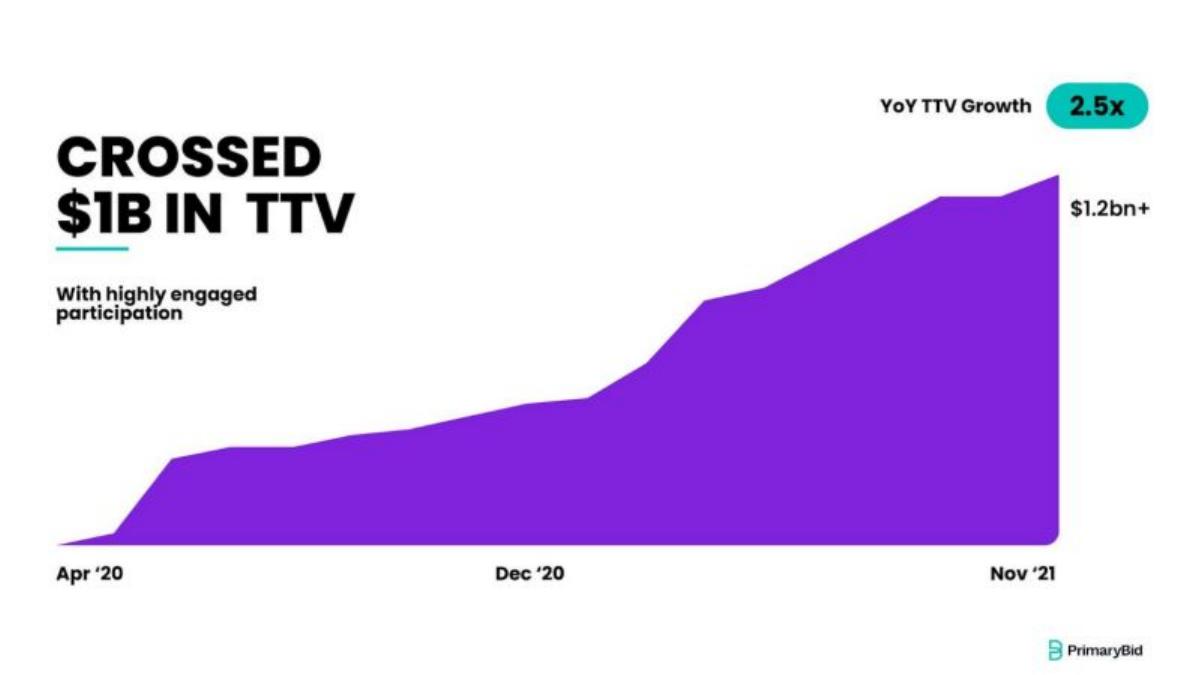
- The company achieved a Total Transaction Value (TTV) of over $1.2bn by November 2021, representing a 2.5x YoY growth rate (Slide 6).
- PrimaryBid has established formal partnerships with the London Stock Exchange and Euronext to facilitate retail participation in capital raises (Slide 3).
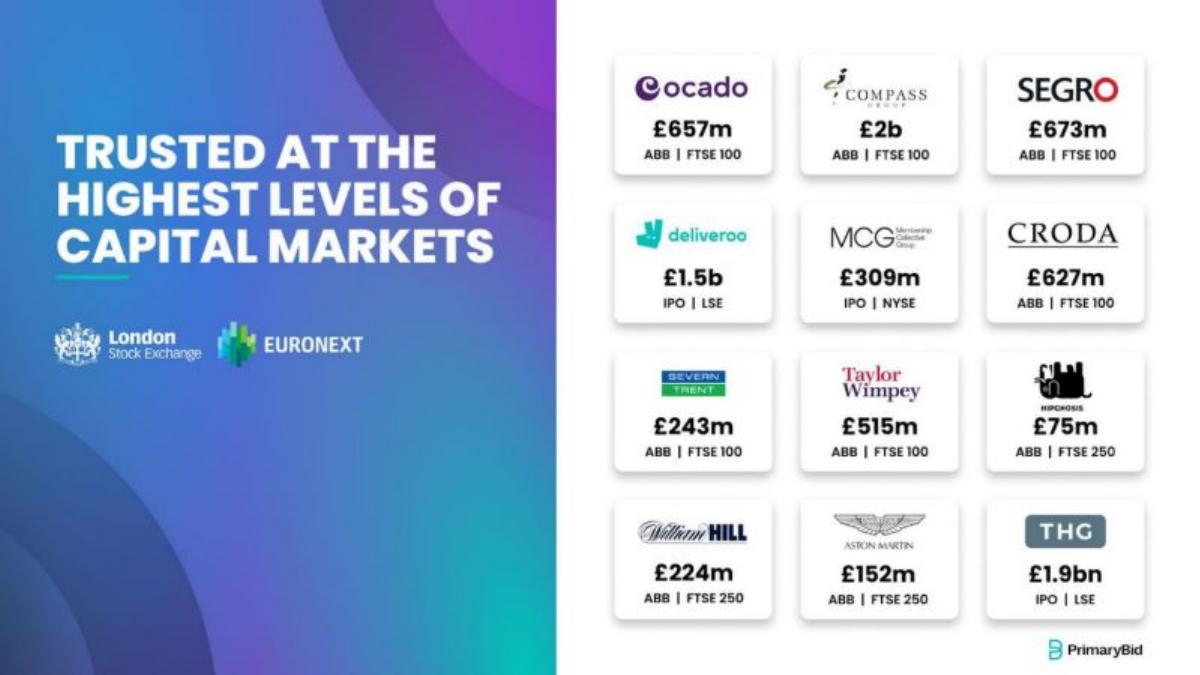
- The platform has been used by high-profile issuers including Ocado (£657m), Deliveroo (£1.5bn), and THG (£1.9bn) (Slide 3).
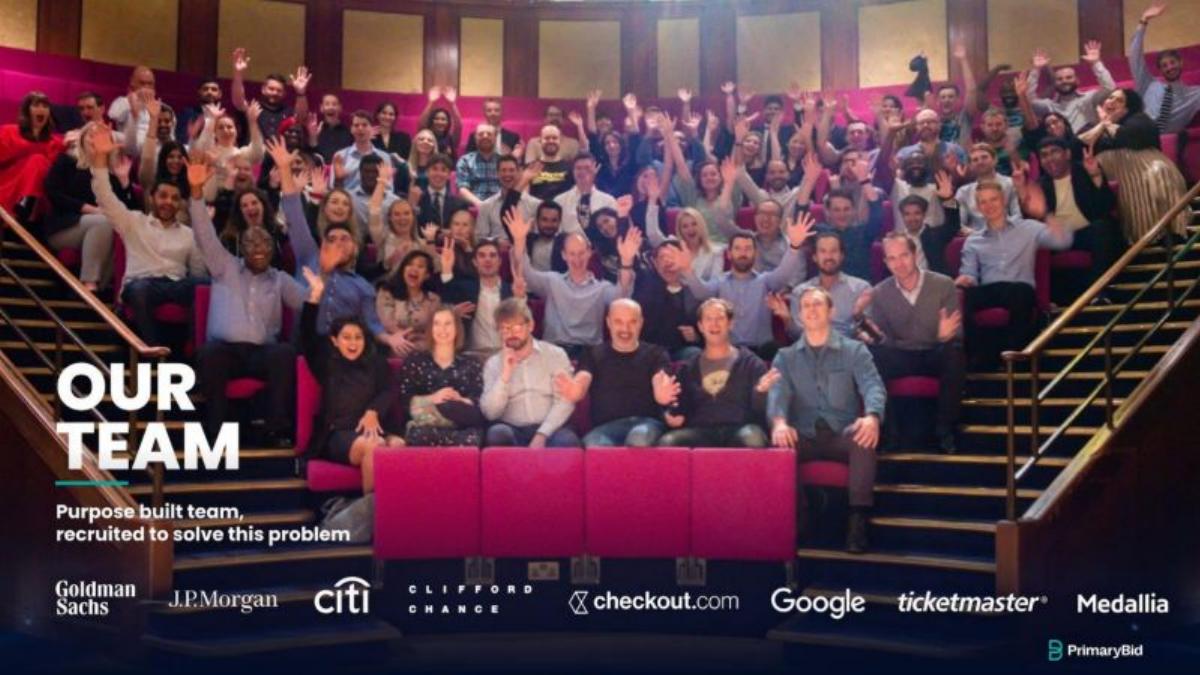
- The team is composed of former executives from top-tier financial and tech firms including Goldman Sachs, J.P. Morgan, Citi, and Google (Slide 2).
- The deck identifies five key user groups empowered by their data-driven products: customers, employees, shareholders, chair list, and the general public (Slide 9).
- Expansion into the EU is supported by strategic partnerships with Bourse Direct, Boursorama, and ABN AMRO (Slide 10).
- A significant portion of Series C funding (53%) is earmarked for Product, Engineering, and Operations (Slide 12).
- The deck highlights regulatory tailwinds such as the Capital Markets Union and the Shareholder Rights Directive II as key growth drivers (Slide 10).
The Narrative of Institutional Democratization
PrimaryBid’s pitch deck is a sophisticated example of how a fintech company can transition from a disruptive startup to a piece of essential market infrastructure. The theme, established on the cover slide, is "Democratising Public Markets." This isn't just a marketing slogan; the deck spends 13 slides proving that the company has the regulatory blessing and the institutional partnerships to make this a reality. By the time an investor reaches the end, the message is clear: PrimaryBid is no longer an experiment; it is a standard part of the UK and European equity issuance process.
Slide 1: The Vision and Context
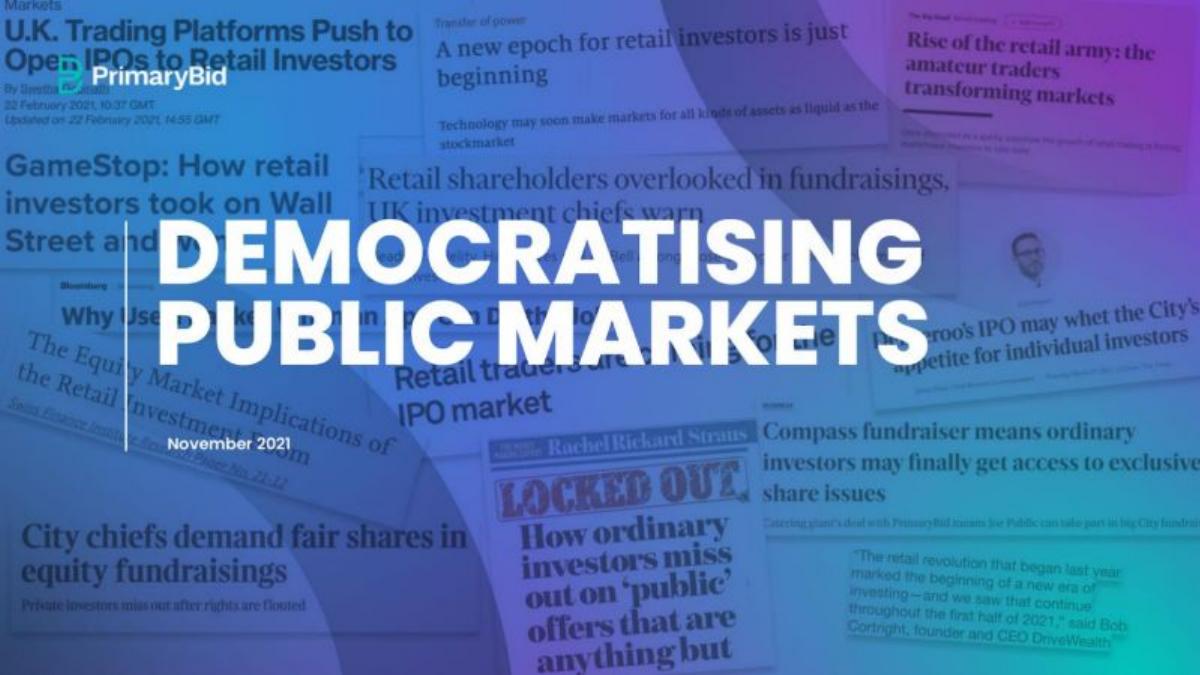
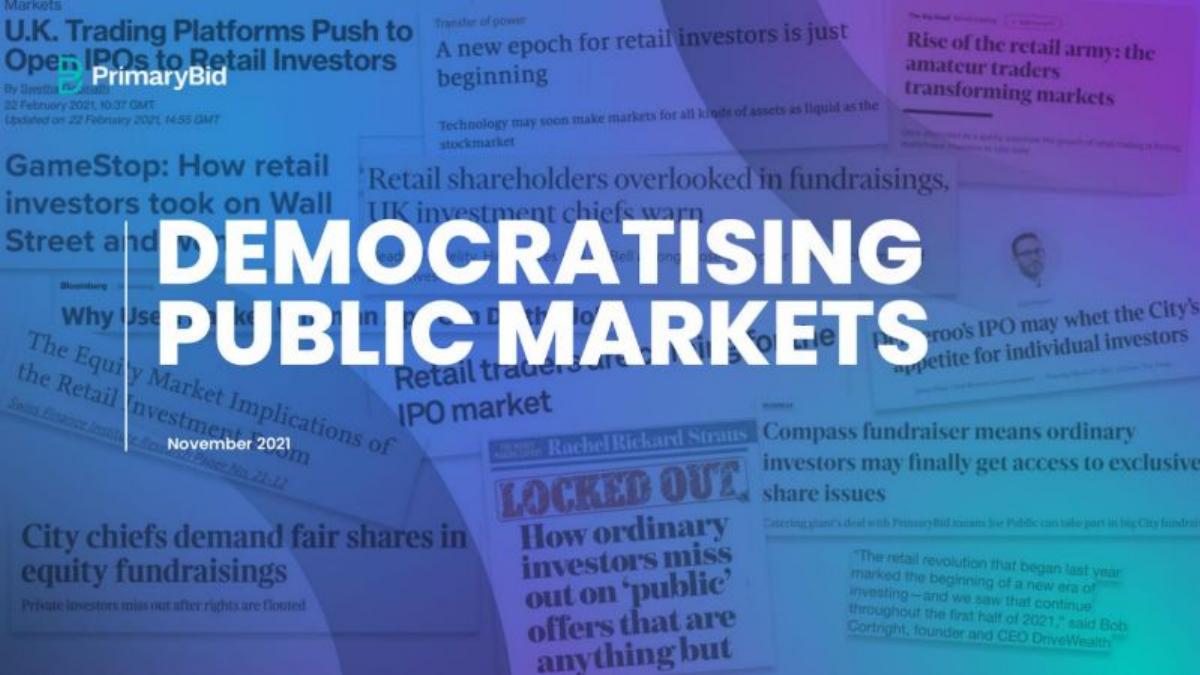
The cover slide uses a collage of news headlines to establish the "why now." It references the "retail army," the GameStop phenomenon, and the "City chiefs demand fair shares" narrative. By dating the deck November 2021, PrimaryBid positions itself at the center of a global shift in how retail investors interact with public markets. The central title, DEMOCRATISING PUBLIC MARKETS , is bold and clear, setting a high-level mission for the slides that follow.
Slide 2: The Pedigree of the Team
Instead of individual headshots and bios, Slide 2 features a group photo of the team in a theater setting, emphasizing scale and unity. The text describes them as a "Purpose built team, recruited to solve this problem." The most impactful part of this slide is the row of logos at the bottom: Goldman Sachs, J.P. Morgan, Citi, Clifford Chance, Checkout.com, Google, Ticketmaster, and Medallia . This signals to Series C investors that the company has the internal expertise to navigate complex capital markets and high-growth tech scaling simultaneously.
Slide 3: Establishing Market Authority
Slide 3 is a "wall of logos" done correctly. Titled "Trusted at the Highest Levels of Capital Markets," it prominently features the London Stock Exchange and Euronext logos. This is followed by a grid of 12 high-profile deals facilitated by the platform. Notable entries include Deliveroo (£1.5b IPO) , Ocado (£657m ABB) , and THG (£1.9bn IPO) . By listing the deal size and the index (FTSE 100/250), PrimaryBid proves it can handle the largest transactions in the market.
Slide 4: Demonstrating Sustained Adoption
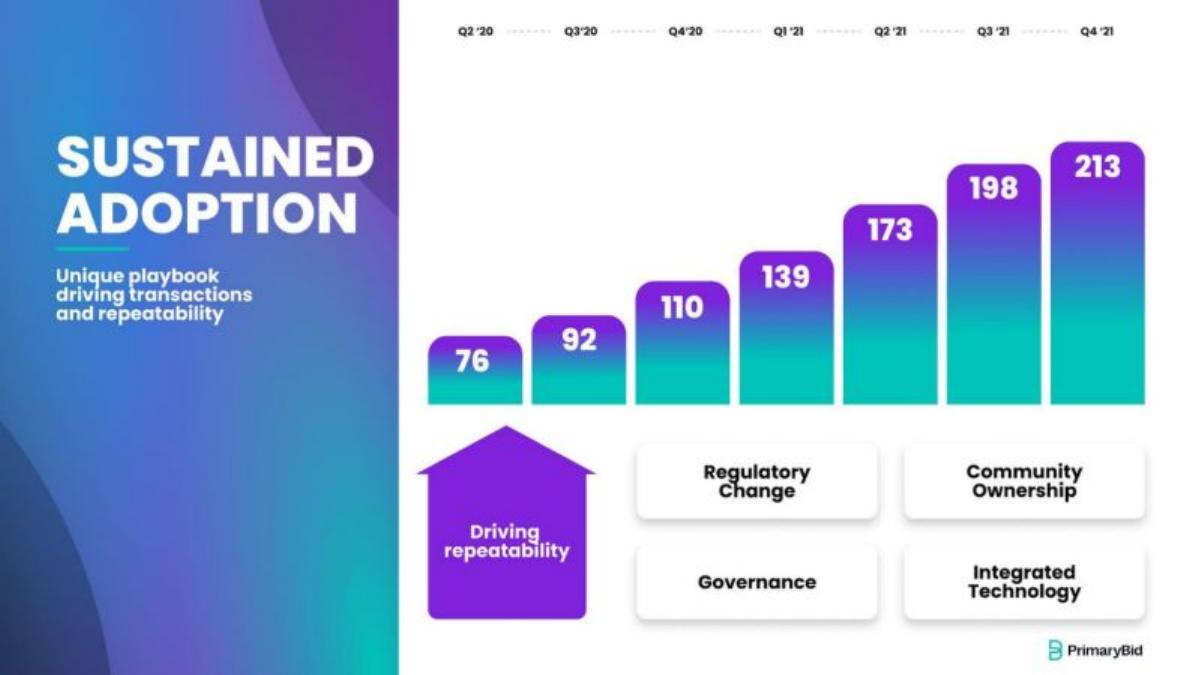
This slide addresses the potential criticism that retail participation might be a fleeting trend. The bar chart shows a consistent upward trend in transactions, moving from 76 in Q2 '20 to 213 in Q4 '21 . The slide attributes this growth to a "Unique playbook" involving regulatory change, community ownership, governance, and integrated technology. This suggests that the growth is structural, not just a result of market volatility.
Slide 5: The Voice of the Customer (Issuers)
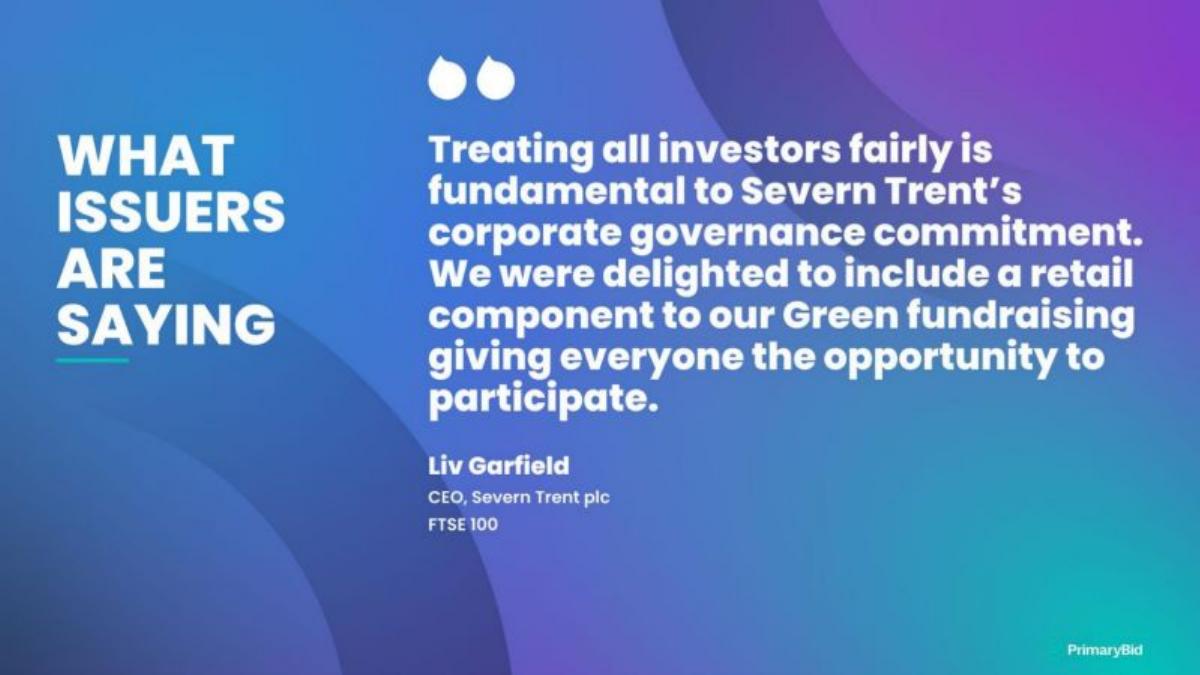
Social proof is critical in B2B fintech. Slide 5 features a quote from Liv Garfield, CEO of Severn Trent plc (a FTSE 100 company). She emphasizes that treating investors fairly is fundamental to corporate governance. This is a strategic inclusion; it tells potential investors that PrimaryBid isn't just a tool for retail traders, but a solution for CEOs and Boards looking to satisfy ESG and governance requirements.
Slide 6: The Billion-Dollar Milestone
Slide 6 is the "money slide." It announces that PrimaryBid has Crossed $1B in TTV (Total Transaction Value). The chart shows a sharp incline from April '20 to November '21, ending at $1.2bn+ . The callout box highlights a 2.5x YoY TTV Growth . This provides the quantitative evidence needed to justify a Series C valuation, showing that the platform is processing significant capital flows.
Slide 7 & 8: Regulatory and Political Support
Slide 8 features a quote from John Glen, Economic Secretary to the Treasury , regarding the desire to facilitate wider participation in the ownership of public companies. This slide, along with the QR code (presumably linking to the Hill Review), demonstrates that PrimaryBid is aligned with government policy. In a highly regulated sector, having the backing of the Treasury is a massive competitive moat that few startups can claim.
Slide 9: Product Diversification
Slide 9, "Data Driven Products," shows how the platform has evolved to serve multiple offer types. It lists five specific groups: Customers, Employees, Shareholders, Chair list, and the General Public . Two smartphone mockups show a variety of deals, including Aston Martin, Compass, and PensionBee . This slide illustrates that PrimaryBid is a multi-faceted distribution engine, not just a simple IPO app.
Slide 10: The European Expansion Strategy
Titled "Scaling the EU," this slide outlines the roadmap for geographical growth. It lists regulatory bodies like the ACP (Banque de France) and strategic partners like Bourse Direct, Boursorama, and ABN AMRO . The expansion strategy is broken down into four clear pillars: regulatory permissions, independent capabilities, cross-border distribution, and alignment with the Capital Markets Union . This provides a clear "use of funds" narrative for international growth.
Slide 11: The Global Vision
Slide 11 features a quote from Brian Chesky, CEO of Airbnb , about aligning the interests of all stakeholders, including hosts. While Airbnb is a US company, the inclusion of this quote suggests PrimaryBid’s ambitions extend beyond Europe and into the broader global trend of stakeholder capitalism.
Slide 12: Funding History and Use of Proceeds
The final content slide summarizes the company's capital journey. It shows a $9m Series A and a $50m Series B , listing the blue-chip investors involved (LSEG, Draper Esprit, OMERS, etc.). A pie chart breaks down the planned allocation for the Series C: 53% for Product, Eng, Ops ; 24% for Marketing ; 14% for Legal, Finance, HR ; and 9% for Capital Markets . This is a standard but necessary slide that shows the company is disciplined about its capital allocation.
Slide 13: The Disclaimer
The final slide is a dense legal disclaimer, which is appropriate for a company operating in the regulated financial services space. It confirms PrimaryBid is authorised and regulated by the Financial Conduct Authority (FCA) , further reinforcing the theme of institutional credibility.
What PrimaryBid Does Well
The deck excels at credibility by association . By repeatedly featuring the London Stock Exchange, the Treasury, and FTSE 100 CEOs, PrimaryBid moves the conversation away from "will this work?" to "how big can this get?" The use of TTV as a primary metric is also clever; while it doesn't show revenue, it shows the massive scale of the transactions the platform is capable of processing, which is the most important indicator of market fit in this sector.
What is Missing from the Deck
The most notable omission is unit economics and revenue . There is no mention of the take rate, the cost of customer acquisition (CAC), or the lifetime value (LTV) of a retail investor on the platform. While TTV is impressive, investors eventually need to see how that volume translates into a sustainable and profitable business model. Additionally, there is no competitive landscape slide. While PrimaryBid is a leader in the UK, there are other players in the retail IPO space globally, and the deck does not address how it intends to defend its position as it scales into the EU and potentially the US.
What Other Founders Should Copy
Founders in regulated industries should copy PrimaryBid's regulatory alignment strategy . Instead of positioning themselves as "disruptors" fighting the system, PrimaryBid positions itself as a partner to the system, helping exchanges and governments achieve their own stated goals (like the Capital Markets Union). This reduces perceived risk for late-stage investors. Furthermore, the "Wall of Logos" on Slide 3 is a perfect template for any B2B or infrastructure company; it doesn't just show names, it shows the specific value and scale of the work done for those clients.
Frequently asked questions
- What is PrimaryBid's core business model?
- PrimaryBid acts as an intermediary platform that allows retail investors to participate in public equity offerings, such as IPOs and Accelerated Bookbuilds (ABBs), on the same terms as institutional investors. According to the deck, they leverage 'integrated technology' and 'strategic partnerships' with exchanges like the LSE to provide this access, which was historically reserved for large funds.
- How much has PrimaryBid raised and who are their investors?
- The deck outlines a clear funding trajectory on Slide 12. They raised a $9m Series A led by Pentech and Outward, followed by a $50m Series B that included the London Stock Exchange Group, Draper Esprit, OMERS Ventures, and ABN AMRO Ventures. The catalogue listing indicates this deck was used for a $50m Series C round.
- What metrics does PrimaryBid use to show growth?
- The primary growth metrics presented are Total Transaction Value (TTV) and transaction volume. Slide 6 shows they crossed $1.2bn in TTV with a 2.5x YoY growth rate. Slide 4 shows transaction volume increasing steadily over seven quarters, reaching 213 transactions in Q4 2021.
- What is PrimaryBid's strategy for European expansion?
- Slide 10 details their 'Scaling the EU' strategy. This involves securing regulatory 'passporting' permissions, building independent origination and distribution capabilities, and leveraging partnerships with local players like Boursorama in France and ABN AMRO in the Netherlands. They also cite the EU's Capital Markets Union as a favorable regulatory tailwind.
- Does the deck include a detailed financial forecast?
- No, the deck does not include detailed financial projections, revenue figures, or a path to profitability. It focuses almost exclusively on transaction volume, TTV, and the quality of the issuer logos on the platform. This is common for late-stage fintech decks where the focus is on market dominance and infrastructure 'stickiness' rather than near-term EBITDA.