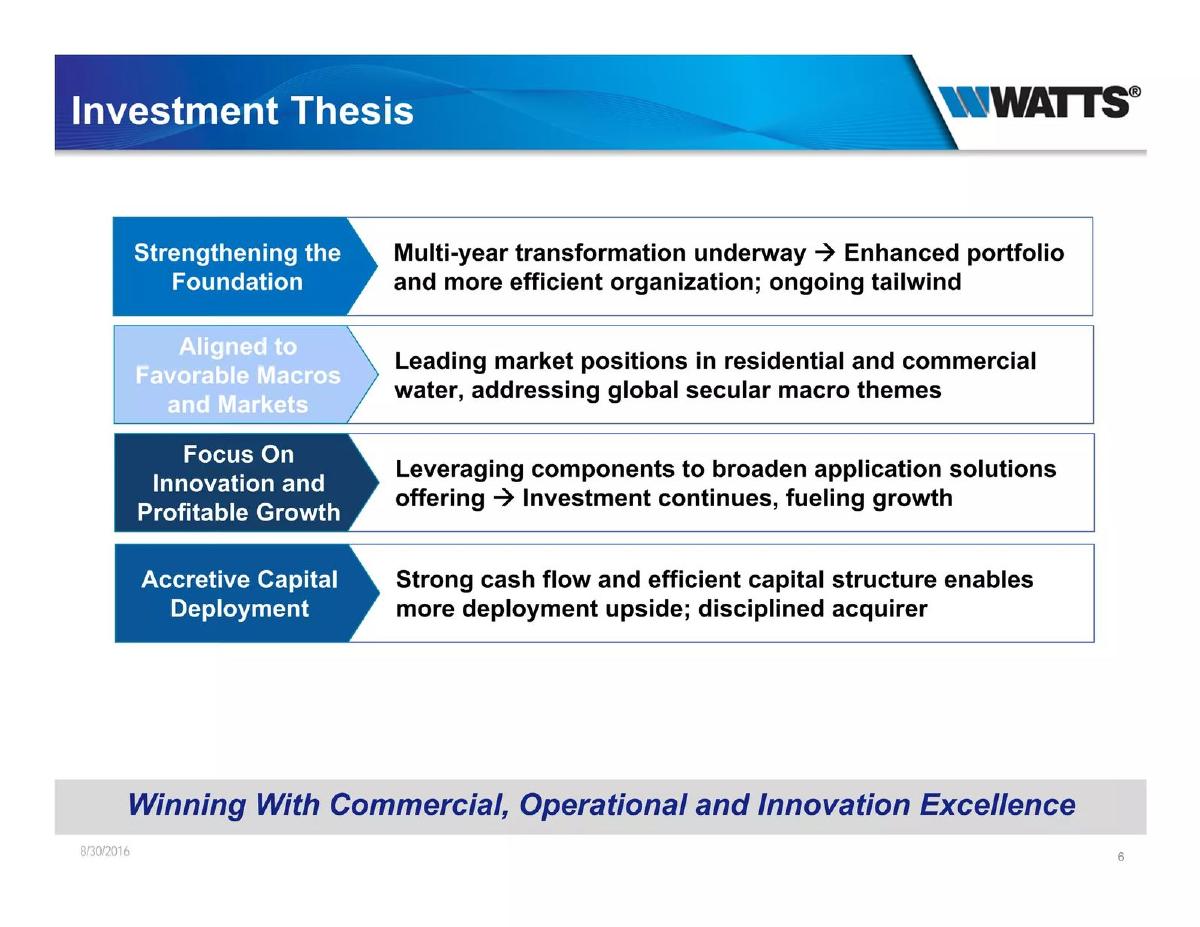
The Watts Water Technologies investor presentation from August 2016 serves as a strategic roadmap for a mature industrial giant undergoing significant structural change. With $1.5B in revenue and a balanced 60/40 domestic-to-international split, the company uses this deck to pivot investor focus from simple hardware sales to high-margin 'transformation' themes. The narrative centers on a three-phase restructuring plan (2013-2017+) aimed at footprint optimization and exiting non-core products. By aligning their product suite with macro trends like water conservation and energy efficiency, Watt…
Key takeaways
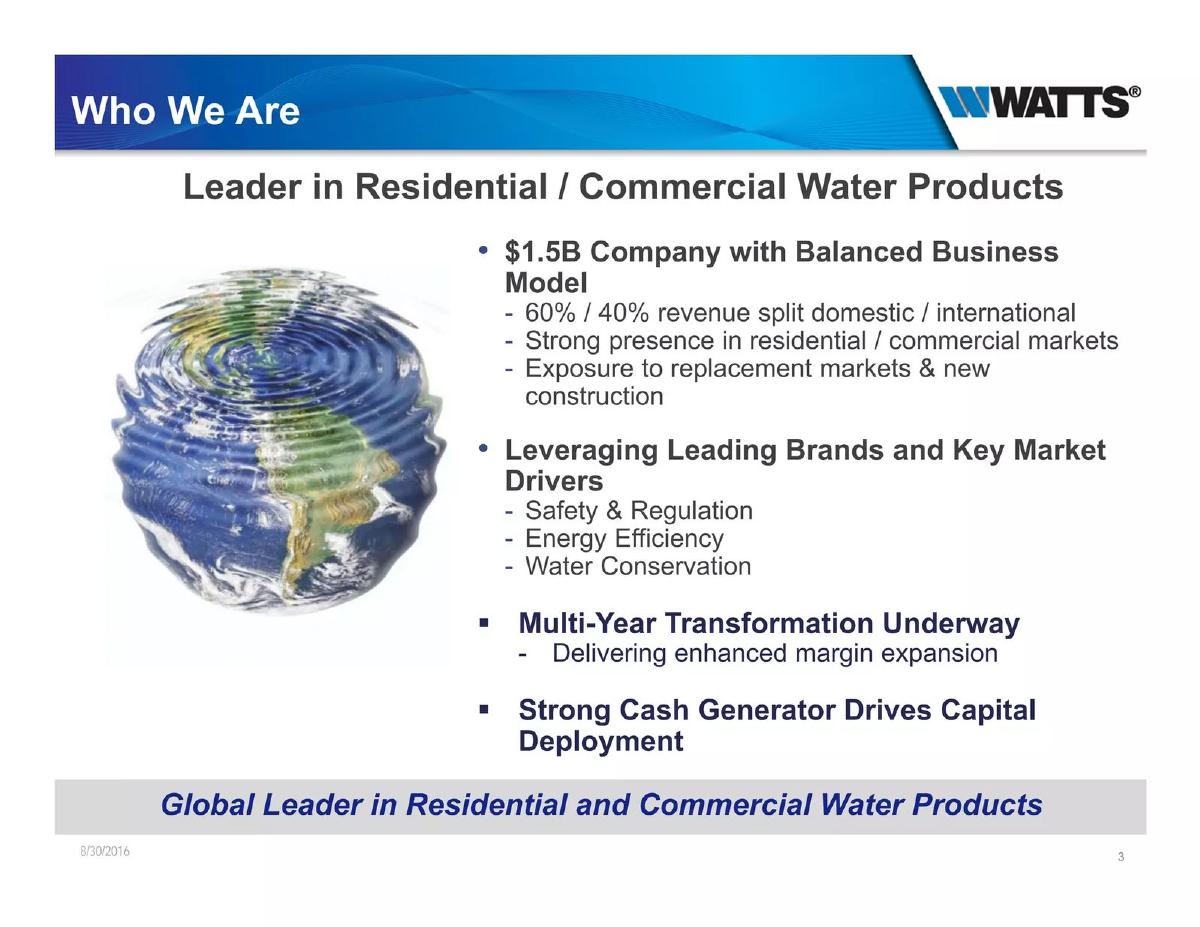
- Watts identifies as a $1.5B company with a balanced 60% domestic and 40% international revenue split on slide 3.
- The company is executing a multi-year transformation focused on margin expansion and footprint optimization as detailed on slide 7.
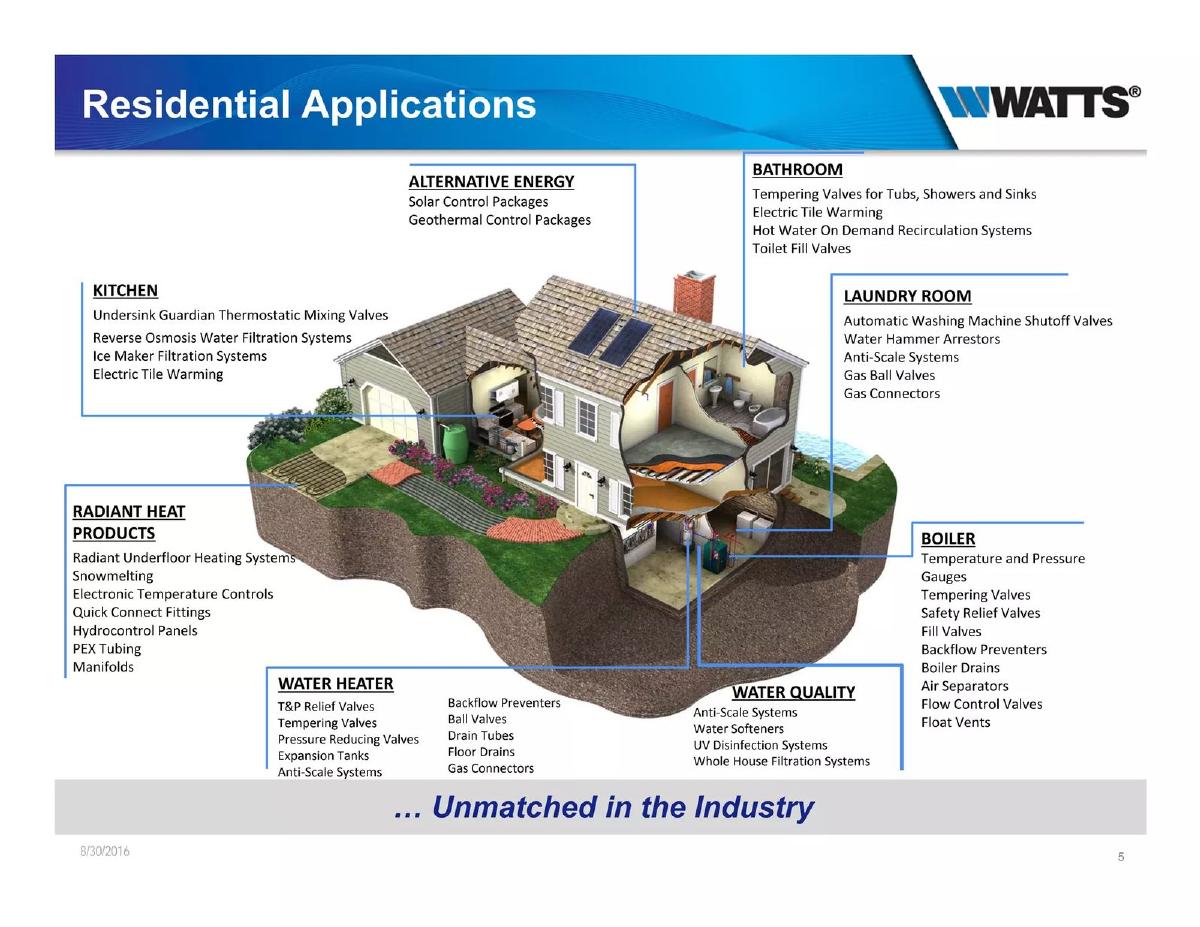
- A comprehensive residential application map on slide 5 illustrates a product presence in every major home system, from solar control to radiant heat.
- Strategic growth is tied to three secular macro themes: Safety & Regulation, Energy Efficiency, and Water Conservation, according to slide 9.
- The restructuring timeline shows a shift from European realignment (2013-2014) to Americas/Asia transformation (2015-2016) on slide 7.
- Capital deployment priorities include a reinvestment ratio of 80-100% and a commitment to double-digit dividend increases on slide 11.
- The deck targets a >100% Free Cash Flow (FCF) conversion by 2019, moving up from 2015 levels as shown on slide 11.
- The presentation omits a specific management team slide and detailed competitive landscape analysis in the provided 6-slide sample.
The Industrial Giant's Pivot: A Teardown of Watts Water Technologies
The 2016 investor presentation for Watts Water Technologies (WWT) is a quintessential example of how a large-cap industrial player communicates a 'turnaround' or 'transformation' story to the public markets. At the time of this deck, Watts was already a $1.5B revenue company, but it was facing the classic challenges of a legacy manufacturer: fragmented global operations, a bloated product catalog, and inconsistent margins. This teardown examines the 6 key slides that define their strategy to move from a collection of brands to a unified, high-margin global leader.
Slide 1: The Visual Hook
The cover slide uses a collage of industrial and residential imagery to establish the company's breadth. We see high-efficiency boilers, clean water access, construction sites, and heavy-duty valves. The inclusion of the 'Watts Water Technologies, Inc.' logo alongside the 'Watts' brand mark immediately signals a corporate identity that encompasses multiple sub-brands. While the slide contains no data, the imagery of a worker in a hard hat and high-tech boiler rooms sets the stage for a company that sits at the intersection of traditional labor and modern efficiency.
Slide 3: Who We Are - The $1.5B Baseline
Slide 3 is the 'anchor' slide for the entire presentation. It establishes the scale of the business with a bold headline: $1.5B Company with Balanced Business Model . The data points here are critical for institutional investors. The 60% domestic and 40% international revenue split suggests a global footprint that isn't overly dependent on a single economy. Perhaps most importantly, the slide mentions 'Exposure to replacement markets & new construction.' In the industrial sector, replacement (or aftermarket) revenue is highly prized because it is less cyclical than new construction. The slide also introduces the 'Multi-Year Transformation' theme, which is the primary value lever the company is pitching to investors.
Slide 5: Residential Applications - The Product Ecosystem
Slide 5 uses a 3D cutaway of a residential home to map out the company's product density. This is a highly effective visualization tool. Instead of listing hundreds of SKUs, Watts shows how their products permeate every room: Kitchen (filtration, mixing valves), Bathroom (tempering valves, toilet fill valves), Laundry Room (shutoff valves), and Boiler/Water Heater (relief valves, backflow preventers). The caption 'Unmatched in the Industry' serves to position Watts as a one-stop-shop for water safety and flow control, suggesting a competitive moat built on the sheer variety and integration of their catalog.
Slide 7: The Transformation Roadmap
This slide provides the strategic 'why' for the investment. It breaks the company's evolution into three distinct chronological blocks. The 2013-2014 period is defined by 'European Restructuring,' which involved realigning cost structures. The 2015-2016 period focuses on 'Americas / Asia Transformation,' specifically citing the 'Exited Non-core Products' and 'Footprint Optimization.' This is code for closing underperforming factories and cutting low-margin inventory. The 2017 & Beyond arrow points toward 'One Watts,' a vision of productivity and innovation. For an analyst, this slide is a checklist to measure management's performance against their stated milestones.
Slide 9: Aligned to Favorable Macro Trends
To justify long-term growth, Watts aligns itself with three 'Global Secular Macro Themes.' Safety & Regulation is described as 'Code & specification driven,' implying that as governments pass stricter building codes, Watts' certified products become mandatory. Energy Efficiency is framed as an 'economic and environmental value proposition,' while Water Conservation is linked to 'emerging global demand.' By framing their mundane hardware (valves and pipes) as essential tools for solving global water scarcity and energy waste, Watts elevates its market perception from a commodity manufacturer to an ESG-aligned growth story.
Slide 11: Disciplined Capital Deployment
The final slide in this set addresses the 'how' of financial returns. The chart shows a projected growth in Free Cash Flow (FCF) Conversion , targeting >100% by 2019 (labeled 2019T). This is an aggressive and attractive metric for value investors. The 'Deployment Priorities' list is a standard but necessary disclosure: 80-100% reinvestment ratio for high ROI CAPEX, 'Selective' M&A with disciplined valuation, and a commitment to double-digit dividend increases. This slide tells the investor that the company is a 'Strong Cash Generator' that knows exactly where to put the next dollar to maximize shareholder value.
What Works in This Deck
The deck excels at simplifying complexity . Watts is a massive company with thousands of products, but the use of the house cutaway (Slide 5) and the three macro pillars (Slide 9) makes the business model easy to digest. The transformation timeline (Slide 7) is also a highlight; it gives investors a clear narrative of progress, moving from 'fixing' the business to 'growing' the business. Finally, the financial transparency regarding FCF conversion and reinvestment ratios (Slide 11) provides the hard data necessary to back up the strategic claims.
What Is Missing
The most glaring omission in this 6-slide sample is a Management Team slide . In a transformation story, the 'who' is just as important as the 'what.' Investors need to know if the leadership has a track record of successful industrial restructuring. Additionally, there is a lack of Competitive Benchmarking . While they claim to be 'unmatched,' they do not show how their margins or market share compare to peers like Zurn, Mueller, or Reliance Worldwide. Lastly, there is no Risk Disclosure slide in this selection, which would typically address raw material costs (copper, steel) or sensitivity to interest rates affecting construction starts.
What a Founder Should Copy
The 'Macro Alignment' Strategy: If you are building a hardware or 'boring' business, follow Watts' lead on Slide 9. Connect your product to massive, unstoppable global trends (regulation, efficiency, conservation) to make your growth feel inevitable. · Visual Product Mapping: Use the 'cutaway' method from Slide 5. If your software or hardware touches multiple parts of a customer's life or business, show it in a single, integrated graphic rather than a bulleted list. · Phased Roadmaps: Don't just show where you are going; show where you've been. The three-stage timeline on Slide 7 builds credibility by showing that the current 'growth' phase is the result of previous 'restructuring' work. · Clear Capital Allocation: Be explicit about what you do with your cash. The 'Deployment Priorities' on Slide 11 are a great template for any company reaching maturity, as it balances reinvestment, M&A, and shareholder returns.
Frequently asked questions
- What is the primary financial goal stated in the Watts deck?
- The primary financial goal is margin expansion driven by a multi-year transformation. On slide 11, the company specifically targets a Free Cash Flow (FCF) conversion rate of greater than 100% by 2019, representing a significant increase over their 2015 baseline. This is supported by a disciplined capital deployment strategy that prioritizes high ROI CAPEX and strategic M&A.
- How does Watts segment its market presence?
- Watts segments its business by geography and market type. Slide 3 notes a 60/40 split between domestic and international revenue. It also highlights a 'strong presence' in both residential and commercial markets, with exposure to both the replacement market (aftermarket) and new construction, providing a hedge against cyclical downturns in the building sector.
- What were the key phases of the company's restructuring?
- As shown on slide 7, the restructuring was a three-phase process. 2013-2014 focused on European restructuring, realigning cost structures to demand. 2015-2016 shifted focus to the Americas and Asia, involving the exit of non-core products and footprint optimization. The 2017 and beyond phase is labeled 'One Watts,' focusing on productivity and innovation-led growth.
- Which macro trends is Watts leveraging for growth?
- Slide 9 identifies three 'Global Secular Macro Themes': Safety & Regulation (driven by codes and certifications), Energy Efficiency (driven by economic and environmental value propositions), and Water Conservation (driven by emerging global demand). The company positions its engineering competencies as critical to addressing these specific market drivers.
- What is the company's approach to shareholder returns?
- Watts maintains a balanced approach to capital deployment. According to slide 11, they prioritize paying a 'competitive dividend' with consistent double-digit increases. Additionally, they utilize stable share buybacks to offset option dilution at a minimum, ensuring that cash generation benefits shareholders while still allowing for an 80-100% reinvestment ratio into the business.