Maestro raised $15M in 2021 with a 16-slide deck that emphasizes the shift from quantity-based social media to value-based direct relationships. The presentation successfully bridges the gap between the massive 'creator economy' and the high-revenue 'enterprise' segment. By showcasing a blue-chip client list including the NBA, Fortnite, and Adobe, Maestro proves product-market fit in a crowded media landscape. The deck relies heavily on a three-pillar value proposition—Build, Control, Profit—and introduces a defensive 'app store' model for interactive video. While it lacks detailed financial…
Key takeaways
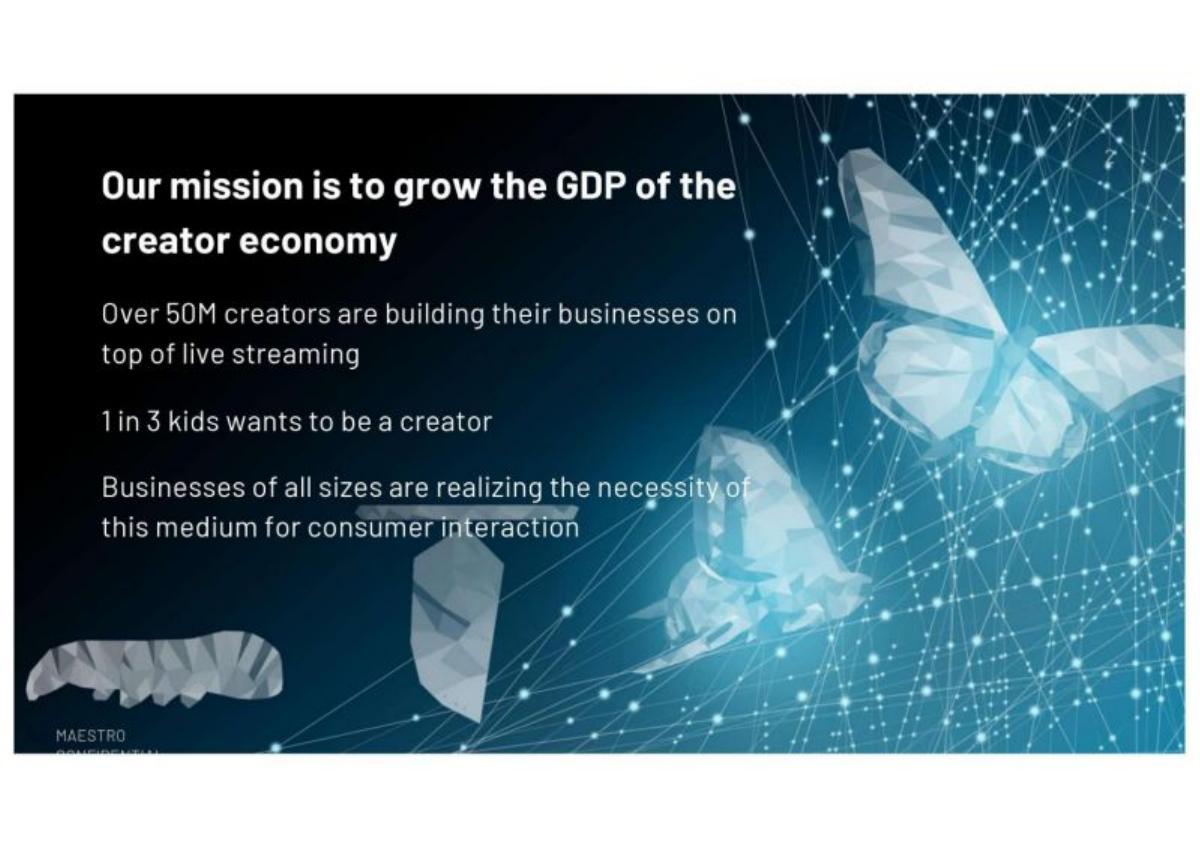
- The company defines its mission as growing the 'GDP of the creator economy,' citing that 1 in 3 kids wants to be a creator (Slide 2).
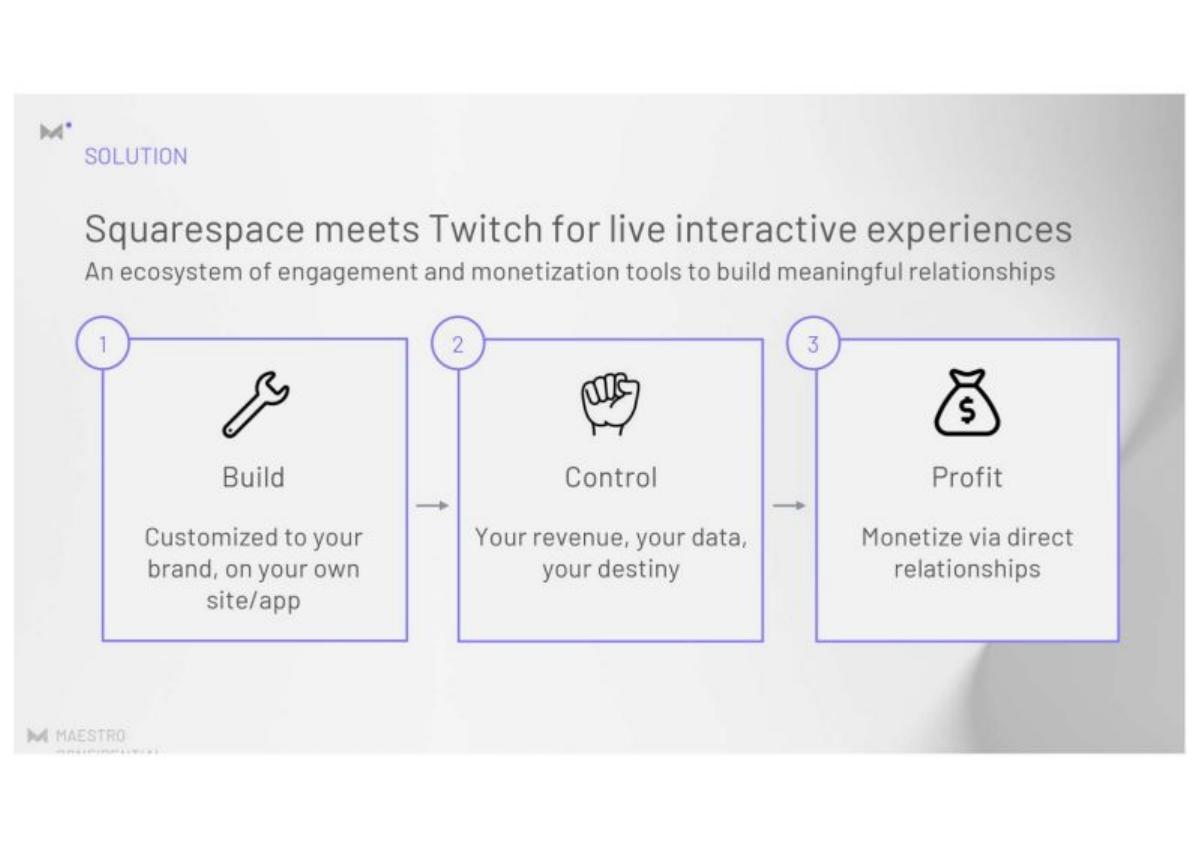
- Maestro uses a clear 'X meets Y' analogy, describing itself as 'Squarespace meets Twitch' to simplify a complex white-label offering (Slide 5).
- The deck highlights significant enterprise traction with 25M unique viewers and over 120M hours watched through the platform (Slide 7).
- A high-density logo slide features major brands like Fortnite, NBA, The Grammys, Coachella, and Microsoft to establish immediate credibility (Slide 8).
- The business model is dual-pronged, combining transaction fees (tickets, subs, merch) with usage-based SaaS revenue (Slide 11).
- Maestro projects a revenue opportunity of $52M ARR achievable within 18 months (Slide 11).
- The team slide emphasizes deep industry experience with logos from Goldman Sachs, Zynga, Fox Sports, and ESPN (Slide 12).
- The competitive landscape slide positions Maestro as the leader for creators who 'bring your audience' rather than 'find an audience' (Slide 14).
The Narrative: Reclaiming the Creator Economy
Maestro’s Series B deck is a masterclass in positioning. In 2021, the 'Creator Economy' was a peak buzzword, but most of the value was being captured by centralized platforms. Maestro’s pitch is a direct challenge to that status quo. By framing the problem as a shift from 'quantity to value,' they appeal to the desire for independence that large brands and top-tier creators share.
Slides 1-4: The Vision and Mission
The deck opens with a minimalist title slide (Slide 1) and immediately moves into a high-level mission statement: 'to grow the GDP of the creator economy' (Slide 2). This is a bold, Stripe-esque ambition. They support this with a few key stats: 50M creators globally and the cultural shift where '1 in 3 kids wants to be a creator.' This sets the stage for a massive TAM (Total Addressable Market).
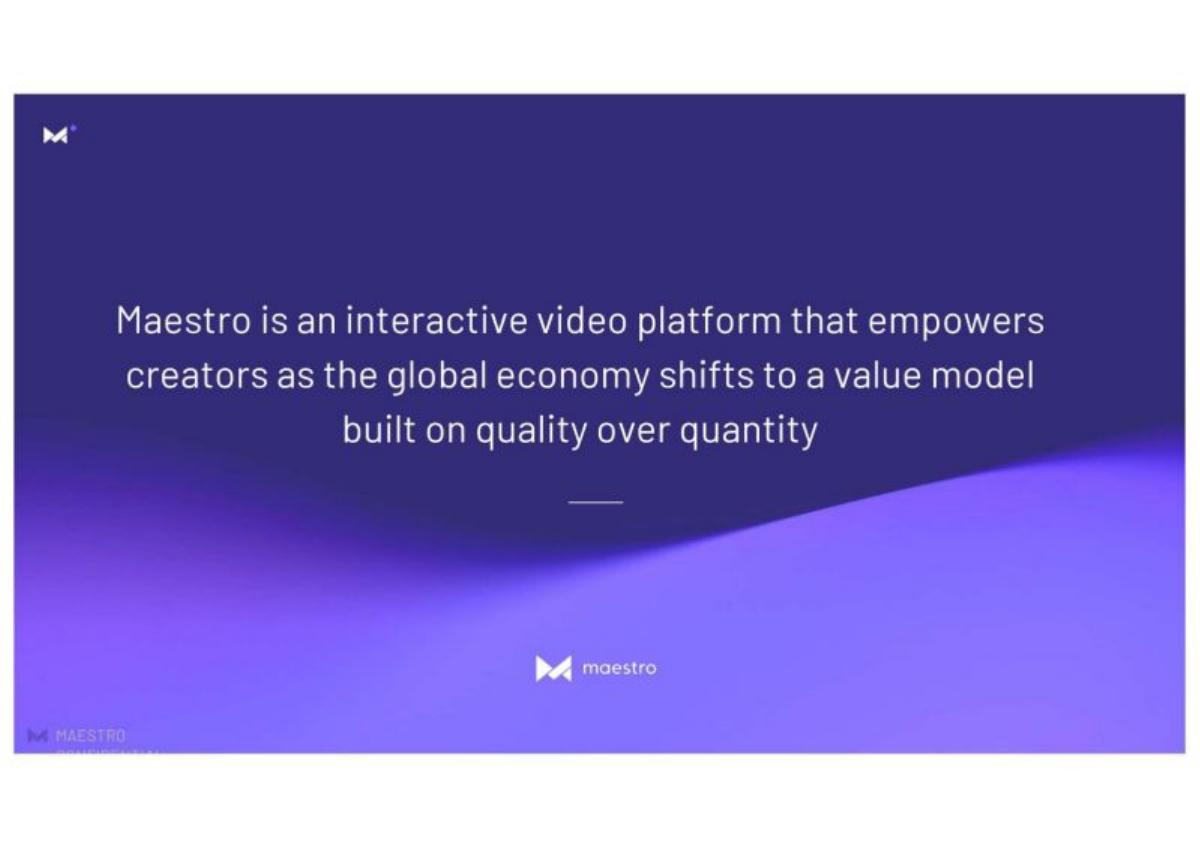
Slide 3 and 4 refine the thesis. They argue that the global economy is shifting to a 'value model built on quality over quantity.' This is a crucial distinction for a white-label platform. If you want 10 million random views, go to TikTok. If you want to monetize 10,000 core fans at a high level, you need Maestro. Slide 4 uses a simple visual of a hand circling a 'core audience' to drive home the point that monetization follows deep engagement, not just reach.
Slide 5: The Solution (The 'Aha' Moment)
'Squarespace meets Twitch for live interactive experiences.' This is perhaps the strongest slide in the deck. It uses two well-known anchors to explain a complex B2B2C product. Squarespace implies 'easy-to-build, white-label, and branded.' Twitch implies 'live, interactive, and community-driven.' The three-step process—Build, Control, Profit—is simple and effective. It promises the creator their 'revenue, data, and destiny.'
Slides 6-8: Market Segments and Traction
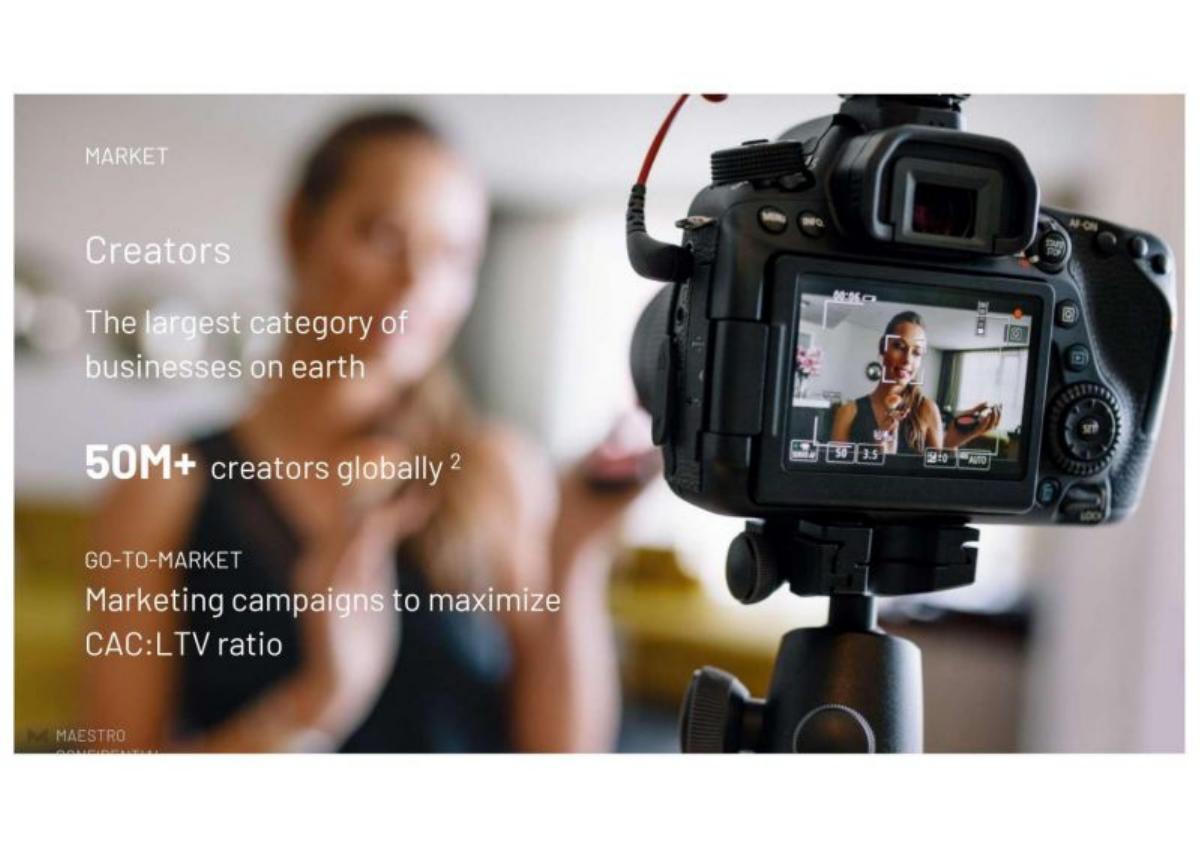
Slide 6 addresses the 'Creator' market, but Slide 7 reveals the 'Beachhead Segment': Enterprise. This is where the real money is. Maestro highlights 'massive event scale' with 25M unique viewers and 120M hours watched. This proves the technology is robust enough for the world's largest stages. The 'Go-To-Market' strategy here is traditional enterprise sales, targeting C-level executives (CDO, CMO, CRO).
Slide 8 is the 'Wall of Logos.' For a Series B, this is the most important slide. Seeing Fortnite, NBA, The Grammys, Coachella, Microsoft, Adobe, and Ubisoft all on one page removes almost all perceived risk regarding product-market fit. If these brands trust Maestro for their flagship events, the platform is clearly enterprise-grade.
Slides 9-10: Defensibility and the Ecosystem
Maestro isn't just pitching a tool; they are pitching a platform. Slide 9 lists six pillars of long-term value, including 'Switching Costs' and 'Network Effects.' Slide 10 introduces the 'App Store for interactive video.' This is a classic platform play: by allowing developers to build on top of Maestro, they create a virtuous cycle. More apps lead to more customers, which leads to more developers. This moves Maestro from a 'feature' that a competitor could copy to an 'ecosystem' that is much harder to replicate.
Slide 11: The Business Model
The business model is refreshingly transparent. It’s a mix of transactional revenue (a cut of the money flowing through the platform) and usage-based SaaS (fees for the infrastructure). This 'double dip' allows Maestro to benefit from both the volume of events and the success of those events. The slide concludes with a bold projection: '$52M ARR achievable within 18 months.' While ambitious, it provides a clear target for investors to model against.
Slide 12: The Team
The team slide is strong, featuring Founder/CEO Ari Evans and executives with backgrounds at Goldman Sachs, Zynga, Fox Sports, and ESPN . The inclusion of an 'Advisory Board' with the former CEO of ESPN and the CEO of DraftKings is a strategic move to show they have the 'insider' connections needed to win in sports and media. The investor list at the bottom shows a solid foundation of existing venture support.
Slides 13-15: The Landscape and Product Deep-Dive
Slide 14 provides a competitive landscape that is actually useful. Instead of the standard 'we are in the top right' checkmark box, they use a quadrant based on 'Find an audience' vs. 'Bring your audience' and 'Digital' vs. 'Physical' products. Maestro sits in the 'Bring your audience / Digital products' quadrant alongside Substack and Patreon, but with a focus on live video. Slide 15 gives a final look at the UI, showing how 'Panels,' 'Overlays,' and 'Quests' work in a real-world scenario (Sky Sports).
What Maestro Does Well
1. Clarity of Purpose: The 'Squarespace meets Twitch' analogy is perfect. It tells an investor exactly what the product is and who it is for in four words.
2. Proof of Scale: The viewer metrics (25M uniques) and the blue-chip logo slide are the heavy hitters. At Series B, investors want to see that the 'experiment' phase is over and the 'scaling' phase has begun.
3. Platform Thinking: By emphasizing the 'App Store' and 'Developer Ecosystem,' Maestro shows they aren't just building a video player—they are building a foundation for the future of interactive media.
What is Missing from the Deck
1. Unit Economics: While they mention the revenue model, there is no data on CAC (Customer Acquisition Cost), LTV (Lifetime Value), or Churn. For a Series B, these are usually expected in the appendix or a follow-up data room.
2. The 'Ask': The deck does not explicitly state how much they are raising or how they plan to spend the capital. While the catalogue facts state $15M was raised, the deck itself leaves the 'Ask' for the verbal pitch.
3. Detailed Financials: There are no historical revenue growth charts. The $52M ARR figure is a forward-looking projection, but investors would want to see the month-over-month growth leading up to this point.
What a Founder Should Copy
1. The 'Bring Your Audience' Distinction: If you are building a tool for creators, clearly define whether you are helping them find people (discovery) or monetize people (infrastructure). Maestro wins by focusing on the latter, which is a more defensible business model.
2. Strategic Advisor Logos: If you are in a niche industry (like sports media), having the right advisors is as important as having the right investors. Maestro’s use of the ESPN and DraftKings logos via their advisors adds immense sector-specific credibility.
3. Visualizing the Product in Context: Slide 15 shows the product on a laptop and a phone with specific callouts for features. This makes the 'white-label' concept tangible and easy to visualize for an investor who might not be a regular live-stream viewer.
Frequently asked questions
- What is Maestro's core product offering?
- Maestro provides a white-label interactive video platform. Unlike Twitch or YouTube, where the platform owns the user data and a large cut of the revenue, Maestro allows brands and creators to build their own branded streaming sites or apps. This enables them to control their data, customize the user experience with 'panels' and 'quests,' and keep a larger share of profits through direct monetization tools like ticket sales and merchandise.
- How does Maestro differentiate itself from social streaming platforms?
- As shown on Slide 14, Maestro differentiates itself by audience ownership. Platforms like TikTok and Twitch are for 'finding an audience,' but they often limit monetization and data access. Maestro is for those who already have an audience and want to 'bring' them to a controlled environment. This 'value over quantity' model focuses on deep engagement and direct-to-consumer relationships rather than broad, algorithm-dependent reach.
- What are the primary revenue drivers for the company?
- Maestro utilizes a hybrid revenue model. First, it earns through transactions, taking a cut of ticket sales, subscriptions, merchandise, and tips. Second, it operates a usage-based SaaS model where fees are determined by the number of unique viewers and total viewer hours. This allows the company to scale its revenue alongside the success and growth of its clients' events.
- Who are the key investors and advisors mentioned in the deck?
- The deck lists several institutional investors including The Strand Partners, Sterling.VC, Rubicon Venture Capital, Scrum Ventures, Stadia Ventures, and Hersh Interactive. Notable advisors include Steve Bornstein (Former CEO of ESPN), Larry Marcus (Partner at Walden Venture Capital and early Pandora investor), and Jason Robins (CEO of DraftKings), signaling strong ties to the sports and gaming industries.
- What is the 'App Store' concept mentioned in the defensibility section?
- Maestro aims to build a 'developer ecosystem' for interactive video. By creating an app store where third-party developers can build engagement and monetization tools (like specific types of overlays or games), Maestro creates a network effect. Customers are attracted to the library of apps, and developers are attracted to the growing pool of enterprise customers, making the platform harder to displace than a simple video player.