Magroove’s 21-slide deck presents a dual-threat solution to the music industry: a flagship distribution platform and an AI-powered recommendation engine. The company targets the massive 'Independent Market Share,' which it cites as 39.9% of the industry as of 2018 (Slide 2). With a reported $1.6M Seed round raised in 2024, the deck highlights impressive early traction, including 70k+ artist sign-ups within the first 10 months and a robust LTV/CAC ratio of 8.78 (Slide 6). While the deck is light on specific financial projections and team bios in the provided samples, it builds a compelling cas…
Key takeaways
- The global music market size is valued at $21.6B as of 2020, with independent artists representing nearly 40% of the share (Slide 2).
- Magroove identifies a massive total addressable market of 20 million musicians, of which 80% are independent (Slide 3).
- The 'Flagship' product simplifies distribution, allowing artists to upload albums to major streaming services with 'only a few clicks' (Slide 4).
- A secondary 'MVP' product uses in-house AI to recommend independent artists alongside major industry names to listeners (Slide 5).
- Marketing efficiency is a core strength, boasting an LTV/CAC ratio of 8.78 and 70k+ artist sign-ups in under a year (Slide 6).
- The company utilizes a massive outbound database of 2 million contacts for proof-of-concept marketing (Slide 6).
- The 2024 goal is to reach 1.5 million artists and become a top 5 global music distributor (Slide 7).
- The roadmap includes scaling the team to 20-25 people, specifically focusing on Development and Operations (Slide 7).
Executive Summary: The Indie Music Powerhouse
Magroove enters the venture landscape at a time when the 'creator economy' for musicians is exploding. Based in São Paulo and raising a reported $1.6M Seed round in 2024, the company positions itself not just as a utility for distribution, but as a discovery engine. By bridging the gap between 'uploading' and 'being heard,' Magroove addresses the primary pain point of the 16.1 million independent artists they identify in their market research. The deck is characterized by clean aesthetics, aggressive growth targets, and a heavy emphasis on unit economics.
Slide 1-3: Market Opportunity and the 'Indie' Surge
The deck opens with a minimalist title sequence before diving immediately into the macro-environment. Slide 2 establishes the 'Target Market' with two staggering figures: a $21.6B global music market size (2020) and a 39.9% independent market share (2018). This is a classic 'large and growing' market slide, but it adds a layer of specificity by pointing an arrow toward 'Other Needs,' suggesting that the current market leaders are failing to serve the nuances of the independent sector.
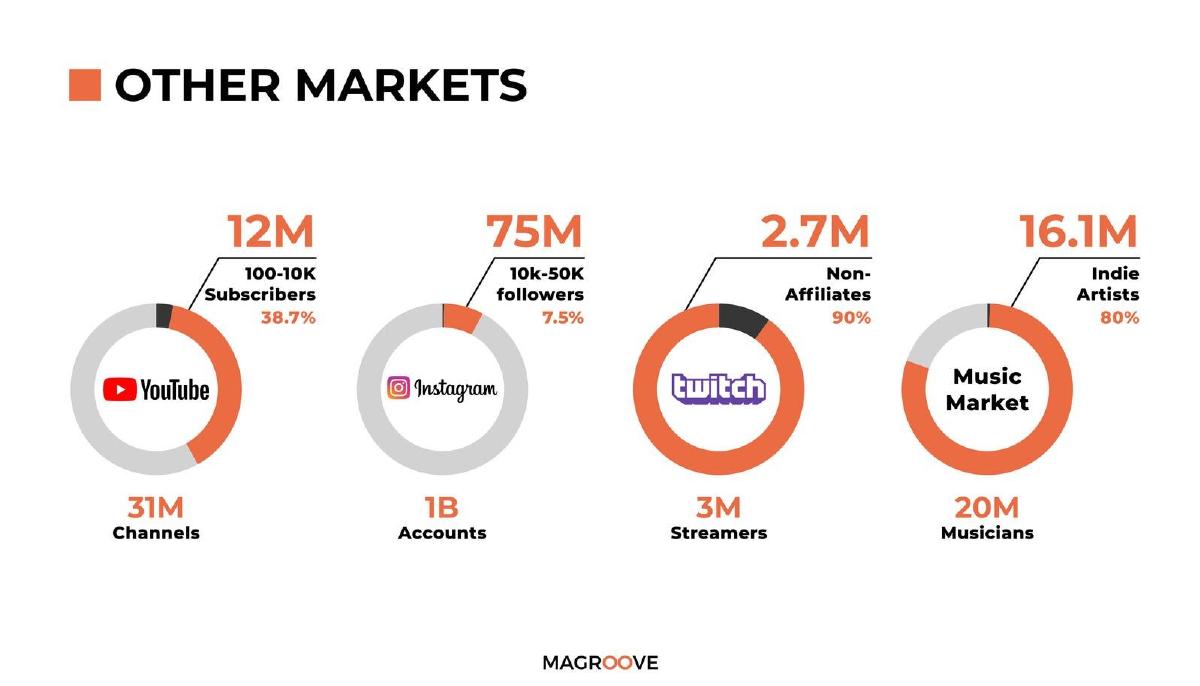
Slide 3 expands this view into 'Other Markets.' Here, Magroove contextualizes their opportunity within the broader social media ecosystem. They cite 31M YouTube channels (with 12M having 100-10k subscribers) and 1B Instagram accounts. The most critical data point on this slide is the 'Music Market' breakdown: 20M total musicians, with 16.1M (80%) classified as 'Indie Artists.' By framing the market this way, Magroove suggests that the 'long tail' of the music industry is actually the 'fat head' of their business model.
Slide 4-5: The Dual-Product Solution
Magroove splits its value proposition into two distinct categories: Distribution (Flagship) and Recommendation (MVP) . This is a strategic move to show investors that they have a stable, proven revenue generator (distribution) and a high-upside, tech-moat product (AI recommendation).
Slide 4 details the Distribution platform. It promises a 'few clicks' workflow for uploading albums, moderation monitoring, analytics, and payments via Paypal. The UI shown on the laptop mockup is clean and professional, emphasizing ease of use—a critical factor for independent artists who often act as their own managers and tech support.
Slide 5 introduces the AI component. Labeled as 'Recommendation (MVP),' this product is an 'Artist to Listener' platform. The slide claims the use of 'cutting edge technology' via an in-house AI that coordinates the system. The visual shows a mobile interface (notably featuring a Samsung logo, perhaps indicating a partnership or platform focus) that looks remarkably like a modern streaming app. The key takeaway here is the 'Opportunity' bullet point: independent artists are recommended alongside 'big names,' solving the visibility problem that plagues platforms like Spotify for new creators.
Slide 6: Marketing Prowess and Unit Economics
For a Seed round, Slide 6 is arguably the most important. It breaks down Magroove's marketing engine into three pillars: E-MKT Outbound, Social Media (Google/FB/IG), and Content/SEO. The metrics provided are highly specific and impressive:
70k+ artists signed up in the first 10 months. · An LTV/CAC ratio of 8.78 . This is a standout figure; in SaaS and platform businesses, a ratio above 3 is considered good, and nearly 9 suggests a highly efficient and scalable acquisition model. · A database of 2 million contacts for outbound marketing. · 20 thousand monthly unique visitors (MUV) via SEO.
The mention that they are 'reviewing our strategy' for SEO shows a level of transparency and iterative thinking that investors appreciate. It suggests the team is data-driven and willing to pivot tactics to maintain their high acquisition efficiency.
Slide 7: The Roadmap to 2024
The roadmap on Slide 7 is a linear progression of scale. It sets clear milestones for artist counts: 50k in 2021, 150k in 2022, 500k in 2023, and 1.5M in 2024. The strategic milestones are equally ambitious:
2021: Launch of the recommendation platform and scaling ads. · 2022: Investment round (presumably the one this deck supported) and team growth to 20-25 people. · 2023: Scaling secondary artist revenue streams. · 2024: Reaching 200k albums distributed and entering the 'top 5 music distributors' globally.
This slide effectively communicates that the company is moving from a 'product-market fit' phase into a 'pure scaling' phase.
What Magroove Does Well
Clarity of Market: The deck does an excellent job of quantifying the 'Independent' music sector. By using a 20M musician baseline and narrowing it down to 16.1M indie artists, they make the opportunity feel tangible rather than theoretical.
Unit Economic Focus: Leading with an 8.78 LTV/CAC ratio is a power move. It tells investors that for every dollar they put into the 'machine,' they are getting nearly nine dollars of value back. This reduces the perceived risk of the 'Scale Ads' phase of the roadmap.
Product Synergy: The link between distribution (the 'how') and recommendation (the 'who hears it') creates a closed-loop ecosystem. This is a more defensible business model than simple distribution, which has become a commoditized race to the bottom on pricing.
What is Missing from the Deck
Team Background: In the provided slides, there is no mention of who is building Magroove. For a $1.6M Seed round, the 'Why this team?' question is usually as important as the 'Why this market?' question. Investors want to know if the founders have deep ties to the music industry or a history of building AI at scale.
Revenue Model Specifics: While 'payouts' and 'revenue streams' are mentioned, the deck does not explicitly state the pricing model. Is it a subscription (like DistroKid), a per-upload fee, or a percentage of royalties? Without this, the LTV/CAC ratio lacks context—we don't know what the 'Value' actually represents in dollars.
Competitive Landscape: The music distribution space is crowded with giants like TuneCore, CD Baby, and DistroKid. The deck mentions being a 'top 5 distributor' but doesn't provide a feature-by-feature comparison to show how they will unseat the incumbents beyond their AI recommendation engine.
Founder's Teardown: Lessons to Copy
The 'MVP' Label: Magroove wisely labels their AI platform as an 'MVP' (Slide 5). This manages expectations. It tells investors: 'Our core business (Distribution) works now, and this AI piece is our future-facing moonshot that we are already testing.'
Visual Consistency: The deck uses a consistent color palette (orange and black) and high-quality mockups. This professional polish reflects the 'quality control' they promise in their product description (Slide 4).
Defined Milestones: The roadmap (Slide 7) doesn't just list dates; it lists specific KPIs (artist counts). This gives investors a clear yardstick to measure the company's progress in subsequent board meetings. If you are raising a Seed round, your roadmap should always include a 'North Star' metric like Magroove's artist count.
Final Thoughts
Magroove’s deck is a masterclass in 'Efficiency Pitching.' They aren't just asking for money to find a market; they are asking for money to pour fuel on a fire that is already burning at an 8.78x efficiency rate. While the missing team and pricing details are notable, the sheer volume of the market opportunity and the dual-product strategy make a compelling case for a $1.6M Seed investment in the media tech space.
Frequently asked questions
- What is Magroove's primary business model?
- Magroove operates as a digital music distribution service. According to Slide 4, their flagship product allows independent artists to upload music to major streaming platforms, manage moderation, and access performance analytics. They also monetize through an AI-driven recommendation platform that connects these artists directly with new listeners, as detailed on Slide 5.
- How efficient is Magroove's artist acquisition?
- The deck reports high marketing efficiency. Slide 6 states that Magroove achieved an LTV/CAC ratio of 8.78. This was accomplished by signing up over 70,000 artists in the first 10 months using a mix of social media advertising (Google, Facebook, Instagram) and a database of 2 million outbound contacts.
- What is the 'Recommendation MVP' mentioned in the deck?
- The Recommendation MVP is an AI-powered platform designed to help music lovers discover new tunes. Slide 5 explains that this in-house technology recommends Magroove's independent artists alongside 'big names' in the industry, providing a discovery mechanism that traditional distribution-only services often lack.
- What are the company's growth targets for 2024?
- As shown on the roadmap in Slide 7, Magroove aims to reach 1.5 million artists by 2024. Their strategic objective for that year is to be ranked among the top 5 music distributors globally, supported by a milestone of 200,000 albums distributed.
- Does the deck provide information on the founding team?
- The provided slide text and images do not include a team slide or founder biographies. While the roadmap on Slide 7 mentions growing the team to 20-25 people (primarily in Dev and Ops), the specific leadership background is omitted from the analyzed portion of the 21-slide deck.