MAI’s 11-slide pitch deck is a masterclass in 'founder-market fit' as a primary fundraising lever. Raising $25M at the seed stage is an outlier, and the deck explains why: the team is almost entirely composed of former Google Ads and Instacart engineering leadership. Rather than spending time on broad market statistics or TAM slides, the deck focuses on the technical architecture of their 'AI Agent' and three detailed case studies showing specific ROI improvements (e.g., a 3x increase in profitable spend). The deck is light on financial projections and heavy on technical moats, signaling to V…
Key takeaways
- The team slide (Slide 2) is the strongest asset, featuring 11 members with backgrounds from Google Ads, Instacart, and Amazon, including multiple PhDs in Machine Learning.
- MAI identifies 'manual coordination' and 'data fragmentation' as the core problems in marketing workflows (Slide 3).
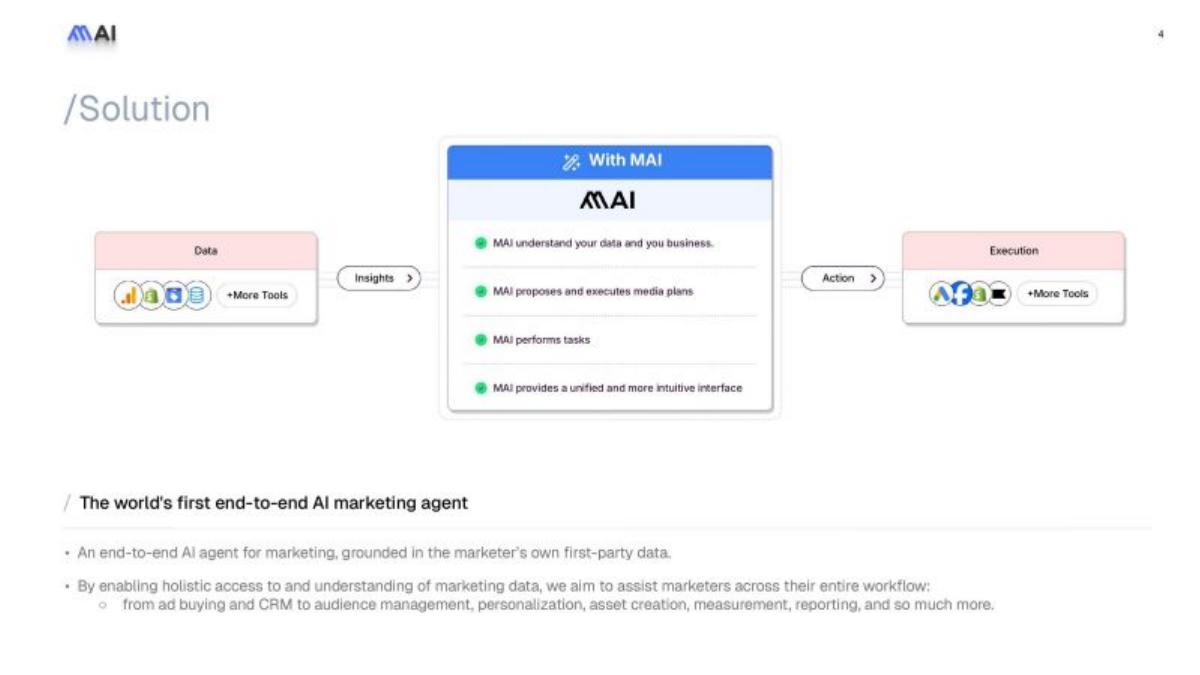
- The solution is positioned as the 'world's first end-to-end AI marketing agent' grounded in first-party data (Slide 4).
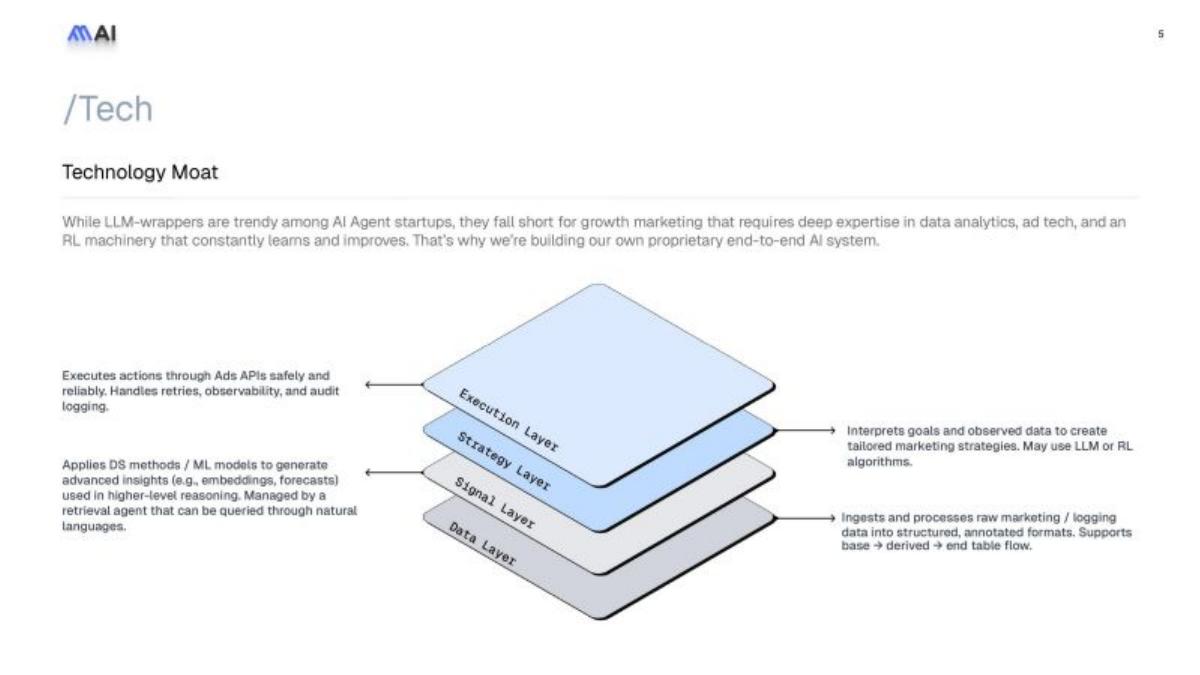
- The technical moat is defined by a four-layer stack: Execution, Strategy, Signal, and Data, explicitly distancing the product from 'trendy LLM-wrappers' (Slide 5).
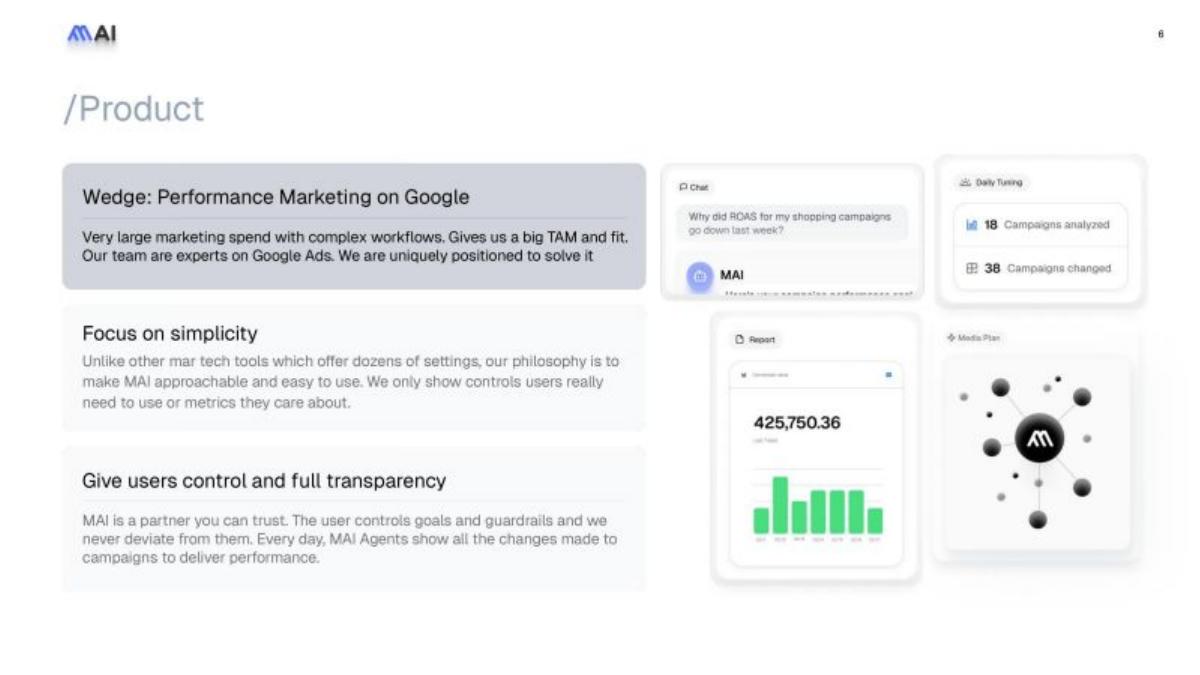
- The company uses Google Ads as a strategic 'wedge' due to its high complexity and large TAM (Slide 6).
- Customer testimonials provide specific, quantifiable metrics, such as a 118% increase in ROAS for Velotric (Slide 8).
- The deck completely omits a competition slide, a market size (TAM) slide, and a specific 'Ask' or use of funds slide.
- The presentation relies on a clean, dark-mode aesthetic that emphasizes technical sophistication over marketing fluff.
The Power of Pedigree: A $25M Seed Deck Analysis
MAI’s pitch deck is a fascinating example of how a high-conviction team can bypass many of the 'standard' rules of pitch decks. In a typical seed round, you expect to see a clear 'Ask' slide, a detailed market size analysis, and a competitive landscape. MAI includes none of these. Instead, they lean heavily into their technical architecture and the sheer density of talent on their team. This is a deck designed for top-tier VCs who are looking for the next foundational AI company in the marketing sector.
Slide 1: Title and Positioning
The cover slide is minimalist, featuring the company name 'MAI' and the tagline '//Marketing AI: AI agents to grow your business.' Notably, it lists the two founders, Yuchen and Jian, by their first names only, suggesting a level of familiarity or a 'builder-first' culture. The use of double slashes (//) throughout the deck evokes a coding environment, reinforcing the technical nature of the startup.
Slide 2: The 'Heavy Hitter' Team Slide
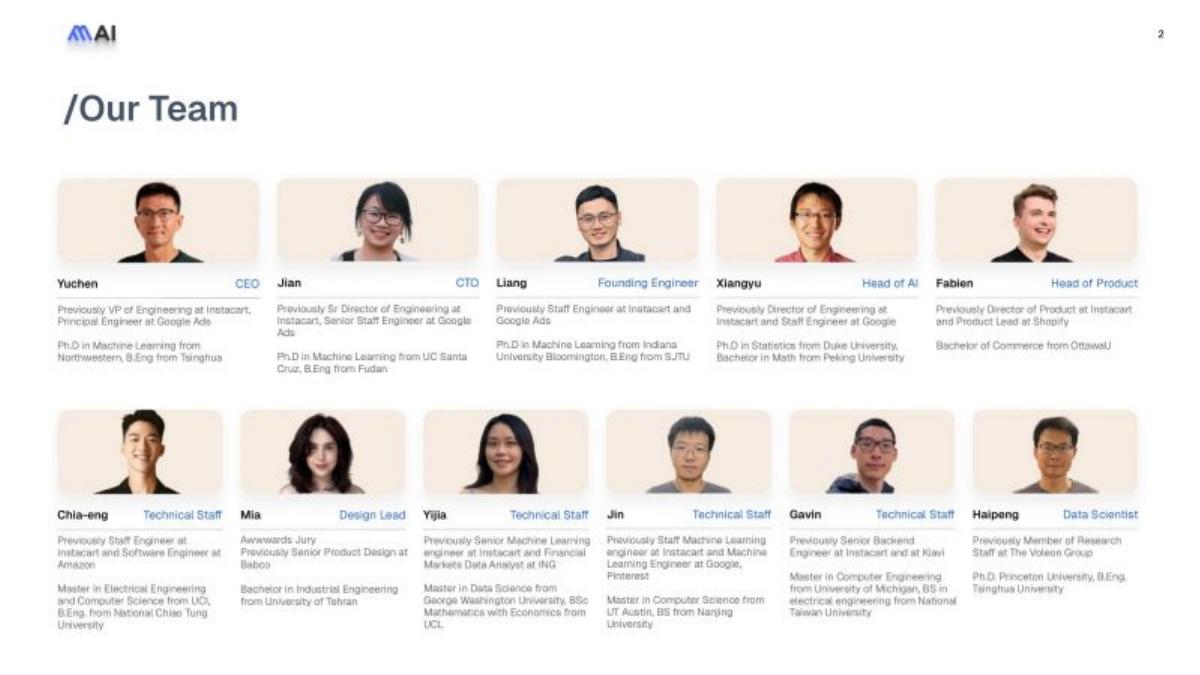
This is arguably the most important slide in the deck. It features 11 team members, which is large for a seed-stage startup, and their credentials are extraordinary. Yuchen (CEO) was previously VP of Engineering at Instacart and a Principal Engineer at Google Ads, with a PhD in Machine Learning. Jian (CTO) was a Senior Director of Engineering at Instacart and a Senior Staff Engineer at Google Ads. The rest of the team includes alumni from Google, Amazon, Pinterest, and Shopify, with multiple PhDs from Princeton, Duke, and Northwestern. For an investor, this slide alone justifies a $25M check; it represents a concentrated 'brain trust' of the people who actually built the modern ad-tech stacks at Google and Instacart.
Slide 3: Defining the Problem in MarTech
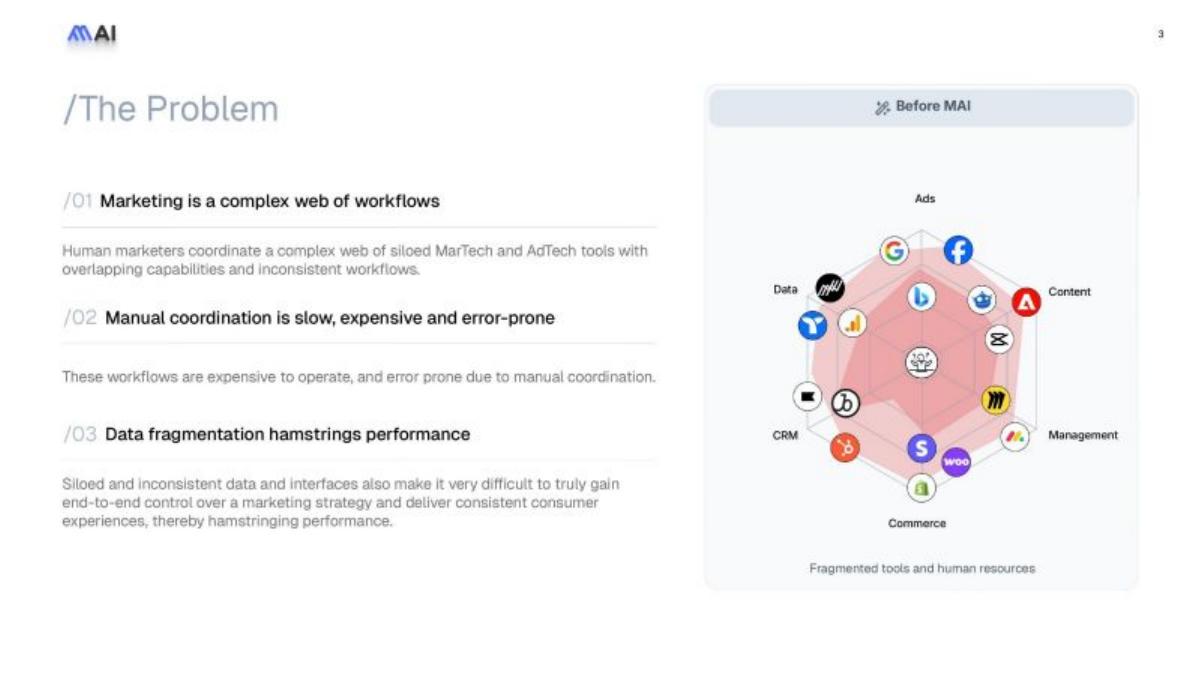
MAI breaks the problem down into three pillars: 01 Marketing is a complex web of workflows , 02 Manual coordination is slow , and 03 Data fragmentation hamstrings performance . The graphic on the right shows a 'Before MAI' state—a chaotic web of logos including Google, Facebook, HubSpot, Shopify, and Mailchimp. The core argument is that human marketers are currently the 'glue' holding these siloed tools together, which leads to errors and inefficiency.
Slide 4: The Solution - The End-to-End Agent
The solution slide introduces MAI as the 'world's first end-to-end AI marketing agent.' The diagram shows MAI sitting between 'Data' (Google Analytics, Shopify, etc.) and 'Execution' (Google Ads, Facebook Ads). The value proposition is that MAI understands the business, proposes media plans, performs tasks, and provides a unified interface. The key phrase here is 'grounded in the marketer's own first-party data,' which addresses the privacy and accuracy concerns prevalent in modern digital advertising.
Slide 5: The Technical Moat
Slide 5 is a direct response to the 'is this just a wrapper?' question. MAI explicitly states: 'While LLM-wrappers are trendy... they fall short for growth marketing.' They present a four-layer stack:
Execution Layer: Handles Ads APIs, retries, and audit logging. · Strategy Layer: Interprets goals to create tailored marketing strategies using LLM or RL algorithms. · Signal Layer: Applies ML models to generate advanced insights (embeddings, forecasts). · Data Layer: Ingests and processes raw marketing data into structured formats.
This diagram communicates that MAI is building a deep-tech infrastructure, not just a prompt-engineering interface.
Slide 6: The Strategic Wedge
MAI identifies 'Performance Marketing on Google' as their initial wedge. They justify this by citing the 'very large marketing spend' and 'complex workflows' associated with Google Ads. They lean back on their team's expertise, stating, 'Our team are experts on Google Ads. We are uniquely positioned to solve it.' This slide also emphasizes 'simplicity' and 'transparency,' promising that users retain full control over goals and guardrails.
Slides 7-9: Proof of Concept via Testimonials
The deck devotes three full slides to customer success stories: NutritionFaktory, Velotric, and DrWoof. These aren't just quotes; they are structured case studies.
NutritionFaktory (Slide 7): MAI increased 'profitable spend by 3x in 90 days.' · Velotric (Slide 8): MAI increased 'ROAS by 118% and sales by 32%.' · DrWoof (Slide 9): MAI delivered a '2x increase in profitable spend for the Australian market.'
By showing consistent results across different industries (supplements, e-bikes, apparel) and different geographies, MAI proves that their AI agent is versatile and effective.
Slide 10-11: Closing
The deck ends abruptly with a '//Thanks!' slide. There is no 'Roadmap' slide, no 'Market Size' slide, and no 'Financials' slide. The final slide is a promotional graphic for the pitch deck library itself.
What Works in This Deck
The Credibility Lead: By putting the team slide second, MAI immediately establishes that they are the 'A-team' for this specific problem. In a crowded AI market, pedigree is a massive differentiator.
Specific ROI Metrics: The case studies are not vague. They use hard numbers (3x, 118%, 2x) that speak directly to the primary pain point of any marketing executive: return on ad spend.
Technical Defensibility: Slide 5 does an excellent job of explaining the 'how' without getting bogged down in code. It uses architectural layers to show that the product is a system, not a single feature.
What Is Missing
The Market Opportunity (TAM): While it's implied that the marketing market is huge, the deck never quantifies it. Most decks include a slide showing a multi-billion dollar Total Addressable Market.
Competitive Landscape: There is no mention of existing players like Albert.ai, Smartly.io, or the native AI tools being built by Google and Meta themselves. Investors would certainly ask how MAI stays ahead of the platforms' own automation.
The Ask: The deck does not state how much they are raising or what the milestones for the next 18 months are. While the catalogue facts state they raised $25M, the deck itself is silent on the terms of the round.
What Founders Should Copy
The 'Wedge' Concept: Don't try to be everything to everyone on day one. MAI’s focus on Google Ads as a starting point makes their massive vision feel achievable.
The 'Anti-Wrapper' Narrative: If you are building in AI, you must explain why your product won't be rendered obsolete by the next GPT update. MAI’s four-layer diagram is a great template for showing architectural depth.
Case Study Structure: Use the 'Challenge / How we helped / Results' format. It is the most efficient way to communicate value to a potential investor or customer.
Frequently asked questions
- How did MAI raise $25M with only 11 slides and no financial projections?
- The $25M seed round, led by Kleiner Perkins, was likely driven by the exceptional team pedigree shown on Slide 2. When a founding team consists of former VP and Director-level engineers from Google Ads and Instacart with PhDs in Machine Learning, investors often prioritize 'betting on the jockey.' The deck proves they have the technical capability to build a complex, non-wrapper AI system, which justifies a higher valuation and larger check size without needing standard projection slides.
- What is the 'wedge' strategy mentioned in the deck?
- On Slide 6, MAI identifies 'Performance Marketing on Google' as its wedge. Instead of trying to automate all marketing at once, they focus on a single, high-spend, high-complexity channel where the founders have 'expert' status. This focus allows them to demonstrate immediate ROI, which they then use to validate their broader 'AI Agent' vision.
- Why does the deck emphasize that they are not an 'LLM-wrapper'?
- Slide 5 addresses a common VC concern in the current AI cycle: defensibility. By describing a proprietary four-layer system (Data, Signal, Strategy, Execution) and mentioning 'RL machinery' (Reinforcement Learning), MAI signals that their value isn't just a UI on top of OpenAI, but a deep-tech stack that learns from marketing data.
- Is the lack of a competition slide a mistake?
- In a seed deck for a team this experienced, omitting a competition slide is often a tactical choice to frame the company as being in a category of its own ('the world's first'). While investors will certainly do their own competitive analysis, MAI chooses to focus the narrative entirely on their unique technical approach and customer results.
- What metrics does MAI use to prove product-market fit?
- MAI uses three specific case studies (Slides 7, 8, and 9) rather than an aggregated metrics slide. They highlight '3x increase in profitable spend,' '118% increase in ROAS,' and '2x increase in profitable spend' for specific brands. This 'proof by example' is highly effective for B2B SaaS at the seed stage.