Mako AI's 9-slide seed deck is a masterclass in 'founder-market fit' for the enterprise AI sector. Raising $1.6M in 2024, the company targets the high-stakes world of private equity and professional services. The deck eschews typical growth charts and financial projections, focusing instead on the team's background at Bain and Glean to establish immediate credibility. By positioning the product as a 'secure AI Associate' that lives within a firm's own VPC, Mako addresses the primary objection in high-finance AI adoption: data privacy. While the deck lacks a formal 'Ask' slide or business mode…
Key takeaways
- The deck relies heavily on team pedigree, citing experience from Bain's Private Equity Group and Glean's Founding Search Team on Slide 2.
- Mako positions itself as an 'AI Associate,' a specific persona that resonates with the hierarchical structure of private equity firms (Slide 4).
- Security is the primary value proposition, with Slide 8 highlighting SOC 2 Type II certification and deployment within the client's own VPC.
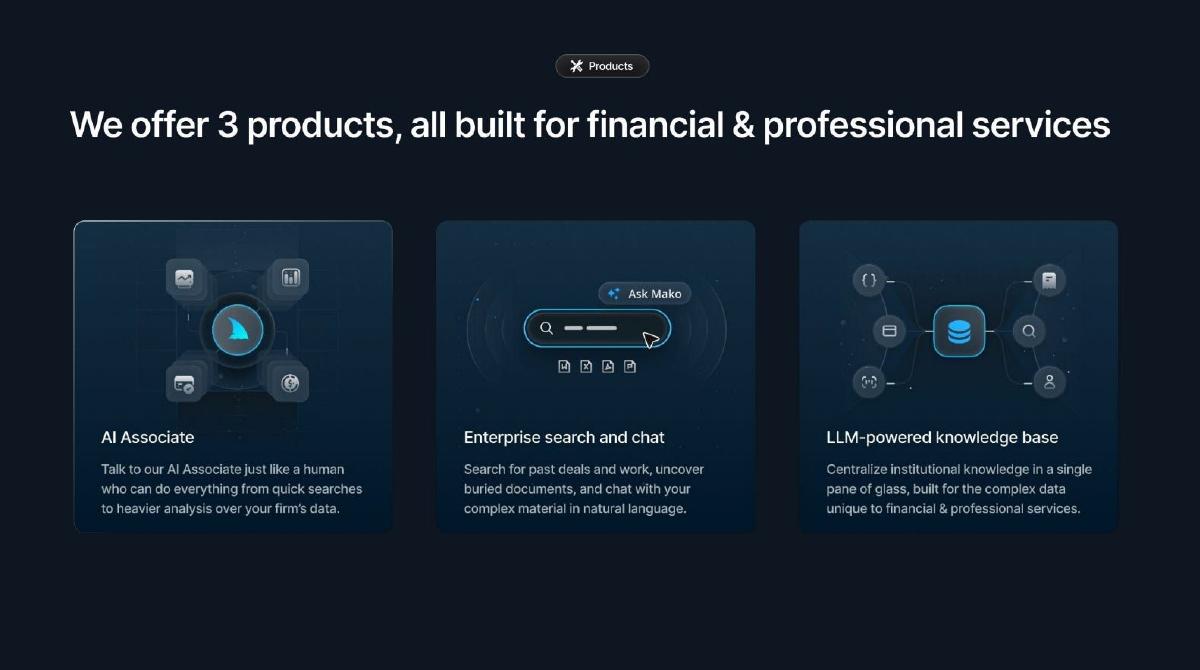
- The product is structured as a three-tier offering: AI Associate, Enterprise Search, and a Knowledge Base (Slide 5).
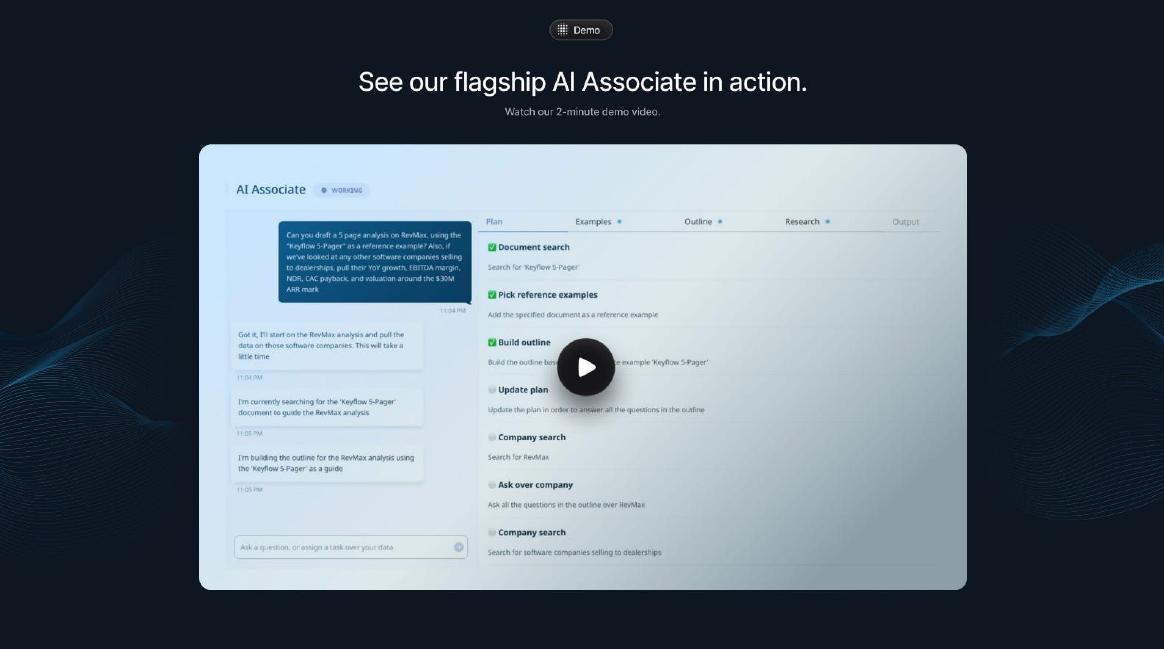
- A 2-minute demo video is embedded on Slide 6 to prove the technical feasibility of drafting complex 5-page analyses.
- The deck identifies 8 specific high-value use cases, including data room analysis and customer call synthesis (Slide 9).
- Mako claims users typically execute 2-5 tasks per day once onboarded, providing a rare glimpse into engagement metrics (Slide 9).
- The deck completely omits a financial 'Ask' slide, market sizing (TAM), and a roadmap for future development.
The Pedigree Play: Mako AI's $1.6M Seed Deck
Mako AI entered the 2024 fundraising market with a lean, 9-slide deck that secured $1.6M in seed funding. In an era where generative AI startups are ubiquitous, Mako chose to differentiate not through broad horizontal utility, but through deep vertical specialization in private equity and asset management. The deck is a study in building trust through institutional credibility and technical security.
Slide 1: The Hook
The title slide is minimalist, featuring the Mako logo and the tagline: "The most secure AI Associate." By leading with security rather than intelligence or speed, Mako immediately addresses the number one barrier to AI adoption in the financial services sector. The branding is professional and understated, fitting the aesthetic of the private equity firms they aim to serve.
Slide 2: The Team (The 'Why Us')
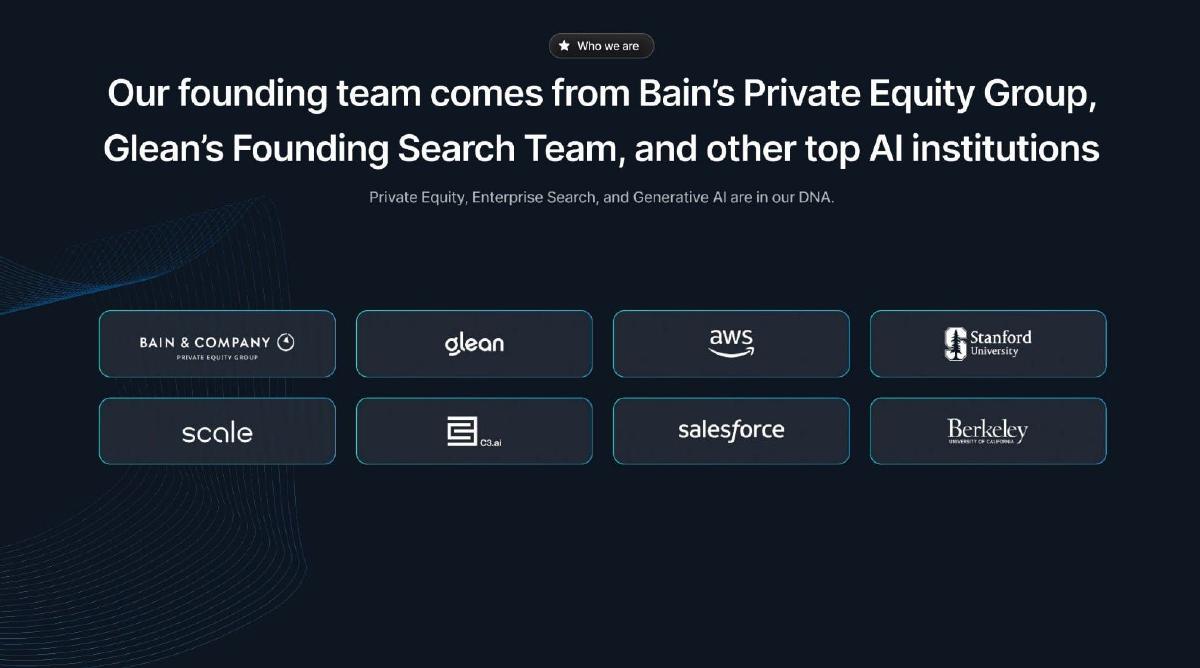
Mako places its team slide second, a strategic move for a seed-stage company where the founders are the primary asset. The slide states: "Our founding team comes from Bain’s Private Equity Group, Glean’s Founding Search Team, and other top AI institutions." It features logos from Bain & Company, Glean, AWS, Stanford, Scale AI, C3.ai, Salesforce, and Berkeley. This slide establishes 'Founder-Market Fit' by showing they understand the domain (Bain PE) and have the technical chops to build the solution (Glean, Scale, C3.ai).
Slide 3: The Problem
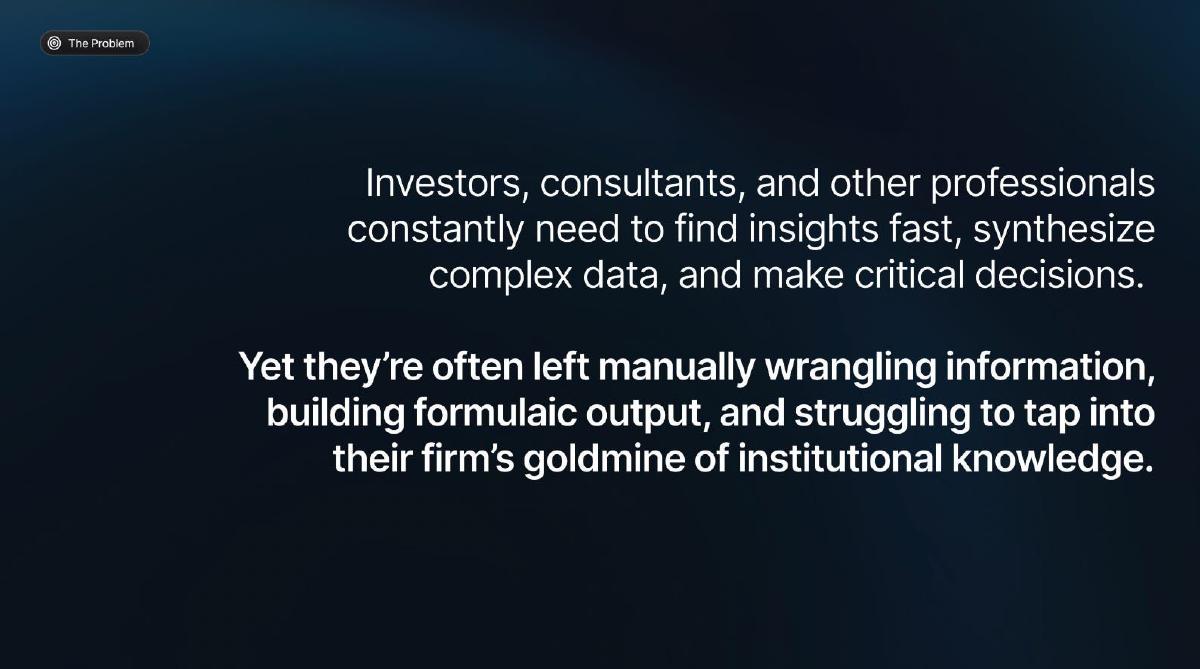
The problem statement is concise. It notes that professionals "constantly need to find insights fast, synthesize complex data, and make critical decisions," but are "left manually wrangling information" and "struggling to tap into their firm’s goldmine of institutional knowledge." This identifies the 'data silo' problem common in large investment firms where years of deal history are buried in PDFs and spreadsheets.
Slide 4: The Solution
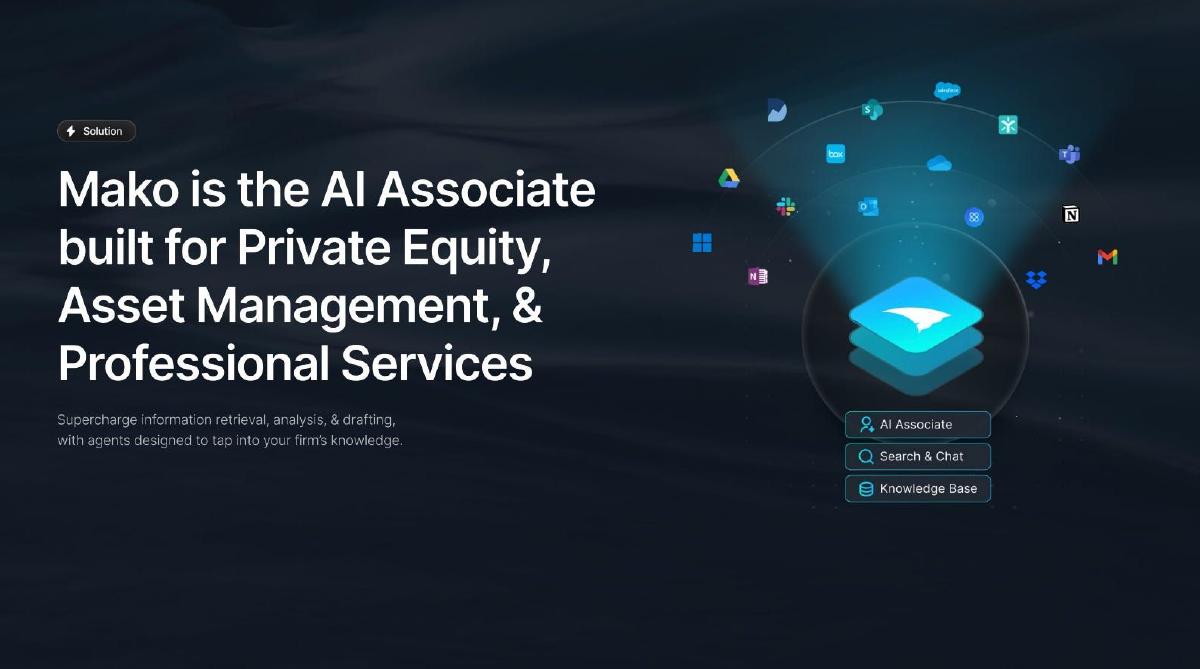
Slide 4 introduces Mako as the "AI Associate built for Private Equity, Asset Management, & Professional Services." The graphic shows the Mako platform sitting at the center of a firm's tech stack, connecting to logos for Microsoft, Notion, Slack, Salesforce, Box, and Dropbox. It defines the core value as supercharging "information retrieval, analysis, & drafting."
Slide 5: Product Architecture
AI Associate: A conversational interface for searches and heavy analysis. · Enterprise Search and Chat: A tool to uncover buried documents and past deal work. · LLM-powered Knowledge Base: A 'single pane of glass' for institutional knowledge.
This structure suggests a comprehensive platform rather than a single-feature tool.
Slide 6: The Demo
Slide 6 is a placeholder for a "2-minute demo video." The static image shows the AI Associate drafting a 5-page analysis on a company called 'RevMax,' using a 'Keyflow 5-Pager' as a reference. The UI displays a step-by-step plan including 'Document search,' 'Pick reference examples,' and 'Build outline.' This transparency into the AI's reasoning process is critical for building user trust in high-stakes financial environments.
Slide 7: Differentiation
True multi-agent system: Mirroring the actions of a human associate. · Pre-built app integrations: No manual document uploading required. · Built to handle internal data: Using a specialized knowledge graph. · Precise data orchestration: Honing in on critical document subsets. · Trustworthy, explainable: Including inline citations to sources. · Enterprise-grade security: SOC 2 Type II certified and VPC deployment.
This slide is the most information-dense in the deck, aimed at technical due diligence.
Slide 8: Security & Compliance
Mako doubles down on its security messaging here, claiming to offer the "most secure AI platform for firms." It reiterates the "Your Cloud, Your Data" promise, ensuring that data is never used to train models accessible to others. For private equity firms handling sensitive M&A data, this is a non-negotiable requirement.
Slide 9: Use Cases & Results
The final slide lists eight specific use cases, such as Data Room Analysis, Portfolio Reporting, and Customer Call Synthesis. It includes a key engagement metric: "Mako users typically execute 2-5 tasks per day." While it doesn't name specific clients, the phrase "Top investment firms are already using Mako" signals existing market validation.
What Mako AI Does Well
The deck is exceptionally focused. It doesn't try to be everything to everyone; it speaks the language of a Private Equity Associate. The emphasis on security (Slides 1, 7, and 8) is a masterclass in overcoming sales objections before they are even raised. Furthermore, the team slide (Slide 2) is incredibly strong, providing a 'halo effect' that likely carried significant weight with seed investors.
What is Missing from the Deck
The Ask: There is no slide detailing how much they are raising or what the capital will be used for. · Business Model: The deck does not explain how Mako charges (e.g., per seat, per fund, or consumption-based). · Market Size: There is no TAM/SAM/SOM analysis to show the scale of the opportunity. · Roadmap: The deck focuses entirely on the current product without showing the long-term vision or expansion plans. · Competition: There is no competitive matrix or mention of how they stack up against incumbents like Bloomberg or newer AI rivals.
Lessons for Founders
Founders can learn two major lessons from Mako AI. First, verticalization wins in the AI era. By building specifically for PE, Mako can create workflows (like data room analysis) that a general tool like ChatGPT cannot easily replicate. Second, pedigree is a shortcut to trust. If you have a team with elite institutional experience, lead with it. Mako didn't need 20 slides because their background and their security posture answered the most difficult questions upfront.
Frequently asked questions
- How much did Mako AI raise with this deck?
- According to publisher-reported facts from Business Insider, Mako AI raised $1.6M in a Seed round in 2024. The deck itself does not state the amount raised or the terms of the round.
- What is Mako AI's primary target market?
- The deck specifically targets Private Equity, Asset Management, and Professional Services firms. Slide 4 and Slide 9 emphasize workflows unique to these sectors, such as deal sourcing and data room analysis.
- How does Mako AI handle data security?
- Security is a central theme of the deck. Slide 8 states that Mako is SOC 2 Type II certified and deploys directly into the client's cloud environment (VPC) to ensure data never leaves the firm's control.
- Does the deck show any traction or revenue?
- The deck does not list revenue or specific customer names. However, Slide 9 claims that 'top investment firms' are using the platform and that users typically execute 2-5 tasks per day.
- What makes Mako different from a standard LLM like ChatGPT?
- Slide 7 highlights that Mako is a multi-agent system designed for 'messy internal data.' It uses a specialized knowledge graph and provides inline citations to underlying sources to ensure explainability and trust.