This 2014 investor presentation from Mandalay Digital (NASDAQ: MNDL), the entity that would become Digital Turbine, outlines a comprehensive strategy for mobile content management and monetization. The deck focuses on two primary products: Ignite, an app management service for carriers and OEMs, and DT Pay, a mobile billing solution. By positioning itself as the 'Visa' for mobile content transactions, the company sought to capitalize on the shift toward Cost-Per-Install (CPI) advertising, citing Facebook's success in the space as a market validator. The deck provides granular revenue projecti…
Key takeaways
- The company identifies as an 'End to End Mobile Content Solution for Carriers and OEMs' on slide 1.
- Mandalay Digital uses Facebook's 2012 launch of app install ads and subsequent $1 billion in annual revenue as a primary market validator on slide 10.
- The Ignite product allows operators to monetize subscribers through pre-installed and post-installed application bundles, as detailed on slide 13.
- DT Pay is positioned as a billing solution that allows content providers like Electronic Arts to bill directly to a customer's mobile bill, according to slide 16.
- The company claims a $10 million revenue run-rate for DT Pay following its launch in Australia on slide 16.
- Slide 19 lists active and upcoming carrier partnerships, including Cricket (5M subscribers) and MSAI India (50M smartphones/year).
- The business model for Ignite includes a set-up fee of $100K to $500K and a sliding revenue scale averaging $0.25 per device, as shown on slide 22.
- Revenue projections on slide 22 suggest that 100 million devices could generate $25 million in base revenue and $300 million in CPI advertising revenue share.
Introduction and Market Positioning
Slide 1: Title Slide
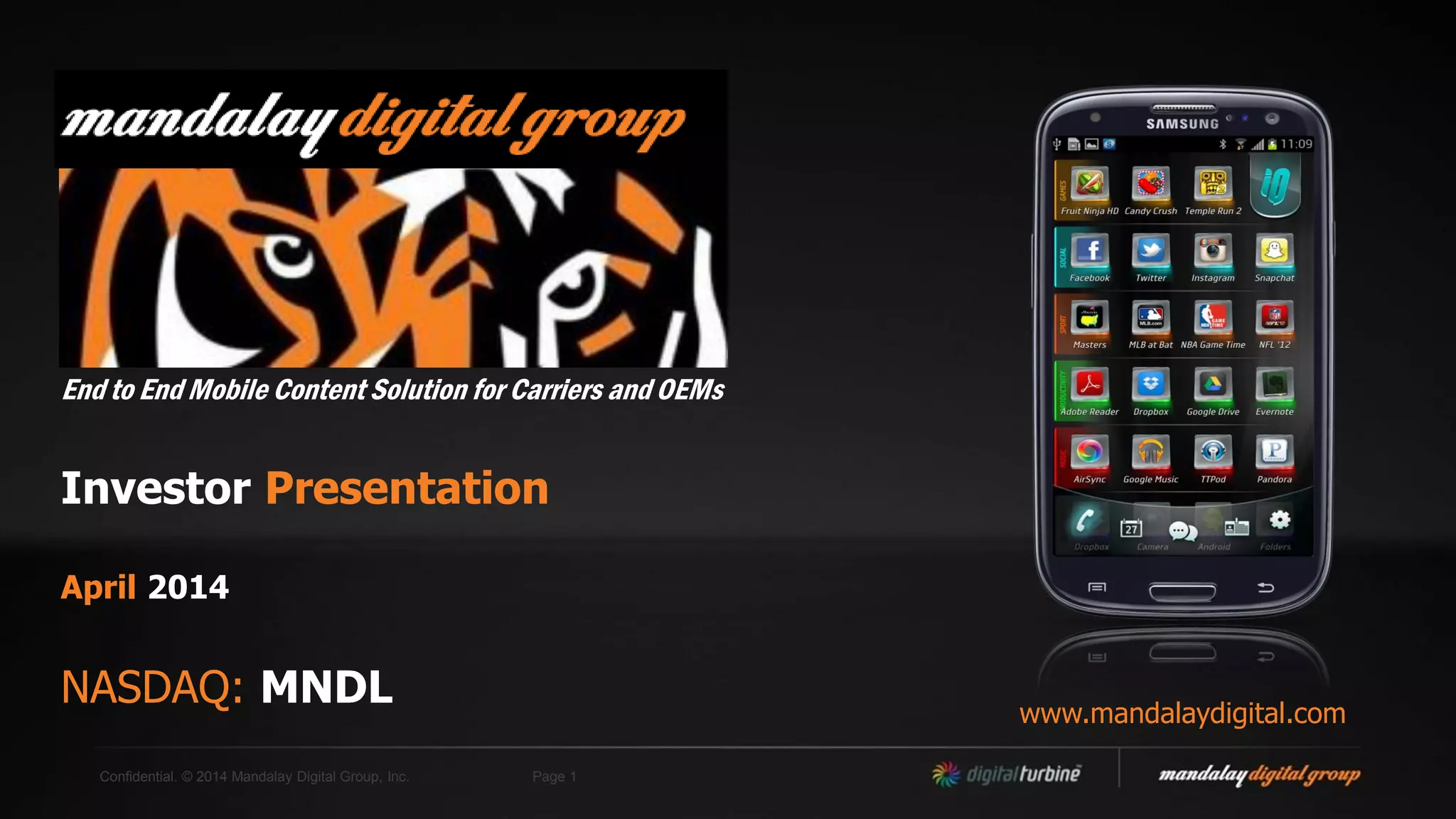
The presentation opens with the branding for Mandalay Digital Group, identifying the company as an "End to End Mobile Content Solution for Carriers and OEMs." The slide prominently features the NASDAQ ticker symbol MNDL and the date April 2014. A visual of a Samsung smartphone displaying various popular apps (Facebook, Twitter, Instagram, Dropbox) is used to contextualize the company's focus on the mobile ecosystem. The website URL and the "Digital Turbine" sub-brand logo are also present at the bottom.
Slide 4: The Company
This is a simple transition slide titled "The Company." It serves as a structural marker for the presentation but contains no specific data or narrative content.
Slide 7: The Opportunity
Similar to slide 4, this is a transition slide titled "The Opportunity." It signals the shift from company overview to market analysis and the specific problem-solution set the company addresses.
Market Validation and Product Ecosystem
Slide 10: CPI Advertising Driving Meaningful Mobile Growth
Mandalay Digital uses this slide to validate the Cost-Per-Install (CPI) advertising model. It cites Facebook as the primary example of success in this nascent field. The slide lists several key milestones: Facebook stock hitting a low of $17.73 in September 2012, the launch of app install ads in October 2012, and the subsequent achievement of 245 million app installs by the end of 2013. It also notes Facebook's 556 million mobile daily active users and the fact that app install ads were driving more than $1 billion in annual mobile ad revenue. This slide establishes that the market for Mandalay's services is proven and lucrative.
Slide 13: Ignite Product Overview
This slide introduces "Ignite," an application management solution. The subtitle states it provides "Control for the carrier and OEM for monetization of their subscriber." The bullet points detail that the service enables mobile operators to manage apps installed both pre- and post-purchase. It allows for the creation of new advertising revenue streams, personalized service packages, and application bundles. The slide also mentions that Ignite provides tools for full analysis and reporting, positioning it as a comprehensive B2B software suite.
Slide 16: DT Pay Product Overview
The second major product, "DT Pay," is described as the tool that "Closes the loop on content to billing." The slide positions the product as the "Visa" for processing mobile content transactions. It enables content providers, specifically mentioning Electronic Arts, to bill directly to a customer's mobile bill. The slide highlights a launch in Australia with a $10 million revenue run-rate and mentions an upcoming launch in Italy across four carriers. This slide emphasizes the company's role in the financial plumbing of the mobile content market.
Distribution and Financial Modeling
Slide 19: Current Access to Over 1 Billion Subscribers
This slide provides a table of carrier partnerships to demonstrate scale. It lists Cricket (US) with ~5M subscribers using Ignite, AIS (Thailand) with ~36M subscribers launching in Q1 '14, and MSAI (India) with ~50M smartphones/year launching in June '14. It also mentions "ALL US CARRIERS" for an eBooks product. The text at the bottom notes that while the current focus is on Android and smartphones, the suite is agnostic and has growth opportunities in Windows Mobile, HTML5, and tablets.
Slide 22: Business Model Example: Ignite
This slide provides a detailed breakdown of how the company generates revenue. It notes a set-up fee for operators ranging from $100K to $500K. The recurring revenue is based on a sliding scale per device, averaging $0.25. A table shows that 100 million devices would result in $25 million in revenue. A second table details the revenue share from CPI advertising, assuming a $1.50 per slot rate and 4 slots per device. In this scenario, 100 million devices could generate $300 million in revenue, illustrating the massive upside of the advertising share compared to the flat per-device fee.
Slide 25: Compelling Valuations
The final slide in the selection provides a list of comparable companies and acquisitions to justify Mandalay Digital's potential valuation. Under "Mobile Application Management," it lists VMWare's acquisition of Airwatch for $1.2B and IBM's acquisition of Fiberlink for $130M. For "Search and Discovery," it mentions Everything.me raising $35M at a $200M valuation. For "Shop and Buy," it cites Spotify's $3B valuation and Glu Mobile's $180M market cap. Finally, for "Billing," it lists Gemalto's acquisition of Ericsson IPX for $60M and Amdocs' acquisition of MX Telecom for $104M. This slide is designed to show investors that the company operates in high-value segments with active M&A interest.
What Works and What is Missing
What Works
The deck is highly effective at establishing market validation. By leaning heavily on Facebook's success with app install ads, the founders avoid having to prove that the market exists and can instead focus on how they capture a share of it. The business model slide (Slide 22) is exceptionally clear, showing the transition from low-margin setup fees to high-margin advertising revenue sharing. The use of a table to show scaling from 1 million to 500 million devices provides a clear visual of the company's operating leverage. Furthermore, the partnership slide (Slide 19) provides concrete evidence of international traction, which is vital for a company positioning itself as a global infrastructure provider.
What is Missing
The most notable omission in this selection of slides is a team slide. While the company was already public (NASDAQ: MNDL) at the time of this presentation, investors still look for the leadership team's pedigree in mobile and telecommunications. There is also no explicit "Ask" slide in this set, though as a public company, this presentation may have been intended for general investor relations rather than a specific private placement. Additionally, while the deck mentions "full analysis and reporting" tools, it does not show any screenshots of the actual dashboard or the user interface for carriers, which would have helped ground the software claims in reality. Finally, there is no discussion of the competitive landscape beyond the valuation comps; a direct comparison against other mobile middleware providers would have strengthened the narrative.
Founder Takeaways
Use Market Leaders to Validate Your Model: If you are entering a new or "nascent" space, do not try to prove the market yourself. Use the success of a giant like Facebook or Google to show that the underlying consumer behavior is already profitable. Mandalay Digital does this perfectly on slide 10.
Show the Path to Scale: Slide 22 is a masterclass in showing how a business scales. By breaking down revenue into "per device" and "per advertising slot," the founders make a complex global business feel like a simple math problem. Investors love businesses that can be modeled with clear inputs (devices) and outputs (revenue).
Segment Your Product Value: Instead of pitching one monolithic platform, the deck breaks the offering into Ignite (management) and DT Pay (billing). This allows them to use different sets of valuation comps on slide 25, effectively arguing that they are the sum of several high-value parts rather than just one niche player.
Leverage Geographic Traction: For B2B companies, showing that you can win in diverse markets (US, Thailand, India, Italy) proves that your solution is not a local fluke. The partnership table on slide 19 is a powerful way to demonstrate that the product has global appeal and can navigate different regulatory and carrier environments.
Frequently asked questions
- What is the core value proposition of Mandalay Digital's Ignite product?
- As described on slide 13, Ignite is an application management service that gives mobile operators and OEMs control over the apps installed on their devices. It enables them to manage both pre-installed and post-installed apps, creating a new advertising revenue stream through personalized service packages and application bundles targeted by segment or device type.
- How does Mandalay Digital justify the market opportunity for app installs?
- The company points to Facebook as the market leader on slide 10. It notes that after launching app install ads in late 2012, Facebook achieved 245 million installs by the end of 2013 and generated over $1 billion in annual mobile ad revenue from that specific segment, proving the scalability of the CPI model.
- What are the specific revenue streams for the Ignite platform?
- According to slide 22, the revenue is two-fold. First, carriers pay a set-up fee between $100,000 and $500,000, plus a per-device fee averaging $0.25. Second, the company shares revenue with the operator from CPI advertising, estimated at $1.50 per slot with an assumption of four slots per device.
- Which geographic markets and carriers were part of their 2014 footprint?
- Slide 19 identifies Cricket in the US, AIS in Thailand, and MSAI in India as key partners. Additionally, slide 16 mentions that DT Pay was launched in Australia and was in the process of launching across four carriers in Italy, indicating a global expansion strategy targeting high-growth mobile markets.
- What exit or valuation benchmarks does the company provide?
- Slide 25 lists several 'Compelling Valuations' across their product categories. For mobile management, they cite VMWare/Airwatch ($1.2B) and IBM/Fiberlink ($130M). For billing, they point to Gemalto/Ericsson IPX ($60M) and Amdocs/MX Telecom ($104M). They also reference Spotify's $3B valuation as a benchmark for the 'Shop and Buy' category.