Bespoken Spirits presents a compelling case for modernizing the traditional spirits industry by replacing decades-long barrel aging with a proprietary process called ACTivation technology. The deck highlights a massive $500 billion global market and identifies significant inefficiencies in the 'Ancient (Barrel) Model,' including up to 20% 'angels share' loss and billions of dollars in wasted resources. By offering three distinct business models—a house brand, Maturation as a Service (MaaS), and Customization as a Service (CaaS)—the company positions itself as both a product and a platform. Wh…
Key takeaways
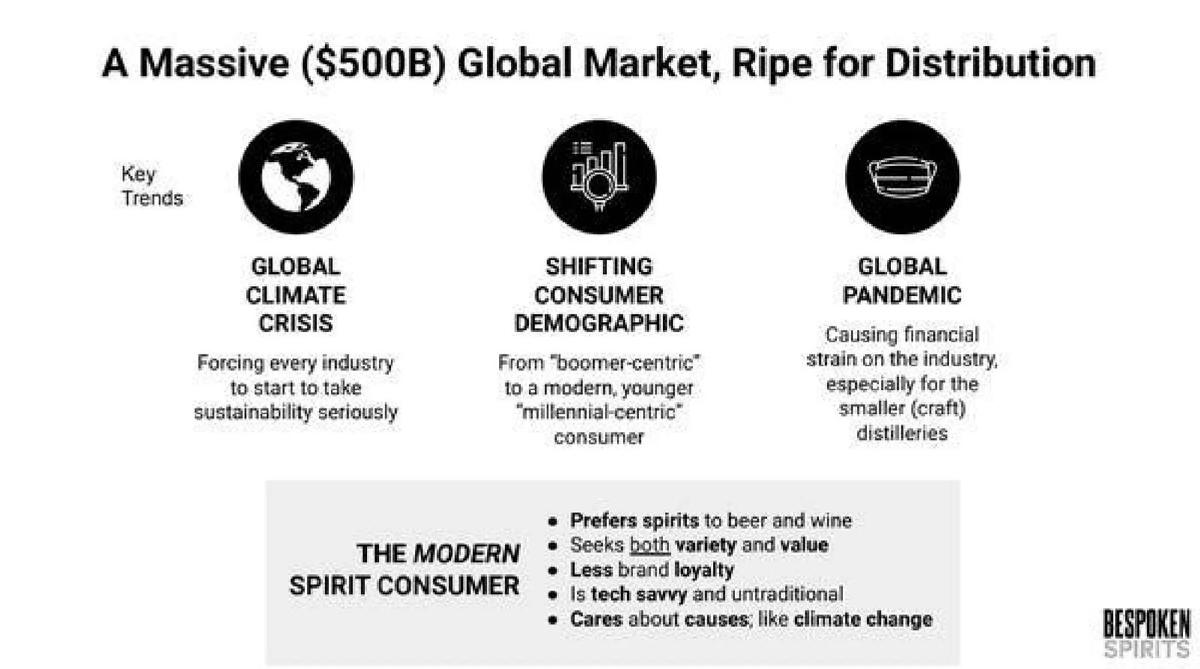
- The global spirits market is valued at $500 billion and is currently facing pressure from climate change and shifting consumer demographics (Slide 2).
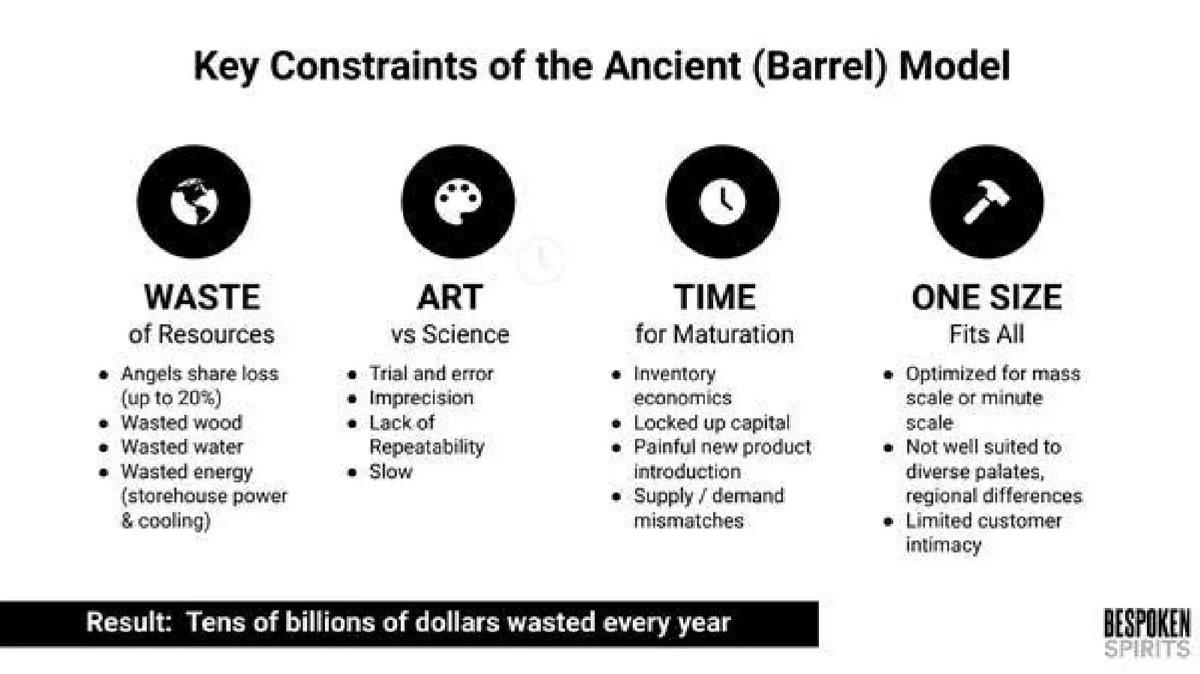
- Traditional barrel aging results in an 'angels share' loss of up to 20% and tens of billions of dollars in annual waste (Slide 4).
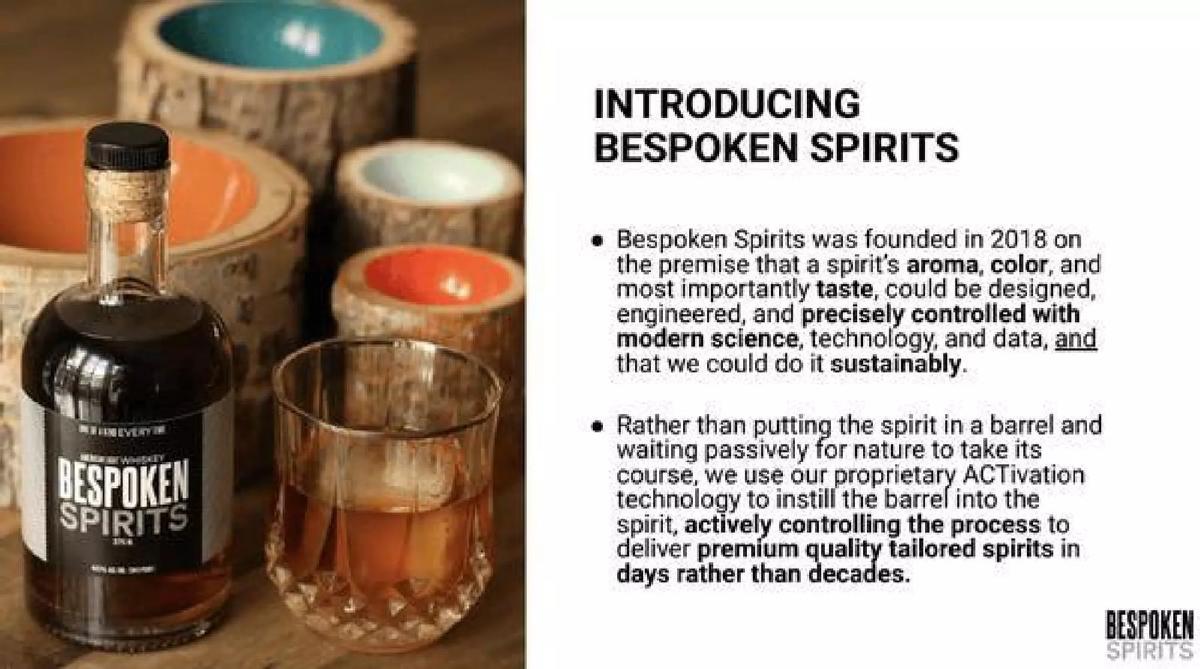
- Proprietary ACTivation technology allows for the design and engineering of aroma, color, and taste in days rather than decades (Slide 3).
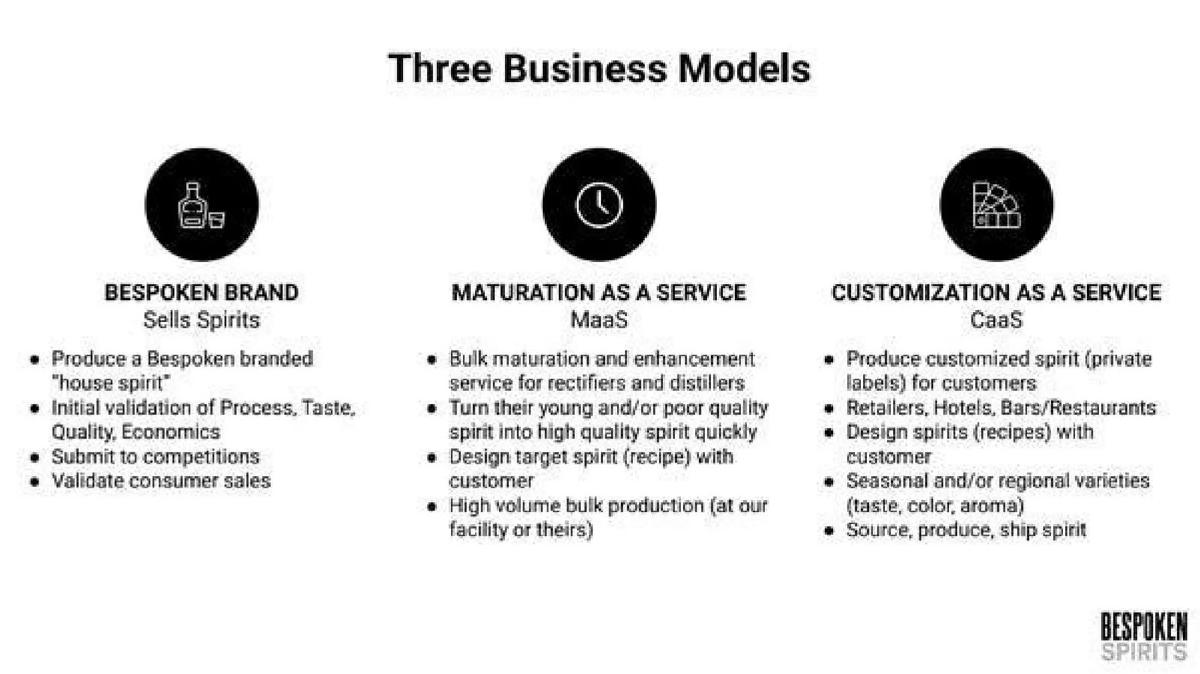
- The company operates three business models: Bespoken Brand, Maturation as a Service (MaaS), and Customization as a Service (CaaS) (Slide 6).
- Bespoken Spirits has earned 22 medals in prestigious competitions across whiskey, bourbon, rye, and rum categories (Slide 9).
- The technology can convert expired or excess beer from breweries into premium whiskey (Slide 7).
- The deck includes a dedicated tasting guide for six specific samples, indicating it was used for interactive investor sessions (Slides 11-12).
- There is no mention of the founding team, their backgrounds, or specific financial milestones in the 13-slide deck.
The Bespoken Spirits Pitch Deck: A Tech-First Approach to Distilling
Bespoken Spirits entered the market in 2018 with a bold claim: that the centuries-old tradition of barrel-aging spirits is inefficient, wasteful, and ripe for technological disruption. Headquartered in Menlo Park, the company raised $2.6 million in Seed funding to scale its 'ACTivation' technology. This 13-slide deck, dated October 2020, serves as a bridge between a traditional business pitch and a sensory product demonstration.
Introduction and Market Dynamics
Slide 1: Title Slide The deck opens with a minimalist black-and-white aesthetic, featuring the Bespoken Spirits logo and the date October 2020. The design language is clean and modern, setting the tone for a technology-driven company rather than a rustic, traditional distillery.
Slide 2: A Massive ($500B) Global Market The company establishes the scale of the opportunity immediately. It cites three key trends driving the need for change: the global climate crisis, a shifting consumer demographic (moving from 'boomer-centric' to 'millennial-centric'), and the global pandemic. The slide notes that the modern spirit consumer prefers spirits over beer and wine, seeks variety and value, and cares about sustainability. This slide successfully connects macro-economic shifts to the specific value proposition of the company.
The Solution and Technology
Slide 3: Introducing Bespoken Spirits This slide defines the company's mission: to design and engineer spirits using 'modern science, technology, and data.' It introduces the proprietary ACTivation technology, which aims to deliver premium spirits in 'days rather than decades.' The visual contrast between a traditional glass of whiskey and the high-tech description creates a clear 'before and after' narrative.
Slide 4: Key Constraints of the Ancient (Barrel) Model This is the 'Problem' slide, and it is highly effective. It breaks down the inefficiencies of traditional aging into four categories: Waste (up to 20% angels share loss), Art vs. Science (imprecision and lack of repeatability), Time (locked-up capital), and One Size Fits All (limited customer intimacy). The footer contains a powerful summary: 'Result: Tens of billions of dollars wasted every year.'
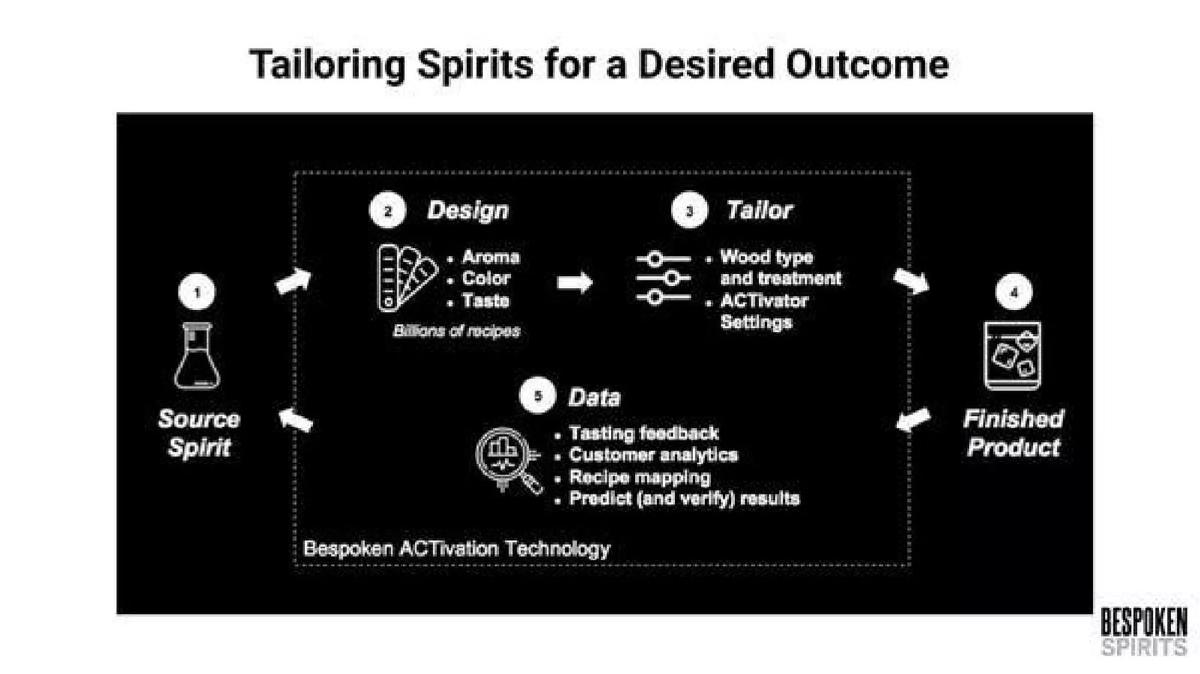
Slide 5: Tailoring Spirits for a Desired Outcome This slide provides a high-level process map for the ACTivation technology. It shows a five-step loop: 1. Source Spirit, 2. Design (aroma, color, taste), 3. Tailor (wood type and treatment), 4. Finished Product, and 5. Data (tasting feedback and analytics). By showing 'billions of recipes' as a possibility, the company emphasizes the scalability and flexibility of its software-like approach to liquid production.
Business Models and Customer Proof
Slide 6: Three Business Models Bespoken Spirits outlines a diversified revenue strategy. The 'Bespoken Brand' serves as a proof of concept and retail product. 'Maturation as a Service' (MaaS) targets existing distillers to fix or speed up their products. 'Customization as a Service' (CaaS) targets B2B clients like hotels and retailers for private labels. This multi-pronged approach suggests a lower-risk profile, as they are not solely dependent on building a consumer brand from scratch.
Slide 7: MaaS Customer Examples This slide provides concrete use cases for the maturation service. It mentions distillers looking for cost savings, rectifiers enhancing matured products, and—most interestingly—breweries converting 'expired/excess beer into premium whiskey.' This last point highlights a unique circular economy benefit of their technology.
Slide 8: CaaS Customer Examples The deck lists specific, though unnamed, customers: a grocery chain in the Western US and PA, a grocery chain in CA and NV, and general restaurants and bars. The mention of producing 'Japanese style' light whiskey for a grocery chain demonstrates the technology's ability to mimic specific, high-demand global styles.
Slide 9: Award Winning Results To combat the perception that 'tech-aged' whiskey is inferior, the company presents its trophy cabinet. 22 medals are cited, including 11 for whiskey and 6 for bourbon. Listing specific competitions like the San Francisco World Spirits Competition provides the necessary third-party validation to back up their technological claims.
Value Propositions and Interactive Tasting
Slide 10: Customer Value Propositions This slide summarizes the benefits for B2B partners: enhancing products, accelerating time to revenue, developing new products quickly, and reducing waste. It serves as a summary of the 'Why Now' for potential partners.
Slide 11 & 12: Tasting Contents and Notes These slides are unique to this deck. They provide a guide for six samples, ranging from the 'Source Spirit' to 'French Toast' and 'Noble Prize' batches. Slide 12 includes a table for the investor to record their own tasting notes. This indicates the deck was likely used in a setting where investors were actively sampling the product, turning the pitch into a physical experience.
Slide 13: Thank You The deck concludes with the website URL and a repeat of the brand's visual motif.
What Works in the Bespoken Spirits Deck
Quantified Problem: The deck does an excellent job of quantifying the 'pain' of the status quo. Citing the 20% 'angels share' loss and the 'tens of billions' in waste gives the problem a financial weight that demands a solution. Founders often describe problems qualitatively; Bespoken describes it economically.
Diversified Revenue Streams: By presenting three distinct business models (Brand, MaaS, CaaS), the company shows it has multiple paths to success. If their own brand fails to gain traction in a crowded retail market, their technology can still be sold as a service to the incumbents. This is a classic 'picks and shovels' strategy that appeals to Seed investors.
Social Proof as a Quality Shield: The biggest hurdle for any synthetic or rapid-aging spirits company is the 'stigma' of not being traditional. Slide 9 addresses this head-on with 22 medals. It effectively says, 'Don't take our word for it; the experts already gave us gold medals.'
What is Missing from the Bespoken Spirits Deck
The Team Slide: This is the most glaring omission. In a Seed round, the team is often the most important factor. There is no mention of the founders, their scientific backgrounds, or their experience in the spirits industry. Without this, an investor cannot assess the 'founder-market fit' or the technical credibility of the proprietary technology.
Financials and Projections: The deck contains no information regarding current revenue, burn rate, or future projections. While it mentions 'validating consumer sales' on Slide 6, it provides no data on how many bottles have been sold or what the margins look like for the MaaS and CaaS models.
The Ask: There is no slide detailing how much capital the company is raising or how they intend to use the funds. A standard pitch deck should clearly state the funding goal and the milestones that capital will unlock (e.g., 'Raising $X to build a new production facility and hire 5 sales reps').
Competition: The deck operates as if Bespoken Spirits is the only player in the rapid-aging space. It does not acknowledge other startups or traditional methods that might be evolving. A competitive landscape slide would help define their specific technological moat.
What a Founder Should Copy
The 'Process Map' Visual: Slide 5 is a great example of how to explain a complex technical process simply. Using icons and a circular flow helps the investor visualize how the 'black box' of technology actually interacts with the physical product.
Use Case Specificity: Instead of just saying 'we sell to businesses,' Slides 7 and 8 give specific examples like 'converting expired beer' or 'Japanese style whiskey for grocery chains.' This specificity makes the business model feel grounded and achievable rather than theoretical.
Interactive Elements: If you have a physical product, including a 'Tasting Notes' or 'Demo Guide' slide (like Slide 12) is a brilliant way to engage the audience. It transforms the pitch from a passive presentation into an active evaluation of the product's quality.
Final Verdict: This deck is an excellent product-and-market primer, likely designed to accompany a live demonstration. However, as a standalone fundraising tool, it lacks the critical 'business' components—team, financials, and the ask—required to close a deal without significant follow-up documentation.
Frequently asked questions
- What is Bespoken Spirits' core technology?
- Bespoken Spirits utilizes proprietary ACTivation technology. As described on Slide 3, this technology allows the company to 'instill the barrel into the spirit' by actively controlling the extraction of key elements that enhance aroma, color, and taste. This process enables the production of premium quality spirits in a matter of days, bypassing the traditional requirement for years or decades of barrel maturation.
- How does the company generate revenue?
- According to Slide 6, the company employs three business models. First, it sells its own 'Bespoken Brand' house spirits. Second, it offers 'Maturation as a Service' (MaaS) for distillers and rectifiers to enhance young or poor-quality spirits. Third, it provides 'Customization as a Service' (CaaS), producing private-label spirits for retailers, hotels, and restaurants tailored to specific regional or demographic preferences.
- What environmental problems does this solve?
- Slide 4 identifies several environmental and resource constraints of the 'Ancient Model.' These include the 'angels share' loss (evaporation) of up to 20%, wasted wood from barrels, wasted water, and significant energy consumption for storehouse power and cooling. By maturing spirits in days, Bespoken Spirits claims to reduce these financial and environmental wastes significantly.
- Is the quality of the spirit comparable to traditional methods?
- The deck addresses quality concerns primarily through social proof on Slide 9. It lists 22 medals won in prestigious competitions, including the San Francisco World Spirits Competition and the New York World Wine & Spirits Competition. These awards span multiple categories: whiskey (11), bourbon (6), rye (2), and rum (3), suggesting the technology produces competitive results.
- Who are the target customers for their services?
- Slides 7 and 8 detail target customers for their service models. MaaS targets distillers, large rectifiers, and breweries (specifically to convert excess beer). CaaS targets grocery chains in the Western US, California, Nevada, and Pennsylvania for private labels, as well as restaurants and bars looking for customized well products for cocktails.