Food and Agriculture Solution Slide: Pitch Deck Examples
How food, restaurant, beverage and farming startups present the solution in a pitch deck: show how the food gets from where it is made to the customer.
Food and Agriculture Startup Solution Slide: Real Pitch Deck Examples
Eight solution slides from food, restaurant, beverage and farming startups, shown in full, compare whether each slide shows how the food reaches the customer, what changes in how it is made, and whether it gives a price, margin or result.
TL;DR
A food or agriculture solution slide should show the path from where the food is made to the person who eats it, what you change on that path, and one number: a price, a margin or a result. Samosa King draws the whole chain on one slide ("Central Cloud Kitchen" → "Franchise Outlet" → delivery apps → "Consumer") and gives the outlet's economics ("35-40% profit margin", "Shelf life of around 45 days"). Bespoken Spirits names one change in production and its effect ("premium quality tailored spirits in days rather than decades"). Direct Dairy lists what consumers like ("Fresh", "Local", "Natural") and says "DirectDairy makes it to reality!" without showing how, which is the weaker pattern.
Food and agriculture solution slides from real pitch decks
Each example shows the exact stored slide above its analysis and links to the full teardown. Claims are as shown on the slides; we have not verified them.
Samosa King solution slide — slide 4
Samosa brand in India running a central cloud kitchen that supplies franchise outlets. The whole chain is drawn left to right, with delivery apps between outlet and customer.
Samosa King deck, slide 4. Exact stored slide matched to this analysis.
Our analysis: Each column says what one party does and gets, so the investor sees the kitchen's role, the franchisee's economics and how the customer orders.
Evidence and limitation: 35–40% outlet profit margin and 45-day shelf life; not sourced.
What a founder can adapt: Draw your chain as columns, one per party, with what they do and what they earn.
Supporting analysis
What the deck claims: "Solution." "Central Cloud Kitchen": "Preparing and Supply of Raw Samosa", "Shelf life of around 45 days", "Tracking of Inventory at Outlets". "Franchise Outlet": "No Wastage", "No prior Food Industry experience required", "35-40% profit margin", "Almost nil dependency on Cooking Staff". "Consumer": "Online Order/Door Service". Logos: Swiggy, Zomato, Uber Eats, Dunzo.
Presentation choice: It is the only slide here that shows the full path and a margin for the party who has to buy in (the franchisee).
When it does not fit: Cut the generic bullets ("Innovative and New products", "Quality and Hygiene") so the margin and shelf life stand out.
Grocery delivery app in Egypt. Four phone screens run from categories to basket to delivery tracking.
Freshmart deck, slide 6. Exact stored slide matched to this analysis.
Our analysis: The screens walk from browsing to delivery, so the order path is clear, but not who picks, packs and delivers.
Evidence and limitation: Screens show sample prices in EGP; no delivery time or fee.
What a founder can adapt: Put your order screens in sequence and end on delivery.
Supporting analysis
What the deck claims: "Product Demo." Screens: "Home", "Menu" (vegetables, fish), "Order" ("Total: 785 EGP", "Place your order"), "Track Order" ("Order received", "On the way", "Delivered", "Confirm delivery"). "Skip the shopping trip and get your purchases through shopping at 'Freshmart' app... delivered to you doorstep depending on your location."
Presentation choice: Showing the tracking screen proves the order is fulfilled, not only placed.
When it does not fit: Add the delivery time and fee; "depending on your location" leaves the key promise open.
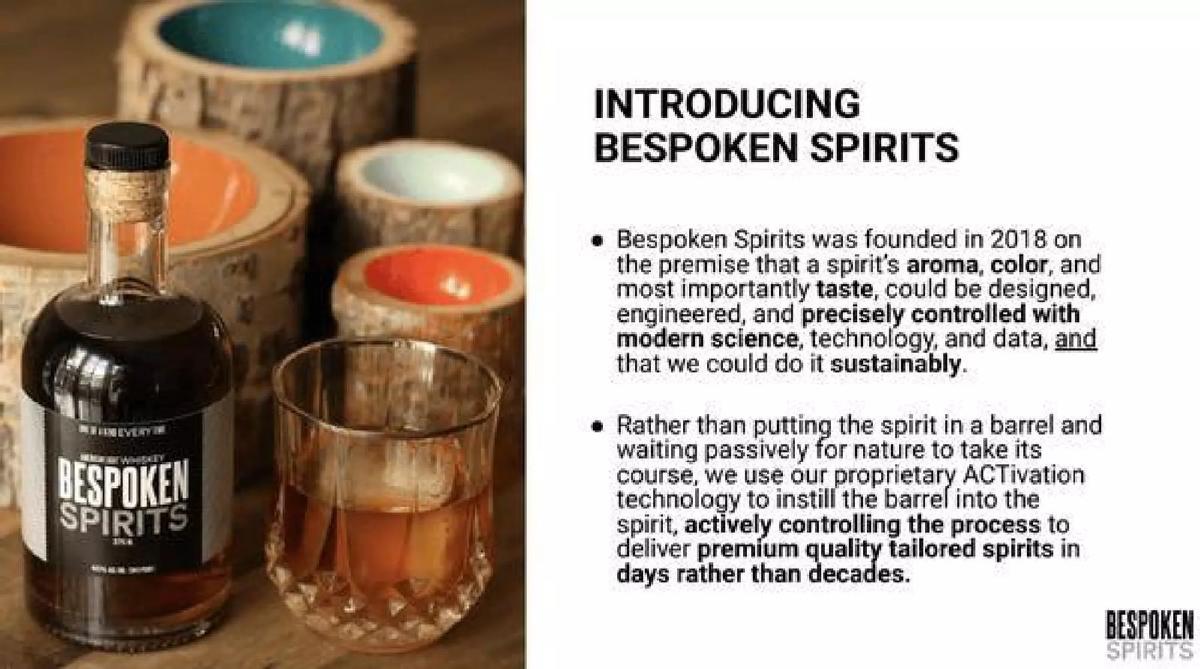
Spirits producer that ages spirits with a proprietary process instead of years in barrels. Product photo beside two paragraphs.
Bespoken Spirits deck, slide 3. Exact stored slide matched to this analysis.
Our analysis: It names one production change (the barrel goes into the spirit) and one effect (time to make), which is the core of the investment case.
Evidence and limitation: "Days rather than decades"; no cost or tasting evidence on the slide.
What a founder can adapt: Name the one step you change in production and what it does to time, cost or yield.
Supporting analysis
What the deck claims: "Introducing Bespoken Spirits." "A spirit's aroma, color, and most importantly taste, could be designed, engineered, and precisely controlled with modern science, technology, and data." "Rather than putting the spirit in a barrel and waiting passively for nature to take its course, we use our proprietary ACTivation technology to instill the barrel into the spirit... to deliver premium quality tailored spirits in days rather than decades."
Presentation choice: Time to make a product is a clear number for investors because it drives inventory and working capital.
When it does not fit: Add evidence the result tastes as good, such as blind-tasting scores or awards.
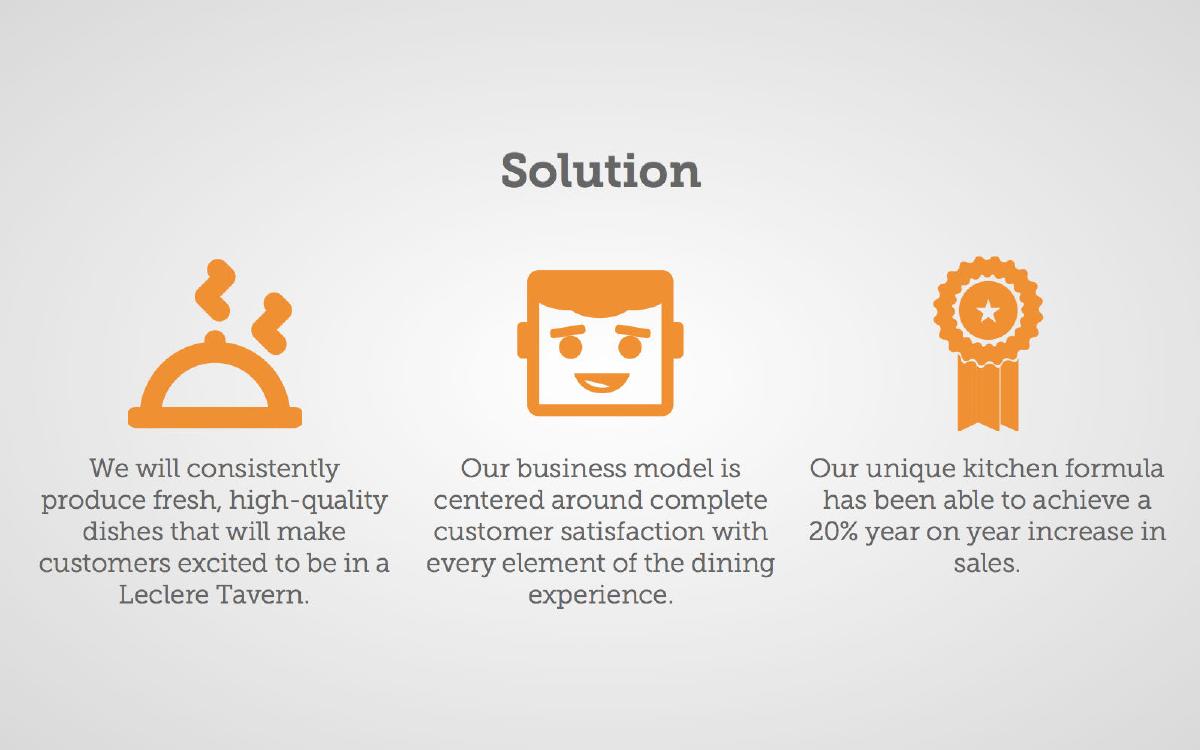
Restaurant group. Three icons with one sentence each.
Leclere Taverns deck, slide 3. Exact stored slide matched to this analysis.
Our analysis: Two statements are promises; the third is a result, but the "kitchen formula" behind it is not described.
Evidence and limitation: 20% year-on-year sales increase; not sourced.
What a founder can adapt: Keep the result and describe what the kitchen formula is: menu size, prep method, cost per plate.
Supporting analysis
What the deck claims: "Solution." "We will consistently produce fresh, high-quality dishes that will make customers excited to be in a Leclere Tavern." "Our business model is centered around complete customer satisfaction with every element of the dining experience." "Our unique kitchen formula has been able to achieve a 20% year on year increase in sales."
Presentation choice: A sales-growth figure on the solution slide is rare and useful; it needs the mechanism next to it.
When it does not fit: "Complete customer satisfaction" is not a solution; replace it with a repeat-visit rate or review score.
Poultry farming and processing in Nigeria. Text slide with three parts and five outcomes.
Newinfo Farms deck, slide 3. Exact stored slide matched to this analysis.
Our analysis: It covers the chain from farm to packaged product in three steps, but every outcome is a direction ("improved", "reduced") without a number.
Evidence and limitation: No figures.
What a founder can adapt: Keep the three steps and give one number each: mortality rate, birds processed per day, days from farm to shelf.
Supporting analysis
What the deck claims: "Solution Overview." "Efficient farming practices: Modern farm management system." "Advanced processing and packaging: Automated processing and packaging lines." "Transparent and traceable supply chain: Real-time data analytics." "Our solutions ensures: Improved yields and reduced mortality rates... Increased efficiency and reduced costs."
Presentation choice: Naming farm, processing and supply chain shows the company controls the whole path, which matters for food safety.
When it does not fit: Five unmeasured outcomes read as a wish list; keep the two you can measure.
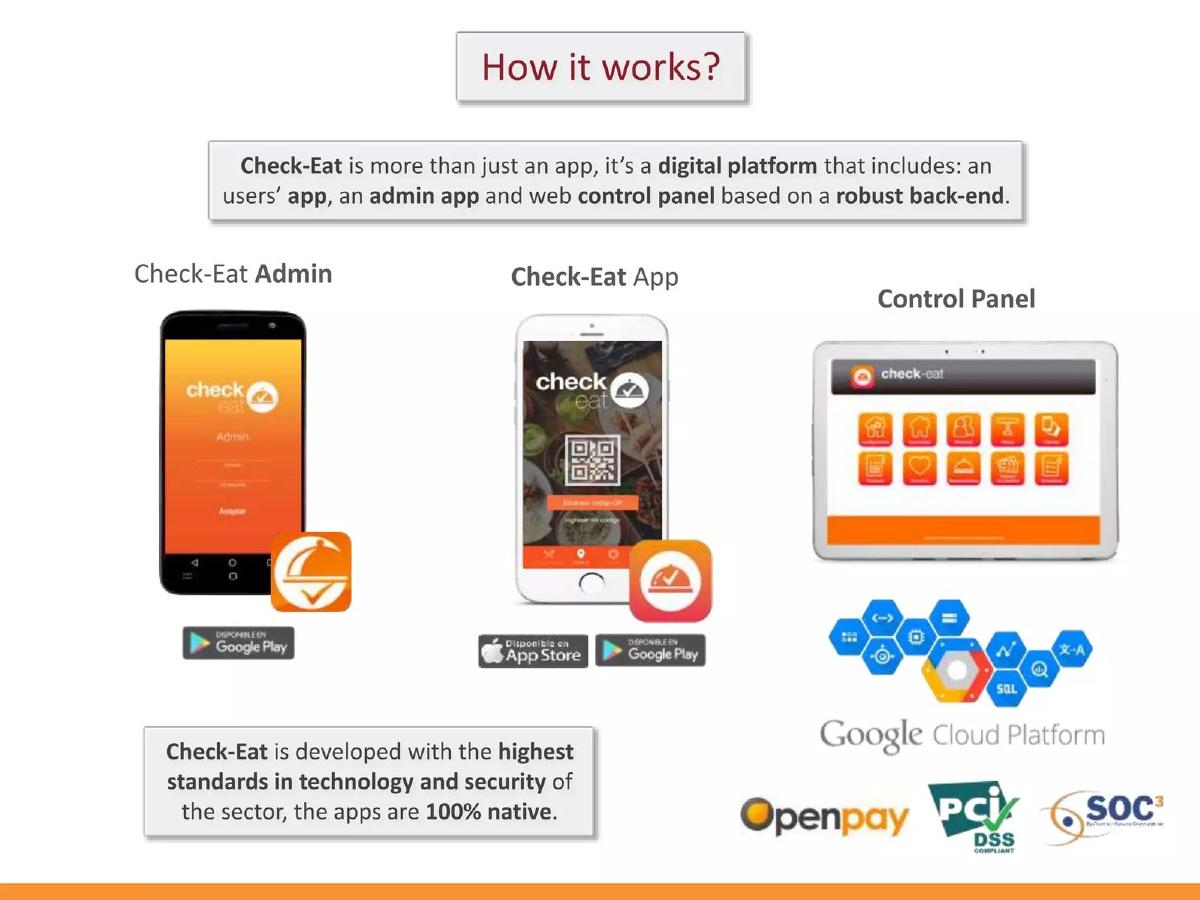
Restaurant ordering and payment platform in Mexico. Three device screens and technology logos.
Check-Eat deck, slide 6. Exact stored slide matched to this analysis.
Our analysis: It lists the software parts but not what happens at the table: the diner scans a QR code (visible on the screen), orders, pays.
Evidence and limitation: No figures.
What a founder can adapt: Replace the components with the diner's steps (scan, order, pay) and the restaurant's gain, such as table turn time.
Supporting analysis
What the deck claims: "How it works?" "Check-Eat is more than just an app, it's a digital platform that includes: an users' app, an admin app and web control panel based on a robust back-end." "Check-Eat is developed with the highest standards in technology and security of the sector, the apps are 100% native." Logos: Google Cloud Platform, Openpay, PCI DSS, SOC 3.
Presentation choice: It shows the common trap of answering "how it works" with components rather than the diner's steps.
When it does not fit: Security logos belong lower in the deck unless payment trust is the problem you solve.
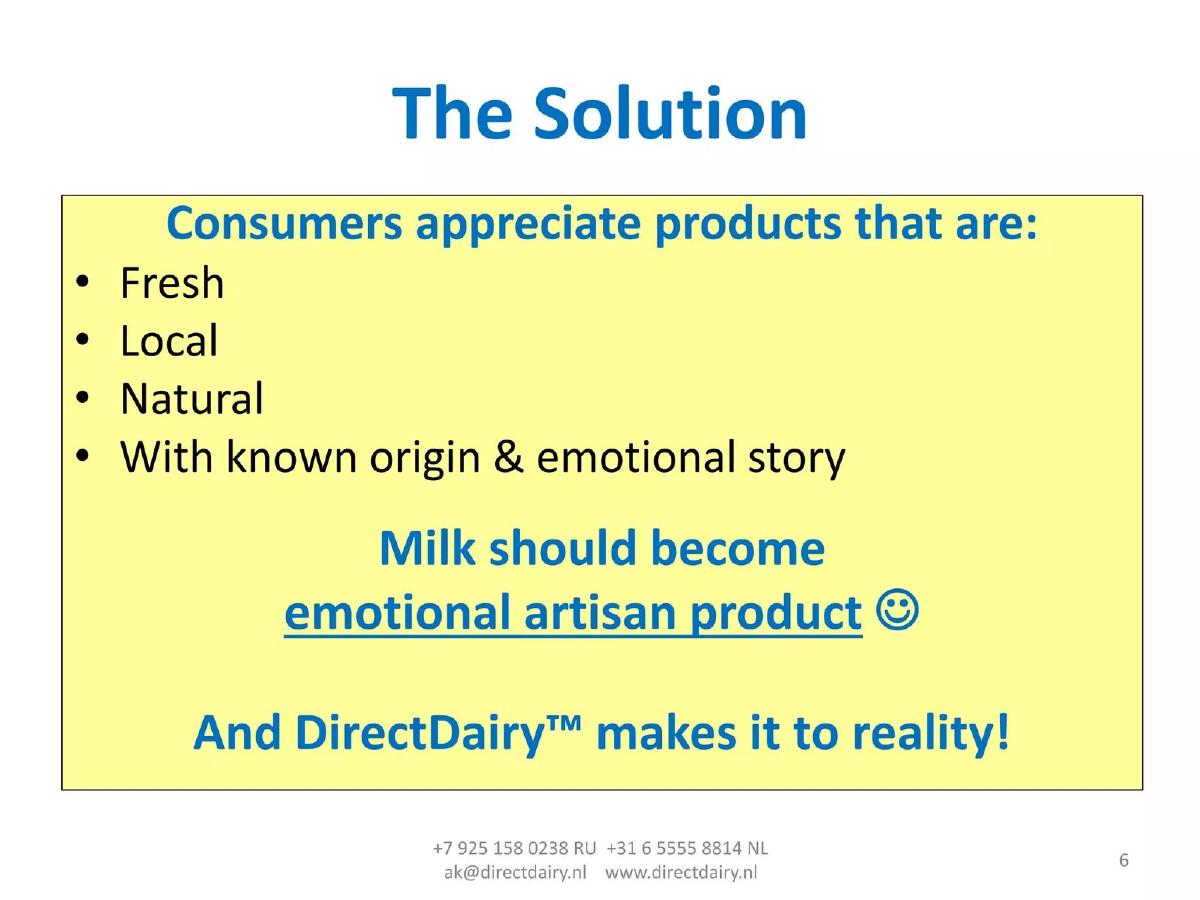
Farm-to-consumer dairy in the Netherlands and Russia. Text box on a yellow background. Weak on purpose.
Direct Dairy deck, slide 6. Exact stored slide matched to this analysis.
Our analysis: It describes what consumers want and states that the company delivers it, without saying how milk gets from the farm to them.
Evidence and limitation: No figures.
What a founder can adapt: Show the route (farm, bottling, delivery or shop), the time from milking to shelf and the price against supermarket milk.
Supporting analysis
What the deck claims: "The Solution." "Consumers appreciate products that are: Fresh, Local, Natural, With known origin & emotional story." "Milk should become emotional artisan product." "And DirectDairy makes it to reality!"
Presentation choice: It shows the minimum a food solution slide needs: the path, the change and one number.
When it does not fit: A list of qualities belongs on a customer or market slide, not the solution.
Before: Fresh, healthy, sustainable meals delivered with love.
After: Our kitchen cooks → meals are chilled the same day (7-day shelf life) → office fridges we stock → employees pay by card. Money: £6 a meal, 45% gross margin. Result: pilot offices reorder every week, 30 of 34.
What improved: Our illustrative rewrite; the figures are invented for the example. It shows the path, the production change, the money and a result.
What this guide adds
The general solution slide guide covers any business, and the food and agriculture problem guide shows how these startups describe what goes wrong. This guide covers the next slide: what the company actually changes in how food is made, sold or delivered. Food investors look for the operating detail behind thin margins: where it is made, how long it keeps, who sells it and what each party earns.
Three of these companies (Freshmart, Newinfo Farms, Direct Dairy) also appear in the food problem guide with their problem slides, so problem and solution can be read side by side.
Three things a food solution slide proves
The path: from kitchen or farm to the customer (Samosa King, Freshmart's order-to-delivery screens).
The production change: what is done differently and what it improves (Bespoken Spirits' days instead of decades; Newinfo Farms' farm management, processing and traceability).
The economics or result: a margin, shelf life or sales figure (Samosa King, Leclere Taverns). Most slides skip this.
Common mistakes
A list of qualities. "Fresh, local, natural" describes demand. Show how you deliver it.
App screens without fulfilment. Show who picks, cooks or delivers after the order is placed.
Software components instead of steps. Describe what the diner or buyer does, not the admin panel.
Unmeasured outcomes. "Improved yields" needs a number, such as mortality rate before and after.
No money on the slide. Give a price, a margin per outlet or a cost per unit.
Diagnostic checklist
The path from maker to eater is visible.
The step you change is marked.
It says who does each step and who earns money.
One number is given: shelf life, time, margin or result.
It answers the problem slide directly.
Frequently asked questions
How we chose these examples
Corpus: published pitch deck teardowns on StartupFundraising.com. Founder-uploaded private decks are excluded.
Selection (2026-09-25): we searched slides 3–6 of food, beverage, restaurant, grocery and agriculture decks for solution, product and how-it-works slides. Ten stored images were inspected. Blackpepper's slide was set aside as a restaurant social network rather than a food business. Brewpublik's slide was set aside because its stored text is unreadable. HelloBello, Forklyft and Sun Flour Baking were excluded because their solution slides already appear in other guides. Direct Dairy is kept as a weaker contrast; Fundnesia is marked partial.
Overlap check: none of these eight slides appears in another guide. Three of the companies appear in the food and agriculture problem guide with different slides.
Review: all eight stored slide images were inspected on 2026-09-25 and matched to company, deck and slide number (editorial model review). No person has yet completed an editorial review of this page.
Claims are as shown on the slides; we have not verified them. We make no claim that any slide caused a fundraising outcome.