Food and Agriculture Problem Slide: Pitch Deck Examples
How food, beverage and agriculture startups present the problem in a pitch deck: name the eater, grower or producer who pays.
Food and Agriculture Startup Problem Slide: Real Pitch Deck Examples
Eight problem slides from food, beverage and agriculture startups, shown in full, compare who the slide says has the problem (the consumer, the producer or the farmer), where between farm and plate the problem sits, and whether it is measured.
TL;DR
A food or agriculture problem slide should answer three questions: whose problem is it (the person eating, the brand or retailer selling, or the farmer growing), where between farm and plate does it happen (growing, processing, distribution, buying, cooking), and how big is it in days, money or health. Direct Dairy draws the industrial milk cycle and totals it: "4 DAYS from cow to package". HelloBello says it is "almost impossible" for dog owners to buy healthy food and footnotes the obesity figure. Aviwell backs its food security claim with an Economist cover and a World Food Programme report. Urban Harvest gives one sentence ("fresh produce shortages, long supply chains, and high environmental costs"), which is the weaker pattern.
Food and agriculture problem slides from real pitch decks
Each example shows the exact stored slide above its analysis and links to the full teardown. Claims are as shown on the slides; we have not verified them.
Direct Dairy problem slide — slide 5
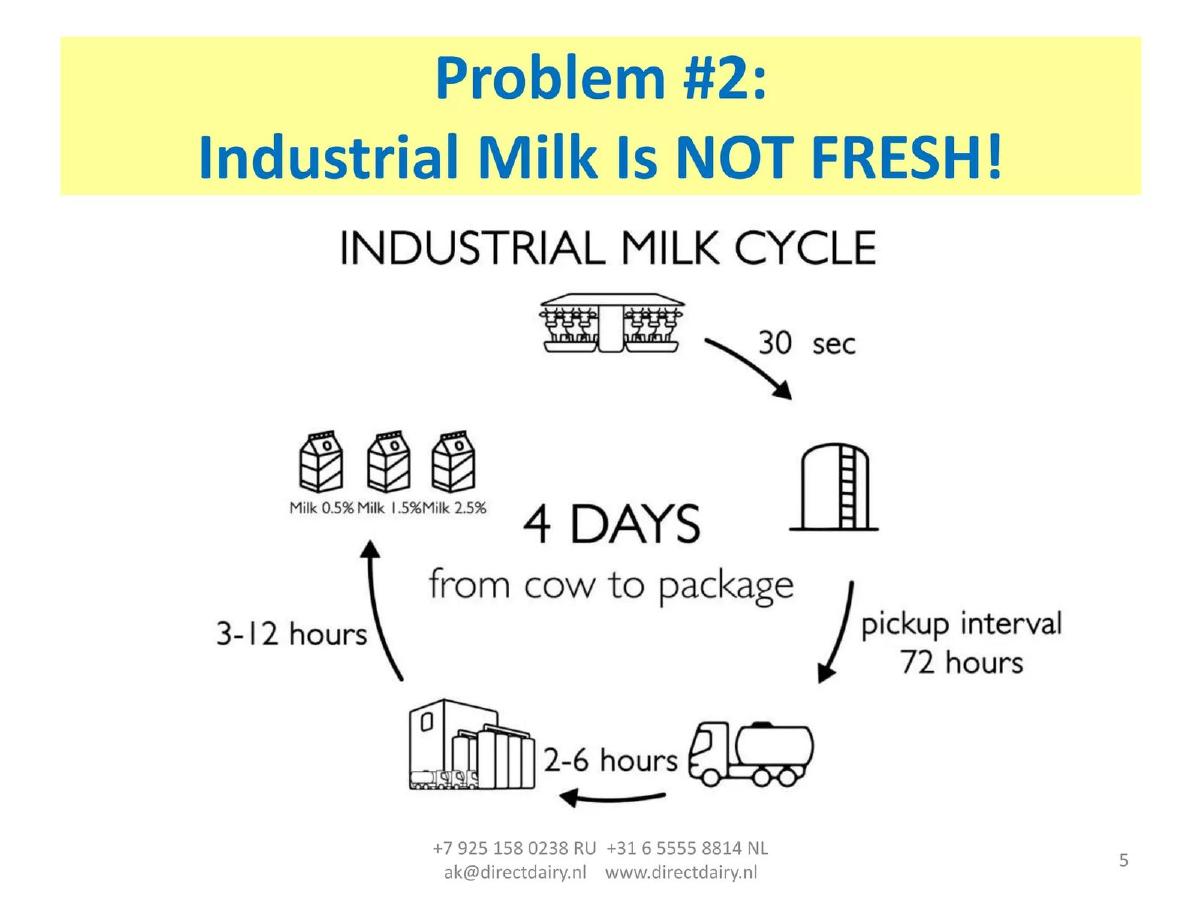
Fresh milk delivered from the farm. Draws the industrial milk cycle with the time taken at each step.
Direct Dairy deck, slide 5. Exact stored slide matched to this analysis.
Our analysis: It shows exactly where freshness is lost (the 72-hour pickup interval) and totals the delay.
Evidence and limitation: Times shown without sources.
What a founder can adapt: Draw your supply chain as steps with a time or cost on each, and total it.
Supporting analysis
What the deck claims: "Problem #2: Industrial Milk Is NOT FRESH!" "INDUSTRIAL MILK CYCLE": milking "30 sec", "pickup interval 72 hours", transport "2-6 hours", processing "3-12 hours". Centre: "4 DAYS from cow to package."
Presentation choice: Timing each step points to the one the product removes, so the solution slide has an obvious job.
When it does not fit: Source the times and say why freshness matters to the buyer: taste, shelf life or price.
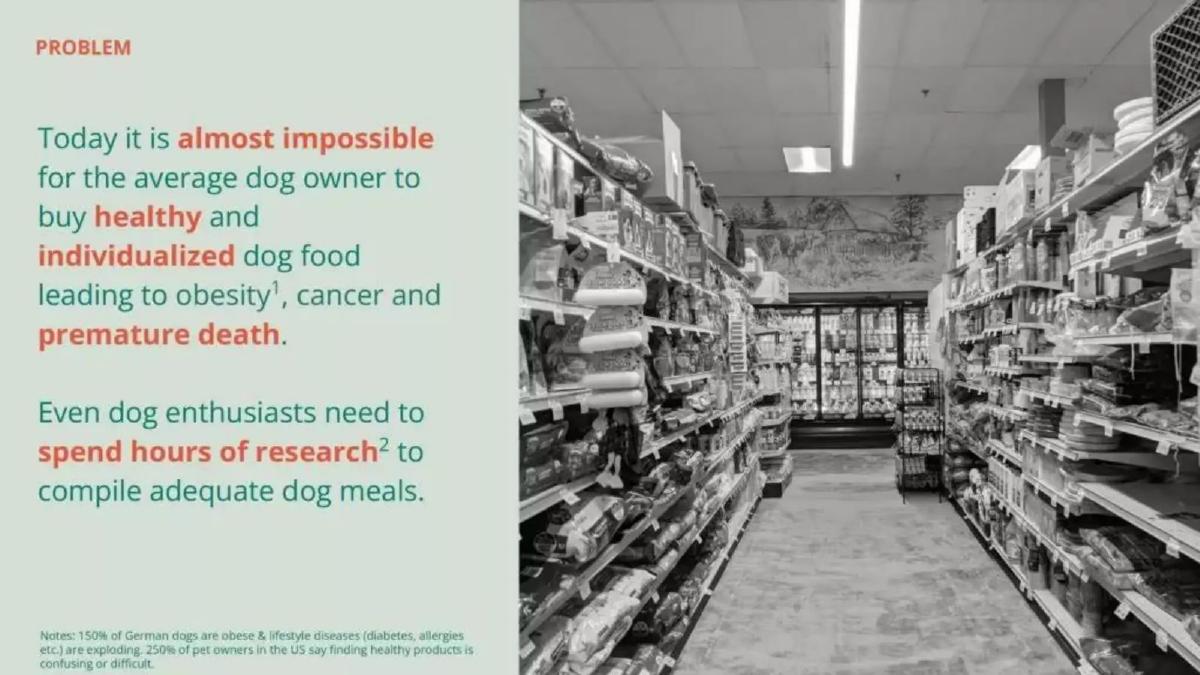
Individualised dog food. A statement about buying, a health consequence with footnotes, and a pet-store aisle photo.
HelloBello deck, slide 5. Exact stored slide matched to this analysis.
Our analysis: It names the buyer (dog owners), where the problem sits (buying) and two costs (health, hours of research).
Evidence and limitation: Two footnoted figures; the sources behind them are not named on the slide.
What a founder can adapt: Make one strong claim in the headline and put the figures that back it in a footnote.
Supporting analysis
What the deck claims: "Today it is almost impossible for the average dog owner to buy healthy and individualized dog food leading to obesity, cancer and premature death." "Even dog enthusiasts need to spend hours of research to compile adequate dog meals." Footnotes: "50% of German dogs are obese & lifestyle diseases (diabetes, allergies etc.) are exploding. 50% of pet owners in the US say finding healthy products is confusing or difficult."
Presentation choice: The footnotes put numbers under a strong claim without cluttering the headline.
When it does not fit: Name the studies behind the 50% figures; "almost impossible" invites challenge without them.
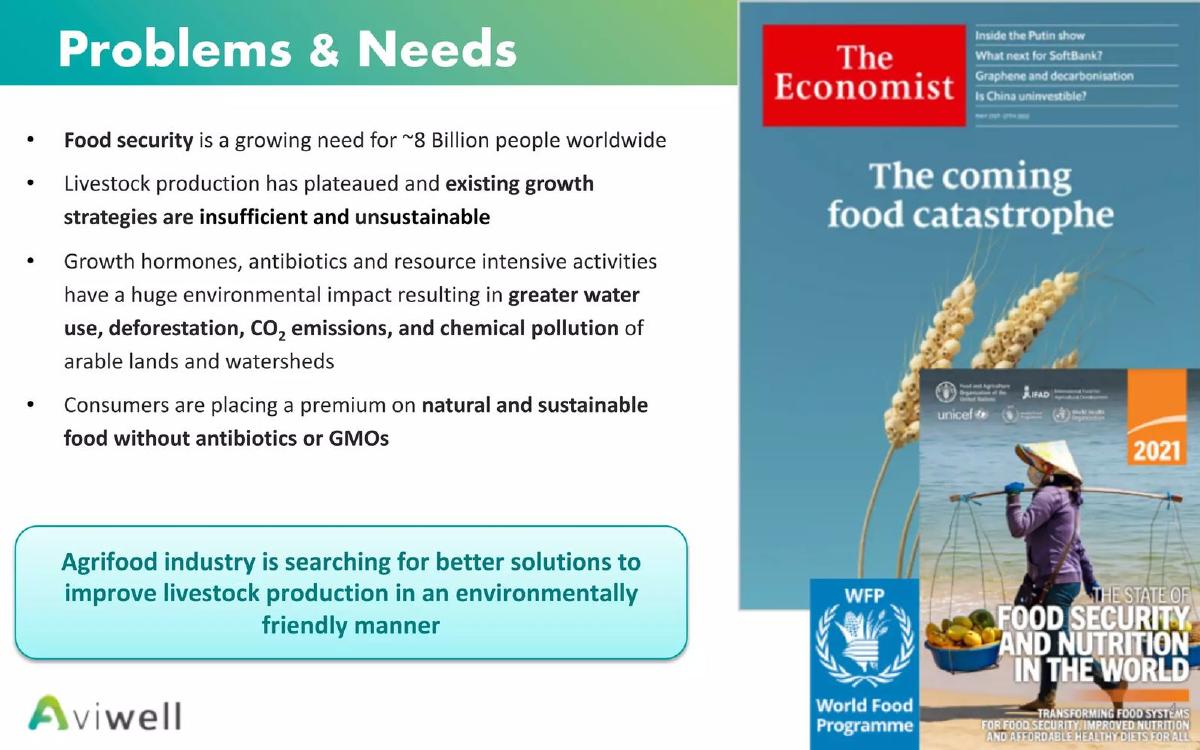
Livestock production technology. Four bullets and two third-party covers (The Economist, a World Food Programme report).
Aviwell deck, slide 4. Exact stored slide matched to this analysis.
Our analysis: It moves from the global need to the buyer (the agrifood industry) and a demand signal (consumers pay a premium).
Evidence and limitation: Economist cover "The coming food catastrophe" and the WFP report cover; no figures for livestock yields.
What a founder can adapt: Use one outside source for context, then narrow to the buyer and why they will pay.
Supporting analysis
What the deck claims: "Food security is a growing need for ~8 Billion people worldwide." "Livestock production has plateaued and existing growth strategies are insufficient and unsustainable." "Growth hormones, antibiotics and resource intensive activities have a huge environmental impact." "Consumers are placing a premium on natural and sustainable food without antibiotics or GMOs." Box: "Agrifood industry is searching for better solutions to improve livestock production in an environmentally friendly manner."
Presentation choice: The covers show outside sources agree; the last bullet links the problem to money.
When it does not fit: Replace "plateaued" with a number: yield per animal or growth over five years.
A craft brewery on the Gold Coast. A local capacity gap, compared with other cities.
The Black Hops deck, slide 2. Exact stored slide matched to this analysis.
Our analysis: It defines a local gap by comparison with other cities, for two customers (drinkers and brewers who need contract capacity).
Evidence and limitation: Counts of local bars and breweries; no sources.
What a founder can adapt: If your market is local, count what exists there and compare it with a similar city.
Supporting analysis
What the deck claims: "Queensland has very few places for craft brewers to 'contract brew' beer." "The Gold Coast has one craft beer bar and one brewery." "Both Sydney and Melbourne have established facilities that attract the best brewers." "Every other major city in Australia has a thriving and exploding craft beer bar and microbrewery scene."
Presentation choice: For a local food or drink business, a count of what exists here versus elsewhere is direct evidence of the gap.
When it does not fit: Add demand: drinkers per bar or contract brewing requests turned away.
Grocery delivery. Two problems, each with named groups.
Freshmart deck, slide 3. Exact stored slide matched to this analysis.
Our analysis: It names specific groups who cannot easily shop, then adds a second, separate problem at checkout.
Evidence and limitation: No figures.
What a founder can adapt: Name the groups, then pick the one you will serve first and size it.
Supporting analysis
What the deck claims: "First Problem": "People who find it difficult to go out for grocery shopping 'elderly people, people with disability'." "Professionals with busy schedule." "Expatriate people." "Second Problem": "The problem of payment, queues and congestion when paying for my purchases."
Presentation choice: Naming groups is better than "everyone"; it shows who the first customers are.
When it does not fit: Three different groups and two problems dilute the slide; lead with one.
Poultry farming in Nigeria. A list of seven industry challenges and their result.
Newinfo Farms deck, slide 2. Exact stored slide matched to this analysis.
Our analysis: It names the country and industry, and the closing sentence names the costs, but seven challenges hide which one the company fixes.
Evidence and limitation: No figures.
What a founder can adapt: Keep the country and the result sentence; cut the list to the challenge you address.
Supporting analysis
What the deck claims: "In Nigeria, the poultry industry faces numerous challenges, including: Inefficient farming practices; Limited access to quality feed and vacccines; Inadequate processing and packaging facilities; Lack of transparency and tracebility; High post-harvest losses and waste; Limited value-added products and services." "These challenges result in high cost, low profitability, and limited access to healthy and safe poultry products."
Presentation choice: The last sentence is the useful part: it links the challenges to cost and profit.
When it does not fit: Measure one item, such as post-harvest loss as a share of output.
Hydroponic Greenhouse R900 problem slide — slide 4
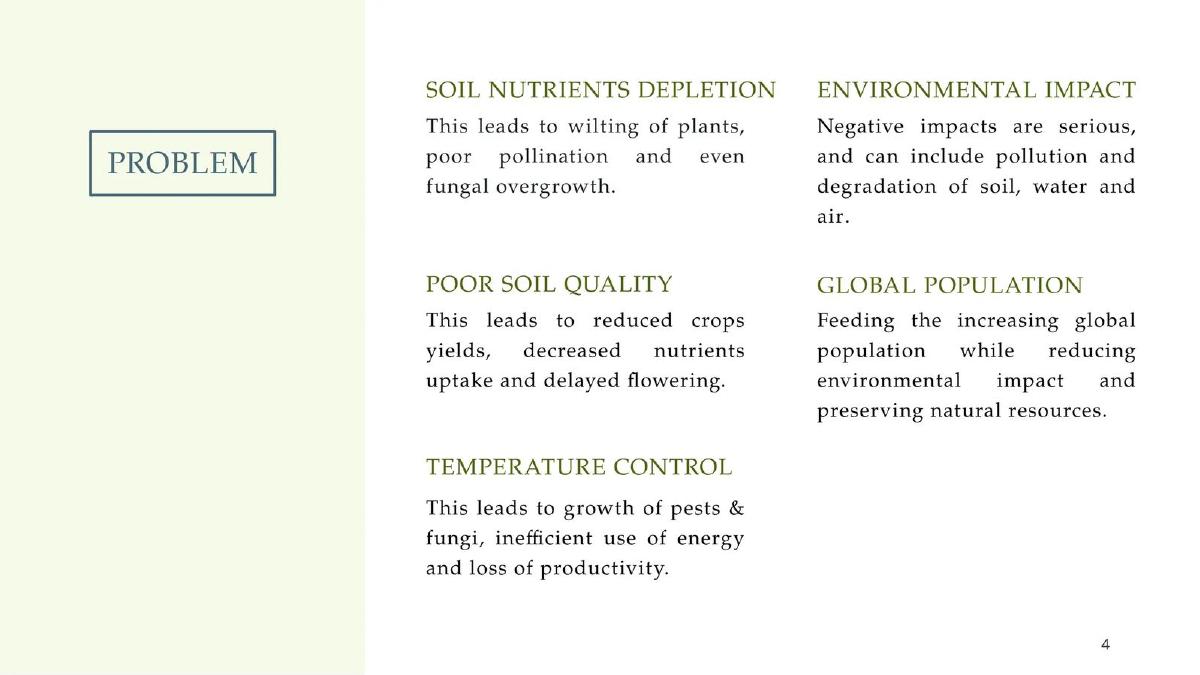
Hydroponic growing for fruit and vegetables. A partial example: five problems, each with a short explanation.
Hydroponic Greenhouse R900 deck, slide 4. Exact stored slide matched to this analysis.
Our analysis: Each heading has a consequence, which helps, but there is no grower named and no measure of lost yield.
Evidence and limitation: No figures.
What a founder can adapt: Name the grower (size, crop, region) and give one yield or cost figure for the problem you fix.
Supporting analysis
What the deck claims: "Soil nutrients depletion", "Poor soil quality" ("reduced crops yields, decreased nutrients uptake and delayed flowering"), "Temperature control" ("growth of pests & fungi, inefficient use of energy and loss of productivity"), "Environmental impact", "Global population."
Presentation choice: It shows the gap between describing agronomy and describing a customer's loss.
When it does not fit: Drop "global population"; it is context, not the grower's problem.
Whose problem each slide describes, where between farm and plate it sits, and whether it is measured.
Example
Whose problem
Where it sits
Measured
Direct Dairy
Milk drinkers
Processing and distribution
Yes (4 days, 72 hours)
HelloBello
Dog owners
Buying
Yes (footnoted 50% figures)
Aviwell
Agrifood industry
Livestock farming
Partly (outside sources)
The Black Hops
Drinkers and brewers
Local production capacity
Partly (counts)
Freshmart
Shoppers who struggle to go out
Buying and checkout
No
Newinfo Farms
Poultry farmers (Nigeria)
Farming and processing
No
Hydroponic Greenhouse R900
Unclear (growers)
Growing
No
Urban Harvest
Unclear
Unclear
No
Key Takeaways
Say whose problem it is: the consumer, the producer, the retailer or the farmer. They pay for different fixes.
Locate it between farm and plate: growing, processing, distribution, buying or cooking.
Measure it in food-industry units: days to shelf, share wasted, cost per kilo, yield per hectare, health outcomes.
Global statements (feeding 8 billion people, climate) set context; they are not your customer's problem.
One drawn chain with times on each step (Direct Dairy) beats a list of five industry challenges.
Build your food or agriculture problem slide
One customer, one step between farm and plate, one measure.
Whose problem. Is this the eater's, the retailer's, the processor's or the farmer's problem? Who pays for the fix?
Where it sits. At which step does it happen: growing, processing, distribution, buying, cooking?
Measure. How big is it: days to shelf, share wasted, cost per kilo, yield, a health figure? What is your source?
Context vs customer. If you open with a global figure, which sentence brings it down to your customer?
Copyable framework: [Customer] lose [measure, source] because [step] takes [time / cost], so [consequence they pay for].
Illustrative example 1 — written by us
Before: The food system is broken and unsustainable.
After: Independent grocers in Leeds throw away about 15% of fresh vegetables because wholesale deliveries arrive three days after harvest, which costs a typical store around £1,200 a month.
What improved: Our illustrative rewrite; the figures are invented for the example. It names the customer, the step, a measure and the cost.
What this guide adds
The general problem slide guide covers any business, and the consumer problem guide covers consumer apps. Food and agriculture differ in one way investors look for: the product passes from farmer to processor to retailer to eater, and each step has a different buyer. A slide that opens with world hunger and ends with an app for city shoppers leaves investors to guess who pays.
Food decks also lean on large global statistics. This guide contrasts those with slides that measure one step for one customer.
Three things a food problem slide proves
Whose problem: milk drinkers (Direct Dairy), dog owners (HelloBello), shoppers who struggle to get to a store (Freshmart), craft brewers (The Black Hops), poultry farmers (Newinfo), growers (the hydroponic greenhouse), the agrifood industry (Aviwell).
Where it sits: processing and distribution (Direct Dairy), buying (HelloBello, Freshmart), production capacity (The Black Hops), farming (Newinfo, hydroponic greenhouse, Aviwell).
How big: Direct Dairy (days, hours) and HelloBello (footnoted health figures) measure; most others describe.
Common mistakes
Global hunger as the problem. World population is context; name the customer who pays.
No step named. Say where between farm and plate the problem sits.
Long list of industry challenges. Seven challenges hide the one you fix.
Strong claim, no footnote. "Almost impossible" needs a figure and a source underneath.
Empty slide. One sentence on a blank slide leaves investors nothing to check.
Diagnostic checklist
It is clear whose problem this is and who pays.
The step between farm and plate is named.
The problem is measured in days, cost, waste, yield or health.
Global context is brought down to the customer.
Every figure has a source.
Frequently asked questions
How we chose these examples
Corpus: published pitch deck teardowns on StartupFundraising.com. Founder-uploaded private decks are excluded.
Selection (2026-09-25): we searched extracted text of slides 2–6 for problem and challenge slides in decks whose recorded sector is food, beverage, restaurants, grocery, meals, agriculture or farming. About twenty candidates were listed and thirteen stored images inspected. Forklyft's problem slide was set aside because it already appears in the consumer problem guide. Direct Dairy's slide 4 was set aside in favour of slide 5. Ajinomatrix, Eziban and Fundnesia were set aside as weaker than those chosen. Urban Harvest is kept as a weaker contrast.
Overlap check: none of these eight slides appears in another guide. HelloBello's slides 2 and 6 appear in the executive summary and solution guides; this guide uses its slide 5.
Review: all eight stored slide images were inspected on 2026-09-25 and matched to company, deck and slide number (editorial model review). No person has yet completed an editorial review of this page.
Claims are as shown on the slides; we have not verified them. We make no claim that any slide caused a fundraising outcome.