How consumer startups describe the problem in a pitch deck: a moment the investor recognises, what it costs a household in money or time.
Consumer Problem Slide: Real Pitch Deck Examples
Eight problem slides from consumer startups, shown in full, compare how each makes an everyday frustration feel real, puts a price on it for one household, and shows why the products people already use don't solve it.
TL;DR
A consumer problem slide should describe a moment the investor has lived through, give its cost to one person or household, and show what people use today and why it falls short. HomeHub gives the cost per household: "over 60 hours furniture shopping / year" and "~$2.5K per year on furniture." Chptr turns its own slide text into the price: the two sentences on the page "would cost a grieving family $205.35 to publish as an obituary." Super Coffee puts the existing drinks on the slide with their sugar counts. Lifestyler starts from "the health and fitness of the world's population", a problem too large to belong to any one customer.
Consumer problem slides from real pitch decks
Each example shows the exact stored slide above its analysis and links to the full teardown. Figures are as shown on the slides; we have not verified them.
HomeHub problem slide — slide 3
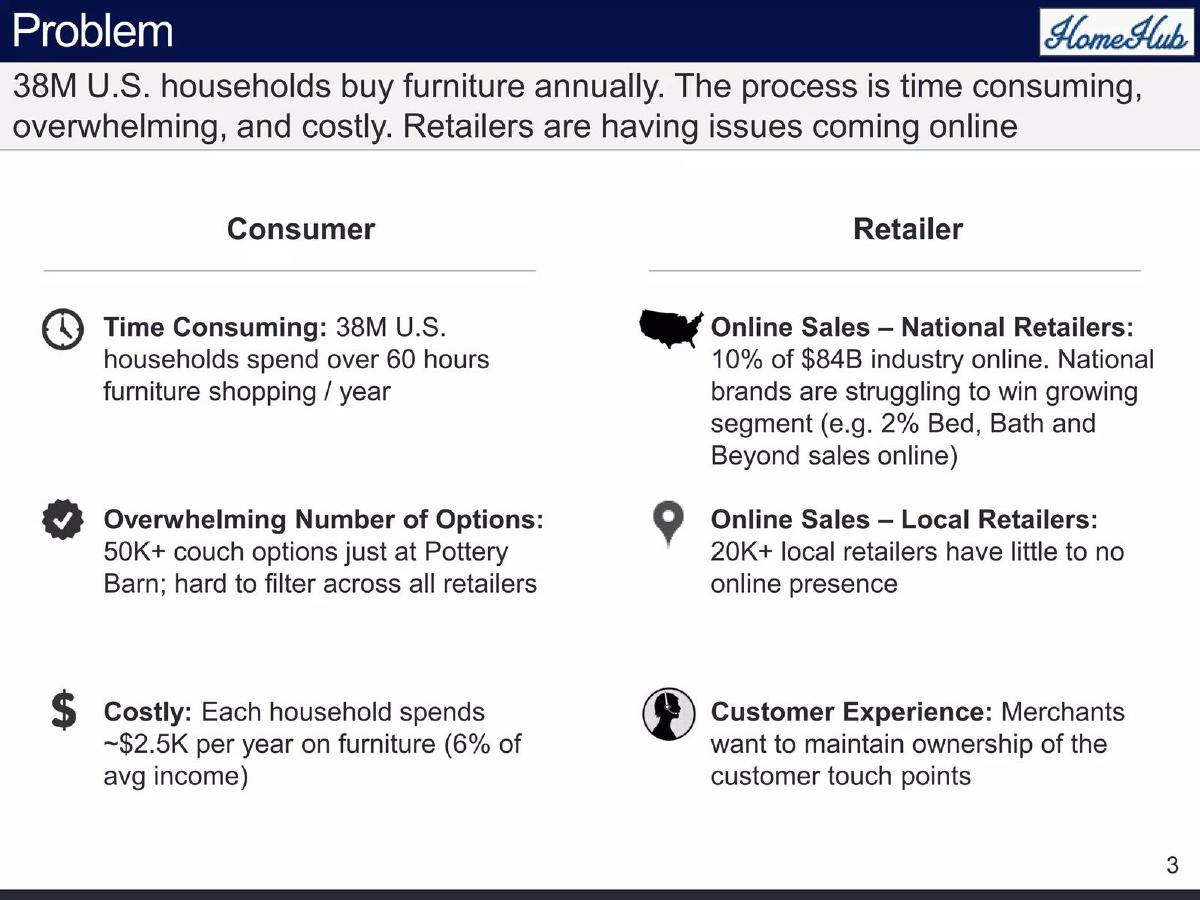
Online furniture search across retailers. Two columns: consumer and retailer.
HomeHub deck, slide 3. Exact stored slide matched to this analysis.
Our analysis: Each consumer pain has its own number at the household level.
Evidence and limitation: Hours, spend and share of income per household; no sources cited on the slide.
What a founder can adapt: Give one time figure and one money figure per household, with where they come from.
Supporting analysis
What the deck claims: "38M U.S. households buy furniture annually. The process is time consuming, overwhelming, and costly." "Time Consuming: 38M U.S. households spend over 60 hours furniture shopping / year." "Overwhelming Number of Options: 50K+ couch options just at Pottery Barn; hard to filter across all retailers." "Costly: Each household spends ~$2.5K per year on furniture (6% of avg income)." Retailer column: "10% of $84B industry online" and "20K+ local retailers have little to no online presence."
Presentation choice: An investor can picture one family's 60 hours and $2.5K, which a market-size figure can't do.
When it does not fit: Cite the sources; three unsourced numbers invite the question of where they came from.
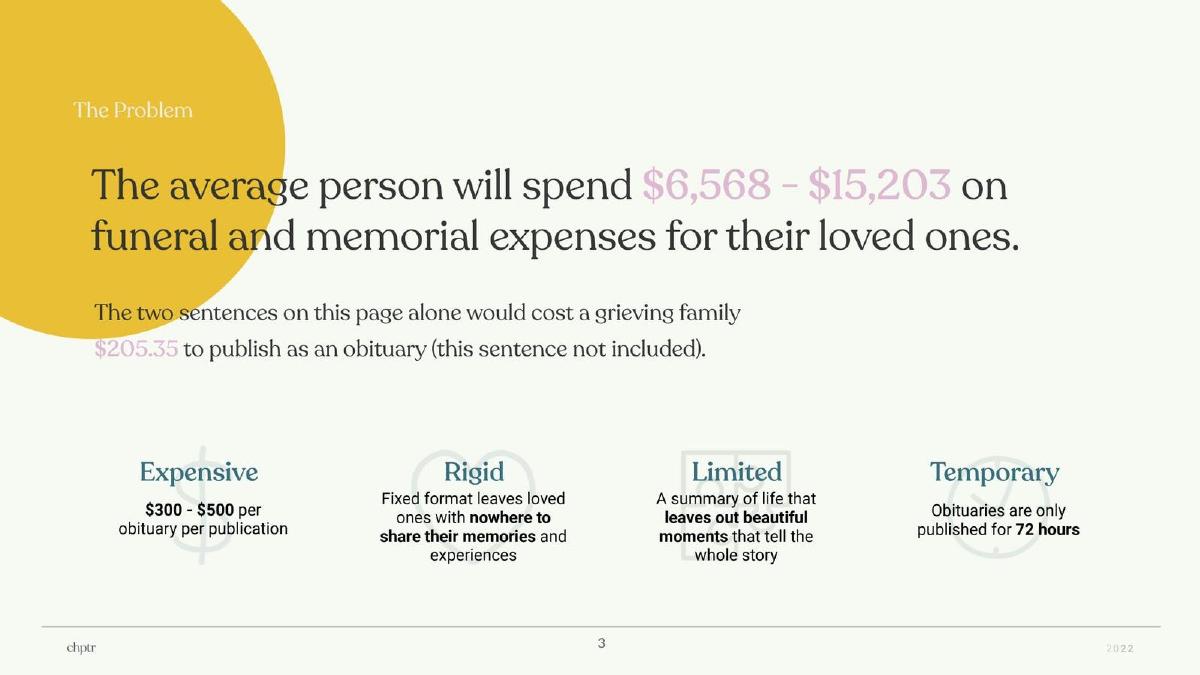
Online memorials. One headline cost and four short failings of obituaries.
Chptr deck, slide 4. Exact stored slide matched to this analysis.
Our analysis: The slide prices its own words as an obituary, so the investor feels the cost while reading.
Evidence and limitation: Cost range per person; price per obituary; 72-hour publication window.
What a founder can adapt: Find one way to make the cost felt on the slide itself, then list today's option's failings in single words.
Supporting analysis
What the deck claims: "The average person will spend $6,568 – $15,203 on funeral and memorial expenses for their loved ones." "The two sentences on this page alone would cost a grieving family $205.35 to publish as an obituary (this sentence not included)." "Expensive: $300 – $500 per obituary per publication." "Rigid: Fixed format leaves loved ones with nowhere to share their memories and experiences." "Limited: A summary of life that leaves out beautiful moments." "Temporary: Obituaries are only published for 72 hours."
Presentation choice: It makes an uncomfortable subject concrete without sentiment, and names four specific failings of today's option.
When it does not fit: Cite the source of the $6,568–$15,203 range, and keep the grey sub-text legible at presentation size.
Ready-to-drink coffee. Existing bottles shown with their sugar and calories.
Super Coffee deck, slide 3. Exact stored slide matched to this analysis.
Our analysis: The competing products are the problem, shown with the one number buyers compare.
Evidence and limitation: Sugar and calorie counts for four existing products; 83% survey figure without a source.
What a founder can adapt: If today's option fails on a measurable attribute, show it next to the option.
Supporting analysis
What the deck claims: "The problem? Sugar & high calories." "RTD Coffee continues to be the fastest growing category, while big brands continue to duplicate the same flavors and the same nutrition facts. 83% of Americans' are seeking healthier options (e.g. lower sugar & lower calories)." "The bad guys": "45g sugar 250+ calories", "20g sugar 190 calories", "45g sugar 260+ calories", "40g sugar 250 calories." Against them: "0g sugar, 80 calories."
Presentation choice: The investor sees the gap in a glance: 40–45g of sugar versus zero.
When it does not fit: Keep your product for the next slide; here it takes a third of the problem slide. Source the 83%.
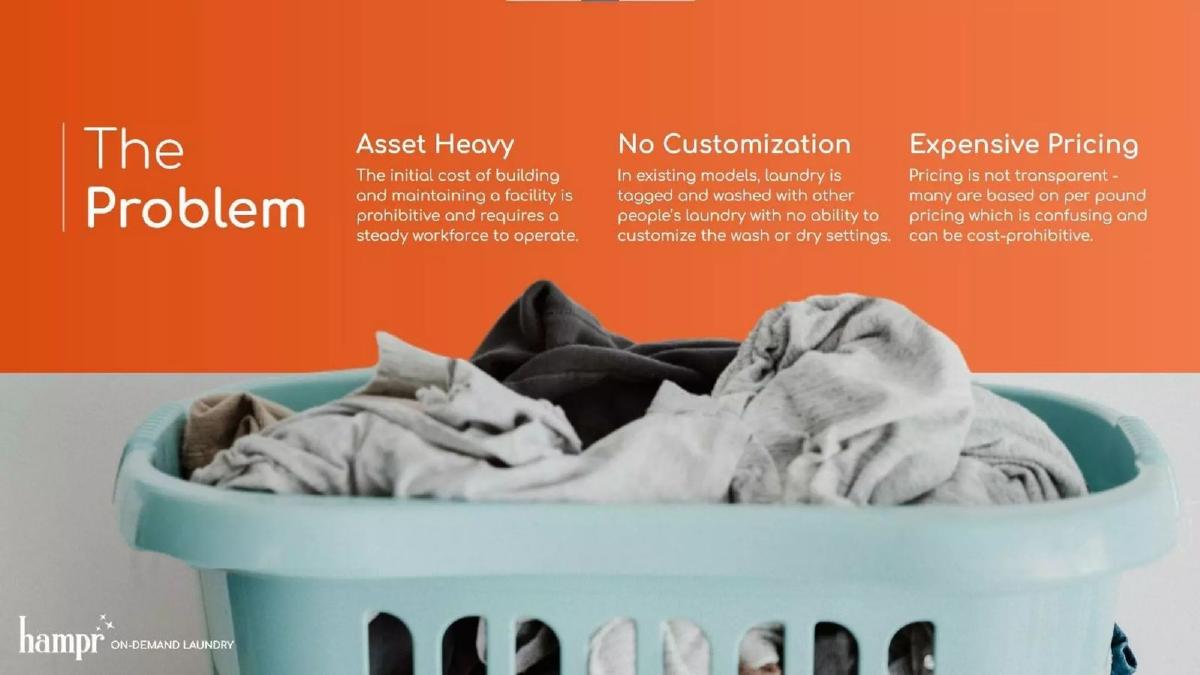
On-demand laundry. Three failings of existing laundry services over a photo.
Hampr deck, slide 6. Exact stored slide matched to this analysis.
Our analysis: Two failings are the customer's (shared washing, confusing pricing); one is the operator's (facilities).
Evidence and limitation: No figures.
What a founder can adapt: Describe the gap in the customer's words, like the shared wash.
Supporting analysis
What the deck claims: "Asset Heavy: The initial cost of building and maintaining a facility is prohibitive and requires a steady workforce to operate." "No Customization: In existing models, laundry is tagged and washed with other people's laundry with no ability to customize the wash or dry settings." "Expensive Pricing: Pricing is not transparent – many are based on per pound pricing which is confusing and can be cost-prohibitive."
Presentation choice: "Washed with other people's laundry" is a detail a customer recognises instantly.
When it does not fit: Put a price on per-pound pricing, and move the operator's cost problem to the business model slide.
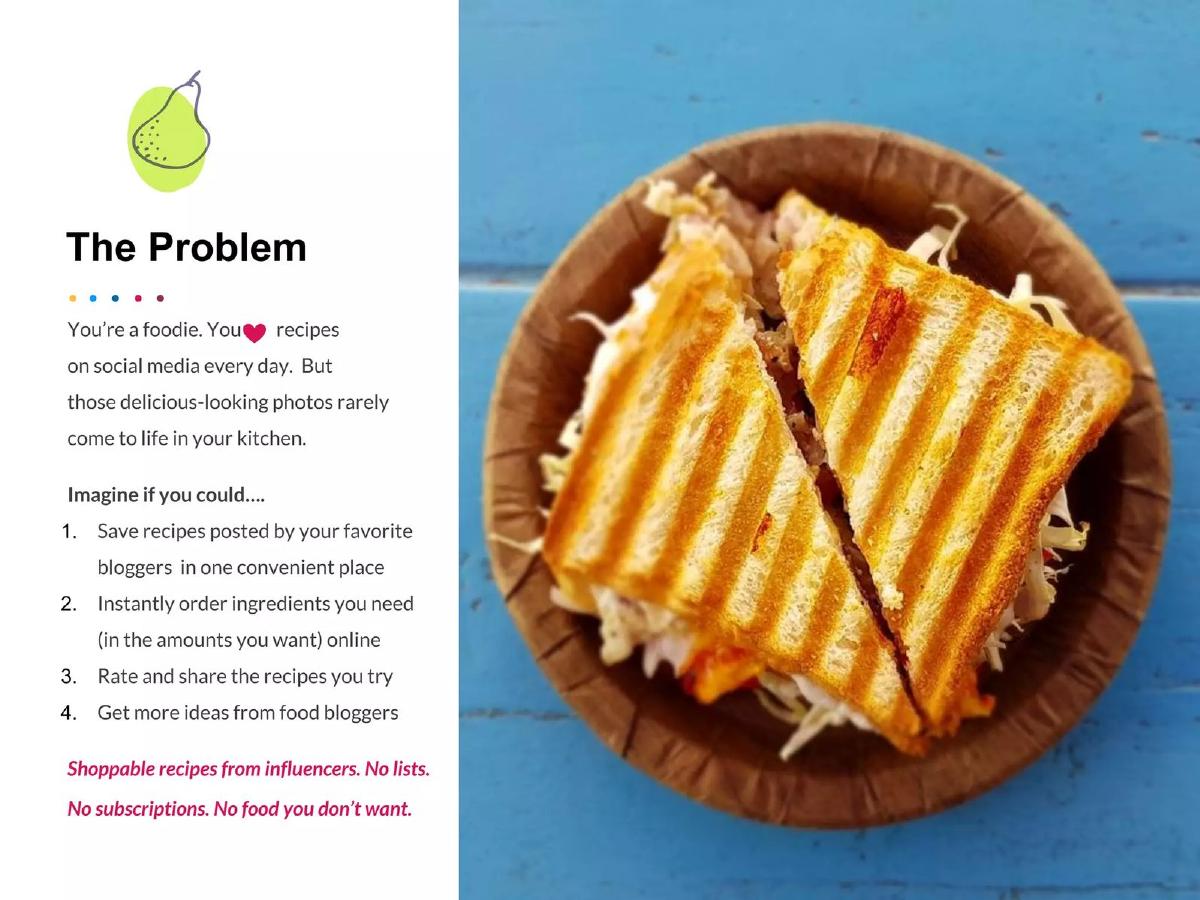
Shoppable recipes from food bloggers. Written in the second person.
Forklyft deck, slide 3. Exact stored slide matched to this analysis.
Our analysis: The first three lines name a person and a gap between saving a recipe and cooking it.
Evidence and limitation: No figures.
What a founder can adapt: Name the person and the moment in one or two sentences.
Supporting analysis
What the deck claims: "You're a foodie. You ♥ recipes on social media every day. But those delicious-looking photos rarely come to life in your kitchen." "Imagine if you could… Save recipes posted by your favorite bloggers in one convenient place; Instantly order ingredients you need (in the amounts you want) online; Rate and share the recipes you try; Get more ideas from food bloggers." "Shoppable recipes from influencers. No lists. No subscriptions. No food you don't want."
Presentation choice: The investor recognises the moment of scrolling past food they'll never make.
When it does not fit: The "Imagine if you could" list is the solution; move it to the next slide and add how often saved recipes go uncooked.
Sport-specific bags. Three problems with bold headlines.
ING Bags deck, slide 3. Exact stored slide matched to this analysis.
Our analysis: It names today's option (all-purpose bags, old totes) and three ways it fails.
Evidence and limitation: No figures.
What a founder can adapt: Name the workaround people put up with, and what it lacks.
Supporting analysis
What the deck claims: "Difficult to find unique bags specific to an active lifestyle. Active people make-do with all purpose bags because they can't find specific activity bags for tennis, golf, running." "Active bags are not complimenting the stylish active wear trend. Old tote bags and backpacks clash with active people's carefully styled active wear." "Customers can't find good gym bags. Bags are usually all-purpose, don't have multiple compartments, and aren't sturdy enough for daily gym-going."
Presentation choice: "Make-do" is the right idea: people have a workaround they aren't happy with.
When it does not fit: Add evidence that people want something better, such as search volume, reviews or survey answers.
A chore-reward product for families. One recognisable line, then product features.
Choreosity deck, slide 4. Exact stored slide matched to this analysis.
Our analysis: The opening line is a strong recognition moment; the bullets describe what the product does.
Evidence and limitation: No figures.
What a founder can adapt: Keep one line any parent, commuter or pet owner would recognise.
Supporting analysis
What the deck claims: "As any one with children knows, getting kids to complete chores can often be more trouble than doing it yourself." "Choreosity addresses several psychological problems with getting kids to do chores: Creates clear and pre-defined rewards, that are immutable. Kids can see a record of what they have done, helping them understand cause and effect. Can help remove negative emotions that teaching responsibility can incite."
Presentation choice: Most parents in the room will nod at "more trouble than doing it yourself."
When it does not fit: Turn the bullets into problems: arguments over rewards, no record of what was done.
Fitness planning software. A weaker example, included on purpose: three paragraphs starting from the world's population.
Lifestyler deck, slide 2. Exact stored slide matched to this analysis.
Our analysis: The useful point (logging apps track but don't guide, and focus on weight loss) is buried in paragraph three.
Evidence and limitation: No figures.
What a founder can adapt: Lead with the gap in today's apps and the person it leaves out.
Supporting analysis
What the deck claims: "The health and fitness of the worlds population is decreasing." "Most people want to be healthier but lack of knowledge makes it difficult to know what to do, or even where to start… the majority of people cannot afford this kind of service." "The only solution software provides so far is a variety of logs, such as Weight Watchers and My Fitness Pal… all of these current apps and websites are tailored towards weight loss."
Presentation choice: It shows that a problem framed at population level belongs to no one the investor can picture.
When it does not fit: Start from a person, not the world; cut paragraphs to single lines; put a price on a personal trainer.
Whether each slide gives a recognisable moment, a cost to the household, and today's option with its gap.
Example
Recognisable moment
Cost to household
Today's option and gap
HomeHub
Partly (overwhelming choice)
Yes (60 hours, $2.5K a year)
Partly (retailers offline)
Chptr
Yes (grieving family)
Yes ($6,568–$15,203; $205.35)
Yes (obituaries: four failings)
Super Coffee
No
No
Yes (sugar counts of rivals)
Hampr
Yes (shared wash)
No figure
Yes (existing laundries)
Forklyft
Yes (saved recipes)
No
No
ING Bags
Partly
No
Yes (all-purpose bags)
Choreosity
Yes (chores)
No
No
Lifestyler
No (world population)
No
Yes, buried (logging apps)
Key Takeaways
Open with a moment the investor recognises, not a statistic about society.
Give the cost to one person or household, in money or hours.
Put today's option on the slide and say exactly where it falls short.
Name the person narrowly: a foodie who saves recipes, a parent, a grieving family.
Keep your solution for the next slide; a problem slide that lists features stops being a problem slide.
Build your consumer problem slide
One line per part, with a number where you have one.
Person. Who exactly has this problem? Describe them in a few words.
Moment. When does it happen, in a way the investor has experienced?
Cost. What does it cost one person or household per year, in money or hours?
Today. What do they use now, and where exactly does it fall short?
Copyable framework: [Person] [moment]. It costs them [money or hours] a year. Today they use [option], which [specific gap].
Illustrative example 1 — written by us
Before: Pet ownership is growing worldwide and pet health is a huge market.
After: Dog owners in cities spend about 4 hours a month arranging walks and sitters, and $900 a year on last-minute bookings. Today they use neighbourhood chat groups, where no one is vetted and prices change every time.
What improved: Our illustrative rewrite; figures are invented for the example. It names a person, a moment, a household cost and today's option with its gap.
What this guide adds
The general problem slide guide covers describing customer pain in any business. Consumer startups sell to individuals who don't have a budget line or a procurement process, so the problem has to be recognisable from personal experience and priced for a household rather than a company. This guide compares how consumer decks do that.
It complements the consumer app and consumer product traction guides, which cover the proof that comes after the problem. None of the eight decks here appear in those guides.
Three parts of a consumer problem
Recognition: a situation the investor has been in (Forklyft, Choreosity, Chptr).
Cost to the household: money or time per person or per year (HomeHub, Chptr).
Today's option and its gap: what people use now and where it fails (Super Coffee, Hampr, ING Bags).
Strong slides cover all three. Most real slides cover one or two.
Common mistakes
Society-level framing. Start from one person, not the world's population.
Features on the problem slide. "Imagine if you could…" lists belong on the solution slide.
No household cost. Give money or hours per person or per year.
Today's option missing. Name what people use now and where it fails.
Unsourced survey figures. Cite where a percentage comes from.
Diagnostic checklist
The slide names a specific person, not "consumers".
It opens with a moment the investor recognises.
It gives a cost per person or household.
It names today's option and its specific gap.
Your product does not appear until the next slide.
Frequently asked questions
How we chose these examples
Corpus: published pitch deck teardowns on StartupFundraising.com. Founder-uploaded private decks are excluded.
Selection (2026-09-25): we searched extracted text of slides 2–6 for slides beginning with "problem" or "pain" in decks whose recorded sector is consumer, food and beverage, fashion, beauty, pets, travel, fitness, social or e-commerce. About sixty candidates were read; business-facing, marketplace-supply and society-level slides with no household angle were set aside, apart from Lifestyler, kept as a weaker contrast.
Overlap check: the general problem slide guide uses nine different decks (Airbnb, YouTube, Front, Opendoor, Mixpanel, Amplitude, Code Four, Carbon Block, Capdesk); none appears here. HomeHub appears in the solution slide guide (slide 4) and Hampr in the customer research guide (slide 4), both with different slides.
Super Coffee's deck is stored under a generic teardown address; the stored slide shows Super Coffee branding and was matched to company and slide number.
Review: all eight stored slide images were inspected on 2026-09-25 and matched to company, deck and slide number (editorial model review). No person has yet completed an editorial review of this page.
Figures are as shown on the slides; we have not verified them. We make no claim that any slide caused a fundraising outcome.