How pet startups present the problem in a pitch deck: go past "pets are family", name what goes wrong for the owner or the animal.
Pet Startup Problem Slide: Real Pitch Deck Examples
Eight problem slides from pet startups, shown in full, compare whether each slide names a specific owner or animal, says what goes wrong, and backs it with a sourced number.
TL;DR
A pet problem slide has to go past "people love their pets" to something that goes wrong. The stronger slides name it and source it. Dutch splits the problem between owners and vets: "Pet owners are avoiding the vet, sparing themselves from the cost and inconvenience" and "Vets themselves are at the breaking point", with "Veterinarians saw 25% fewer patients per hour in 2020" and "Average wait time was up 82% in 2020 vs. 2019". Puptimize says "63% of dogs are relinquished during their lifetimes" and names a cause, "Lack of preparation and education", with sources. Kriddr's page of small paragraphs, with no figures, is the weaker pattern.
Pet startup problem slides from real pitch decks
Each example shows the exact stored slide above its analysis and links to the full teardown. Claims are as shown on the slides; we have not verified them.
Dutch problem slide — slide 4
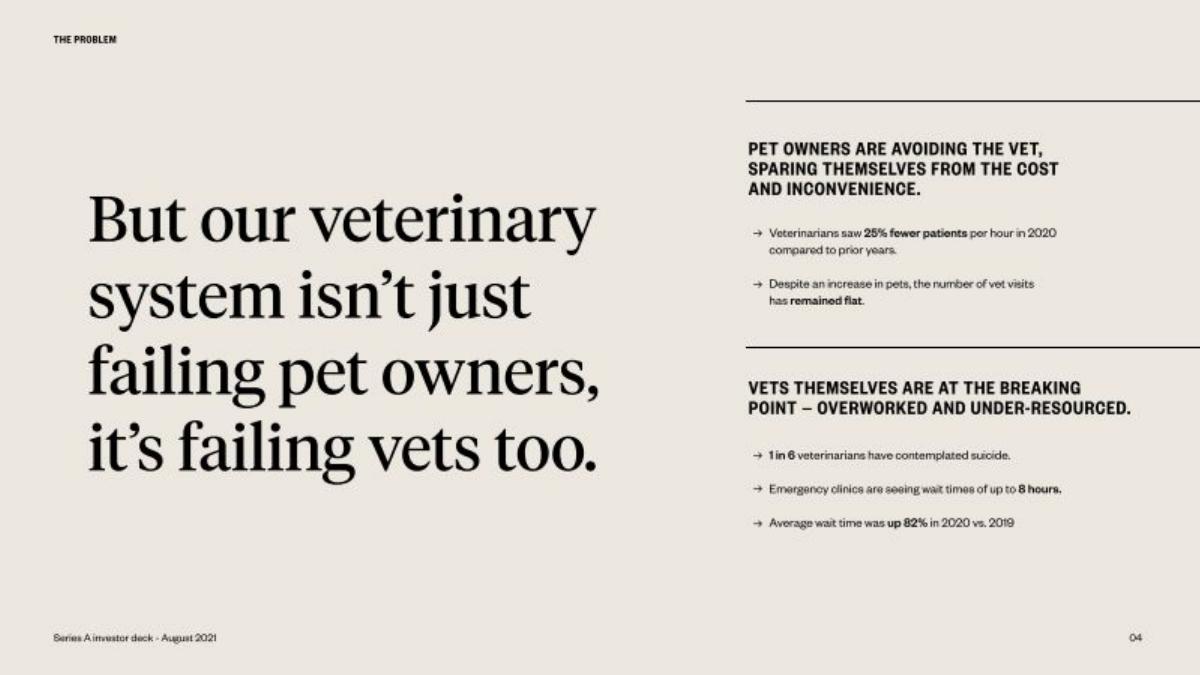
Online vet care. A large serif headline on the left, two blocks of figures on the right.
Dutch deck, slide 4. Exact stored slide matched to this analysis.
Our analysis: The strongest slide here: two groups who both lose, each with figures, and a headline that says it in one sentence.
Evidence and limitation: Five figures; no sources on this slide.
What a founder can adapt: If your product helps two sides, give each its own block and figures.
Supporting analysis
What the deck claims: "But our veterinary system isn't just failing pet owners, it's failing vets too." "Pet owners are avoiding the vet, sparing themselves from the cost and inconvenience." "Veterinarians saw 25% fewer patients per hour in 2020 compared to prior years." "Despite an increase in pets, the number of vet visits has remained flat." "Vets themselves are at the breaking point — overworked and under-resourced." "1 in 6 veterinarians have contemplated suicide." "Emergency clinics are seeing wait times of up to 8 hours." "Average wait time was up 82% in 2020 vs. 2019."
Presentation choice: Showing the vet's side too explains why the fix can't just be more clinics.
When it does not fit: Add sources; the suicide figure in particular needs one. The figures are small on a large slide.
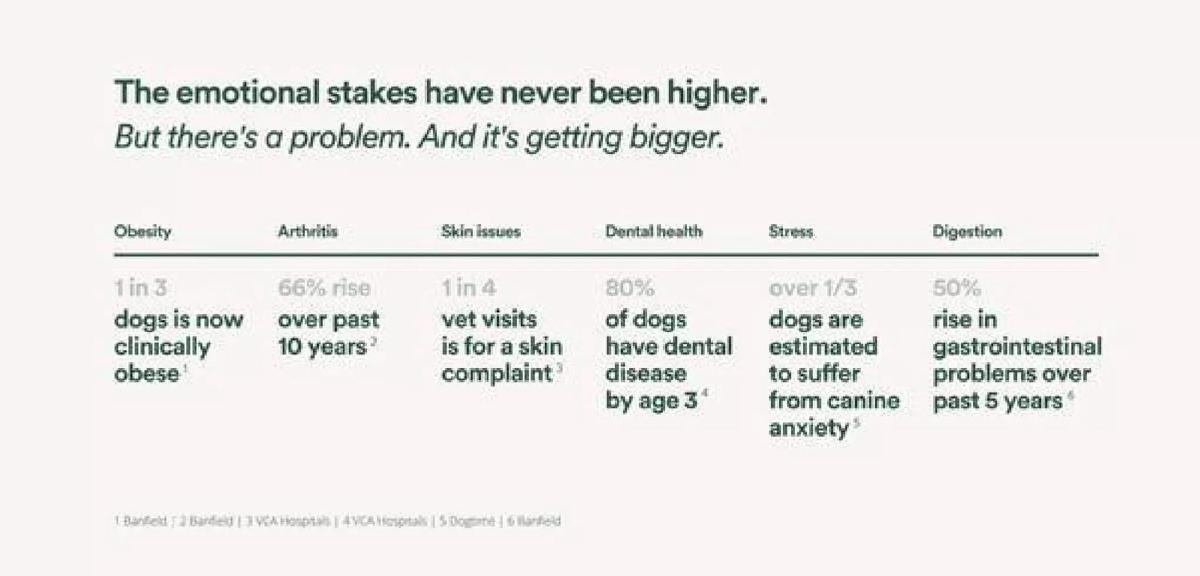
Dog health supplements. A headline and six columns, each a health problem with a figure, footnoted.
Front of the Pack deck, slide 3. Exact stored slide matched to this analysis.
Our analysis: Every figure has a source, and the layout is easy to scan.
Evidence and limitation: Six figures, each footnoted.
What a founder can adapt: Footnote each figure on the slide, not in an appendix.
Supporting analysis
What the deck claims: "The emotional stakes have never been higher. But there's a problem. And it's getting bigger." "Obesity: 1 in 3 dogs is now clinically obese." "Arthritis: 66% rise over past 10 years." "Skin issues: 1 in 4 vet visits is for a skin complaint." "Dental health: 80% of dogs have dental disease by age 3." "Stress: over 1/3 dogs are estimated to suffer from canine anxiety." "Digestion: 50% rise in gastrointestinal problems over past 5 years." Sources: Banfield, VCA Hospitals, Dogtime.
Presentation choice: The footnotes make six health claims believable.
When it does not fit: Six conditions is broad; say which ones your product treats.
Advice and products for new dog owners. Two figures, an arrow, and a root cause, over a photo of a dog behind a fence.
Puptimize deck, slide 3. Exact stored slide matched to this analysis.
Our analysis: It moves from outcome (dogs given up) to cause (owners unprepared) in one arrow.
Evidence and limitation: Two figures, both footnoted.
What a founder can adapt: Give the outcome, then an arrow to the cause your product fixes.
Supporting analysis
What the deck claims: "Pet owners are struggling." "63% of dogs are relinquished during their lifetimes." "3.9M dogs/year in shelters." "Lack of preparation and education is the root cause." Sources: "2015-2016 APPA National Pet Owners Survey", "2015 ASPCA estimate".
Presentation choice: Naming the root cause sets up the product without mentioning it.
When it does not fit: Say what "relinquished" costs the owner, not only the dog.
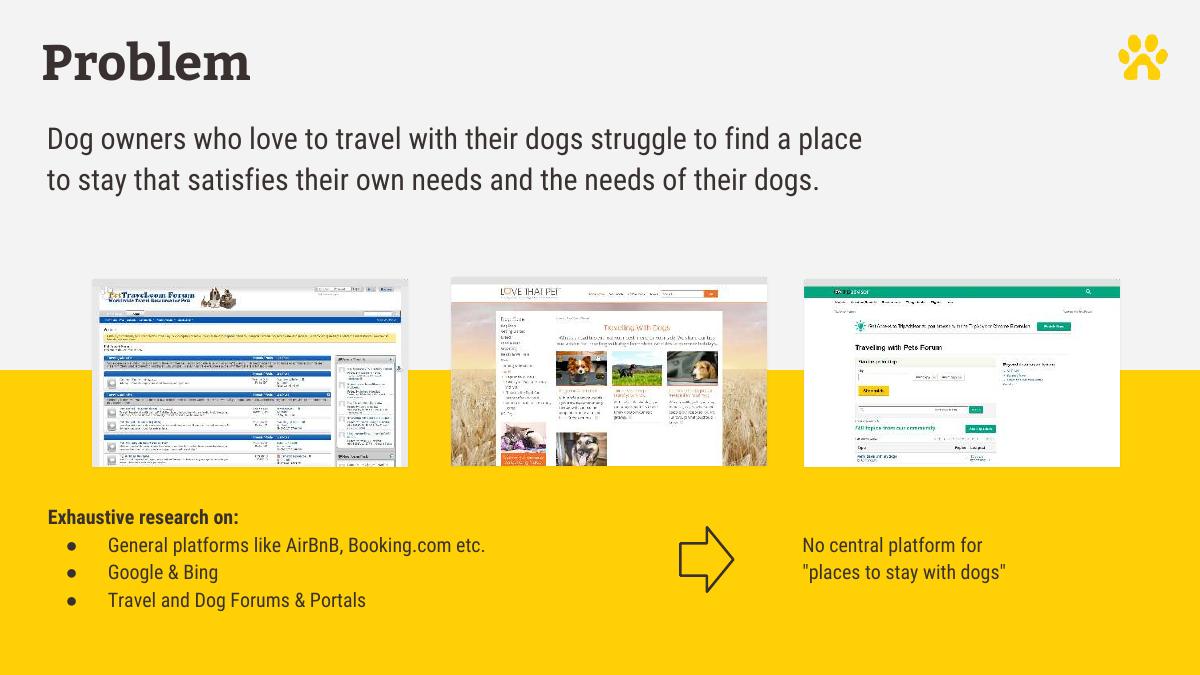
Dog-friendly places to stay. A problem sentence, three screenshots of forums and sites, and a yellow band.
DoggyHut deck, slide 3. Exact stored slide matched to this analysis.
Our analysis: A precise user and a clear picture of today's workaround: searching three kinds of sites.
Evidence and limitation: No figures; screenshots of current options.
What a founder can adapt: Show the sites or tools your user juggles today.
Supporting analysis
What the deck claims: "Dog owners who love to travel with their dogs struggle to find a place to stay that satisfies their own needs and the needs of their dogs." "Exhaustive research on: General platforms like AirBnB, Booking.com etc.; Google & Bing; Travel and Dog Forums & Portals." "No central platform for 'places to stay with dogs'."
Presentation choice: The screenshots show the effort instead of describing it.
When it does not fit: Add how many dog owners travel with their dogs, or how long the search takes.
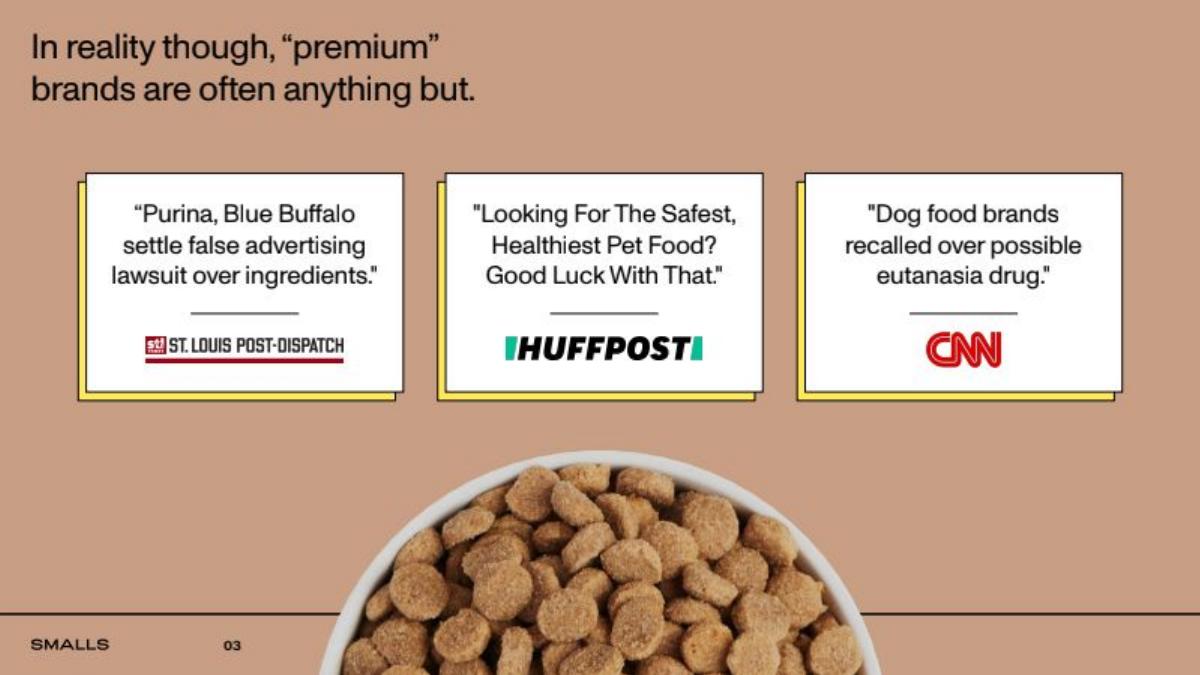
Fresh cat food. Three news headlines over a bowl of kibble.
Smalls deck, slide 2. Exact stored slide matched to this analysis.
Our analysis: Headlines from named outlets do the work of figures: they show the distrust is public, not the founder's opinion.
Evidence and limitation: Three attributed news headlines.
What a founder can adapt: If your problem is trust, quote named press or regulators.
Supporting analysis
What the deck claims: "In reality though, 'premium' brands are often anything but." "Purina, Blue Buffalo settle false advertising lawsuit over ingredients." (St. Louis Post-Dispatch) "Looking For The Safest, Healthiest Pet Food? Good Luck With That." (HuffPost) "Dog food brands recalled over possible eutanasia drug." (CNN)
Presentation choice: The kibble photo makes the target (dry food) clear.
When it does not fit: Headlines about dog food on a cat food deck; add one figure on cat health or spending. The slide's own page number reads 03, but it is the second stored slide.
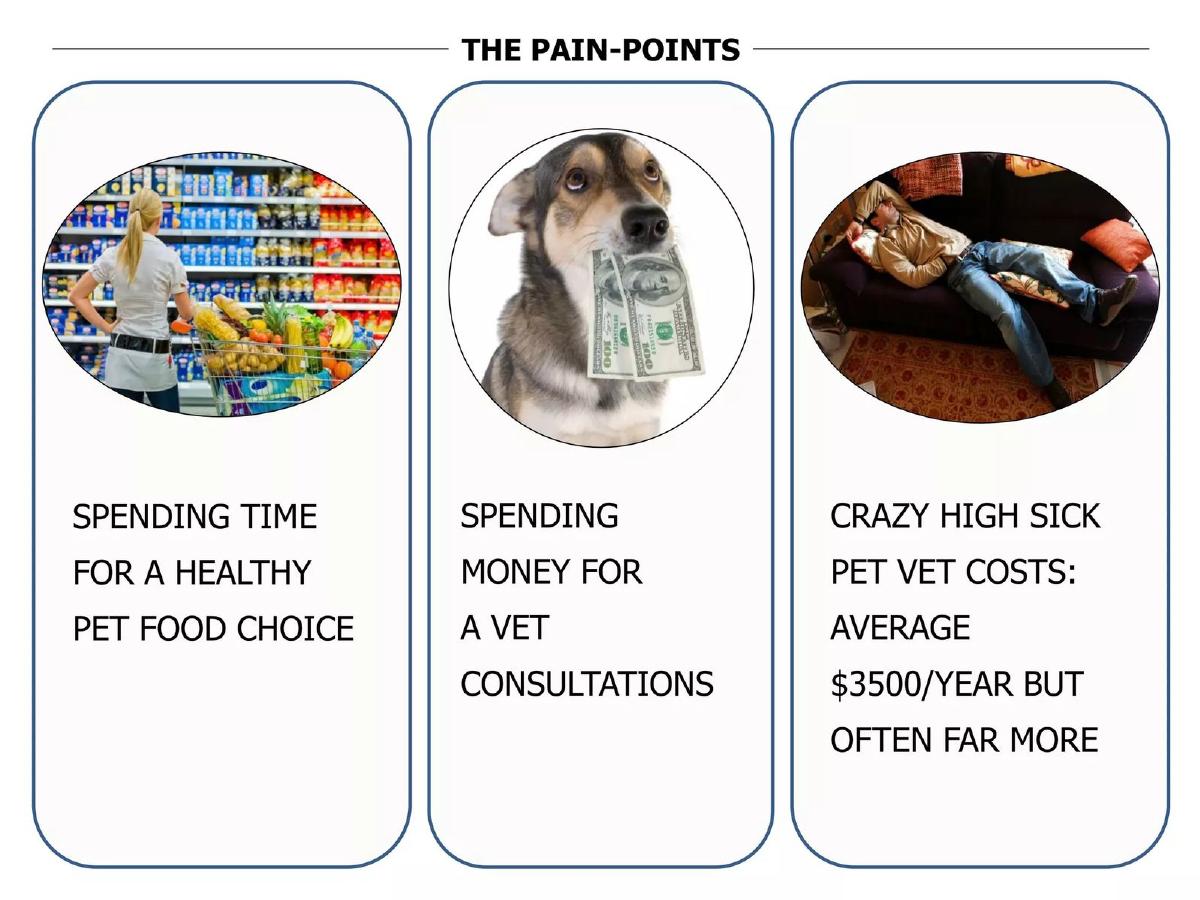
Pet food and health. Three rounded boxes, each with a photo and a capitalised line.
Happy Tom deck, slide 5. Exact stored slide matched to this analysis.
Our analysis: It links food choice to vet bills, which is the case for healthier food.
Evidence and limitation: One figure, unsourced.
What a founder can adapt: Connect the everyday choice to the expensive outcome with one figure.
Supporting analysis
What the deck claims: "The pain-points." "Spending time for a healthy pet food choice." "Spending money for a vet consultations." "Crazy high sick pet vet costs: average $3500/year but often far more."
Presentation choice: The $3,500 vet bill is a cost owners feel.
When it does not fit: Source the $3,500; the photos (a supermarket, a dog holding cash, a man on a sofa) add little.
Dog park with a café. Two first-person lists beside a photo of a running dog. Partial.
Mutts and Mugs deck, slide 4. Exact stored slide matched to this analysis.
Our analysis: Written in the owner's voice, which works, but eleven points in small text bury the two that matter: safety and food.
Evidence and limitation: One figure in the footer, unsourced.
What a founder can adapt: Keep the owner's voice, but pick three lines.
Supporting analysis
What the deck claims: "Dog Gone Problem." "When I go to the dog park... I have to stop and buy food and drinks at a different location; There are no dog mediators to monitor for aggressive dogs; I am uncomfortable bringing my dog because either the dog park is dirty or I do not know if other dogs are vaccinated, neutered or spayed..." "When I go out to dine... I cannot bring my dog and I feel terrible leaving my dog at home." "Dog owners spend over $50bn on their dogs annually."
Presentation choice: First-person lines show the founder has listened to owners.
When it does not fit: The $50bn footer is market size, not the problem.
Pet profiles shared by owners and service providers. Two long paragraphs in small grey text. Weak on purpose.
Kriddr deck, slide 3. Exact stored slide matched to this analysis.
Our analysis: The story of Jane and her dog walker is a good idea, but problem, solution and adoption are all in one block of small text.
Evidence and limitation: No figures.
What a founder can adapt: Take one line, owners don't keep pet records up to date, and give a figure for it.
Supporting analysis
What the deck claims: "B2C: Pet Profile Management." "Overview: Pet owners face many challenges providing the best care for their pets. However, most pet owners have not adopted mobile technology to support their efforts... we simply cannot rely on people to update profiles themselves at scale." "User Adoption Process: Jane owns Sammy, an Australian Huskie..."
Presentation choice: It shows what the stronger slides avoid: a page of text in place of one clear problem.
When it does not fit: Move the Jane story to the solution slide as a short sequence.
Whether each slide names who suffers, what goes wrong, and a sourced number.
Example
Who suffers
What goes wrong
Sourced number
Dutch
Owners and vets
Yes (vet visits skipped)
Figures, no sources
Front of the Pack
Dogs
Yes (six health problems)
Yes (six, footnoted)
Puptimize
Dogs and owners
Yes (dogs given up)
Yes (two, footnoted)
DoggyHut
Travelling dog owners
Yes (nowhere to stay)
No
Smalls
Owners (implied)
Yes (misleading food)
Named press, no figure
Happy Tom
Owners
Partly (vet costs)
One, unsourced
Mutts and Mugs
Dog owners
Partly (eleven points)
Market size only
Kriddr
Owners
Buried in text
No
Key Takeaways
Don't spend the problem slide on how much people love pets; investors know, and it belongs on the market slide.
Name what goes wrong: the vet visit skipped, the dog given up, the hotel that won't take dogs.
Say who suffers: the owner, the animal, or the vet. Dutch shows two of them.
Source health figures; pet claims are easy to exaggerate, and Front of the Pack and Puptimize footnote theirs.
A named root cause ("lack of preparation and education") points straight to the product.
Build your pet problem slide
One owner or animal, what goes wrong, one sourced number.
Who. Which owner or animal: species, age, situation?
What goes wrong. What happens: a skipped vet visit, a health problem, a dog given up?
Number. How often or how much, with a source on the slide.
Cause. Why it happens, in a way your product can fix.
Copyable framework: [Share] of [owners/animals] [what goes wrong] because [cause]. It costs [amount or outcome]. (Source: [source].)
Illustrative example 1 — written by us
Before: Pets are family, and owners want the best for them.
After: 4 in 10 cat owners skip the annual vet check because taking a cat to the clinic is stressful; a missed kidney problem costs about $2,000 to treat later. (Source: our survey of 600 owners.)
What improved: Our illustrative rewrite; the figures are invented for the example. It names the owner, what goes wrong, the cause and the cost.
What this guide adds
Pet decks appear in the food and marketplace guides only when they fit those topics. This guide looks at pet startups as a group: vet care, pet food, dog travel, dog parks and pet apps, where the investor's question is what owners will pay to fix.
The slides range from vet care (Dutch) and health supplements (Front of the Pack) to food (Smalls, Happy Tom), dog ownership advice (Puptimize), travel (DoggyHut), a dog park café (Mutts and Mugs) and pet profiles (Kriddr).
Three things a pet problem slide proves
Who suffers: "Pet owners" and "Vets" (Dutch), "Dog owners who love to travel with their dogs" (DoggyHut), dogs with health problems (Front of the Pack).
What goes wrong: vet visits skipped (Dutch), dogs given up (Puptimize), no dog-friendly places to stay (DoggyHut), false claims on premium food (Smalls).
How much, with a source: "25% fewer patients per hour" (Dutch), "1 in 3 dogs is now clinically obese" (Front of the Pack, footnoted to Banfield), "63%" relinquished (Puptimize, footnoted to an APPA survey).
Common mistakes
"Pets are family" as the problem. It's the reason the market exists, not a problem.
Unsourced health figures. Footnote them, as Front of the Pack and Puptimize do.
Market size in the footer. "$50bn on dogs" belongs on the market slide.
Too many points. Eleven complaints or six conditions: pick the ones you fix.
The solution in the problem. Keep the user story for the next slide.
Diagnostic checklist
It names a specific owner or animal.
It says what goes wrong.
It gives one number with a source.
It names a cause your product can fix.
Love of pets and market size are elsewhere.
Frequently asked questions
How we chose these examples
Corpus: published pitch deck teardowns on StartupFundraising.com. Founder-uploaded private decks are excluded.
Selection (2026-09-25): we searched slides 2–6 for slides mentioning pets, dogs, cats, pet owners, pet food or vets together with a problem. Ten stored images were inspected. HelloBello slide 5 was excluded because it already appears in the food problem guide (the duplicate HelloBello deck shows the same slide); McLovin's slides are market figures, not problems; Petmates slide 3 was left out as a thinner version of the same point as DoggyHut. Mutts and Mugs is marked partial; Kriddr is kept as a weaker contrast.
Overlap check: none of these eight slides appears in another guide.
Review: all eight stored slide images were inspected on 2026-09-25 and matched to company, deck and slide number (editorial model review). No person has yet completed an editorial review of this page.
Claims are as shown on the slides; we have not verified them. We make no claim that any slide caused a fundraising outcome.