Mutts and Mugs is a recreational services concept combining an outdoor dog park with a food and beverage pub. The deck focuses heavily on the 'why now' of the pet industry, citing that 2018 pet expenditures reached $72bn (Slide 2). Unlike many early-stage decks that remain theoretical, this presentation highlights significant operational progress, including a 3-year executed lease for a 28,000 sq. ft. space in Sacramento and the acquisition of key regulatory approvals like an ABC License (Slide 8). While the deck excels at proving local demand and site viability, it lacks traditional financia…
Key takeaways
- The company identifies a massive market shift where 60 million American households own dogs, exceeding the 40 million households with children (Slide 6).
- Operational readiness is a core strength, with a secured 28,000 sq. ft. location at 6622 Freeport Blvd in Sacramento (Slide 8).
- The business model relies on a 'members-only' off-leash area paired with a public-facing on-leash food and beverage zone (Slide 4).
- Regulatory hurdles are largely cleared, with the deck reporting secured Sacramento City Planning and State Modular Container permits (Slide 8).
- Synergistic foot traffic is built into the site selection, as an existing dog groomer on the parcel is booked one year in advance (Slide 10).
- The marketing strategy leans heavily on community engagement, citing 100% support from a 13k resident neighborhood association (Slide 10).
- The deck omits a formal management team slide, leaving the founders' professional backgrounds unknown.
- There is no clear financial ask or equity breakdown provided in the reviewed slides, despite a mention of an 'Equity Offering' in the marketing strategy (Slide 14).
Executive Summary and Vision
Mutts and Mugs is a hospitality concept that attempts to bridge the gap between public dog parks and traditional pubs. The deck, titled 'A hangout for dogs and their best friends,' positions the company as a community-centric recreational service. The presentation follows a logical progression from macro market trends to specific local execution, though it leans more toward a real estate development pitch than a high-growth tech startup deck.
Slide 1: Title and Roadmap
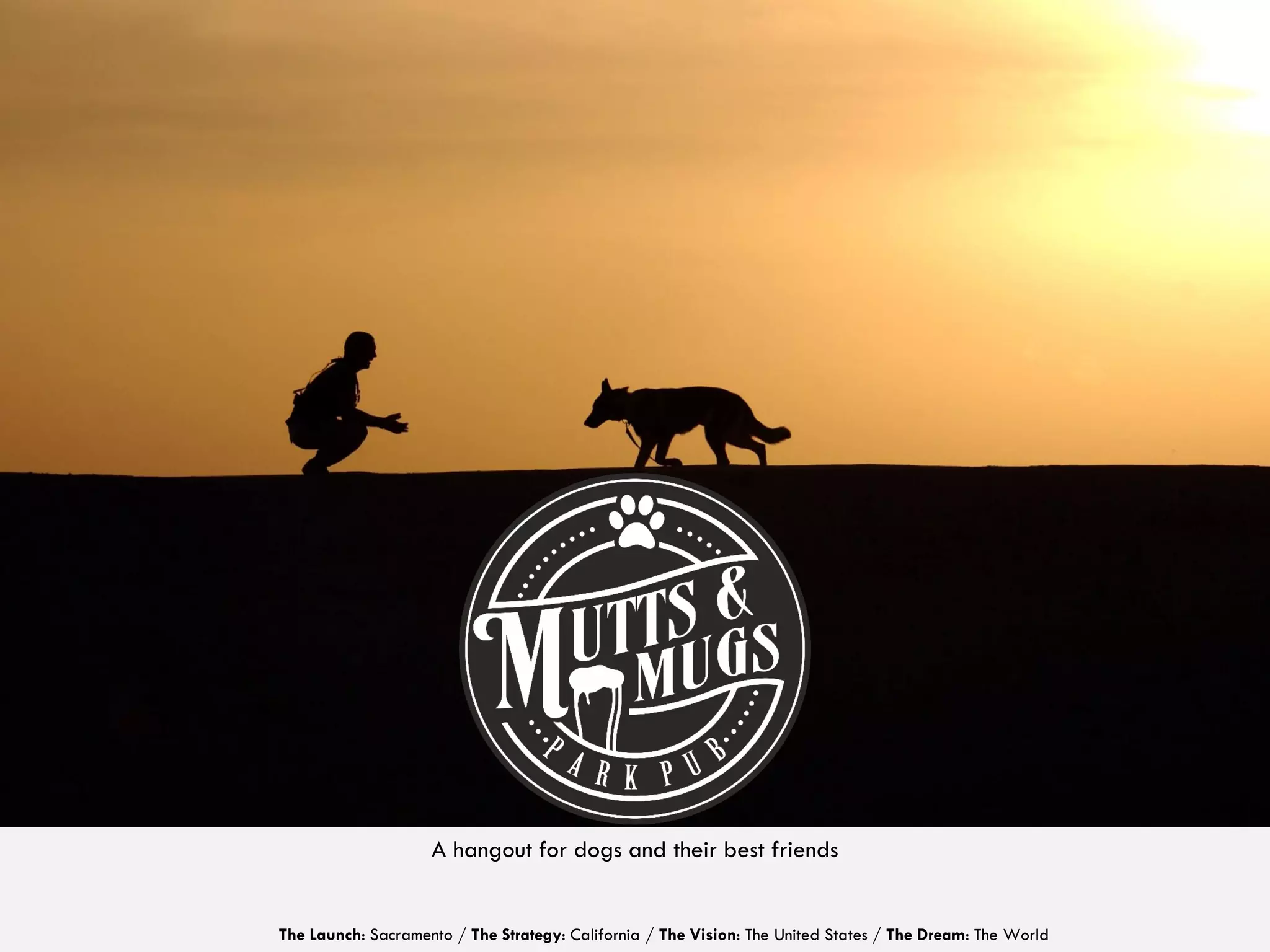
The cover slide establishes the brand identity and a four-stage growth roadmap: The Launch (Sacramento), The Strategy (California), The Vision (United States), and The Dream (The World). This indicates that while the current focus is hyper-local, the founders intend to franchise or scale the model. The logo prominently features a beer mug and a paw print, immediately communicating the dual-purpose nature of the business.
Slide 2: Pet Industry Growth
This slide serves as the 'Why Now' argument. It uses a bar chart to show annual pet expenditures growing from under $20bn in 1994 to $72bn in 2018. A pie chart breaks down these expenditures, showing that 'Food' ($29.9bn) and 'Supplies/Medicine' ($15.5bn) are the largest segments. Crucially, the slide notes that pet spending continued to grow even during recessions, framing the business as a recession-resistant investment. The text also lists extreme examples of pet spending, such as 'wagyu food' and 'cloning,' to illustrate the depth of the 'pet parent' psyche.
Slide 4: The Solution and Concept
The solution is defined as an outdoor space where customers can walk/drive to the location, order food and beverages, and then enter a member-only off-leash area. The slide uses a three-step visual flow: On-leash Area, Off-leash Area, and Enjoy. This segmentation is vital for operational safety and regulatory compliance. The bottom of the slide reinforces the emotional hook, stating that 70% of Americans consider their dog to be part of the family.
Slide 6: Market Size
Rather than a traditional TAM/SAM/SOM slide, Mutts and Mugs uses a series of data points to justify the market. The most compelling figure is 'DOGS v. KIDS,' stating there are 60 million dog-owning households compared to 40 million with children. Other metrics include the fact that 150 million Americans drink espresso/lattes daily and 50% drink beer or wine daily. This slide attempts to prove that the intersection of dog owners and beverage consumers is a massive, underserved demographic.
Slide 8: Development Summary
This is arguably the strongest slide in the deck for a local investor. It moves from theory to reality. The company has secured a 3-year lease (with two 5-year options) for a 28,000 sq. ft. space at 6622 Freeport Blvd, Sacramento. The slide also lists a checklist of regulatory approvals. They have secured the Sacramento City Planning Permit, State Modular Container Permit, and the ABC License. The only pending items are the Environmental Health and Building Permits. This level of 'de-risking' is rare in early-stage pitches.
Slide 10: Site Specifics and Synergies
This slide explains why the Freeport Blvd location was chosen. It cites traffic counts (15,000 daily) and a 'thumbs up' from a 13,000-resident neighborhood association. A key strategic advantage mentioned is the 'Dog Groomer on-Site.' The business 'Friends of Bailee' is already located on the parcel and is booked one year in advance, providing a built-in customer base. The slide also mentions a nearby 4,900-unit residential development, suggesting future growth in the immediate vicinity.
Slide 12: Consumer Testimonials
The deck includes a slide of 'Interested Consumer Testimonials.' These are presented as social media-style snippets from local residents and their dogs (e.g., 'Gizmo Goes Sactown'). While these are not 'traction' in the sense of revenue, they serve as a proxy for community demand and brand sentiment. The footer notes that 91% of adults without children think of their dogs as their children, further driving home the 'pet parent' theme.
Slide 14: Marketing Strategy
The marketing plan is a mix of traditional and community-based tactics. It lists Pre-Launch Events, Founding Memberships, Social Media Campaigns, and an Equity Offering. The imagery shows a variety of community events, including dogs in Halloween costumes and photos with Santa. This suggests the founders have already begun building a community through pop-up events or social media before the physical location is fully operational.
Slide 16: Appendix – Preliminary Design Renderings
The appendix provides a site map and 3D renderings of the facility. The site map shows a 'Small dog park' and an 'All dog park' separated by a path, with the food/drink area located at the top right. The renderings show a modern, industrial aesthetic using shipping containers, which aligns with the 'State Modular Container Permit' mentioned on Slide 8. This design choice suggests a focus on cost-effective, relatively quick construction.
Slide 19: Launch Imagery
The final slide is a collage of lifestyle photography featuring dogs, beer, wine, and burgers. The headline 'Coming to California 2019 – Launching out of Sacramento' sets a clear timeline for the project. It serves as a visual summary of the brand's 'vibe' rather than providing new data.
What Mutts and Mugs Does Well
The deck is exceptionally strong at proving local viability . By securing a lease and an ABC license before finalizing the raise, the founders have removed the two biggest hurdles for any hospitality business. The use of hyper-local data—such as the specific car counts on Freeport Blvd and the booking status of the neighboring groomer—shows a level of due diligence that inspires confidence in the operational plan. Furthermore, the deck does a great job of tapping into the 'pet humanization' trend, using data to show that dogs are increasingly treated as family members with significant discretionary spending power.
What is Missing from the Deck
The most glaring omission is the Team Slide . In a hospitality and real estate play, the background of the founders is critical. Investors need to know if the team has experience running bars, managing large-scale outdoor facilities, or navigating California's complex regulatory environment. Without this, the project looks like a hobbyist endeavor rather than a professional business. Additionally, there are no Financial Projections . There is no mention of the cost to build out the site, the projected revenue per member, or the break-even timeline. Finally, the Ask is missing. While an 'Equity Offering' is mentioned, the deck does not state how much money is being raised or what the funds will be used for (e.g., construction, staffing, marketing).
Founder Takeaways: What to Copy
De-risk before you pitch: Securing a lease and key permits (Slide 8) makes a 'maybe' project look like an 'inevitable' one. · Identify built-in synergies: Locating next to a business with a one-year waiting list of your target customers (Slide 10) is a brilliant way to solve the 'cold start' problem of customer acquisition. · Use macro trends to support micro ideas: The 'Dogs v. Kids' data (Slide 6) elevates a local dog park pub into a play on a massive demographic shift. · Visualizing the space: For any physical location, high-quality renderings (Slide 16) are essential for helping investors see the vision.
Frequently asked questions
- What is the primary revenue model for Mutts and Mugs?
- Based on Slide 4 and Slide 14, the revenue model is multi-faceted. It includes food and beverage sales from the pub, 'Founding Memberships' for access to the off-leash dog area, and potentially event-based revenue from a 10,000 sq. ft. concrete pad designed for special events. The deck emphasizes the 'members' aspect for the off-leash area, suggesting a recurring or subscription-based component to the park access.
- How does the company address the risks of mixing dogs and alcohol?
- The deck addresses this through physical segmentation. Slide 4 illustrates a clear flow: an 'On-leash Area' where customers order food and beverage, and a separate 'Off-leash Area' where members can unleash their dogs. Slide 8 also confirms they have already secured an ABC (Alcoholic Beverage Control) license, indicating they have met local legal requirements for serving alcohol in this specific environment.
- What is the significance of the Freeport Blvd location?
- The location is a strategic asset. Slide 10 notes that 15,000 cars pass the site daily, with another 30,000 on nearby cross-streets. Furthermore, a master-planned community (Delta Shores) with 4,900 residential units is being built 5 miles away. The site also shares a parcel with a popular dog groomer, 'Friends of Bailee,' which provides a pre-existing stream of the target demographic.
- Is this a scalable tech startup or a local small business?
- The deck hints at global ambitions on Slide 1 ('The Dream: The World'), but the content is strictly focused on a single-site launch in Sacramento. The use of modular containers (Slide 8) suggests a desire for a repeatable, lower-cost construction model, but without unit economics or a multi-site rollout plan, it currently reads as a local hospitality project.
- What key information is missing from this pitch deck?
- The most notable omissions are the team slide, the financial projections, and the specific investment ask. There is no mention of the founders' experience in hospitality or animal behavior. Additionally, while the deck mentions an 'Equity Offering' (Slide 14) and a 'Direct Public Offering' permit (Slide 8), it does not state how much capital is being raised or at what valuation.