Prospective Plus (CareerApp) pitches a standardized 'Common Job Application' platform specifically designed for entry-level candidates. The deck identifies high corporate turnover costs—estimated at 25% of an employee's annual salary on slide 4—as a primary driver for their solution. The product strategy relies on a 15-component application including behavioral interviews and culture fit rankings. While the deck provides an unusually granular fee schedule on slide 11, ranging from $500 for micro-businesses to $20,000 for large job sites, it lacks critical investor data. There is no mention of…
Key takeaways
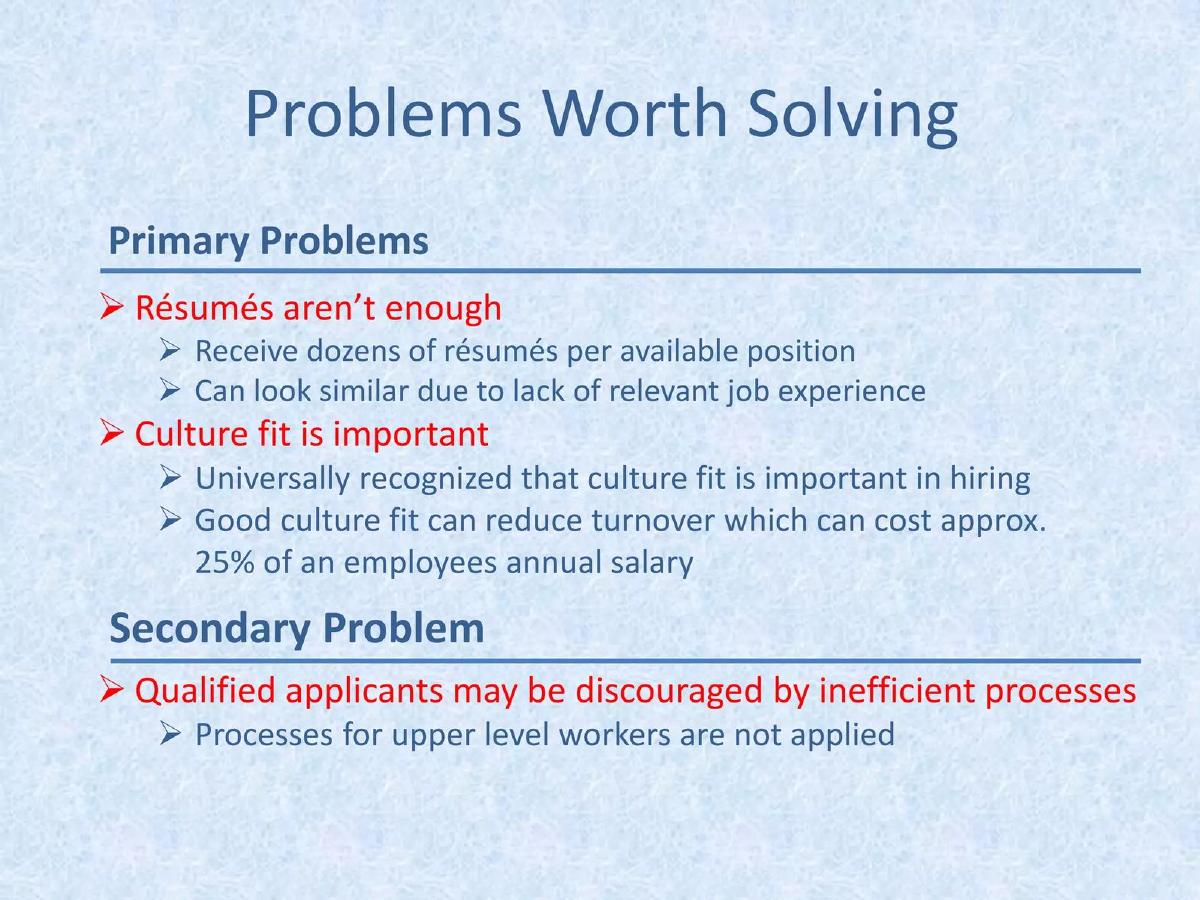
- The company identifies culture fit as a primary hiring problem, noting turnover costs approximately 25% of an annual salary (Slide 4).
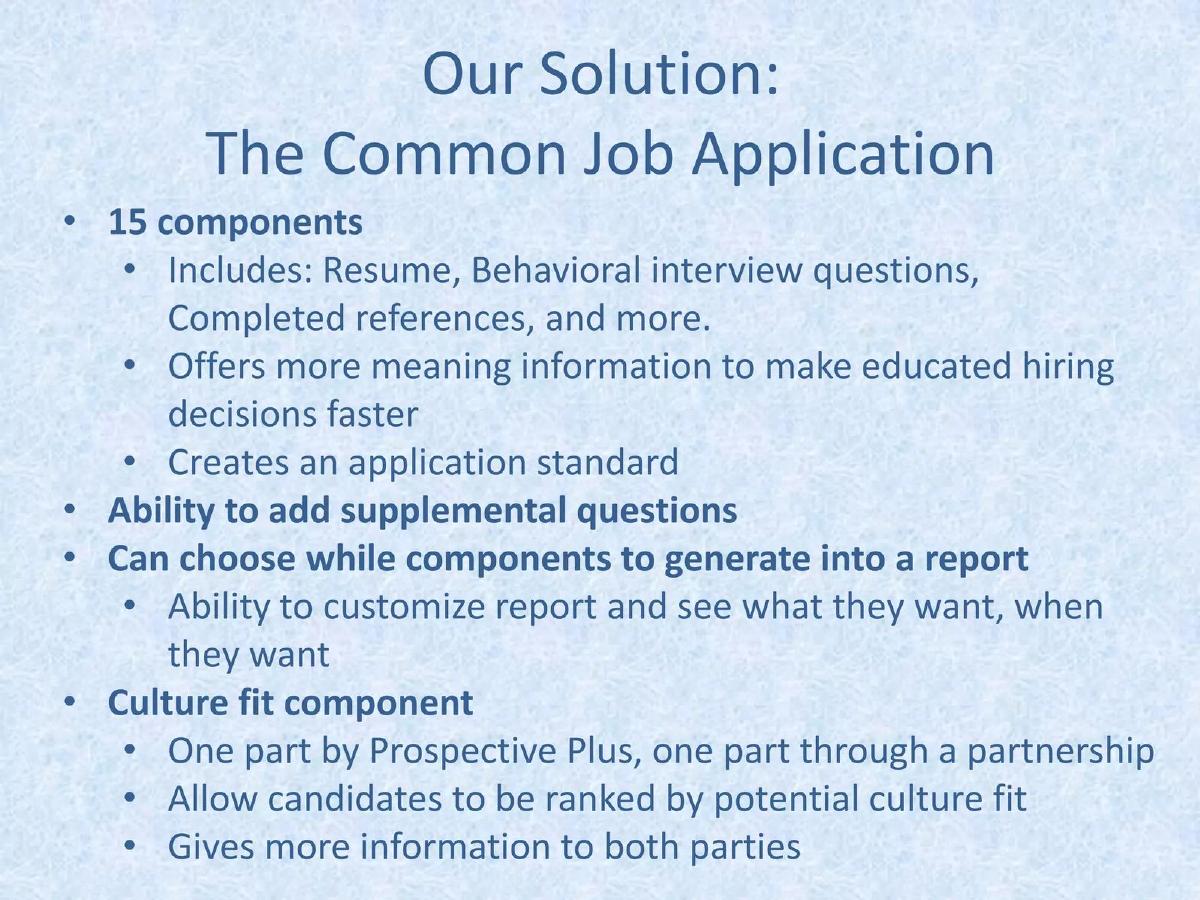
- The solution is a 15-component 'Common Job Application' that includes behavioral questions and reference checks (Slide 5).
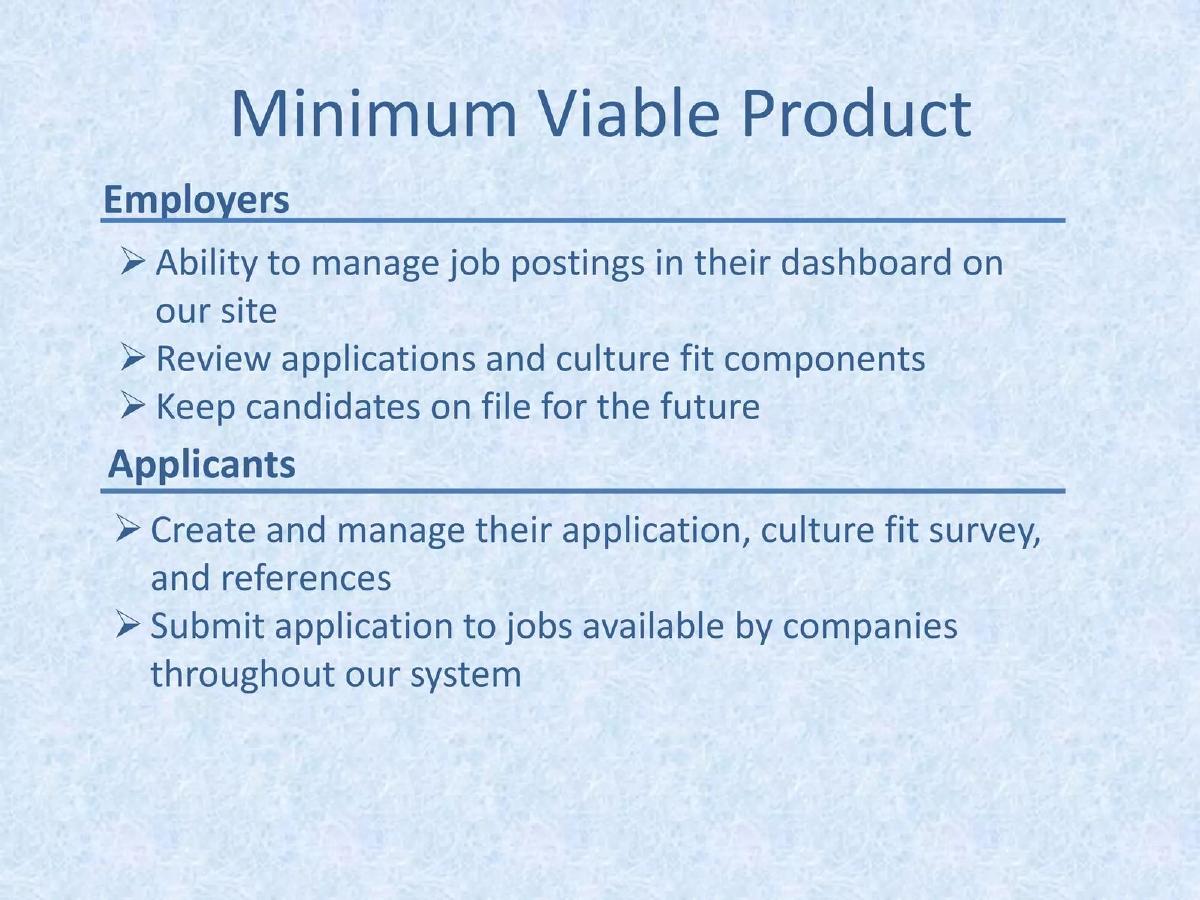
- The MVP focuses on a dashboard for employers to manage postings and a portal for applicants to manage surveys (Slide 6).
- The business model utilizes a three-pronged go-to-market strategy: Direct B2B sales, targeting employers, via a SaaS platform (Slide 8).
- Revenue streams are diversified across annual subscriptions, third-party supplements like background checks, and advertising (Slide 10).
- Pricing is highly specific, with flat annual fees ranging from $500 for micro-businesses to $18,000 for large businesses with up to 2,500 employees (Slide 11).
- The deck positions the product as a $10,000 average annual cost alternative to enterprise competitors like Taleo, which it claims costs $250,000 annually (Slide 13).
- The deck completely omits a financial ask, use of funds, or any mention of current user traction or revenue.
Executive Summary
Prospective Plus, identified in SlideShare listings as CareerApp, presents a pitch deck focused on the entry-level recruitment market. The deck follows a traditional problem-solution narrative, emphasizing the inefficiency of current resume-based hiring and the high cost of turnover. While the deck is strong on pricing transparency and product components, it is notably silent on traction and the specific capital requirements of the business.
Slide 1: Title Slide
The cover slide introduces the brand 'Prospective Plus' with the tagline 'A Common Job Application.' The visual identity uses a blue and yellow color scheme with a cross icon, suggesting a focus on 'adding' value or health to the hiring process.
Slide 2: Team
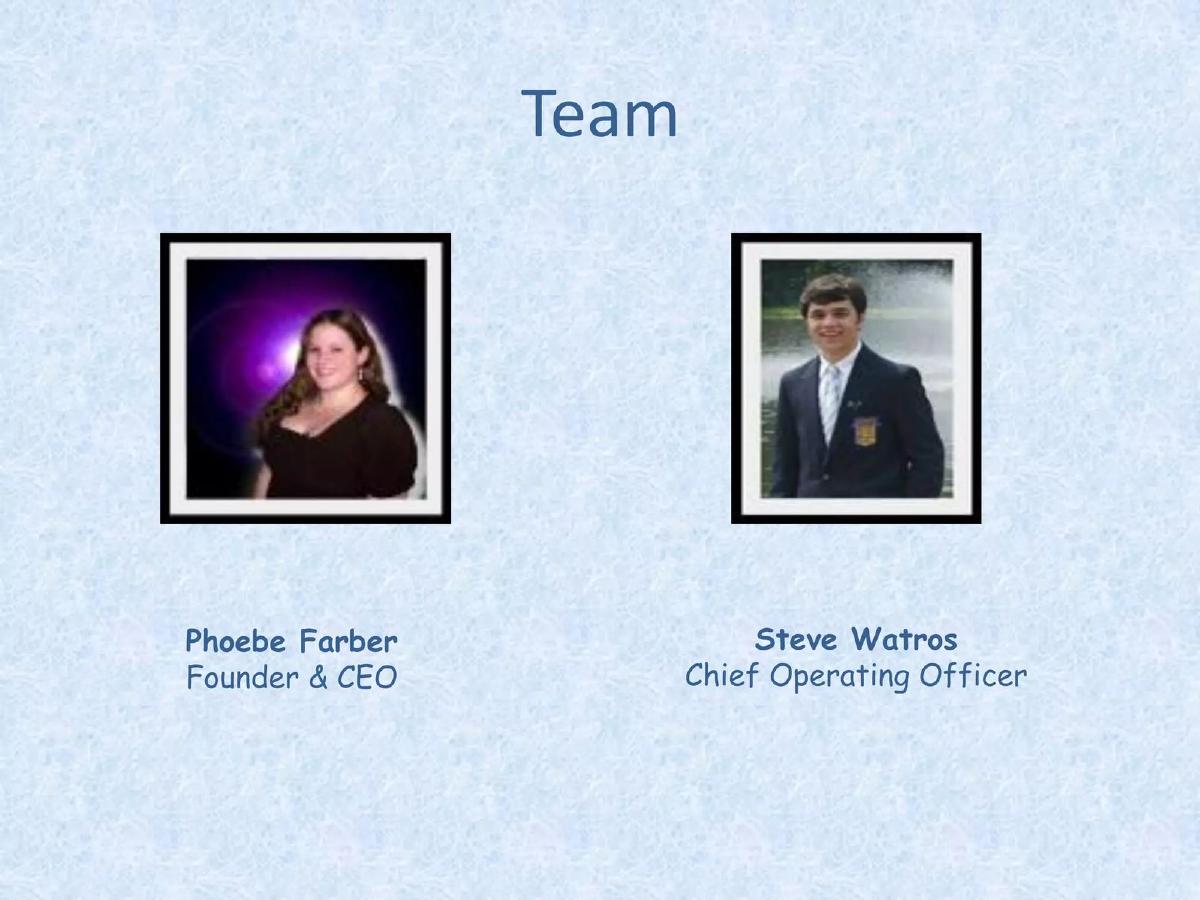
The team slide features Phoebe Farber (Founder & CEO) and Steve Watros (Chief Operating Officer). Unlike most modern decks, this slide provides no biographical information, educational background, or past professional achievements. It relies entirely on names and titles, which fails to establish founder-market fit for an investor.
Slide 3: Mission and Promise
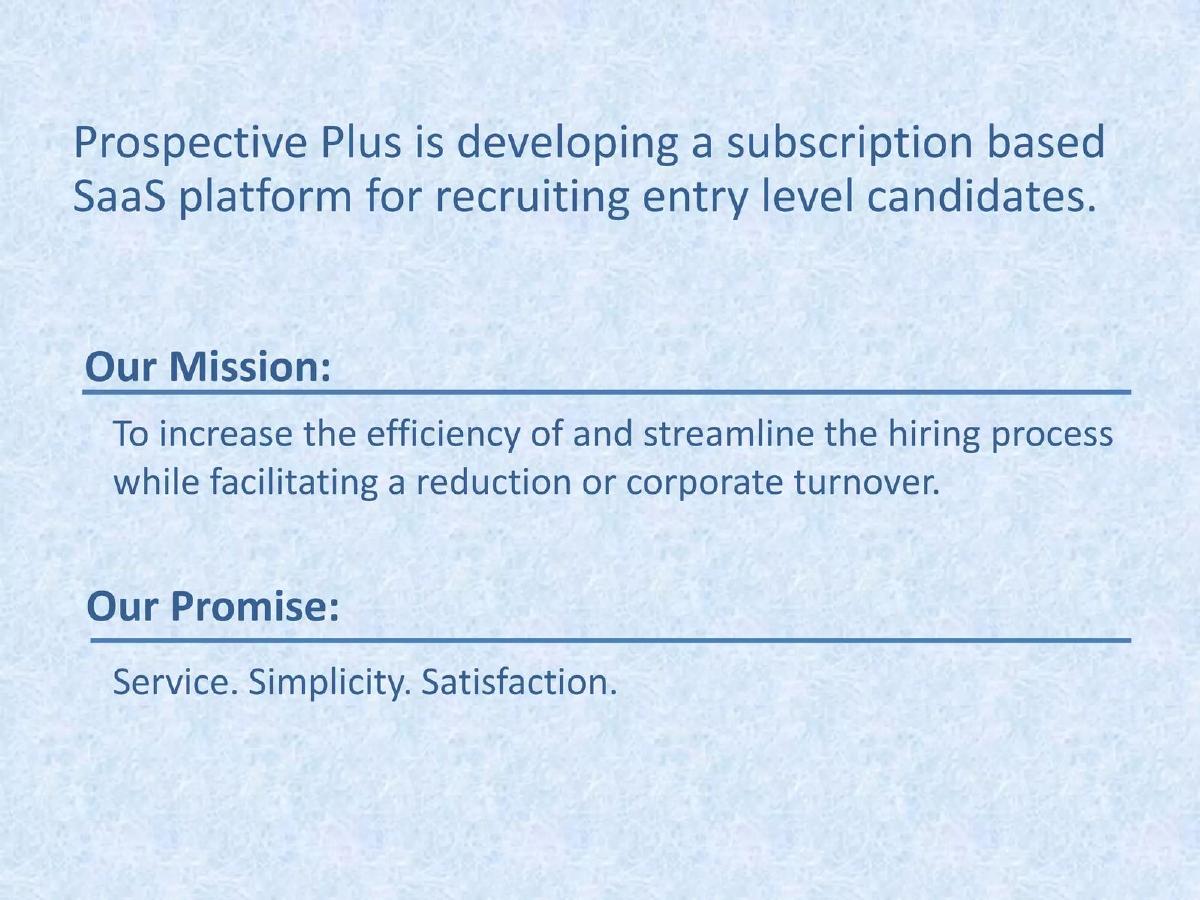
This slide defines Prospective Plus as a subscription-based SaaS platform for entry-level candidates. The mission is stated as increasing hiring efficiency and reducing corporate turnover. The 'Promise' section lists three keywords: Service, Simplicity, and Satisfaction. This slide serves as a high-level positioning statement but lacks specific data.
Slide 4: Problems Worth Solving
The deck categorizes problems into Primary and Secondary. The primary issues are that resumes are insufficient for entry-level roles due to a lack of experience and that culture fit is difficult to measure. Slide 4 provides a specific metric: turnover can cost approximately 25% of an employee's annual salary. The secondary problem is that inefficient processes discourage qualified applicants.
Slide 5: Our Solution: The Common Job Application
The solution is a standardized application consisting of 15 components. These include resumes, behavioral interview questions, and references. The slide highlights the ability to add supplemental questions and a 'Culture fit component' that ranks candidates. This is the first mention of a partnership model for the culture fit aspect of the product.
Slide 6: Minimum Viable Product (MVP)
This slide breaks down the MVP features for two user groups. For employers, it includes a dashboard for job postings and candidate filing. For applicants, it includes tools to manage applications, culture fit surveys, and references. This slide clarifies that the product is a two-sided marketplace/portal.
Slide 7: Ultimate Vision
The vision slide outlines future feature sets, including 3rd party supplements like background checks, compatibility services, and aptitude tests. It also mentions an integrated application tracking system (ATS) and analytics. This slide functions as a product roadmap but lacks specific dates or development milestones.
Slide 8: Business Model
The business model is presented as a triangle diagram. The 'What' is the SaaS platform, the 'Who' is employers, and the 'How' is direct B2B sales. This is a very high-level view of the go-to-market strategy and does not detail customer acquisition costs or sales cycle lengths.
Slide 9: Market Potential
Rather than providing a dollar value for the TAM (Total Addressable Market), slide 9 presents a conceptual formula: # of unemployed people + # of job openings + prevalence of online searches + economic effect of turnover + addressable market opportunity = Potential. This is a weak slide for a professional pitch, as it avoids hard data in favor of a logic model.
Slide 10: Revenue Streams
The company identifies three revenue sources: Annual Subscriptions, 3rd Party Relationships (referral fees for supplements), and Advertising. The advertising section is broad, mentioning banner ads, video tutorials, and book promotions, which may suggest a lack of focus on the core SaaS revenue model.
Slide 11: Fee Schedules
This is the most detailed slide in the deck. It provides flat annual fees across three categories: Individual Companies ($500 to $18,000+), Headhunters/Recruiters ($200 to $1,500+), and Job Search Sites ($3,000 to $20,000). It also notes a $20 surcharge per profile requested for recruiters. This level of pricing transparency is rare in early-stage decks but helps define the target customer segments.
Slide 12: Competition
The competition slide displays logos for OneWire, Taleo, Kenexa, LinkedIn, Readyforce, and 'Internal Sites.' There is no commentary on this slide; it simply acknowledges the existence of these players in the recruitment space.
Slide 13: Us vs. Our Competition
This slide provides the differentiation. Prospective Plus claims to be 'General Purpose' compared to specialized recruiters, targets entry-level instead of executives, and offers a $10,000 average price point. It specifically contrasts its price against Taleo, which it lists at $250,000 annually. It also claims to offer a 'Standard Product' versus the 'complex product offerings' of incumbents.
Slide 14: Contact Information
The final slide provides a 'Thank You' graphic and contact information for Phoebe Farber, including an email address and the company website.
What Prospective Plus Does Well
The deck is exceptionally clear about its pricing model. By providing a full fee schedule on slide 11, the founders eliminate ambiguity regarding their revenue expectations and target market segments. The focus on a specific niche—entry-level hiring—is a smart strategic move that allows them to differentiate from enterprise giants like Taleo and Kenexa, which often focus on high-value executive placements. The identification of the '25% turnover cost' provides a solid economic anchor for their value proposition.
Omissions and Weaknesses
The most glaring omission is the lack of traction. There is no evidence that a single employer has used the platform or that a single candidate has been placed. Without data on user growth or pilot programs, the deck feels like a theoretical exercise rather than a business ready for investment. Furthermore, the 'Market Potential' slide is a missed opportunity; investors need to see the actual size of the entry-level hiring market in dollars, not a math formula. The 'Team' slide is also insufficient, as it fails to explain why these two individuals are qualified to build a recruitment tech company. Finally, the absence of a 'The Ask' slide means the deck fails its primary purpose: asking for money.
Founder Takeaways
Be Specific with Pricing: If you have a tiered SaaS model, showing the actual numbers (as seen on Slide 11) can help investors understand your scaling logic and target customer profile. · Quantify the Problem: Citing the specific cost of turnover (25% of salary on Slide 4) makes the 'pain' tangible and justifies the subscription cost. · Avoid Conceptual Market Slides: Never use a formula to describe your market size. Research the actual TAM, SAM, and SOM and present them as currency figures. · Include a Call to Action: Every pitch deck must end with a clear ask—how much money you need, what milestones it will buy, and how investors can get involved.
Frequently asked questions
- What is the core product offered by Prospective Plus?
- The core product is a standardized 'Common Job Application' for entry-level roles. According to slide 5, this includes 15 components such as resumes, behavioral interview questions, and completed references. It also features a culture fit component, partially developed in-house and partially through partnerships, to rank candidates based on their alignment with a company's environment.
- How does the company plan to generate revenue?
- Revenue is generated through three main channels: annual SaaS subscriptions, third-party relationships, and advertising. Slide 10 details that advertising includes banner ads, video tutorials, and book promotions. Slide 11 provides a tiered fee schedule for different client types, including individual companies, recruiters/headhunters, and job search sites.
- Who are the primary competitors identified in the deck?
- Slide 12 lists six competitors: OneWire, Taleo, Kenexa, LinkedIn, Readyforce, and internal career sites. The company differentiates itself on slide 13 by focusing specifically on entry-level users rather than executives and offering a lower price point, citing an average cost of $10,000 compared to Taleo's $250,000.
- What metrics or traction are included in the pitch?
- The deck contains no metrics regarding current performance. There are no figures for active users, number of partner employers, revenue to date, or growth rates. The 'Market Potential' slide (Slide 9) uses a conceptual formula rather than providing specific Total Addressable Market (TAM) dollar values.
- What information is missing for a potential investor?
- The deck is missing several standard components: a specific funding ask, a 'Use of Funds' breakdown, a roadmap with milestones, and any financial projections. Additionally, the 'Team' slide (Slide 2) provides names and titles for the CEO and COO but omits their professional backgrounds, prior exits, or relevant industry experience.