Cardiff International Inc. (OTC: CDIF) utilizes a conglomerate model to acquire and scale diverse businesses. The January 2017 deck highlights three primary areas of concentration: income-producing real estate, closely held companies seeking exit strategies, and technology-oriented startups. The company demonstrates existing traction through its subsidiary, Repicci’s Italian Ice & Gelato, which claims a $3M revenue run-rate and 48+ units. The deck also details specific real estate holdings in Idaho and a pipeline of five acquisition targets valued between $12M and $51.5M. To fund this growth,…
Key takeaways
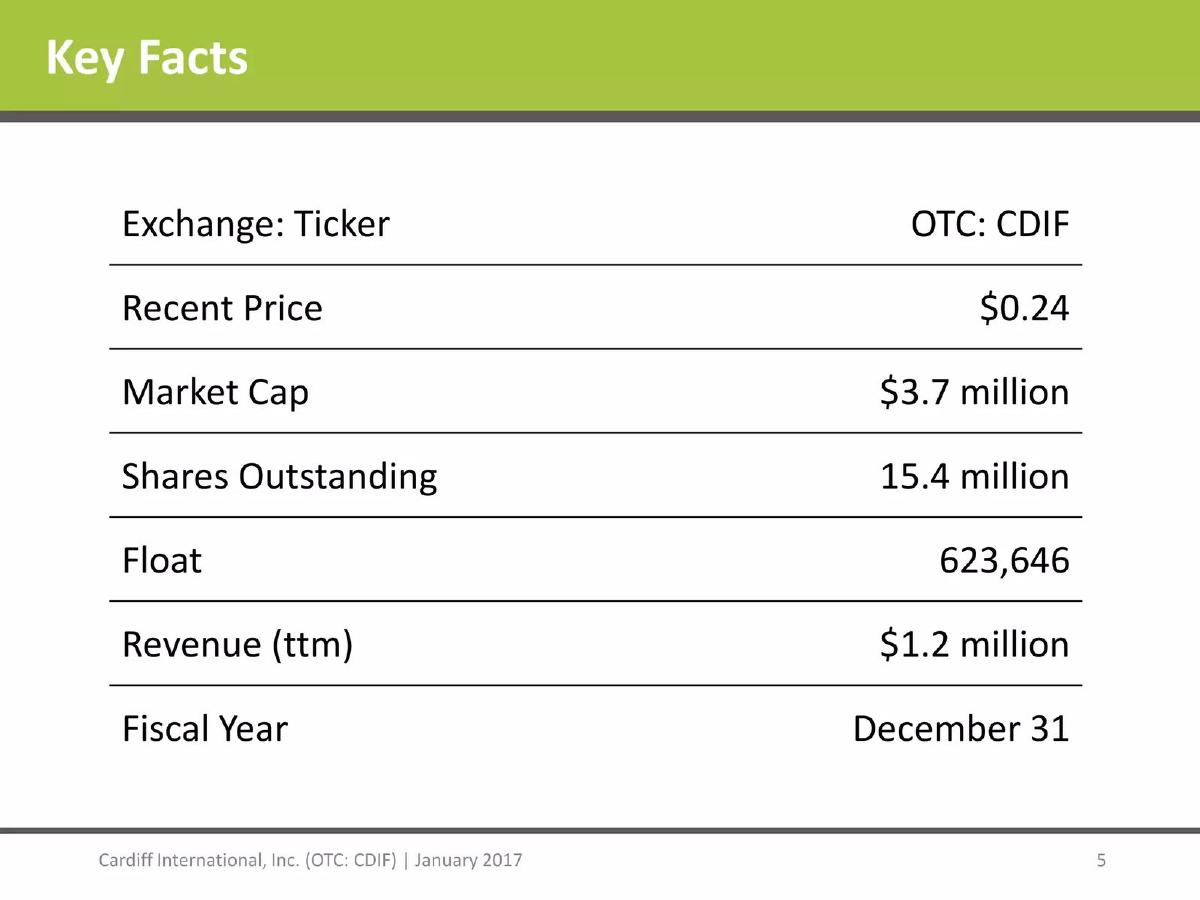
- The company operates as a public entity on the OTC market under the ticker CDIF as of January 2017 (Slide 1).
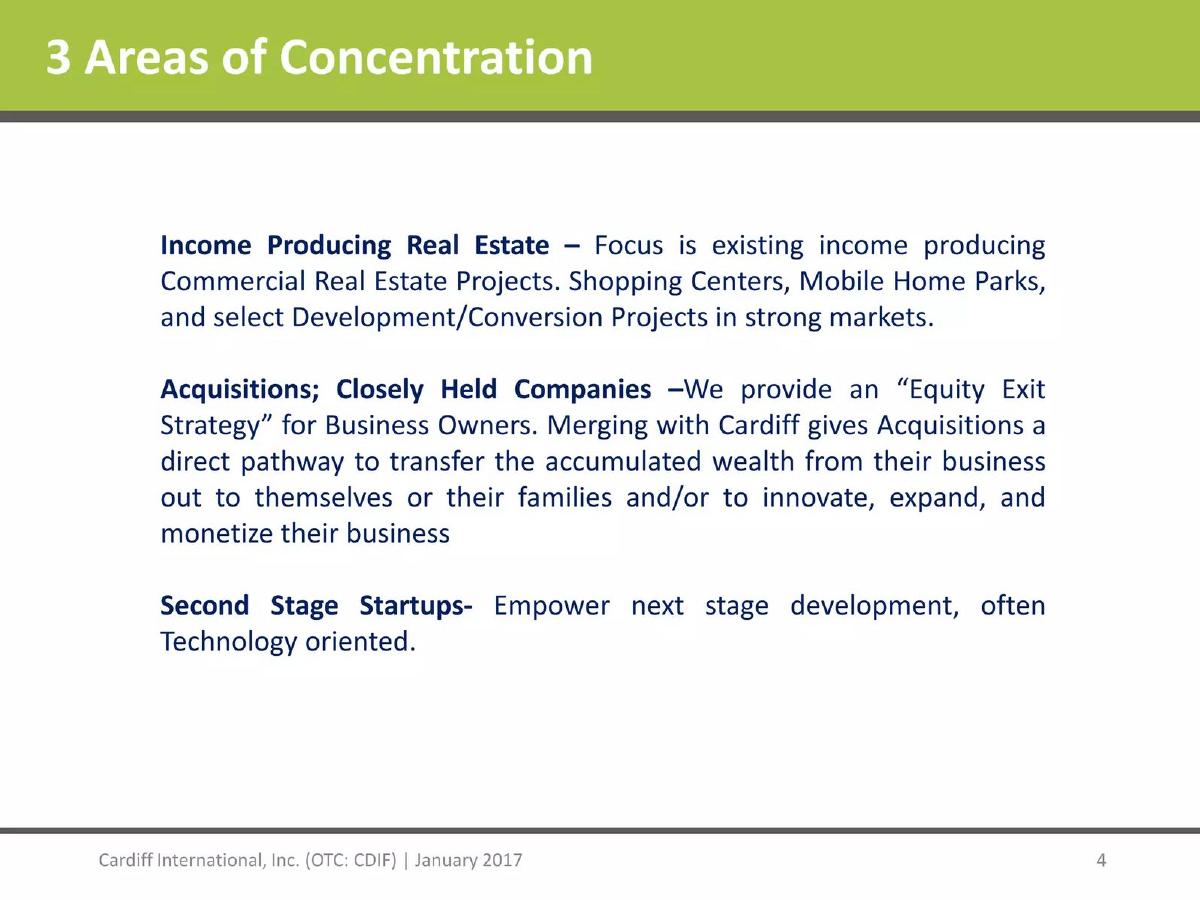
- Cardiff focuses on three distinct sectors: commercial real estate, closely held company acquisitions, and second-stage startups (Slide 4).
- Repicci’s Italian Ice & Gelato is a key subsidiary with a $3M revenue run-rate and 48+ franchise units (Slide 10).
- Real estate assets include 30 acres in Idaho zoned for 60 residential lots and commercial use (Slide 13).
- The acquisition pipeline includes a gourmet supermarket chain with $45M in revenue and $5.2M in earnings (Slide 16).
- Cardiff is targeting a sub-prime motorcycle financing company with $14M in accounts receivable (Slide 16).
- The investment ask is $1M in equity from accredited investors via a convertible debenture (Slide 19).
- The debenture offers a 10% annual interest rate and converts at 70% of the open market price (Slide 19).
Cardiff International Inc. Investor Deck Analysis
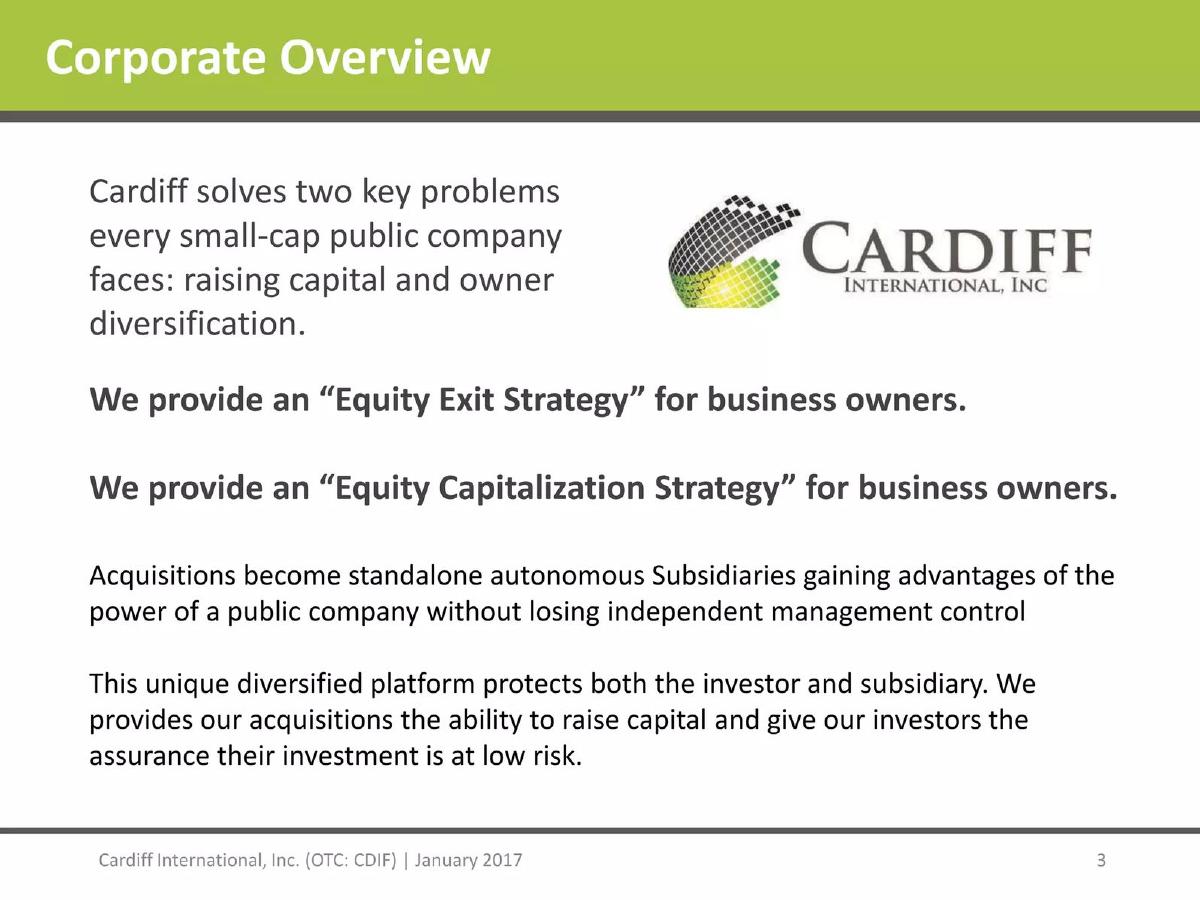
The January 2017 investor presentation for Cardiff International Inc. (OTC: CDIF) outlines a conglomerate-style growth strategy. Unlike a traditional startup pitch that focuses on a single product, this deck presents a platform for acquisition and asset management. The company positions itself as a vehicle for business owners to achieve liquidity while providing investors with a diversified portfolio of cash-flowing assets and real estate.
Slide 1: Title and Ticker
The cover slide introduces Cardiff International, Inc. and prominently displays its OTC ticker: CDIF. The date is listed as January 2017. The branding uses a green and grey color palette with a pixelated globe logo, suggesting a global or multi-faceted reach. The inclusion of the ticker immediately signals to the investor that this is a public company, likely looking for bridge financing or growth capital to fuel its acquisition pipeline.
Slide 4: 3 Areas of Concentration
This slide defines the company's investment thesis. Cardiff divides its focus into three distinct buckets: Income Producing Real Estate , Acquisitions of Closely Held Companies , and Second Stage Startups . The real estate focus is specifically on shopping centers and mobile home parks. The acquisition strategy is marketed as an 'Equity Exit Strategy' for business owners, allowing them to monetize their life's work by merging with a public entity. The startup focus is described as 'empowering next stage development,' with a preference for technology-oriented firms.
Slide 7: Organizational Chart
Cardiff presents a traditional corporate hierarchy. The chart shows a Chairman and a President & CEO overseeing four functional leads: CMO, CDO, COO, and CFO. Below this executive layer are the 'Subsidiary Companies.' This structure is designed to show that the holding company has the necessary management overhead to support multiple disparate business units, though the slide does not name the specific individuals holding these roles.
Slide 10: Repicci’s Italian Ice & Gelato
This slide serves as a case study for their acquisition model. Repicci’s is described as having a $3M revenue run-rate . The deck provides a brief history of the company, noting it was founded by an Italian immigrant in 1911 and began franchising in 2005. Currently, it is a 48+ unit franchise based in Birmingham, Alabama, that operates its own manufacturing plant and a fleet of Mercedes Benz food trucks introduced in 2014. This slide is critical as it provides the only concrete revenue figure for an operating subsidiary in the provided slides.
Slide 13: Edge View Properties
Shifting to the real estate arm, this slide details a 30-acre land holding in Idaho near the Salmon River. The property is broken down by zoning: 23.5 acres for residential (60 lots total between medium and high density), 4 acres for riverfront recreation, and 2.5 acres for commercial use. The stated plan is to develop a storage facility and RV/Cabin timeshare units. This slide demonstrates asset backing for the company’s valuation beyond just operating cash flow.
Slide 16: Acquisition Targets
Cardiff lists five specific targets to demonstrate their pipeline:
Target 1: Gourmet Super Markets ($45M Revenue, $5.2M Earnings). · Target 2: Real Estate related to Target 1 ($51.5M Value). · Target 3: Sub-Prime Motorcycle Financing ($15M Value, $14M AR). · Target 4: Mobile Home Park (47 units, $144,000 generation). · Target 5: Dental Chain (14 locations, $12M Value).
The diversity of these targets—from grocery stores to sub-prime lending—underscores the conglomerate nature of the business. It also sets a high bar for the capital required to execute these deals, as the total value of these targets exceeds $100M.
Slide 19: Direct Investment Capital Raise
The final slide in this set details the 'Ask.' Cardiff is seeking $1M in Equity from accredited investors. The vehicle is a Convertible Debenture with a 10% annual interest rate paid quarterly. The conversion terms are aggressive: the debt converts to common stock at 70% of the open market price (a 30% discount). The minimum investment is $25,000. The slide also mentions plans for a future 'uplift to a larger exchange,' which is a common goal for OTC-listed companies seeking higher liquidity and institutional interest.
What Works in This Deck
The deck is effective at communicating a clear 'roll-up' strategy. By categorizing their interests into three buckets, they provide a framework for how they evaluate opportunities. The inclusion of a specific subsidiary like Repicci’s with a $3M run-rate provides necessary proof of concept—showing they can actually manage a franchise business. Furthermore, the detailed acquisition pipeline on slide 16 gives investors a sense of the scale the company is aiming for, moving from a $3M subsidiary to targets with $45M in revenue.
What Is Missing from This Deck
The most significant omission is the lack of a consolidated financial statement. While individual subsidiaries and targets are mentioned, there is no slide showing the overall health of Cardiff International Inc. as a parent company. We do not see the current debt load, total assets, or net income. Additionally, the organizational chart on slide 7 is anonymous; in a holding company model, the track record of the executives in M&A and operations is the most important factor, yet no bios or names are provided in these slides. Finally, there is no explanation of how a $1M raise will facilitate the acquisition of targets valued at over $100M, suggesting a significant gap in the financing strategy or a reliance on heavy dilution/debt.
Founder Takeaways: Lessons from Cardiff
1. Use specific targets to show ambition: Slide 16 is a strong way to show that you aren't just 'looking for deals' but have a specific pipeline with vetted numbers. Even if the deals aren't closed, it shows the level at which you are operating. 2. Asset backing builds trust: For companies in the OTC or micro-cap space, having hard assets like the 30 acres in Idaho (Slide 13) provides a floor for the valuation that pure 'blue sky' tech startups lack. 3. Clear debt terms: Slide 19 is a model of clarity for a convertible note or debenture. It lists the interest rate, the payment frequency, the conversion discount, and the minimum check size in simple bullet points. This prevents ambiguity during the due diligence phase.
Frequently asked questions
- What is Cardiff International's primary business model?
- Cardiff International operates as a holding company that acquires and manages a diverse portfolio of assets. According to slide 4, they focus on income-producing real estate like shopping centers and mobile home parks, as well as providing an 'Equity Exit Strategy' for owners of closely held companies. They also invest in second-stage, technology-oriented startups to empower their next phase of development.
- What are the specific terms of the $1M capital raise?
- As detailed on slide 19, the company is raising $1M through a Convertible Debenture. Key terms include a 10% annual interest rate paid quarterly and a 365-day maturity. The debt converts into common stock at a 30% discount (70% of the open market price). The minimum investment for accredited investors is $25,000.
- What kind of companies does Cardiff target for acquisition?
- Slide 16 lists five specific targets: a gourmet supermarket chain ($45M revenue), a related real estate entity, a sub-prime motorcycle financing company ($15M value), a mobile home park with 47 units, and a dental chain with 14 locations. They prioritize companies that are already profitable or have significant asset backing, such as accounts receivable or real estate.
- What is the status of their current subsidiaries?
- The deck highlights Repicci’s Italian Ice & Gelato on slide 10, noting it has a $3M revenue run-rate and over 48 franchise units. It also mentions Edge View Properties on slide 13, which holds 30 acres of land in Idaho near the Salmon River, with plans for a storage facility and RV/Cabin timeshare units.
- What is the management structure of Cardiff International?
- Slide 7 provides an organizational chart showing a Chairman at the top, followed by a President & CEO. Reporting to the CEO are four C-level executives: Chief Marketing Officer, Chief Development Officer, Chief Operating Officer, and Chief Financial Officer. This corporate layer sits above the various subsidiary companies in the portfolio.