Capital List is a platform play orchestrated by Capital Enterprise, an association of over 60 London-based universities and incubators. The deck, specifically designed as an invite for advisors, outlines a multi-sided marketplace connecting 'The Source' (incubators), 'The Player' (startups), 'The Enabler' (advisors), and 'The Client' (investors). The platform relies on a vouching system where advisors validate startup details to improve deal flow quality for seed investors. While the deck excels at showcasing institutional support and ecosystem logic, it lacks traditional venture metrics, a c…
Key takeaways
- The platform is operated by Capital Enterprise, which represents a network of 60+ London universities and incubators (Slide 2).
- Crowdmix Labs is identified as the technical platform provider for the service (Slide 2).
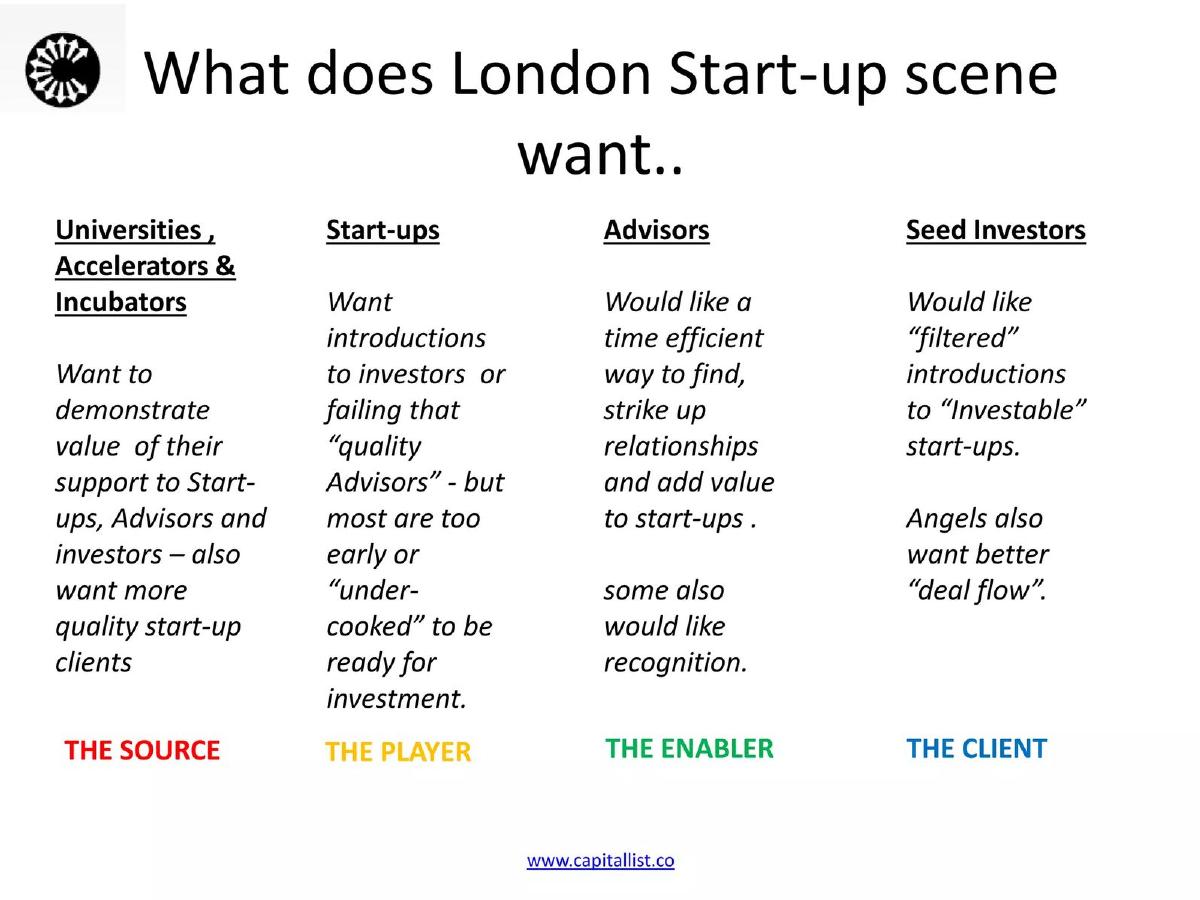
- The ecosystem identifies seed investors as 'The Client' who specifically desire 'filtered' introductions to investable startups (Slide 3).
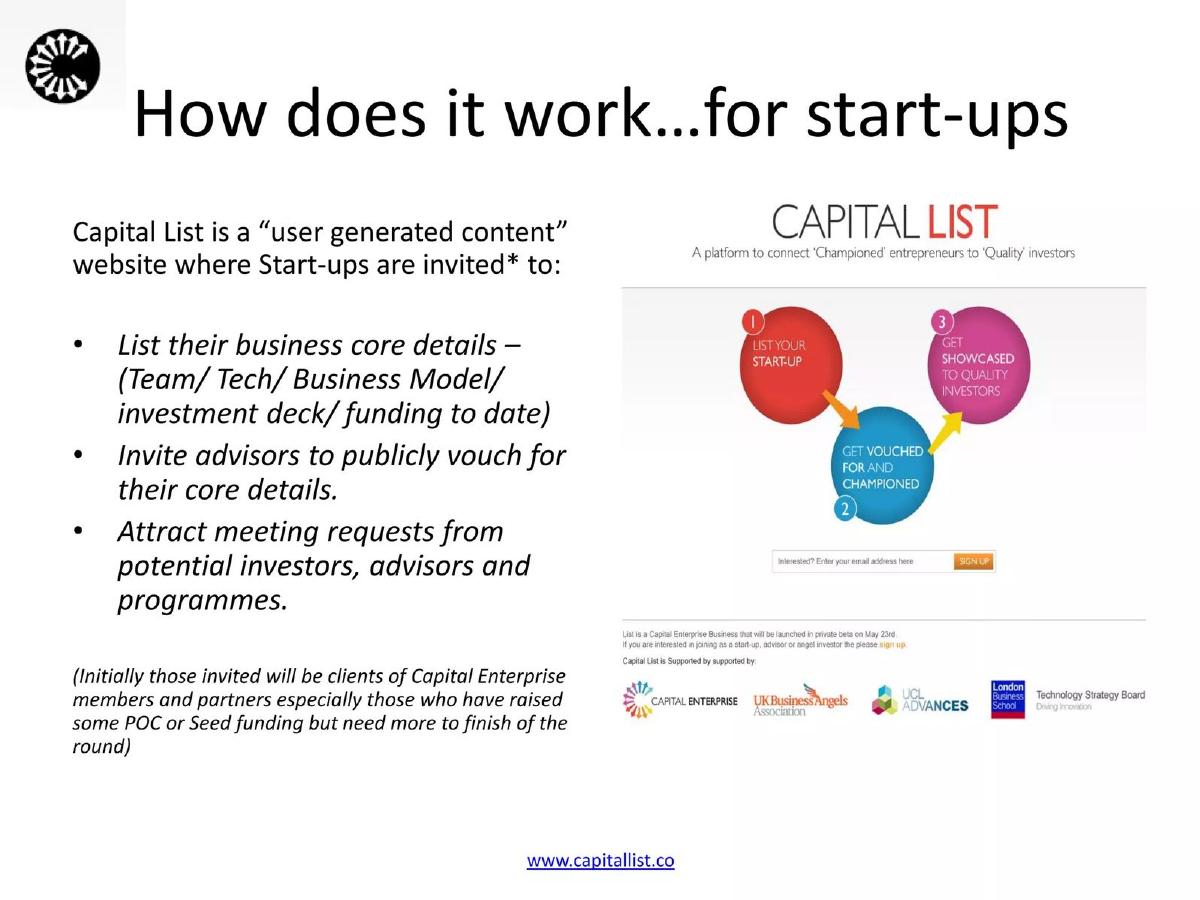
- Advisors are required to 'vouch' for core startup details including team, tech, and business model achievements (Slide 4).
- Investors must be VC or FSA approved Angel Syndicates to be listed on the platform (Slide 5).
- The deck lists 10 specific investment syndicates and 3 FSA regulated crowdfunding platforms as part of the target ecosystem (Slide 6).
- Support providers like incubators are given the power to nominate startups for the platform during the pilot stage (Slide 7).
- Success for the 100-day pilot is measured by the number of meetings generated and the total amount raised by startups (Slide 8).
Capital List: The Ecosystem Connector
The Capital List deck is not a traditional fundraising pitch; it is a strategic invitation for advisors to join a curated ecosystem. The platform aims to solve the fragmentation of the London startup scene by creating a verified pipeline between universities, incubators, advisors, and regulated investors. By positioning itself as a 'platform operator' backed by a massive association (Capital Enterprise), the company attempts to leverage existing trust networks rather than building a user base from scratch.
Slide 1: Title and Mission
The cover slide introduces Capital List with a clear, albeit grammatically imperfect, mission statement: "A platform to showcase the best London Start-up's to advisors and investors." The inclusion of the URL (www.capitallist.co) and a central logo featuring outward-pointing arrows suggests a hub-and-spoke model of distribution. The focus is strictly geographic, targeting the London ecosystem.
Slide 2: The Team and Institutional Backing
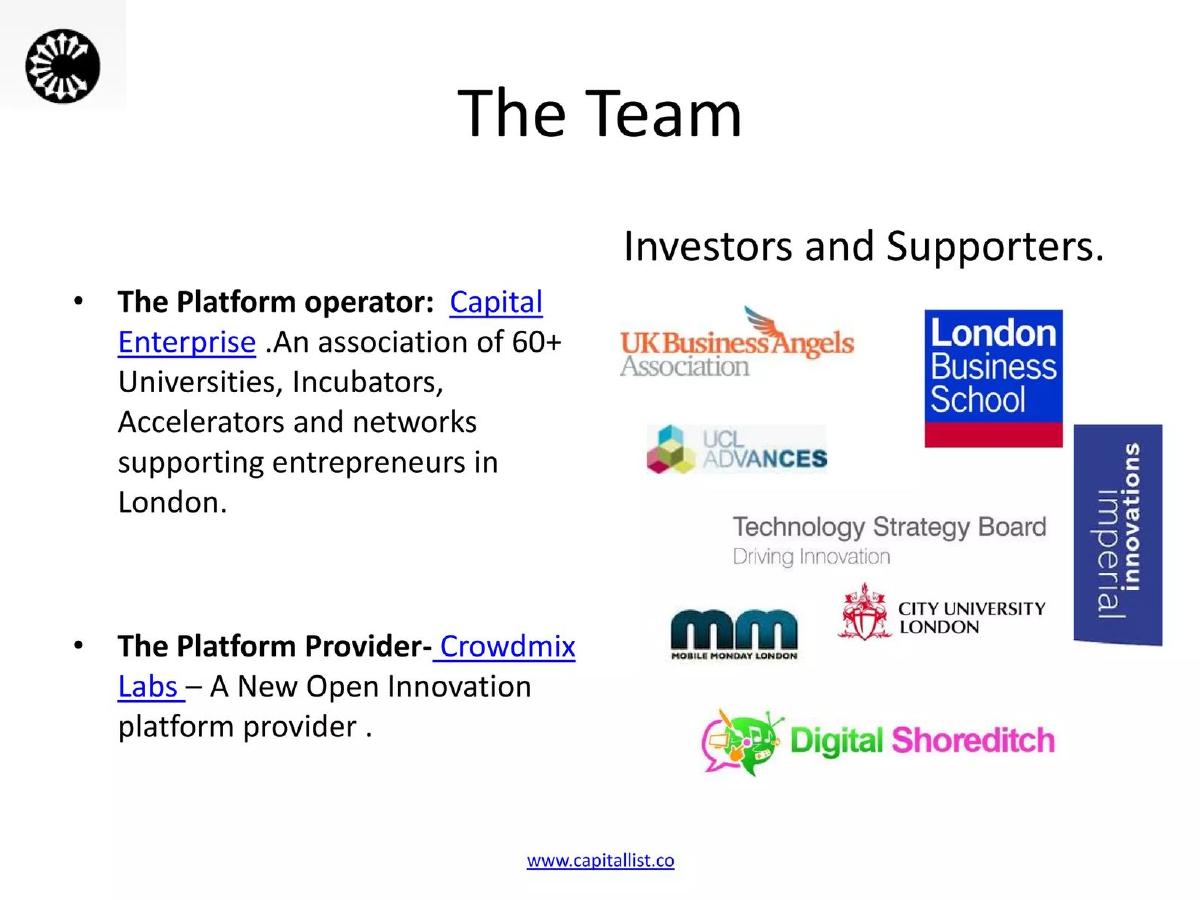
This slide is less about individual founders and more about institutional credibility. It identifies Capital Enterprise as the platform operator, described as an association of 60+ universities, incubators, and accelerators. Crowdmix Labs is credited as the platform provider. The right side of the slide is a 'logo wall' of heavy hitters in the UK innovation space, including the UK Business Angels Association , London Business School , UCL Advances , and Imperial Innovations . This establishes that the project has significant political and institutional buy-in before the product is even explained.
Slide 3: Market Needs and Stakeholder Roles
Capital List breaks down the London startup scene into four distinct personas. The Source (Universities/Incubators) wants to demonstrate the value of their support. The Player (Startups) wants introductions to investors but is often "too early or 'under-cooked'" for investment. The Enabler (Advisors) wants a time-efficient way to find and add value to startups. Finally, The Client (Seed Investors) wants "filtered" introductions and better "deal flow." This slide effectively identifies the 'under-cooked' startup as the primary friction point in the market.
Slide 4: The Advisor Workflow
This slide explains the mechanics for the specific audience of this deck. Advisors are invited to register, see startups in need of help, and most importantly, vouch for core details like team and tech. The screenshot shows a UI where advisors can leave 'Endorsements.' This social proof is the core product feature intended to move a startup from 'under-cooked' to 'investable.'
Slide 5: The Investor Workflow
For investors, the platform acts as a discovery tool. The deck notes that investors must be VC or FSA approved Angel Syndicates . The primary value proposition for investors is the ability to set a "filter" on the types of startups they are interested in, allowing them to receive meeting requests only from companies that meet their specific criteria. This addresses the 'noise' problem common in seed-stage investing.
Slide 6: The Target Syndicates
This slide serves as a directory of the existing ecosystem Capital List intends to serve. It lists 10 major syndicates, including London Business Angels , Oxford Early Investments , and Envestors , alongside three FSA regulated crowdfunding platforms: Crowdcube , Seedrs , and FundingPlanet . By naming these entities, the deck demonstrates a deep understanding of the local capital landscape.
Slide 7: Member and Partner Benefits
This slide addresses the 'Source' (incubators and accelerators). It explains that these partners can advertise their services and, crucially, nominate the startups that get to go on the platform during the pilot stage. This gives the incubators a 'gatekeeper' role, which incentivizes them to promote the platform to their best companies.
Slide 8: The Roadmap and Pilot Metrics
The final slide outlines a 100-day pilot program. It lists specific KPIs: interest, stickiness, effectiveness (meetings generated), and the ultimate metric—amount raised. The "Post Pilot" section suggests a transition to an open platform and a white-label business model, implying that the software could be sold to other cities (e.g., Manchester, Berlin) to manage their own local ecosystems.
What Capital List Does Well
The deck is exceptionally strong at ecosystem mapping . It clearly identifies the pain points for four different groups and explains how one platform provides a unique value proposition to each. By securing the backing of Capital Enterprise, they solve the 'cold start' problem that plagues most marketplace platforms. They aren't just looking for users; they are onboarding an entire existing network of 60+ institutions.
The focus on regulated investment is also a professional touch. By specifying FSA-approved syndicates, they signal to high-quality advisors and startups that this is not a 'wild west' platform, but a serious tool for professional finance.
What is Missing from the Deck
Because this is an 'invite to advisors,' it lacks several components of a standard pitch deck:
Revenue Model: There is no mention of how the platform makes money. Is it a SaaS fee for incubators, a success fee on raises, or a subscription for investors? · Individual Team Bios: While the 'Platform Operator' is named, the actual humans building and running the day-to-day operations are invisible. · Unit Economics: There is no data on the cost of acquisition for startups or the lifetime value of an investor lead. · Competitor Analysis: The deck ignores other platforms like AngelList or Gust, which were active during this period. It assumes the 'London-only' focus is a sufficient moat. · The Ask: There is no financial request. It is unclear if they are raising capital or simply looking for 'sweat equity' from advisors.
Advice for Founders Copying This Format
If you are building a B2B2B ecosystem platform , this deck provides a great template for stakeholder alignment. Founders should emulate the way Slide 3 categorizes different users (Source, Player, Enabler, Client) and assigns them specific desires. This shows a level of market empathy that investors love.
However, do not omit the business model . Even in a partnership deck, stakeholders want to know if the platform is sustainable. If you are using a pilot program to find your product-market fit, be as specific as Slide 8 is about your 100-day goals. Defining 'Effectiveness' as the number of meetings generated is a great way to prove value early without needing to wait for a 6-month investment cycle to close.
Final Verdict: A highly professional ecosystem play that relies on institutional authority rather than raw growth metrics. It is an excellent example of how to pitch a 'curated' marketplace where quality and verification are more important than total user count.
Frequently asked questions
- What is the primary purpose of the Capital List platform?
- According to slide 1, it is a platform to showcase London startups to advisors and investors. It acts as a filtering mechanism where institutional partners and advisors vouch for the quality of startups to ensure seed investors receive 'investable' deal flow, as noted on slide 3.
- Who are the key institutional partners involved?
- Slide 2 lists several high-profile supporters including the UK Business Angels Association, London Business School, UCL Advances, Technology Strategy Board, City University London, and Imperial Innovations. The platform itself is operated by Capital Enterprise, an association of over 60 startup-support organizations.
- How does the platform verify the quality of the startups?
- Verification is handled through a two-step process. First, support providers like incubators nominate startups (Slide 7). Second, advisors are invited to 'vouch' for specific details such as the team, technology, and business model achievements (Slide 4). This creates a layer of human due diligence before a startup reaches an investor.
- What are the criteria for investors to join the platform?
- Slide 5 specifies that investors must be either a Venture Capital firm or an FSA (Financial Services Authority) approved Angel Syndicate. Individual business angels can only join if they are specifically invited to register, ensuring a regulated and professional investor base.
- What are the planned metrics for the pilot phase?
- Slide 8 defines success through four categories: Interest (number of active participants), Stickiness (user interactions after 100 days), Effectiveness (number of meetings generated), and Concept (number of startups that successfully raised capital and the total amount raised).