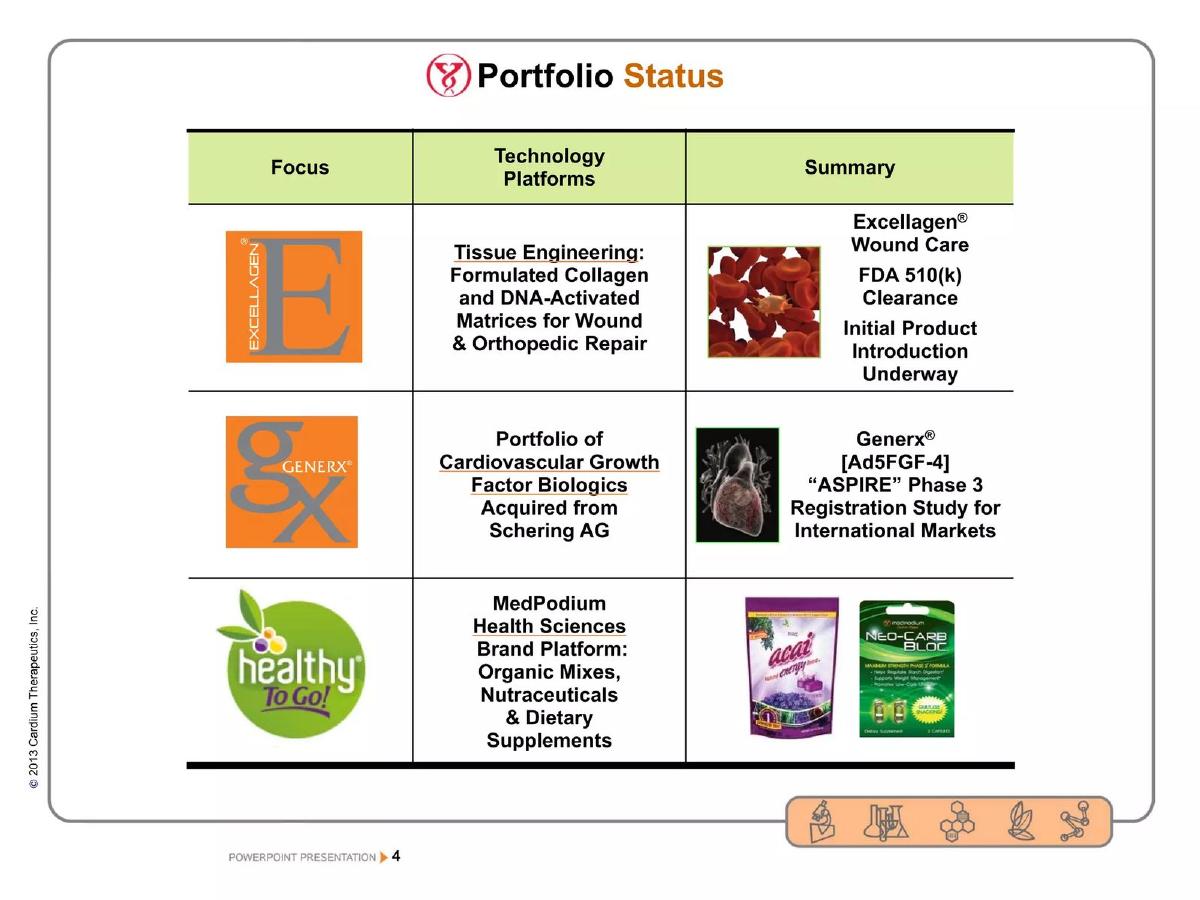
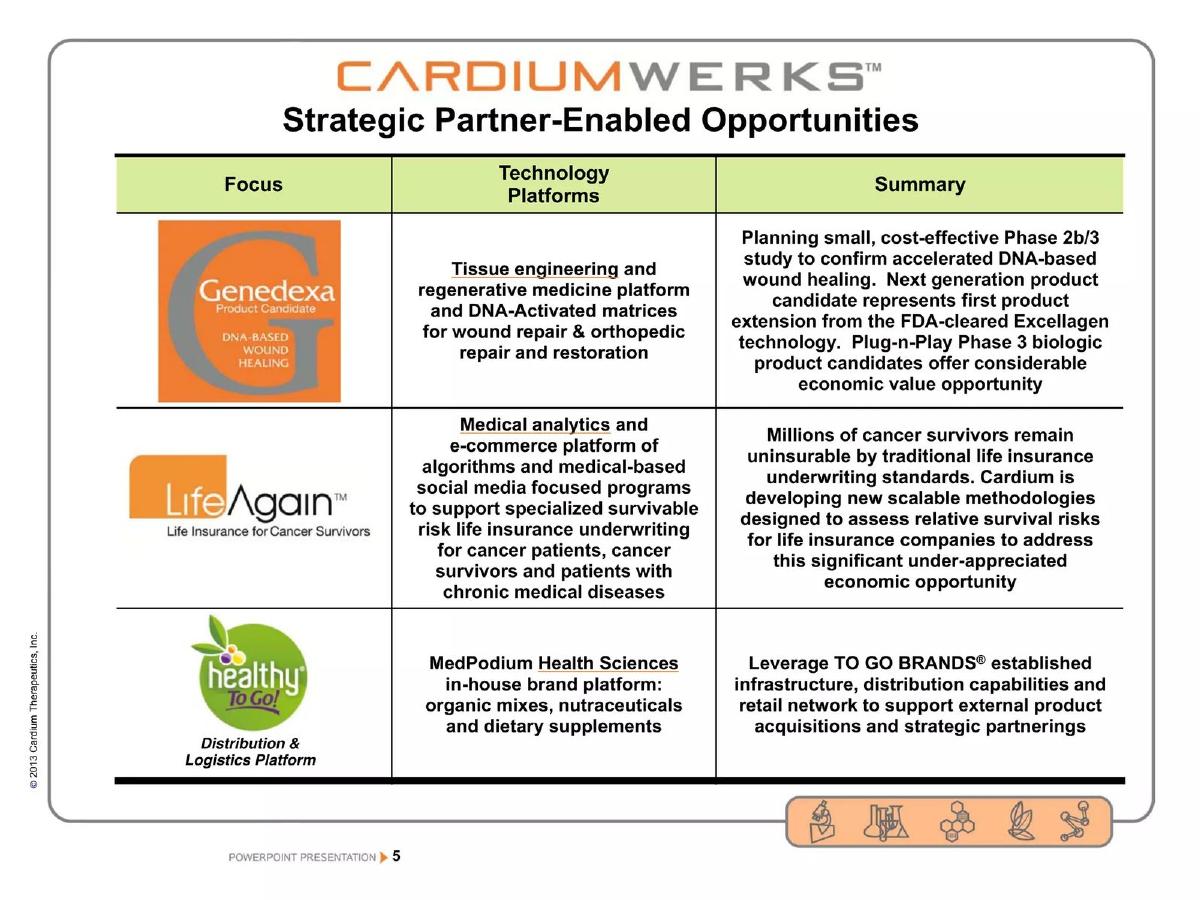
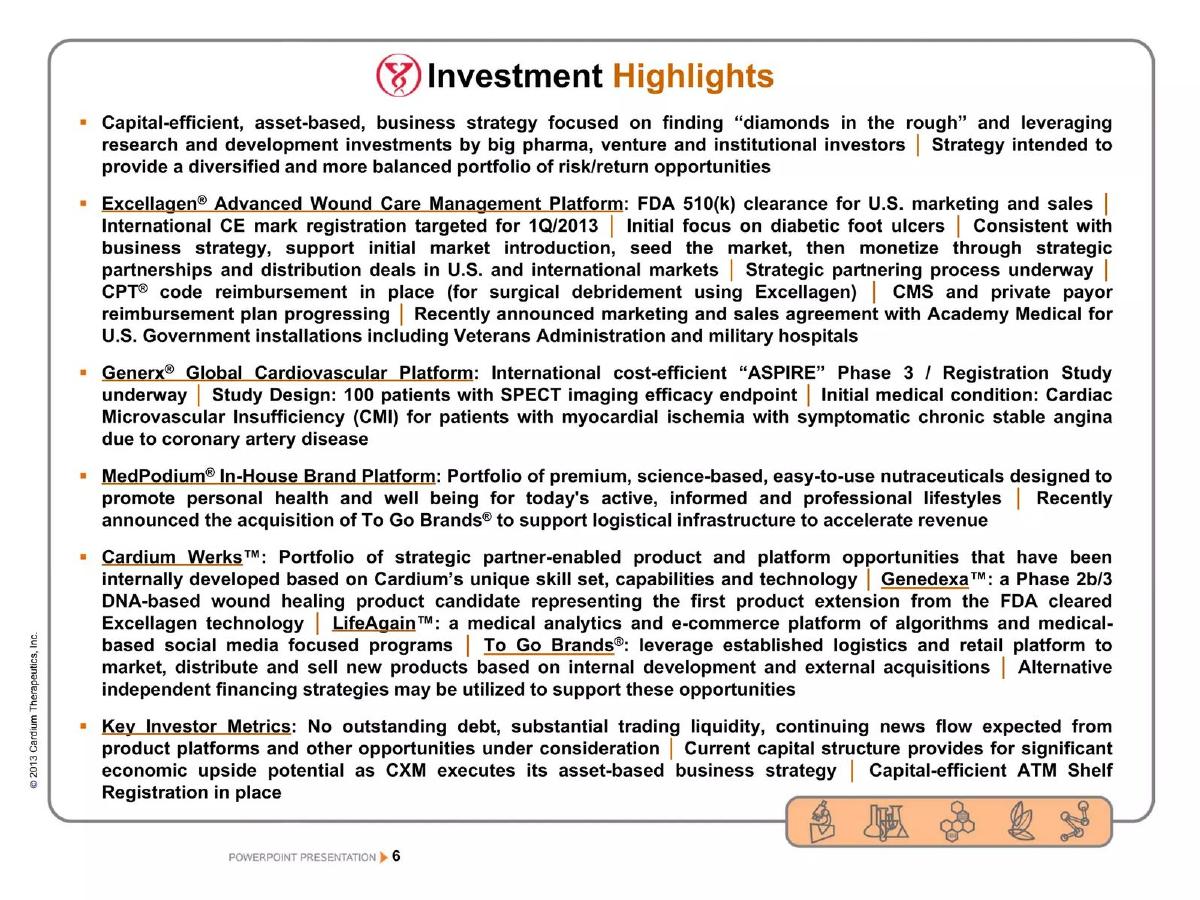
Cardium Therapeutics’ 2013 Biotech Showcase deck functions as a portfolio overview rather than a single-product pitch. The company highlights its lead commercial asset, Excellagen, which has secured FDA 510(k) clearance for dermal wounds and is positioned for a total addressable market of over 92 million annual incidences across various wound types. The deck also details Genedexa, a DNA-based wound healing therapeutic, and Generx, an angiogenic therapy for coronary artery disease. Uniquely for a biotech firm, the presentation includes a consumer segment, To Go Brands, featuring retail partner…
Key takeaways
- Excellagen is positioned as a best-in-class acellular biological modulator with FDA 510(k) clearance for dermal wounds (Slide 8).
- In vitro data demonstrates that Excellagen triggers a dose-dependent release of PDGF-AB, a key wound healing mediator (Slide 15).
- The total U.S. market opportunity for Excellagen spans 92,645,000 annual incidences across illness, immobility, surgery, and trauma (Slide 22).
- Genedexa is a next-generation DNA-based therapeutic utilizing an adenovector delivery system for the PDGF-B growth factor gene (Slide 29).
- Generx is positioned as a non-surgical alternative to traditional drug therapy, stents (PTCA), and bypass surgery (CABG) for coronary artery disease (Slide 36).
- Generx bioactivity assays visualize the angiogenic process through endothelial tube formation at concentrations ranging from 1ng/mL to 8ng/mL (Slide 43).
- The portfolio includes a consumer-facing nutraceutical line, To Go Brands, sold through major retailers like Kroger and Fred Meyer (Slide 50).
- Genedexa's DNA-based adenovector cassette has demonstrated Phase 1/2 safety data with the FDA and shows no observed cytotoxicity (Slide 57).
Cardium Therapeutics: A Diversified Regenerative Medicine Portfolio
The Cardium Therapeutics deck, presented at the 2013 Biotech Showcase, reflects a mature biotech company moving from pure R&D into commercialization. Unlike early-stage startups that focus on a single molecule or platform, Cardium presents a 'Medical Opportunities Portfolio.' This strategy is designed to mitigate the inherent risks of clinical development by balancing long-term gene therapy candidates with immediate-term FDA-cleared medical devices and consumer retail products.
Slide 1: Title and Positioning
The cover slide establishes the company's identity in 'Health Sciences & Regenerative Medicine.' The subtitle, 'Medical Opportunities Portfolio,' is critical as it informs the investor that this is not a single-asset play. The date, January 7, 2013, places this presentation at a time when regenerative medicine and gene therapy were seeing a resurgence in investor interest. The tagline 'The Power of Biology' serves as the unifying theme for their disparate product lines.
Slide 8: Excellagen Summary and Commercialization
This slide serves as the 'traction' and 'product' slide for their lead asset. Excellagen is described as an FDA 510(k) cleared acellular biological modulator. Key commercial milestones are listed: it was selected as a 'Top 10 Innovation in Podiatry' in 2012, and the company has already secured a distribution partner in Smith Medical Partners . The slide emphasizes that the product is 'competitively positioned' due to its flowable syringe format and ease of use, which are critical factors for clinical adoption in wound care.
Slide 15: In Vitro Research Data
To support the clinical claims of Excellagen, Slide 15 provides quantitative data. A bar chart titled 'Activated Platelet Release of PDGF' shows a clear dose-response relationship. The negative control shows minimal PDGF-AB release (under 10,000 pg/mL), while the 720 uL dose of Excellagen triggers a release exceeding 30,000 pg/mL. This data is intended to prove the biological mechanism of action—that the product doesn't just cover a wound but actively triggers the body's healing signaling.
Slide 22: U.S. Market Opportunities
Cardium utilizes a 'Beyond Diabetic Foot Ulcers' strategy to expand its Total Addressable Market (TAM). While many wound care companies focus solely on the 1.26 million diabetic foot ulcers, Cardium identifies a total of 92,645,000 annual incidences. The largest segments identified are major surgical wounds (36 million) and traumatic wounds/lacerations (16.25 million). By citing sources like Medtech Insight and the American Diabetes Association, the company builds a credible case for massive scale if they can achieve broad indications.
Slide 29: Genedexa DNA-Based Therapeutic
The presentation shifts from medical devices to gene therapy with Genedexa . This slide uses a Venn diagram to show the intersection of the Excellagen technology platform, adenovector DNA delivery (Ad5), and the PDGF-B growth factor gene. The company outlines its roadmap: planning a 'confirmatory Phase 2b/3 clinical study' with 10-20 patients, followed by a 'Strategic Partnered-Enabled Phase 3 Product Opportunity.' This indicates a desire to de-risk the asset before seeking a major pharmaceutical partner for the final, expensive stages of development.
Slide 36: Therapeutic Positioning for Generx
Slide 36 addresses Generx (Cardionovo), a DNA-based angiogenic therapy for Coronary Artery Disease (CAD). The positioning diagram places Generx as a fourth pillar alongside traditional drug therapy, bypass surgery (CABG), and stents (PTCA). By labeling it as 'Non-Surgical,' Cardium is pitching a less invasive, potentially lower-cost alternative to the standard of care for heart disease, which remains one of the largest medical markets globally.
Slide 43: Generx Bioactivity Assay
This slide provides visual proof of Generx’s efficacy. It shows four microscopic images (E through H) of HUVEC tube formation. As the dose increases from 1ng/mL to 8ng/mL, the images show a clear progression from small clusters to 'longer tubes and more complex networks.' This visualization is a powerful tool for biotech investors, as it provides qualitative evidence of the 'angiogenic process' the drug is designed to stimulate.
Slide 50: To Go Brands Portfolio
In a departure from clinical data, Slide 50 showcases the To Go Brands nutraceutical line. Featured products include 'Healthy Belly' and 'Extreme Berries.' More importantly, the slide displays the logos of Fred Meyer, Kroger, and Fry’s . This represents the 'Health Sciences' side of their portfolio, providing the company with immediate retail presence and potentially non-dilutive cash flow, which is rare for a biotech firm still pursuing Phase 3 trials.
Slide 57: Genedexa Technical Validation
This slide returns to the technical specifics of the DNA-based adenovector cassette. It lists key safety and manufacturing advantages: 'No Cytotoxicity Observed,' 'Established FDA Manufacturing Standards,' and 'Mutagenesis Improbable.' It also cites three specific research studies published between 2001 and 2004 in journals like Human Gene Therapy and Molecular Therapy , providing a long-term academic foundation for their current clinical efforts.
Slide 64: Social Media and LifeAgain
The final slide in the provided set introduces LifeAgain , described as 'Life Insurance for Cancer Survivors.' The slide emphasizes 'leveraging the new power of social media' with icons for Facebook, Twitter, and LinkedIn. This suggests an attempt to build a patient-centric community or a new business model around the long-term survivability of the patients their therapies aim to treat, though the specific mechanics of this insurance product are not detailed in this slide.
What Cardium Therapeutics Does Well
The deck excels at diversification of risk . By presenting three distinct categories—FDA-cleared devices (Excellagen), clinical-stage gene therapies (Genedexa/Generx), and retail consumer products (To Go Brands)—Cardium makes a case for a company that isn't dependent on a single 'binary' clinical trial result. The use of high-quality microscopic imagery and dose-response charts provides the technical 'proof of work' required for biotech due diligence. Furthermore, the market sizing on Slide 22 is exceptionally detailed, moving beyond vague 'billions of dollars' claims to specific incidence counts by medical condition.
What is Missing from the Deck
The most notable omission in the provided slides is a Management Team slide . In biotech, the pedigree of the scientific advisory board and the executive team's history with the FDA are often as important as the data itself. Additionally, there is no Financial Ask or 'Use of Proceeds' slide. While this was presented at a 'Biotech Showcase' (likely for general investor relations), a fundraising deck typically requires a clear statement of how much capital is being raised and what specific milestones (e.g., 'Completion of Phase 2b') that capital will reach. Finally, there is no Competitor Analysis . While they position Generx against surgery and stents, they do not mention other biotech firms developing competing angiogenic or wound-healing therapies.
Founder Takeaways: Lessons from Cardium
Visualizing the Science: If your product has a biological effect, show it. The tube formation images on Slide 43 are more convincing than a paragraph of text. · Granular Market Sizing: Don't just give a total market number. Break it down by 'Incidence' or 'Wound Type' as seen on Slide 22. This shows you understand the clinical pathways to adoption. · The Portfolio Approach: For founders in high-risk sectors like biotech, showing a 'platform' that can produce multiple assets (or having a lower-risk revenue stream like a consumer brand) can make the company much more attractive to risk-averse investors. · Clear Regulatory Status: Cardium clearly labels what is 'FDA 510(k) cleared' versus what is a 'Product Candidate.' Transparency regarding regulatory hurdles is essential for building trust with sophisticated investors.
Frequently asked questions
- What is the primary commercial product in Cardium's portfolio?
- The primary commercial asset highlighted is Excellagen, an acellular biological modulator. According to Slide 8, it has received FDA 510(k) clearance for a broad array of dermal wounds, specifically targeting diabetic foot ulcers. It is a flowable, syringe-based collagen formulation that has already established an outsourced supply chain and U.S. cold chain distribution through Smith Medical Partners.
- How does Cardium quantify its market opportunity?
- Cardium provides a granular breakdown of the U.S. market on Slide 22. It identifies a total of 92,645,000 annual incidences where its technology could be applied. This includes major categories like surgical wounds (36 million), traumatic wounds and lacerations (16.25 million), and pressure ulcers (2.5 million), moving far beyond its initial focus on diabetic foot ulcers.
- What is the status of Cardium's DNA-based therapeutics?
- The company has two main DNA-based candidates. Genedexa is a wound-healing therapeutic that has completed Phase 1 and 2 safety studies (Slide 57). Generx is an angiogenic therapy for coronary artery disease, positioned as a non-surgical alternative to bypass surgery. Slide 29 indicates that the company is planning a confirmatory Phase 2b/3 clinical study for Genedexa.
- Does the company have revenue-generating products outside of clinical biotech?
- Yes, Cardium maintains a consumer health segment called 'To Go Brands.' Slide 50 shows a product portfolio including 'Healthy Belly' probiotics and 'Extreme Berries' supplements. These products have established retail distribution in major grocery chains including Kroger, Fred Meyer, and Fry's, providing a different risk profile than their clinical assets.
- What clinical evidence is provided for their lead products?
- The deck provides both in vitro and in vivo evidence. Slide 15 shows a bar chart of PDGF-AB release triggered by Excellagen, while Slide 43 provides microscopic visualization of endothelial tube formation (angiogenesis) induced by Generx. Slide 57 further cites peer-reviewed research in journals like 'Human Gene Therapy' and 'Molecular Therapy' to validate their adenovector delivery system.