Careerist presents a highly efficient 13-slide deck that focuses heavily on financial performance and operational traction. The company positions itself as an 'Ed-Fintech' platform, addressing the job market's skill gap and the financial barriers to high-quality training. The deck's strength lies in its transparency regarding revenue growth—climbing from $0.4M in 2019 to a projected $25M+ in 2023—and its claim of profitability with ~$500K in monthly EBITDA. By diversifying revenue through student payments (up to $12,500) and employer recruiting fees (10-20%), Careerist demonstrates a robust b…
Key takeaways
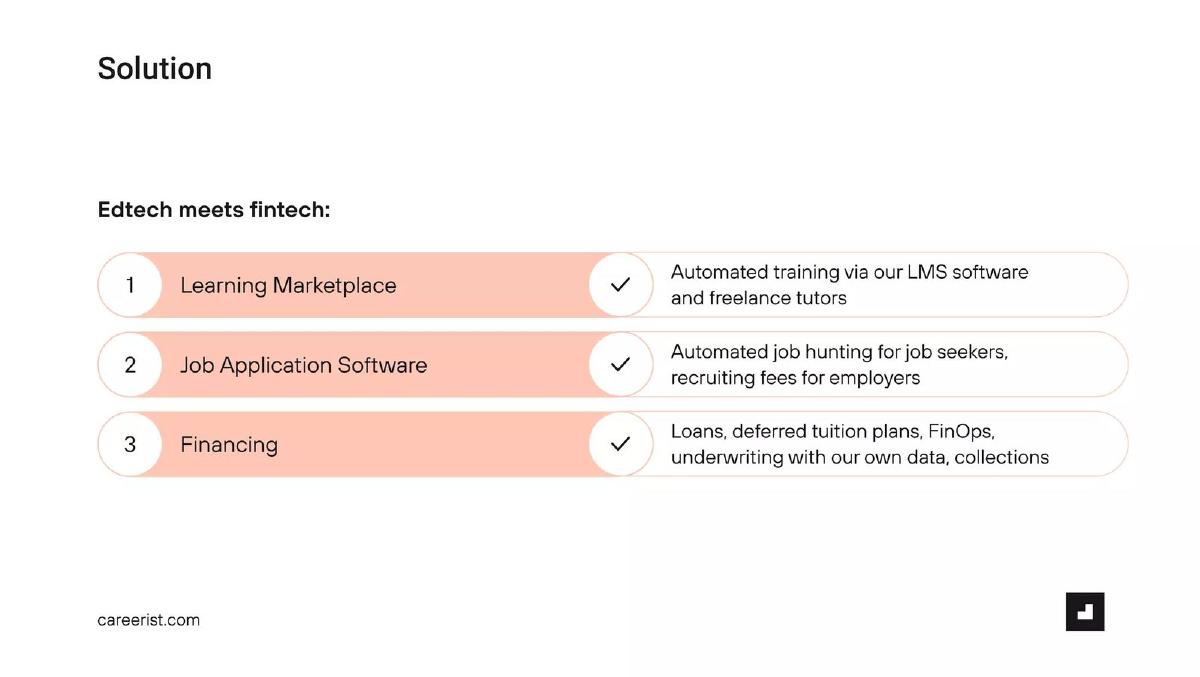
- The company identifies as an 'Ed-Fintech' platform, combining training, job application automation, and tuition financing (Slide 5).
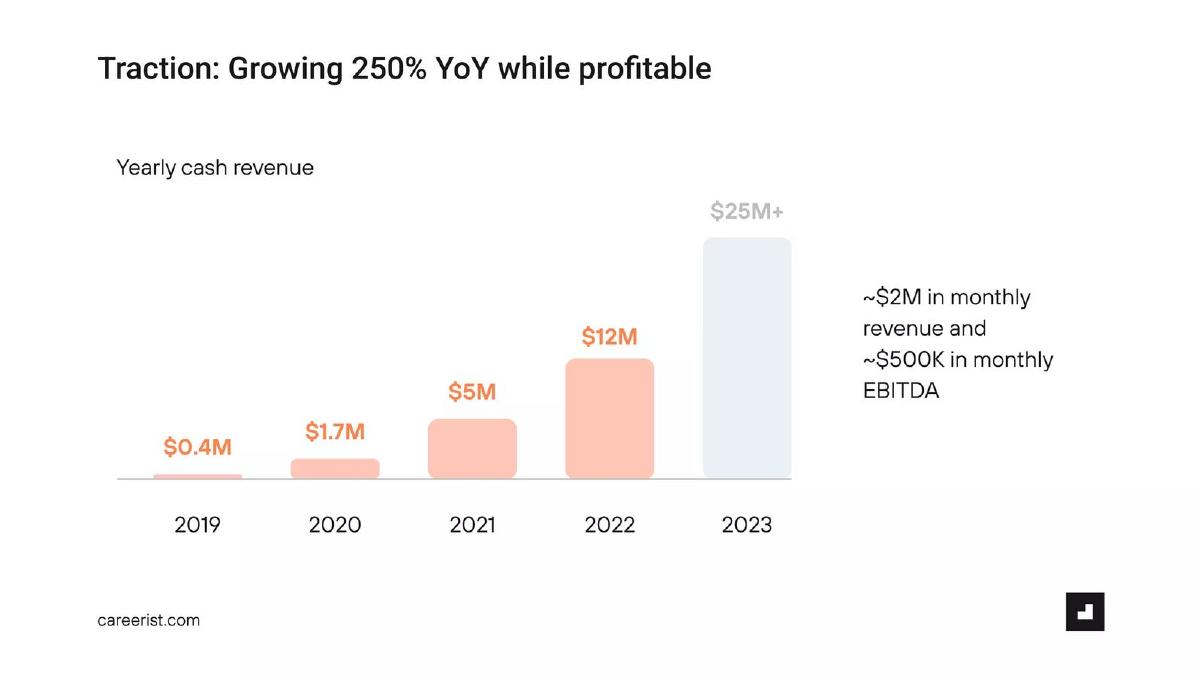
- Revenue growth is the central narrative, showing a jump from $12M in 2022 to a projected $25M+ in 2023 (Slide 6).
- Careerist claims profitability with approximately $500K in monthly EBITDA and $2M in monthly revenue (Slide 6).
- The business model is dual-sided, charging students up to $12,500 and employers 10-20% in recruiting fees (Slide 8).
- Acquisition is driven largely by organic traffic (35.04%) and referrals (25.18%), suggesting a strong network effect (Slide 9).
- Customer satisfaction is high, with an NPS of 70+ and a 95 rating for homework and assignments (Slide 10).
- The Serviceable Addressable Market (SAM) is defined as 3M+ junior and mid-level pros in U.S. tech, valued at $10B+ (Slide 11).
- The founding team includes serial entrepreneurs who previously built Trucker Path, a popular trucking app (Slide 12).
Careerist Pitch Deck Analysis
Careerist positions itself at the intersection of education and finance, a sector they term 'Ed-Fintech.' This 13-slide deck was used to support an $8M Series A round. The narrative is driven by aggressive revenue growth and a transition from a pure training provider to a full-stack career placement and financing engine. The deck is notable for its clean design and heavy emphasis on bottom-line metrics rather than abstract vision statements.
Slides 1-3: Ambition and Identity
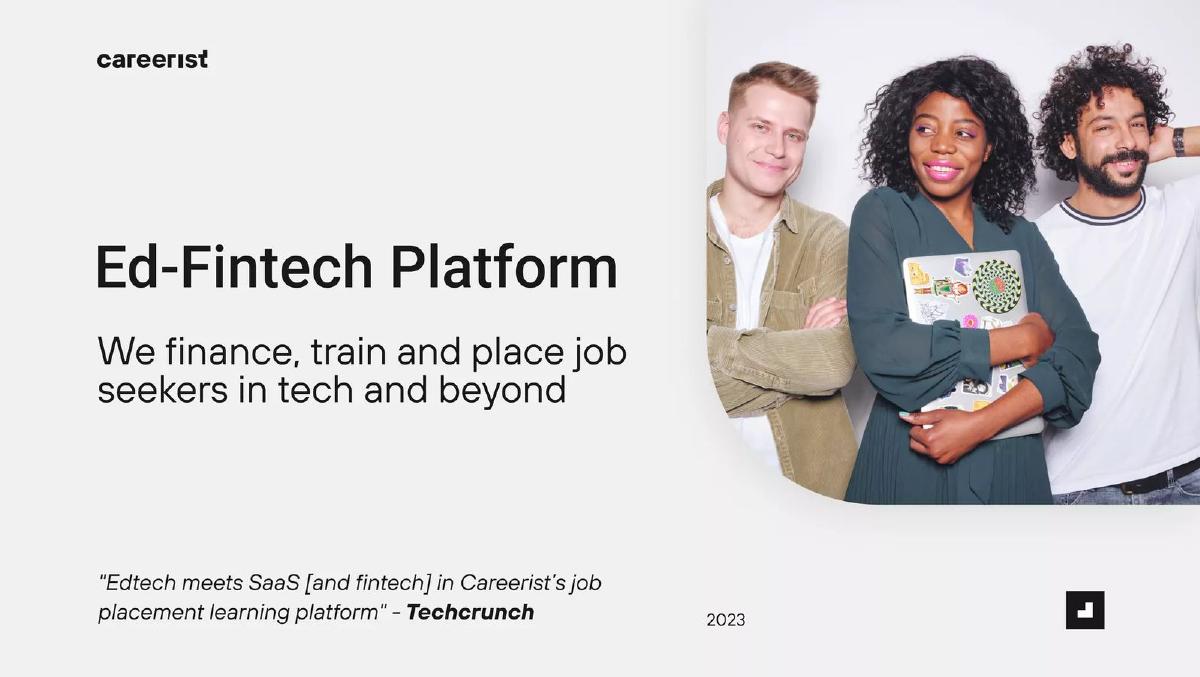
The deck opens with a clear value proposition: 'We finance, train and place job seekers in tech and beyond.' By using the term 'Ed-Fintech Platform' on Slide 1 and Slide 2 , the company immediately signals to investors that this is not a low-margin coaching business, but a scalable technology and finance play. They leverage a TechCrunch quote to validate this positioning. Slide 3 defines their 'Ambition' in simple terms: reaching 'millions of job seekers.' This sets the stage for a high-volume, high-impact business model.
Slide 4: The Problem
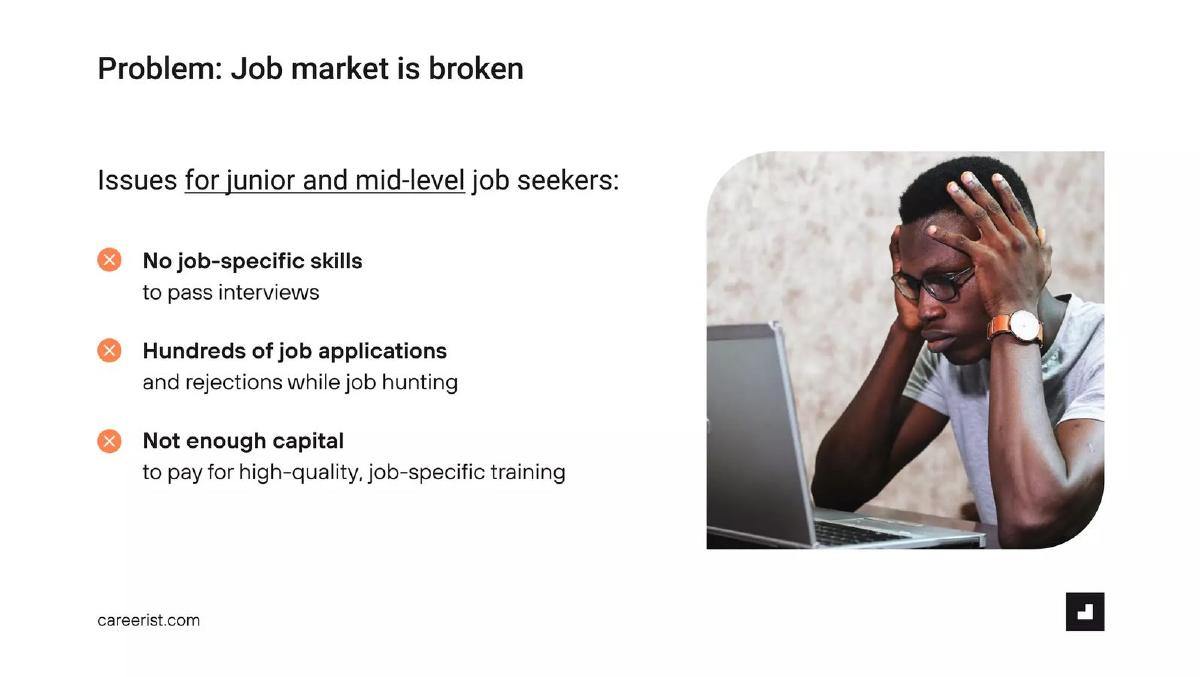
Slide 4 identifies three specific pain points for junior and mid-level job seekers: lack of job-specific skills, the friction of hundreds of rejections, and a lack of capital to afford training. This third point is the most critical for their 'Fintech' narrative, as it establishes the need for the lending and deferred payment products they introduce later in the deck.
Slide 5: The Solution
The solution is presented as a three-part stack on Slide 5 . First is a 'Learning Marketplace' powered by LMS software and freelance tutors. Second is 'Job Application Software' which automates the hunt for seekers and generates recruiting fees from employers. Third is 'Financing,' which includes loans, deferred tuition, and internal underwriting. This slide is the core of the deck, showing how Careerist controls the entire user journey from skill acquisition to employment and payment.
Slides 6-7: Financial Traction and Social Proof
Slide 6 is the 'money slide.' It shows a clear bar chart of yearly cash revenue: $0.4M (2019), $1.7M (2020), $5M (2021), $12M (2022), and a projected $25M+ for 2023. The text call-out claiming ~$500K in monthly EBITDA is a powerful signal for a Series A company, suggesting they are raising for growth rather than survival. Slide 7 provides the necessary social proof, listing logos of Fortune 500 companies where they have placed over 1,000 candidates, including Amazon, Google, and Facebook.
Slides 8-9: Business Model and Acquisition
Slide 8 breaks down the unit economics. Students pay up to $12,500, while employers pay 10-20% in recruiting fees. This dual-sided monetization is a classic marketplace strength. Slide 9 addresses the 'how' of their growth. It provides a table for Q4 '22 showing that 35.04% of clients come from organic traffic and 25.18% from referrals. This data supports their claim of a 'network effect' and suggests that their CAC (Customer Acquisition Cost) is likely lower than competitors who rely solely on paid social ads.
Slides 10-11: Quality Metrics and Market Size
To counter concerns about the quality of 'automated' training, Slide 10 highlights an NPS of 70+ and high ratings across third-party review sites like Career Karma (4.6) and TrustPilot (4.5). They specifically benchmark themselves against Coursera (~2) and Udemy (~2.5) to show superior student outcomes. Slide 11 defines the market. They calculate a TAM of $100B+ based on 50M+ annual job changers in the U.S., but focus on a SAM of $10B+ (3M+ tech job changers). A notable detail here is their claim that they only need 20,000 clients to reach $100M in revenue due to high LTV (Lifetime Value).
Slides 12-13: Team and Conclusion
Slide 12 introduces a large team of 10 individuals. The founders, Ivan Tsybaev and Max Gusakov, highlight their success with 'Trucker Path,' which they describe as the most popular trucking app in the U.S. This establishes them as 'serial entrepreneurs.' The team includes specialists in finance, sales, and marketing, as well as a Fintech Advisor from First Republic Bank. Slide 13 is a standard 'Thank You' slide with contact information. As noted, the deck lacks a formal 'Ask' slide, which is common in decks shared publicly after a round has closed or when the terms are being negotiated privately.
What Careerist Does Well
Financial Transparency: The deck does not hide behind vague percentages. Stating exact revenue figures from $0.4M to $25M (Slide 6) builds immediate trust with analysts. · Strategic Positioning: By calling themselves 'Ed-Fintech' rather than just 'EdTech,' they justify higher valuations and explain their internal underwriting and loan management as a core competency rather than a side feature. · Efficiency Metrics: The breakdown of acquisition channels (Slide 9) proves they aren't just buying growth through Facebook ads, which is a common pitfall for bootcamps. · Outcome Focus: The inclusion of specific NPS scores for 'internship experience' and 'mentors' (Slide 10) shows they are tracking the metrics that actually lead to job placements.
What is Missing from the Deck
The Ask: There is no slide detailing how much they are raising or what the milestones for the next 18-24 months look like. · Unit Economics: While they show revenue and EBITDA, they do not explicitly state their CAC or the default rate on their internal loans/deferred payments. In a fintech-heavy model, the health of the loan book is as important as the revenue. · Product Deep Dive: The 'Job Application Software' is mentioned as a key differentiator (Slide 5), but there is no visual evidence of how it works or what the user experience looks like. · Competitive Landscape: The deck mentions Coursera and Udemy in passing on the NPS slide, but a dedicated competitive matrix is missing.
Founder Takeaways
Lead with Growth: If your revenue chart looks like Slide 6, make it the centerpiece of your deck. Investors will forgive many other omissions if the growth and profitability are clearly stated. · Define Your Category: Careerist successfully avoided the 'just another bootcamp' label by leaning into the fintech aspect of their business. Founders should look for ways to categorize their startup in higher-multiple sectors. · Use Benchmarks: Comparing your NPS to industry giants (as seen on Slide 10) is a highly effective way to demonstrate product-market fit without needing complex case studies. · Keep it Concise: At 13 slides, this deck is lean. It covers the problem, solution, traction, and team without unnecessary filler, making it an excellent template for a Series A pitch.
Frequently asked questions
- What is the primary revenue driver for Careerist?
- Careerist utilizes a two-pronged revenue model. Students pay either an upfront fee of up to $12,500 or utilize a monthly deferred payment plan/loan. Additionally, the company generates revenue from the employer side, charging 10-20% recruiting fees for successful candidate matching. This 'Ed-Fintech' approach allows them to capture value from both the job seeker and the hiring entity.
- How does Careerist justify its 'Fintech' label?
- The company integrates financial services directly into its educational offering. According to slide 5, they handle loans, deferred tuition plans, and 'FinOps.' Crucially, they perform underwriting using their own internal data and manage their own collections process. This allows them to provide capital to students who otherwise could not afford high-quality, job-specific training.
- What does the traction slide reveal about their growth efficiency?
- Slide 9 shows that 60% of their client acquisition comes from organic traffic and referrals. This high percentage of non-paid acquisition supports their claim of a 'network effect' and contributes to their reported profitability. By keeping acquisition costs low, they have managed to scale from $0.4M in 2019 to a $25M+ run rate by 2023.
- Is the team experienced in this specific sector?
- The team presents a mix of sector-specific and general growth experience. Founders Ivan Tsybaev and Max Gusakov previously built Trucker Path, which used factoring (a fintech service) for monetization. Other team members bring experience from General Assembly (EdTech), Apple, and Intel. The inclusion of James Herbert, a former Head of Student Loan Refinancing at First Republic Bank, reinforces their fintech credentials.
- What is missing from this Series A deck?
- The most notable omission is a slide detailing the investment 'Ask.' There is no mention of the $8M target, the valuation, or how the capital will be deployed (e.g., hiring, marketing, R&D). Additionally, while they mention 'automated job hunting software,' there are no product screenshots or deep dives into the technology itself, focusing instead on the financial outcomes.