CareerDean’s pitch deck is a textbook example of a high-traction, early-stage seed deck. Seeking $300,000, the company positions itself as the 'universal destination for career advice.' The deck relies heavily on social proof, showcasing a user base from Tier-1 tech companies and an impressive 198.9% average month-over-month growth in engagement. While the deck is light on specific monetization mechanics—simply citing a $400 billion recruiting market—it compensates with strong engagement metrics, including an average session duration of nearly 10 minutes. The lean structure suggests a focus o…
Key takeaways
- The company is seeking a $300,000 investment to scale its Q&A platform (Slide 1 and 11).
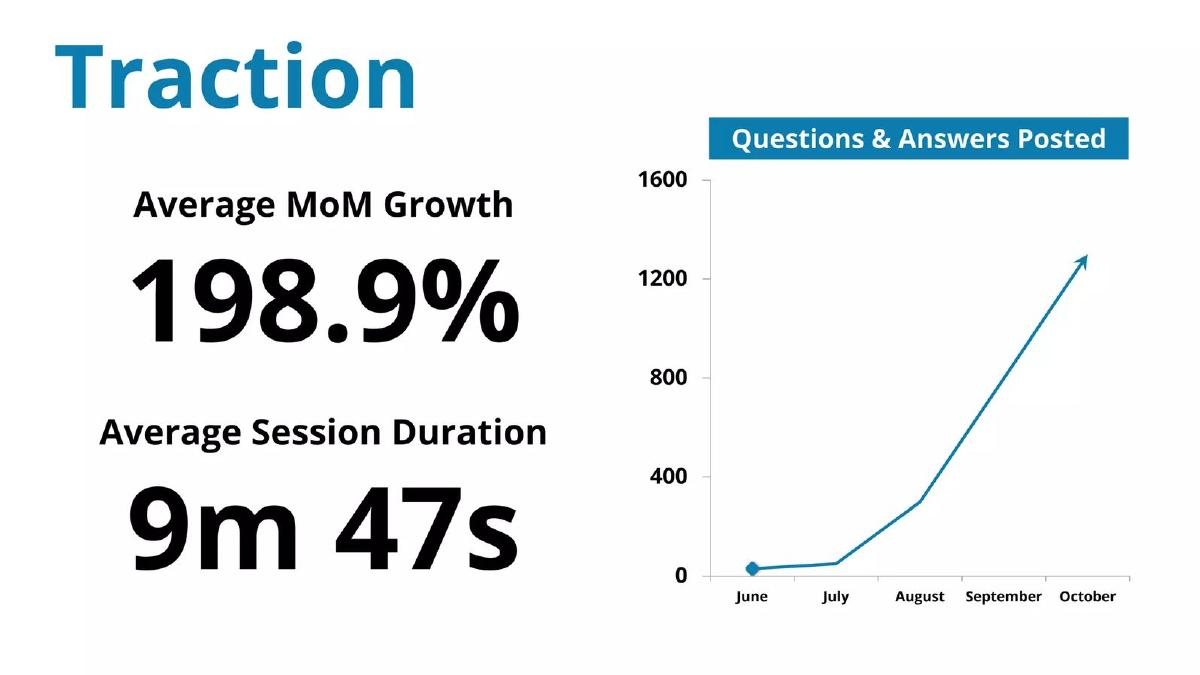
- Traction is the deck's strongest point, reporting 198.9% average month-over-month growth in Q&A activity (Slide 5).
- User engagement is high for a community platform, with an average session duration of 9 minutes and 47 seconds (Slide 5).
- Social proof is established by highlighting users from Box, Facebook, Microsoft, and Google Maps (Slide 4).
- The monetization strategy is broad, targeting the $400 billion annual recruiting market without detailing specific revenue streams (Slide 7).
- The platform has already attracted professional interest from employees at major tech brands including Amazon, Airbnb, Apple, and Salesforce (Slide 8).
- The founding team consists of four members dedicated to Growth, Technology, Business, and Product (Slide 9).
- Existing investors include notable figures like Adam Draper (Boost) and individuals with backgrounds at Facebook, GoPro, and Twitter (Slide 10).
The CareerDean Pitch Deck: A Study in Traction and Social Proof
CareerDean’s pitch deck is a minimalist, 11-slide presentation that prioritizes growth metrics and community quality over complex financial modeling. At its core, the deck is designed to prove that a high-value community is forming around career advice, which can eventually be leveraged into the massive recruiting market. The ask is a modest $300,000, typical for a pre-seed or early seed round intended to extend runway and further prove out user acquisition channels.
Slide 1: Title and The Ask
The cover slide is direct. It identifies CareerDean as a 'Q&A Website for Career Advice' and immediately states the fundraising goal: 'Raising 300K.' This level of transparency is rare on a cover slide but sets a clear expectation for the investor: this is a small, focused round for an early-stage product.
Slide 2: The Problem
The problem statement is distilled into six words: 'No place to get free, quality career advice.' By emphasizing 'free' and 'quality,' the founders are likely positioning themselves against expensive career coaches and the noise often found on general-purpose social networks or forums where advice is unverified.
Slide 3: The Solution
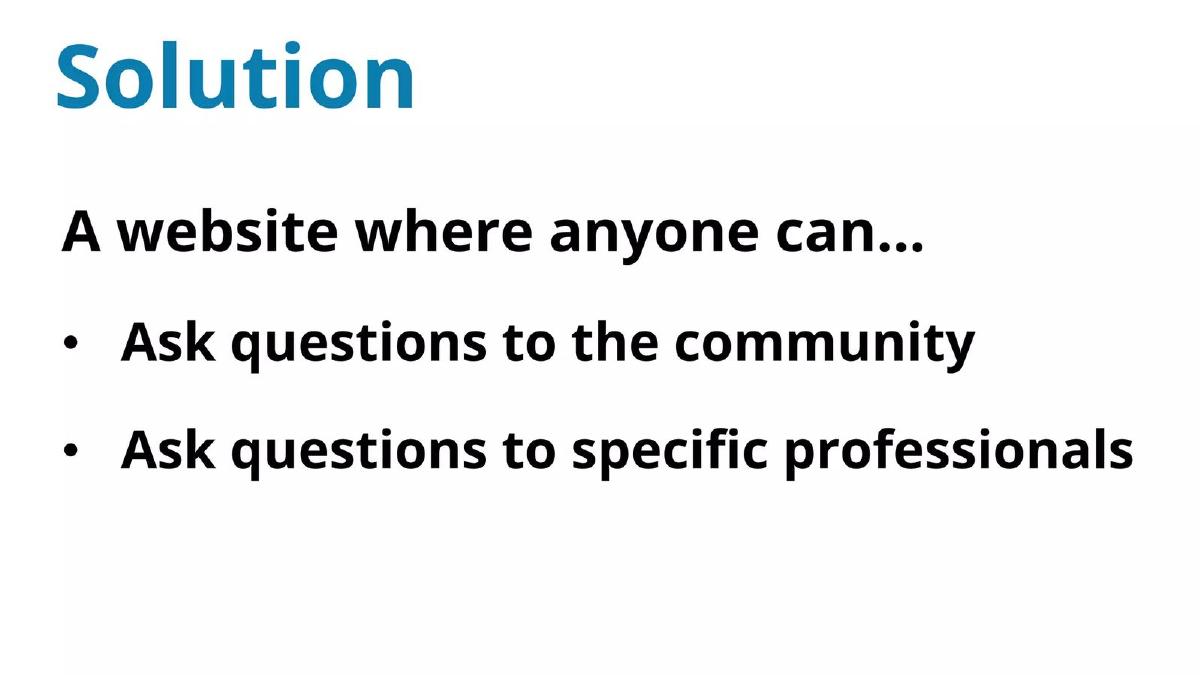
The solution slide describes the platform's functionality. It is a website where users can 'Ask questions to the community' and 'Ask questions to specific professionals.' This two-pronged approach suggests a hybrid of a public forum (like Quora) and a direct messaging or mentorship platform.
Slide 4: User Personas and Social Proof
This is a critical slide for a community-driven startup. CareerDean showcases four specific users to demonstrate the 'quality' mentioned in the problem slide. These include an SVP at Box (who created Google Docs), a University Recruiter at Facebook, a Software Developer at Microsoft, and a Product Manager at Google Maps. By showing that high-level incumbents from Tier-1 tech firms are already using the platform, the founders validate the supply side of their marketplace.
Slide 5: Traction and Engagement
Slide 5 provides the quantitative 'meat' of the deck. It claims an 'Average MoM Growth' of 198.9%. A line chart titled 'Questions & Answers Posted' shows a sharp upward trajectory from June to October. Additionally, the 'Average Session Duration' of 9m 47s is exceptionally high for a web-based Q&A platform, suggesting that users are not just dropping in for a quick answer but are deeply engaging with the content.
Slide 6: The Vision
The vision slide is a standard 'North Star' statement: 'To become the universal destination for career advice.' It is broad and ambitious, intended to show investors that while the current product is a Q&A site, the long-term goal is to own the career advice category entirely.
Slide 7: Monetization and Market Size
This is the weakest slide in the deck regarding specific strategy, but it serves to show the ceiling of the opportunity. It cites a 'Recruiting Market' of '$400BN per year.' It does not explain how CareerDean will capture this market, but the implication is that a community of high-quality professionals is a natural lead-generation engine for recruiters.
Slide 8: Brand Association
Slide 8 reinforces the social proof from Slide 4 by displaying the logos of major tech companies: Amazon, Airbnb, Twitter, Facebook, Square, eBay, Apple, Box, Microsoft, Google, and Salesforce. The slide is simply titled 'Users,' implying that employees from these organizations are active on the platform. For a seed investor, this suggests that the product has 'bottom-up' adoption within the world's most desirable employers.
Slide 9: The Team
The team slide features a candid, casual photo of the four founders: Sam (Growth), David (Technology), Kyu (Business), and Darius (Product). The roles are clearly defined, covering the four essential pillars of a software startup. However, the slide lacks professional bios or past company exits, relying instead on the visual of a cohesive, energetic team.
Slide 10: The Investors
CareerDean lists four key investors to build further credibility. These include Eric Kwan (30+ startups), Jeff Ryan (VP of HR at GoPro, formerly Facebook), Adam Draper (Founder/CEO of Boost), and Oliver Ryan (Ex-Director of Recruiting at Twitter). The inclusion of HR and Recruiting veterans as investors is a strong signal that experts in the industry believe in the platform's potential to disrupt the space.
Slide 11: Closing and Contact
The final slide repeats the logo and the $300k ask, providing a specific email address (Boost@CareerDean.com). The use of a 'Boost' email address suggests the company may have been part of the Boost VC accelerator program.
What CareerDean Does Well
The deck excels at social proof . By naming specific high-profile users and showing logos of top-tier tech companies, CareerDean overcomes the 'cold start' problem that plagues most community platforms. If an investor sees that the creator of Google Docs is answering questions on the site, the 'quality' claim is instantly verified.
The engagement metrics are also a standout. An average session duration of nearly 10 minutes is a powerful indicator of product-market fit. It tells investors that the content is valuable enough to keep users on the site far longer than a typical search-and-exit Q&A interaction.
What is Missing from the Deck
Specific Monetization Mechanics: While the $400 billion market size is impressive, the deck fails to explain the business model. Will they sell job postings? Will they charge for 'featured' questions? Is there a premium subscription for recruiters? Without this, the path to revenue is purely speculative.
Competitive Landscape: The deck operates as if CareerDean exists in a vacuum. There is no mention of LinkedIn (the incumbent), Quora (the direct format competitor), or Glassdoor (the career data competitor). Investors would naturally ask how CareerDean prevents these giants from simply adding a similar Q&A feature.
Unit Economics and CAC: There is no mention of how much it costs to acquire these high-quality users. While the growth is impressive, investors need to know if that growth is organic or fueled by unsustainable marketing spend.
What Founders Should Copy
The 'Users' Slide Strategy: If you are building a platform that relies on a specific type of user (e.g., developers, HR managers, CEOs), don't just say you have them. Show their faces and their titles. CareerDean’s Slide 4 is the most persuasive slide in the deck because it makes the community feel real and elite.
Focus on a Single Metric: Instead of cluttering the traction slide with dozens of data points, CareerDean focuses on 'Questions & Answers Posted.' This clearly defines what 'success' looks like for their specific product at this stage.
Extreme Brevity: The deck uses very little text. This forces the presenter to tell the story and prevents the investor from getting lost in paragraphs of jargon. The clean, white-background aesthetic keeps the focus on the data and the people.
Frequently asked questions
- What is the primary problem CareerDean is solving?
- According to Slide 2, CareerDean identifies a lack of 'free, quality career advice' available online. They aim to bridge the gap between job seekers and experienced professionals through a structured Q&A format, moving away from fragmented or paid advice models.
- How does CareerDean plan to make money?
- The deck is vague on specific revenue models like subscriptions or lead generation. Instead, Slide 7 points to the massive $400 billion recruiting market. This suggests the company intends to monetize by connecting its high-quality user base with recruiters or by charging for premium access to talent.
- What kind of traction did CareerDean have at the time of this deck?
- Slide 5 shows a significant hockey-stick growth curve for 'Questions & Answers Posted' between June and October. They report an average month-over-month growth rate of 198.9% and an average session duration of 9 minutes and 47 seconds, indicating high user stickiness.
- Who are the key people behind the company?
- The team (Slide 9) includes Sam (Growth), David (Technology), Kyu (Business), and Darius (Product). They are supported by an investor group (Slide 10) that includes Adam Draper of Boost and executives from HR and recruiting backgrounds at companies like Facebook and Twitter.
- Is there a competitive analysis in the deck?
- No. The deck completely omits a competitive landscape slide. It does not mention incumbents like LinkedIn, Quora, or Glassdoor, choosing instead to focus entirely on its own internal growth metrics and the quality of its specific user community.